
For exposed optical and sensor glass, match the coating to the erosion mechanism rather than reaching for a generic “durable” finish. Phosphide‑based AR multilayers suit infrared domes and windows facing sand and rain impact, while broadband optics do better with a hard sacrificial topcoat over buried active layers. Whichever family you choose, specify testing against ISO 9211 before signing off any supplier’s data sheet, and ask Precision Glasses for a coated sample if you want a benchmark to test against.
TL;DR:
- Coatings must be matched to the specific erosion mechanism, such as abrasive sand or liquid rain impact, rather than relying on generic durability claims.
- Phosphide-based multilayers excel for infrared optics facing sand and rain, but require careful handling and testing against ISO 9211 standards for validation.
- Buried active layer coatings offer improved micro-abrasion resistance and maintain optical performance after surface damage, making them suitable for critical exposed sensors.
- Testing criteria should include combined erosion and ageing simulations to accurately predict long-term field performance and avoid premature failures like delamination.
- Suppliers and procurement processes need detailed test data and strict specifications matching actual mounting conditions to ensure optical durability in real-world environments.
Table of Contents
- When Do You Need Erosion Resistant Coatings on Optical Glass?
- Material Families and Design Strategies That Preserve Optics
- Which Durability Tests and Standards Should You Require?
- What Should Go in an RFQ for Erosion Resistant Coatings?
- Realistic Erosion Rates and Service Lifetimes by Application
- What Do Failed Erosion Coatings Look Like in the Field?
- What’s Changing in Erosion Resistant Coating Technology?
- What Does Coating Choice Cost You in Practice?
- How Precision Glasses Supports Erosion Resistant Coating Programmes
- Author perspective: priorities when specifying erosion protection
- Sources
- FAQ
When Do You Need Erosion Resistant Coatings on Optical Glass?
Exposed optics fail differently depending on what hits them. Aircraft forward windows, IR domes on missile seekers, external sensor covers on marine and automotive equipment, and any instrumentation window sitting outside a protective housing are all candidates for erosion‑resistant coatings, because they take repeated environmental impact with no shielding.
Two distinct mechanisms drive that damage, and they demand different countermeasures:
- Abrasive erosion from windblown sand or dust causes surface pitting and progressive haze, typically worst on leading edges and forward‑facing sensor windows.
- Liquid impact erosion from rain at high closing speed produces a different signature, ring cracking and pitting from repeated droplet strikes, common on aircraft and high‑speed marine glazing.
- Cumulative micro‑abrasion from dust‑laden wiping or handling degrades AR performance gradually rather than catastrophically, often going unnoticed until transmission has already dropped.
A supplier calling a coating “durable” without naming the test behind that claim is telling you nothing useful. A coating rated against a sand chamber test says little about its rain erosion performance, and vice versa, so the exposure profile has to drive the test selection before it drives the coating choice.
Material Families and Design Strategies That Preserve Optics
Four coating families dominate erosion protection for optical glass, and each trades off differently between mechanical toughness and optical transparency.
Phosphide (BP/GaP) AR multilayers deliver broadband IR transmission while resisting sand and rain erosion, which makes them a strong fit for infrared domes and windows. The catch sits in production rather than performance: boron phosphide and gallium phosphide feedstocks require careful handling, so ask any supplier proposing this route to walk you through their process controls before you commit volume.
Hard carbon and DLC/DLN coatings trace back to decades of use on germanium and zinc sulphide substrates, where hard carbon layers raised rain and sand impact thresholds, though damage still becomes severe at very high closing speeds even with multilayer reinforcement, per durability testing on Ge and ZnS substrates. Diamond‑like nanocomposite coatings extend this further, combining a diamond‑like carbon network with a silicon‑oxygen glass‑like network in one adherent layer, avoiding the interlayers that older hard‑carbon stacks needed and improving thermal stability for DLN‑coated optically transmissive substrates.
Buried active layers place the optically functional layer beneath a hard sacrificial coat, so a scratch on the surface has reduced impact on optical performance rather than ruining the part outright. Reported nanoindentation hardness for this design sits at 16 to 20 GPa, a useful figure to write directly into a performance spec when comparing wavelength‑selective buried‑layer coatings against a conventional thin‑film interference stack.
SiOx hard coats and porous AR films improve initial transmission cheaply, but porosity works against you in a sandstorm: sandstorm chamber testing found some porous AR coatings erode faster than bare glass unless the porosity is reduced or a hydrophobic treatment is applied.
Substrate interaction is the risk teams miss most often. A coating can be hard enough to survive impact on paper yet still fail because the substrate flexes underneath it, producing eggshell‑style cracking where modulus mismatch concentrates stress at the interface. Buffer or adhesion layers, and a chemically strengthened substrate where geometry allows, address this before it becomes a field failure.
Pro Tip: Ask for the coating’s nanoindentation hardness figure alongside its thickness and modulus. A hard but thin buried layer on a soft substrate can still crack under impact that a slightly less hard but better‑matched stack would survive.
Which Durability Tests and Standards Should You Require?
Test selection has to trace back to the actual threat, not to whatever certificate a supplier already holds. ISO 9211 and ECSS environmental durability guidance both define categories of use that scale test severity to the operational environment, including when abrasion testing can reasonably be skipped and when it must be enforced.
Five tests cover most of what optical and sensor glass encounters in service:
- Whirling arm or rotating‑rig rain erosion testing simulates high‑velocity droplet impact for aircraft and high‑speed applications.
- Single and multiple water‑jet impact tests assess cumulative liquid impact damage at lower closing speeds, relevant to automotive and marine sensor covers.
- Sand chamber testing quantifies abrasive erosion rate under controlled particle flux and velocity, the test that exposes weak porous AR coatings.
- Garnet scratch or garnet abrasion testing ranks surface hardness and coating adhesion under a standardised abrasive medium.
- HAST and SUNTEST accelerated ageing, run in combination with erosion exposure, reveal whether a coating that survives fresh erosion testing still holds up after thermal and humidity cycling.
That last point matters more than it looks. Coupled erosion and accelerated ageing tests on coated and uncoated glass mirrors found coated samples generally retained optical performance far better than uncoated ones, but some coatings detached after severe erosion exposure, a failure mode that a single erosion test run in isolation would never catch.
Write acceptance criteria in numbers, not adjectives: allowable transmission loss as a percentage per test fluence, a specific scratch ranking threshold, a named adhesion class, and a requirement that testing runs on the final substrate in its actual mounting arrangement. Fixturing changes alter erosion outcomes more than most specifications acknowledge.
What Should Go in an RFQ for Erosion Resistant Coatings?
A vague RFQ produces quotes you cannot compare. Precision Glasses’ optical coatings guide covers the underlying technology, but the commercial document needs its own checklist:
- Coating type or performance objective, stated as a transmission and hardness target rather than a brand name.
- Substrate and coating pairing, including whether the substrate is chemically strengthened and what buffer layer, if any, sits between the two.
- Specified tests by standard, severity level, and sample count, referencing ISO 9211 categories directly.
- Optical acceptance criteria and the measurement method used to verify them, not just a pass/fail statement.
- Adhesion testing method and environmental conditioning sequence, following the approach set out in guidance on coating adhesion testing.
- Inspection and documentation deliverables, plus batch‑level traceability back to the coating run.
QA deliverables deserve their own line item. Demand raw test data rather than a summary certificate, SEM or XPS analysis on any failed sample, coating process control records, a documented change control procedure, and a firm lead time guarantee. If the proposal involves phosphide feedstocks, ask specifically how the supplier handles that material and what process controls sit around it, since hazardous feedstock handling is where phosphide‑based programmes most often stall between quote and delivery.
Pro Tip: Require change control language in the contract itself. A supplier who alters a recipe or reworks a partial batch without notifying you can hand you parts that pass the paperwork but fail differently to the samples you originally tested.
Realistic Erosion Rates and Service Lifetimes by Application
Coating suppliers rarely publish a single erosion rate figure that transfers across applications, and that inconsistency is itself useful information: it means service life depends heavily on exposure profile, not just coating chemistry. A phosphide‑based AR multilayer on a stationary IR dome sees a very different cumulative dose than the same coating on an airborne window travelling through rain at speed, even though the material and process might be identical.
Buried active layer designs are aimed specifically at extending functional life past first surface damage rather than preventing scratches altogether. Because the optically active layer sits beneath a hard sacrificial coat, a scratch that would blind a conventional thin‑film stack may leave a buried‑layer design still within transmission tolerance, which is the entire rationale behind placing active layers beneath a hard topcoat.
For procurement purposes, treat any lifetime number a supplier quotes as conditional on three things: the exact test fluence used to derive it, whether ageing was run alongside erosion or as a separate test, and whether the sample was mounted the way your part will actually be installed. A figure quoted from a bare erosion test without ageing tends to overstate real service life, since combined erosion and ageing sequences expose delamination that erosion testing alone misses. Ask for the fluence‑to‑transmission‑loss curve rather than a single lifetime number, and you get something you can actually compare across two competing proposals.
What Do Failed Erosion Coatings Look Like in the Field?
Delamination is the failure mode that catches most engineering teams off guard, because a coating can pass a standalone erosion test and still lift from the substrate once thermal and humidity cycling joins the picture. Coupled testing on coated glass mirrors documented exactly this pattern: coatings that survived erosion alone showed detachment after combined erosion and accelerated ageing exposure.
Ring cracking is the signature of liquid impact erosion specifically, appearing as concentric micro‑cracks radiating from a droplet strike point, distinct from the diffuse pitting that sand erosion produces. Confusing the two damage signatures during failure analysis leads teams to specify the wrong follow‑up test, chasing a sand chamber fix for a problem that was actually rain impact.
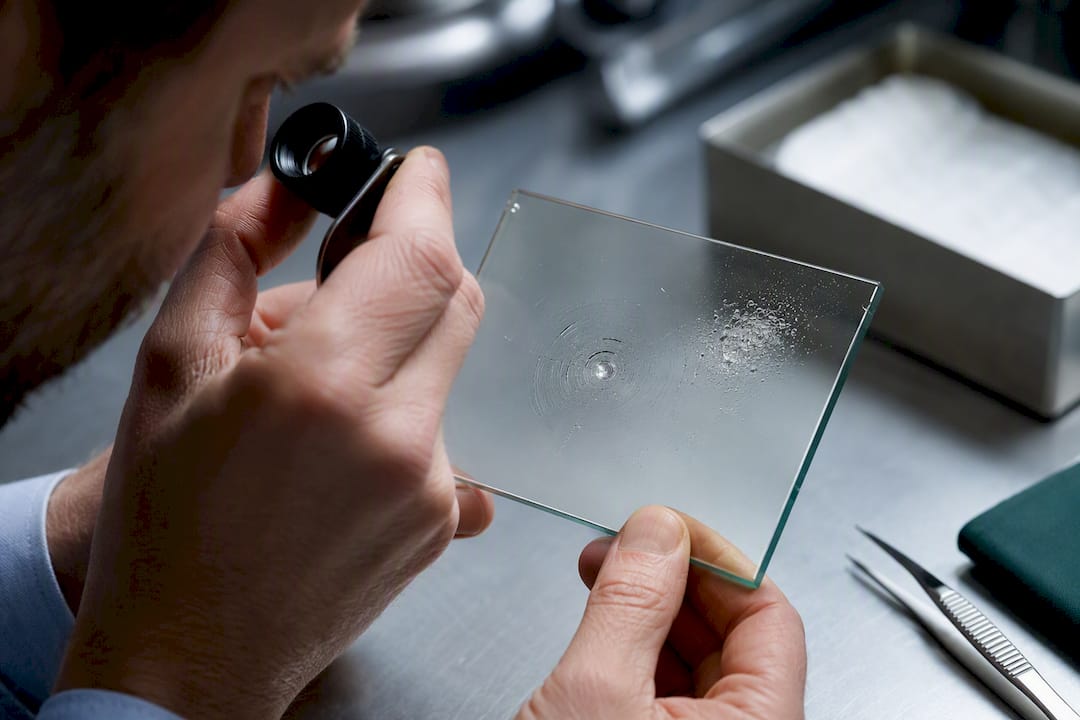
Progressive haze without visible cracking usually points to cumulative micro‑abrasion rather than a single catastrophic event, often from dust‑laden wiping in service rather than airborne particle impact. This one is easy to miss during inspection because no single strike looks alarming; the transmission loss only becomes obvious once you compare against a baseline reading.
Eggshell cracking, where a network of fine cracks appears across a hard coating without full delamination, usually signals substrate modulus mismatch rather than a coating defect. The coating itself may meet every hardness specification and still crack this way if the substrate flexes more than the coating can tolerate under impact, which is why interaction volume between coating and substrate belongs in failure analysis alongside the coating chemistry itself.
What’s Changing in Erosion Resistant Coating Technology?
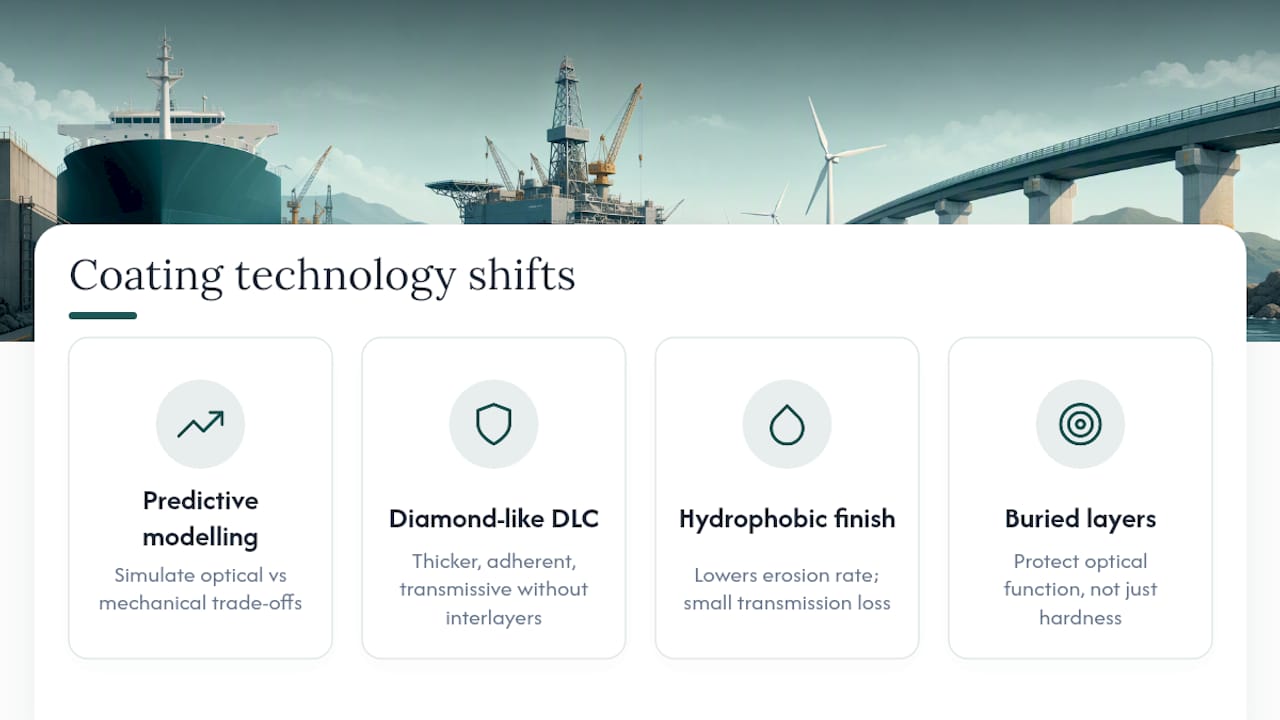
Predictive modelling is shifting coating design away from trial‑and‑error stacking. Design tools that simulate the trade‑off between optical performance and mechanical durability let engineers evaluate a buried‑layer or hard‑carbon configuration before committing to a physical run, and predictive design approaches for erosion resistant coatings are increasingly part of technical due diligence when evaluating a supplier’s capability.
Diamond‑like nanocomposite coatings represent the most practical recent shift for optical applications specifically, because they achieve a thicker, adherent, optically transmissive layer without the interlayers that older diamond‑like carbon stacks needed. That structural simplification reduces the number of interfaces where delamination can start, addressing exactly the failure mode that coupled erosion and ageing testing keeps exposing in conventional stacks.
Hydrophobic surface treatments are moving from an add‑on to a default consideration for porous AR coatings rather than an afterthought. Sandstorm chamber testing found that hydrophobic treatment measurably reduced erosion rate on porous films, at the cost of a small reduction in initial transmission, a trade worth making on any application where sand exposure outweighs the value of the last fraction of a percent in throughput. Precision Glasses’ guidance on hydrophobic glass specifications sets out the testing language to hold a supplier to on this point.
Buried active layer designs themselves keep extending into new substrate combinations, and the underlying logic, protect optical function rather than just surface hardness, is increasingly the framework suppliers use to pitch new stacks even outside the original wavelength‑selective applications they were developed for.
What Does Coating Choice Cost You in Practice?
Phosphide‑based AR multilayers carry the highest cost premium of the four families, driven less by the raw material and more by the process controls that hazardous feedstock handling demands. That premium buys broadband IR performance with genuine erosion resistance, so it earns its cost on IR domes and windows where no cheaper alternative meets the optical specification at all.
Hard carbon and DLC coatings sit in the middle of the cost range and carry the lowest process risk of the four, since deposition methods are well established across decades of use on germanium and zinc sulphide optics. The trade‑off is thickness: getting meaningful sacrificial protection sometimes means a coating thick enough to affect optical path length, which needs checking against your system’s tolerance budget before you lock in the design.
Buried active layer designs cost more upfront in engineering time than in raw material, because the design has to balance the sacrificial topcoat thickness against the active layer’s own optical requirements. Once that balance is set, the manufacturing cost is comparable to a conventional multilayer stack, making this the option where paying for design iteration early avoids a costly requalification later.
Porous AR and SiOx hard coats remain the cheapest route, and that’s precisely why they show up on parts where sand exposure was underestimated at the design stage. The DLR sandstorm testing findings on porosity‑driven erosion make a strong case for spending the extra cost on hydrophobic treatment or a denser structure rather than discovering the shortfall in the field. Weigh coating cost against requalification cost, not against the unit price of the alternative, and the calculation usually favours the more resistant option for anything genuinely exposed.
How Precision Glasses Supports Erosion Resistant Coating Programmes
Precision Glasses manufactures the coated optical windows, sensor covers, and custom components this article has been describing, backed by ISO 9001 certification, batch‑level traceability, and documented export compliance, so procurement teams get audit‑ready records alongside the physical part.
If you’re specifying a phosphide‑based AR stack for an IR window, a buried‑layer design for a broadband sensor cover, or simply need to benchmark an existing supplier’s coating against a known standard, Precision Glasses can produce a coated sample matched to your substrate and mounting arrangement rather than a generic test coupon. That distinction matters given how much fixturing changes erosion outcomes. Review the coated glass and optical windows services to see current coating and fabrication capabilities, or browse optical components if your requirement centres on lenses, filters, or beam splitters rather than flat windows. Submit your application data, expected exposure profile, and target test standard, and request a feasibility quote for a coated sample evaluation before committing to volume production.
Author perspective: priorities when specifying erosion protection
If you take one thing from this article, take this: match the test to the exposure before you match the coating to the test. Insist on testing the final substrate in its actual mounting arrangement, because fixturing changes outcomes more than suppliers admit. Where optical performance must survive surface damage, buried‑layer or hard sacrificial designs earn their premium. For deeper reading on adhesion testing and thin‑film design, Precision Glasses’ technical guides on thin film coatings are worth your time.
— Alexandra
Sources
- Wavelength‑selective coatings on glass with high hardness and damage resistance (Coatings, MDPI)
- Sandstorm chamber testing of anti‑reflective glass coatings for solar energy applications (DLR)
- Advances in ultradurable phosphide-based broadband antireflection coatings for sand and rain erosion protection of infrared windows and domes
- Erosion effect in the degradation of coated and uncoated glass solar mirrors highlighted by coupled accelerated erosion/aging tests (Coatings, MDPI, 2022)
FAQ
What Is the Difference Between Sand and Rain Erosion Testing?
Sand erosion testing measures abrasive particle impact damage in a sand chamber, while rain erosion testing uses whirling arm or water‑jet rigs to simulate high‑velocity droplet impact; the two produce different damage signatures and require separate qualification.
Does ISO 9211 Cover Erosion Testing for Optical Coatings?
ISO 9211 defines durability categories that let engineers scale test severity, including abrasion requirements, to the operational environment of the optical component, working alongside ECSS guidance for space applications.
What Hardness Should I Specify for a Buried‑Layer Erosion Coating?
Buried active layer designs have reported nanoindentation hardness of 16 to 20 GPa, a reasonable benchmark figure to write into a performance specification for comparison against supplier proposals.
Can Precision Glasses Supply Test Samples for Erosion Qualification?
Precision Glasses can produce coated samples on your specified substrate and mounting arrangement for erosion and adhesion testing; contact the team through the services page to discuss a feasibility quote.
Why Do Some Coatings Fail After Passing Erosion Testing Alone?
Coupled erosion and accelerated ageing testing shows that coatings surviving erosion in isolation can still delaminate under combined thermal and humidity cycling, which is why acceptance criteria should require combined test sequences rather than erosion testing alone.