
Antimicrobial glass is defined as a glass material engineered to inhibit or destroy microbial growth through embedded agents or specialised surface coatings. Silver ions are the most widely used active agent, and they eliminate up to 99% of bacteria on treated surfaces. Photocatalytic compounds such as titanium dioxide (TiO2) and zinc oxide (ZnO) represent a second major class of agents, activating under light to generate reactive oxygen species that kill pathogens. In hygiene-critical environments, from hospital wards to diagnostic equipment and consumer electronics, this class of material is no longer a niche specification. It is a functional requirement.
What antimicrobial agents and coatings are used in glass?
The antimicrobial performance of treated glass depends entirely on which active agents are incorporated and how they are applied. Each agent operates through a distinct mechanism, and the choice of coating technique determines both durability and optical quality.
The principal agents used in antimicrobial glass formulations include:
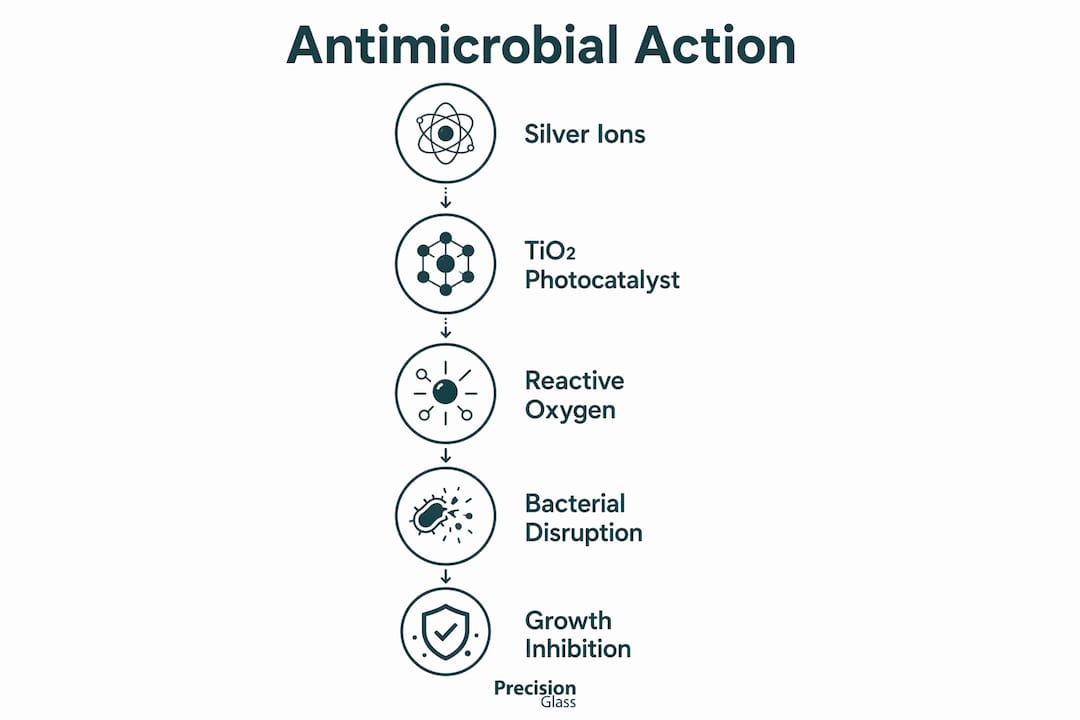
- Silver ions: Released continuously from the glass matrix, silver ions disrupt bacterial cell membranes and interfere with DNA replication. They provide broad-spectrum activity against bacteria and fungi.
- Titanium dioxide (TiO2): A photocatalytic coating that generates reactive oxygen species under visible or ultraviolet light, degrading microbial cell walls on contact.
- Zinc oxide (ZnO): TiO2 and ZnO photocatalysts together enable self-cleaning and antimicrobial action on glass and ceramic surfaces, making them suitable for commercial and architectural applications.
- Bioactive glass with combined metal oxides: Combinations of metal oxides in bioactive glass boost antimicrobial effects by 100 times compared to single agents. That multiplier makes multi-agent formulations the preferred choice for high-risk clinical environments.
- Copper-based coatings: Copper-based surfaces provide natural antimicrobial activity and have been applied to healthcare touch points to reduce microbial transmission.
Coating techniques include dip-coating, chemical vapour deposition, and covalent immobilisation. Bioinspired dopamine-conjugated polymer coatings produce superhydrophilic surfaces with a contact angle of approximately 3–4°. That near-zero contact angle causes water to sheet off the surface, carrying contaminants with it and amplifying the antimicrobial effect through passive self-cleaning.
Pro Tip: When specifying antimicrobial glass for medical optics, request data on contact angle measurements alongside standard microbial reduction figures. A contact angle below 10° confirms genuine superhydrophilicity, which directly supports self-cleaning performance in clinical use.
How does antimicrobial glass work to inhibit microbial growth?
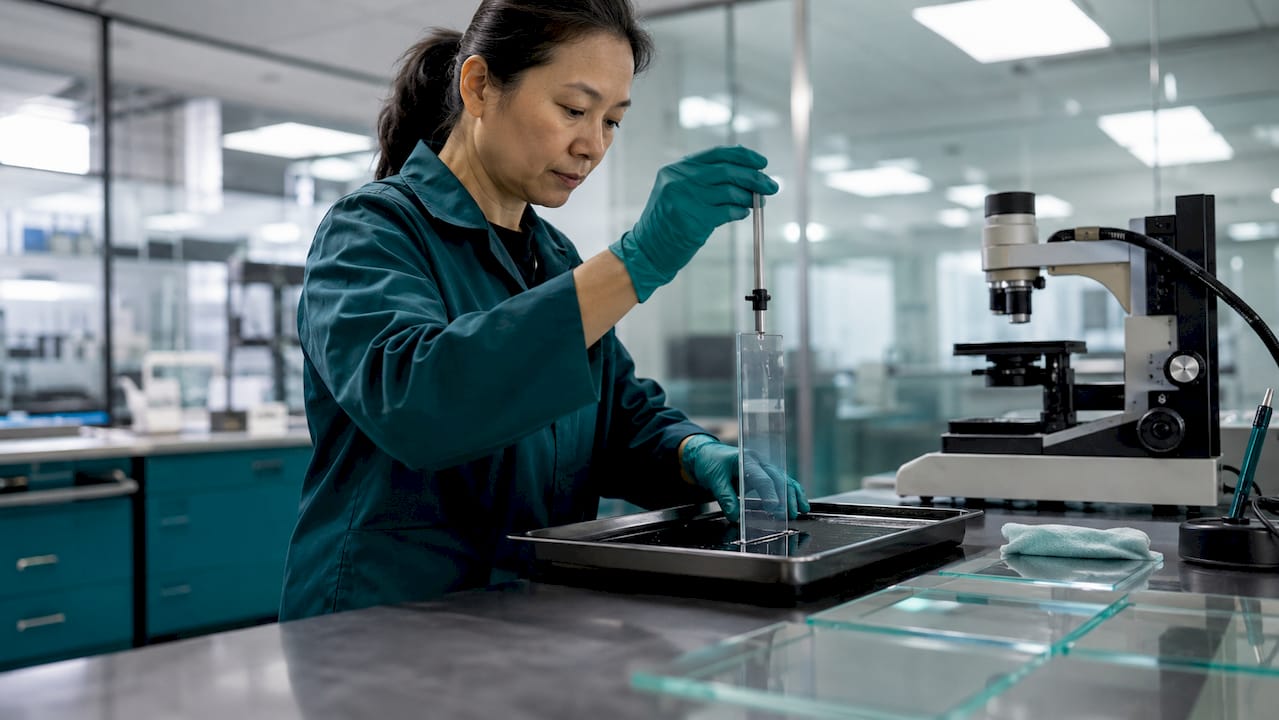
The mode of action varies by agent, but all approved formulations share one goal: preventing viable microorganisms from colonising the glass surface. The mechanisms operate at the cellular level and are effective against a broad spectrum of pathogens, including drug-resistant strains.
- Ionic silver release: Silver ions migrate from the glass matrix to the surface. They bind to bacterial cell membranes, disrupt protein synthesis, and block respiratory enzymes. The result is rapid cell death without the need for light or heat activation.
- Photocatalytic oxidation by TiO2: Under light exposure, TiO2 generates reactive oxygen species including hydroxyl radicals. These radicals oxidise lipids and proteins in microbial cell walls, causing irreversible structural damage. The reaction continues as long as light is present.
- Superhydrophilic self-cleaning: Surfaces with a contact angle of approximately 3–4° do not allow water droplets to bead. Water spreads uniformly, lifts organic matter, and carries it away. This physical removal reduces the microbial load before chemical agents are even required.
- Sustained efficacy after cleaning: Multifunctional coatings retain antimicrobial function and structural integrity after repeated wash cycles and thermal stress. This durability is critical in environments where surfaces are cleaned multiple times daily.
- Broad-spectrum coverage: Treated glass acts against bacteria, fungi, and certain viruses. This breadth of activity is particularly relevant in healthcare settings where multiple pathogen types circulate simultaneously.
Pro Tip: For manufacturing environments where UV light is limited, specify silver-ion formulations rather than TiO2-only coatings. Silver ions activate without any light source, providing consistent protection in enclosed production areas.
What are the benefits and advantages of antimicrobial glass in professional settings?
The practical case for antimicrobial glass rests on measurable reductions in infection risk, cleaning burden, and long-term maintenance costs. These advantages compound over the operational life of the product.
Healthcare-associated infections cause nearly 100,000 deaths annually in the United States alone. That figure represents a systemic failure of surface hygiene that antimicrobial materials directly address. Glass surfaces in operating theatres, isolation rooms, and diagnostic suites that carry active antimicrobial agents reduce the window of opportunity for pathogen transfer between cleaning cycles.
Key advantages for professional procurement and specification teams include:
- Reduced microbial contamination on frequently touched surfaces such as screens, panels, and protective barriers, lowering cross-contamination risk between cleaning cycles.
- Decreased reliance on chemical disinfectants, which reduces both operational cost and the risk of chemical resistance developing in surface-dwelling organisms.
- Durability under repeated cleaning protocols, with coatings engineered to withstand the thermal and chemical stress of industrial cleaning regimes without losing efficacy.
- Regulatory compliance support, as antimicrobial glass formulations can be specified to meet relevant standards for medical device surfaces and cleanroom environments.
- Long-term cost-effectiveness, because surfaces that self-limit microbial growth require fewer emergency deep-clean interventions and have a longer functional service life.
For electronics manufacturers, toughened glass combined with ionic silver delivers antimicrobial protection in touchscreen displays without compromising optical clarity or user experience. That combination is now a standard specification in medical-grade display panels and point-of-care devices.
What are the main applications of antimicrobial glass?
Antimicrobial glass serves a wide range of sectors, each with distinct performance requirements. The common thread is any environment where surface contamination poses a risk to health, safety, or product integrity.
| Sector | Application | Primary benefit |
|---|---|---|
| Healthcare | Diagnostic screens, protective barriers, surgical optics | Infection prevention, regulatory compliance |
| Electronics | Touchscreen displays, control panels | Hygiene without optical compromise |
| Automotive | Dashboard glass, in-cabin displays | Reduced pathogen transfer in shared vehicles |
| Architecture | Partitions, door panels, laboratory glazing | Passive contamination control |
| Manufacturing | Cleanroom windows, inspection glass | Contamination management in production |
Medical devices and diagnostic equipment represent the highest-value application. Glass used in diagnostic equipment must simultaneously meet optical performance standards and hygiene requirements. Antimicrobial coatings that preserve transmission clarity while delivering microbial reduction are therefore the specification benchmark in this sector.
Emerging applications focus on multifunctional coatings that combine antimicrobial, anti-fog, and self-cleaning properties without reducing transparency. These are particularly relevant for endoscopic optics, vehicle-mounted cameras, and outdoor surveillance glass where condensation and contamination occur simultaneously.
What challenges exist in producing antimicrobial glass?
Manufacturing antimicrobial glass to a consistent standard is technically demanding. The core tension is between embedding sufficient active agent to deliver measurable microbial reduction and maintaining the optical clarity that most applications require.
Balancing optical transparency and antimicrobial effectiveness is the primary production challenge. Silver ions and metal oxide particles scatter light if they are not distributed uniformly at the nanoscale. Achieving that uniformity across large glass panels demands precise process control at every stage of fabrication.
Additional production and adoption challenges include:
- Coating adhesion under variable conditions: Coatings applied by dip-coating or vapour deposition must bond reliably to the glass substrate and resist delamination under thermal cycling, mechanical abrasion, and repeated chemical cleaning.
- Antimicrobial efficacy testing: Manufacturers must validate performance against recognised test standards, such as ISO 22196 for measuring antibacterial activity on plastics and non-porous surfaces. Without third-party verification, efficacy claims carry limited weight in regulated procurement.
- Cost versus performance trade-offs: Multi-agent bioactive formulations with combined metal oxides deliver superior performance but carry higher material and processing costs. Procurement teams must weigh upfront cost against the long-term savings from reduced infection incidents and cleaning expenditure.
- Scalability in precision manufacturing: Integrating antimicrobial coatings into high-volume production without introducing dimensional variation or surface defects requires meticulous quality assurance protocols at each fabrication stage.
Researchers evaluating suppliers should request documented wash-cycle durability data alongside initial efficacy figures. A coating that performs well on day one but degrades after 50 cleaning cycles offers no long-term value in a clinical or manufacturing environment. Reviewing a manufacturing quality assurance checklist before supplier selection helps identify whether a manufacturer’s process controls are sufficient for antimicrobial glass production.
Key takeaways
Antimicrobial glass delivers measurable, durable microbial reduction through silver ions, photocatalytic metal oxides, and superhydrophilic coatings, making it a functional specification requirement in healthcare, electronics, and manufacturing.
| Point | Details |
|---|---|
| Core agents | Silver ions, TiO2, ZnO, and combined metal oxides each provide distinct and complementary antimicrobial mechanisms. |
| Multiplied efficacy | Combined metal oxide formulations in bioactive glass boost antimicrobial performance by up to 100 times versus single agents. |
| Durability matters | Coatings must retain efficacy after repeated cleaning cycles; always request wash-cycle test data from suppliers. |
| Broad applications | Healthcare, electronics, automotive, architecture, and manufacturing all have active use cases with distinct performance requirements. |
| Production challenge | Maintaining optical clarity while embedding active agents at nanoscale uniformity is the primary manufacturing constraint. |
Why multifunctional coatings are the specification to watch in 2026
Having worked closely with engineers and procurement teams across healthcare and precision manufacturing, I find that the conversation about antimicrobial glass has shifted decisively in the past two years. Clients no longer ask simply whether a glass surface is antimicrobial. They ask whether it is also anti-fog, self-cleaning, and optically clear under clinical lighting conditions. That is a fundamentally different specification, and most single-function coatings do not meet it.
The research coming out of materials chemistry confirms what I have observed in practice. Multifunctional coatings that combine antimicrobial, anti-fog, and self-cleaning properties without sacrificing transparency are now the benchmark for medical and diagnostic optics. The bioinspired dopamine-conjugated polymer approach, which achieves contact angles of approximately 3–4°, is the most technically credible route to that combination of properties currently available.
Where I see procurement teams make mistakes is in treating antimicrobial glass as a commodity specification. They focus on the microbial reduction percentage and overlook durability data. A coating that loses efficacy after 100 cleaning cycles is not fit for purpose in a hospital environment where surfaces are cleaned four to six times daily. Researchers evaluating new formulations should prioritise durability and biocompatibility testing above headline efficacy figures. The headline number is easy to achieve in a laboratory. Sustained performance in the field is the harder and more meaningful measure.
— Alexandra
Precision Glasses: antimicrobial glass for critical industries
Precision Glasses designs and fabricates custom glass components for sectors where surface performance is non-negotiable. That includes medical devices, diagnostic equipment, defence optics, automotive displays, and electronics.

Our manufacturing process integrates antimicrobial coating specifications from the design stage, not as an afterthought. We apply meticulous quality assurance at every fabrication step, from grinding and polishing through to final coating validation. If your application demands optical clarity alongside verified microbial reduction, our team works with you to define the right formulation and validate it against your cleaning and sterilisation protocols. Explore our full range of precision glass solutions or review our technical glass products to find the specification that fits your requirements.
FAQ
What is antimicrobial glass?
Antimicrobial glass is a glass material that incorporates active agents such as silver ions or photocatalytic metal oxides to inhibit or destroy microbial growth on its surface. It is used in healthcare, electronics, automotive, and manufacturing applications where surface hygiene is critical.
How does antimicrobial glass work?
Silver ions disrupt bacterial cell membranes and block DNA replication, while TiO2 coatings generate reactive oxygen species under light to oxidise and destroy microbial cells. Superhydrophilic surfaces with contact angles of approximately 3–4° also remove contaminants passively through water sheeting.
Is antimicrobial glass safe for use in medical devices?
Antimicrobial glass formulations using silver ions and metal oxide photocatalysts are widely used in medical-grade applications and are validated against recognised test standards such as ISO 22196. Biocompatibility testing is required for direct-contact medical device applications.
What industries use antimicrobial glass?
Healthcare, electronics, automotive, architecture, and precision manufacturing all use antimicrobial glass. Specific applications include diagnostic screens, touchscreen displays, surgical optics, cleanroom windows, and in-cabin automotive glass.
How long does antimicrobial glass remain effective?
Multifunctional coatings are engineered to retain antimicrobial function after repeated wash cycles and thermal stress. Durability varies by formulation and cleaning regime, so procurement teams should request documented wash-cycle test data from the manufacturer before specifying a product.