
AS9100 Rev D (AS9100D), maintained by the International Aerospace Quality Group (IAQG), requires a full ISO 9001:2015 quality management system plus aerospace-specific controls covering product safety, configuration management, first article inspection, key characteristics, counterfeit parts prevention, supplier flow-down, and traceability. If you are a UK aerospace, defence, or aviation supplier preparing for certification, your immediate next steps are:
- Run a gap assessment mapped to Clauses 4–10, comparing your current QMS against the AS9100D standard text and noting every aerospace-specific addition.
- Identify a UKAS-accredited certification body recognised under the IAQG/OASIS scheme, such as BSI (British Standards Institution), and confirm your intended scope before Stage 1.
- Prepare core evidence packs per clause: context and risk register (Clause 4–6), competence and training records (Clause 7), production and inspection records with FAI packages (Clause 8), internal audit reports (Clause 9), and management review minutes (Clause 10).
- Map your supplier base against AS9100 flow-down requirements and confirm which sub-tier suppliers need to hold their own certification or accept your quality clauses by contract.
AS9100D is not simply ISO 9001 with an aerospace label. The standard demands that product-safety risk, configuration control, and traceability are embedded across every function — design, procurement, production, and inspection — not managed as a separate compliance folder.
Key takeaways
AS9100D requires a full ISO 9001:2015 QMS plus aerospace-specific controls for product safety, configuration management, FAI, traceability, and supplier flow-down, certified by a UKAS-accredited, IAQG-recognised body.
| Point | Details |
|---|---|
| Start with a gap assessment | Map your current QMS against AS9100D Clauses 4–10 before engaging a certification body. |
| Focus on four aerospace additions | Product safety, configuration management, FAI (AS9102), and counterfeit prevention are where ISO 9001 holders have the most work to do. |
| Choose an IAQG-recognised body | Verify your certification body in the OASIS database; UKAS accreditation alone is not sufficient for prime contractor acceptance. |
| Embed traceability at batch level | Every component must be traceable from delivery back to raw material batch, process records, and inspection certificates. |
| Add NADCAP only when required | Pursue NADCAP accreditation only when a customer contract or specific process scope mandates it; it is a complement to AS9100, not a substitute. |
Table of Contents
- What do the AS9100 requirements cover clause by clause?
- How does AS9100 differ from ISO 9001, and what should you prioritise?
- How does AS9100 certification work in the UK?
- Practical readiness checklist and common implementation mistakes
- What does AS9100 mean for precision glass and component suppliers?
- What successful AS9100 implementation actually looks like
- Sources
What do the AS9100 requirements cover clause by clause?
AS9100D follows the same high-level structure (HLS) as ISO 9001:2015, running from Clause 4 through Clause 10. Each clause carries the ISO 9001 text verbatim, with aerospace additions bolted in. The table below maps each clause to the evidence auditors expect, the business process it touches, the owning function, and the typical audit question a Stage 2 auditor will ask.
| Clause | Clause intent | Evidence required | Business process | Owner | Typical audit question |
|---|---|---|---|---|---|
| 4 — Context | Define scope, interested parties, and QMS boundaries | Scope statement, stakeholder register, risk and opportunity log | Strategy / senior management | Quality Director | “Show me how you determined the scope and which customer requirements are excluded.” |
| 5 — Leadership | Management commitment, quality policy, roles and responsibilities | Signed quality policy, org chart, management representative appointment | Executive / QA | CEO / MD | “Who is accountable for product safety decisions and how is that documented?” |
| 6 — Planning | Risk-based thinking, quality objectives, change planning | Risk register, quality objectives with measurable targets, change-control log | QA / Engineering | Quality Manager | “Walk me through a recent change and how product-safety risk was assessed before approval.” |
| 7 — Support | Resources, competence, awareness, communication, documented information | Training records, calibration certificates, document control log, communication plan | HR / QA / Facilities | Quality Manager | “Show me evidence that operators on this line are competent and that calibration is current.” |
| 8 — Operation | Planning and control of production, design, FAI, configuration, counterfeit prevention, supplier controls | Work instructions, FAI packages (AS9102), configuration baseline records, approved supplier list, incoming inspection records | Operations / Engineering / Procurement | Production Manager | “Show me the FAI for this part number and the configuration baseline it was built to.” |
| 9 — Performance evaluation | Internal audits, management review, monitoring and measurement | Internal audit schedule and reports, management review minutes, KPI dashboards | QA | Quality Manager | “When was the last internal audit of Clause 8? What nonconformities were raised?” |
| 10 — Improvement | Nonconformity, corrective action, continual improvement | NCR log, CAPA records, lessons-learned register | QA / Operations | Quality Manager | “Show me a closed CAPA and the evidence that the root cause was eliminated.” |
Clause 8 carries the greatest audit weight in aerospace. Auditors spend the majority of Stage 2 time in production and inspection, reviewing FAI packages, configuration records, and supplier qualification evidence. Common nonconformities in UK aerospace audits include incomplete FAI documentation, configuration baselines that have not been updated after engineering changes, and supplier flow-down clauses missing from purchase orders.
Statistic note: IAQG guidance identifies Clause 8 (Operation) as the clause generating the highest volume of findings in AS9100 surveillance audits, reflecting the complexity of aerospace production controls relative to a standard manufacturing QMS.
How does AS9100 differ from ISO 9001, and what should you prioritise?
AS9100D is a direct superset of ISO 9001:2015: every ISO 9001 requirement is present unchanged, and the aerospace additions sit alongside them within the same clause structure. For an organisation already certified to ISO 9001, the gap is real but bounded. Guidance from DNV identifies the most significant shift as the mandatory embedding of aerospace-focused risk management and product-safety protocols across the whole organisation, not just the quality department.
The primary aerospace-only requirements are:
- Product safety — a formal product-safety plan identifying safety-critical characteristics, applicable regulations, and the personnel responsible for safety decisions throughout the product lifecycle.
- Configuration management — a documented system controlling product definitions, engineering change authorisation, and the traceability of as-built configurations against design baselines.
- First article inspection (FAI) to AS9102 — a structured, documented inspection of the first production article confirming that all design and specification requirements are met before series production begins.
- Key characteristics — identification and control of dimensions, materials, or process parameters whose variation significantly affects fit, form, function, or safety.
- Counterfeit parts prevention — a documented process for identifying, controlling, and reporting suspect counterfeit or unapproved parts, particularly in the supply chain.
- Foreign object damage (FOD) prevention — controls to prevent foreign objects entering assemblies or systems during manufacture or maintenance.
- Supplier flow-down — the contractual and procedural mechanism by which your AS9100 requirements, customer-specific requirements, and regulatory obligations are passed to sub-tier suppliers.
- Human factors — consideration of human performance limitations in the design of processes, workplaces, and training programmes.
In practice, configuration management creates the most process-change effort for ISO 9001 holders. Where ISO 9001 asks only for control of documented information, AS9100D requires a traceable link between the approved design baseline, the work instructions used on the shop floor, and the as-built record for every serial or batch number. An engineering change that updates a drawing must trigger a controlled revision to the work instruction, a review of affected FAI packages, and an update to the configuration baseline — all documented and auditable.
Practical guides recommend that ISO 9001-certified organisations concentrate their gap-closing effort on four areas: product safety, configuration management, FAI, and counterfeit prevention. Addressing these four systematically covers the majority of AS9100-specific findings.
Pro Tip: Do not create a standalone “product safety folder” and consider the requirement met. Auditors look for product-safety risk to be embedded in your design FMEA, your process FMEA, your supplier quality clauses, and your management review agenda. A folder that exists in isolation from those processes will generate a major nonconformity.
How does AS9100 certification work in the UK?
The certification pathway follows a defined sequence. Certification bodies describe the standard steps as: understand the standard, implement the QMS, select a certification body, complete the audit stages, and receive certification. In UK practice, the sequence runs as follows.
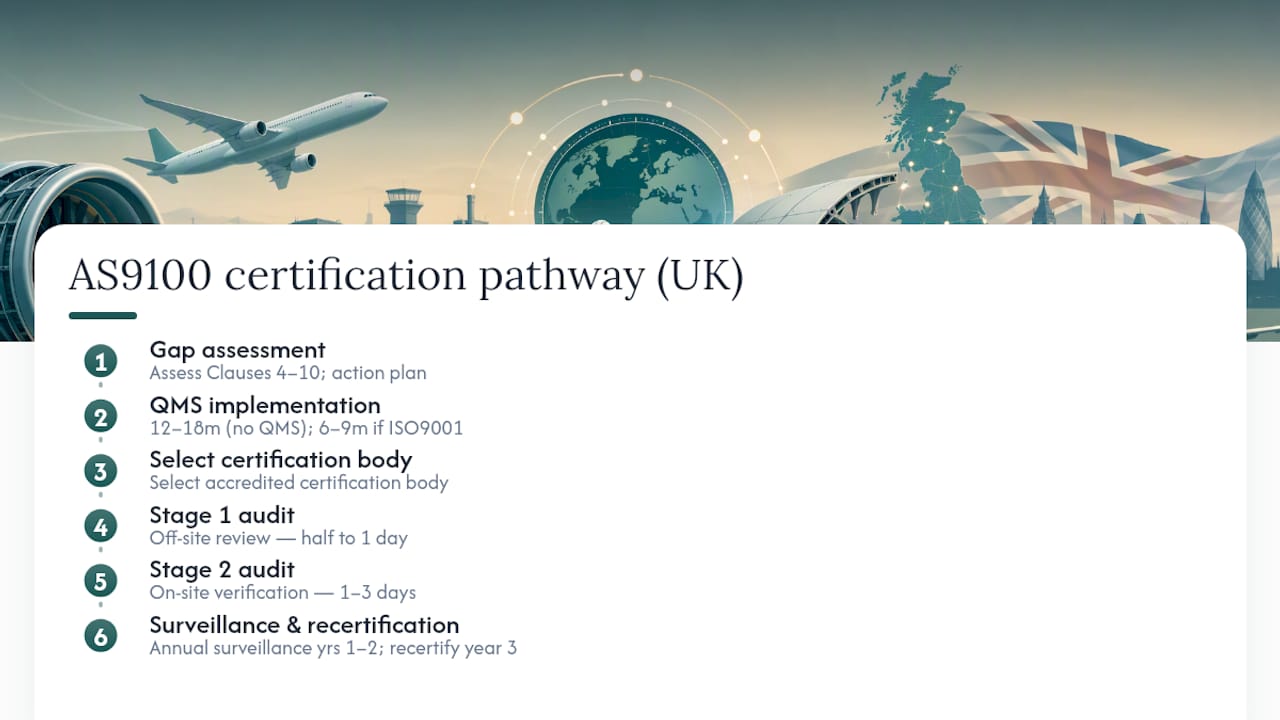
Gap assessment. Before engaging a certification body, most suppliers commission an independent gap assessment against Clauses 4–10. This produces a prioritised action plan and a realistic timeline. For an organisation with no existing QMS, expect 12–18 months of implementation work before Stage 1. For an ISO 9001-certified organisation, 6–9 months is achievable if the four aerospace-specific gaps are addressed methodically.
Stage 1 audit. The certification body reviews your documented QMS for completeness and readiness. Auditors check that your scope statement is accurate, your quality manual or equivalent documentation covers all clauses, and your internal audit programme has been run. Stage 1 is typically conducted off-site or at your premises for half a day to one day, depending on the size of the organisation.
Stage 2 audit. The on-site audit. Auditors verify that your QMS is implemented and effective, sampling production records, FAI packages, supplier qualification files, calibration records, and training evidence. For a small-to-medium supplier, Stage 2 typically runs one to three days on-site.
Surveillance audits. AS9100 certificates are valid for three years, with annual surveillance audits in years one and two. Surveillance audits are shorter than the initial certification audit and focus on areas of previous findings and high-risk processes.
Recertification. A full recertification audit occurs at the end of the three-year cycle.
Who issues and recognises AS9100 certificates in the UK?
Certificates must be issued by a certification body recognised under the IAQG/OASIS scheme. The IAQG OASIS database is the canonical registry where customers and primes verify certificate status and scope. UKAS (United Kingdom Accreditation Service) accredits certification bodies operating in the UK, and a UKAS-accredited body that is also IAQG-recognised provides the dual assurance that UK aerospace customers expect. BSI is among the UKAS-accredited bodies offering AS9100 certification in the UK.
Holding an AS9100 certificate from a body that is not listed in OASIS will not satisfy most prime contractor supplier qualification requirements, regardless of the issuing body’s general reputation. Always verify OASIS recognition before signing a certification contract.
Where does NADCAP fit?
NADCAP is a separate, process-level accreditation for special processes such as heat treatment, non-destructive testing, welding, and chemical processing. It sits on top of AS9100 rather than replacing it. Many prime contractors require NADCAP accreditation for specific processes in addition to AS9100 certification. Advisera’s guidance is direct: pursue NADCAP only when a customer contract or process scope mandates it, because NADCAP audits are technically demanding and costly. The sensible investment order for most UK suppliers is ISO 9001 first, then AS9100, then NADCAP if specific processes or prime contracts require it.
Indicative UK cost bands vary considerably by organisation size and existing QMS maturity. Preparation costs for a small-to-medium supplier include internal resource, consultant support, and documentation. Registrar fees cover Stage 1 and Stage 2 audits combined, with additional fees for annual surveillance audits. These are indicative figures; always obtain quotes from at least two UKAS-accredited, IAQG-recognised bodies.
Practical readiness checklist and common implementation mistakes
A quality manager preparing an AS9100 audit pack should work through the following in order.
- Complete a formal gap assessment against every clause of AS9100D, documenting the current state, the required state, and the action owner.
- Define and document the QMS scope, including site address, product and service categories, and any permissible exclusions with justification.
- Establish a configuration management procedure covering design baseline control, engineering change authorisation, and as-built record linkage.
- Identify all key characteristics for your products and document the control methods (SPC, inspection frequency, acceptance criteria) in your control plans.
- Prepare FAI packages to AS9102 for all applicable part numbers, confirming that design, process, and inspection requirements are fully met before series production.
- Review your approved supplier list and confirm that AS9100 flow-down clauses, quality requirements, and applicable regulatory requirements are included in purchase orders.
- Establish a counterfeit parts prevention procedure covering identification, segregation, reporting, and supply-chain controls.
- Verify records retention meets customer and regulatory requirements — flight-critical parts commonly require 10 or more years of records, and some contracts specify longer periods.
- Run a full internal audit cycle covering all clauses before Stage 1, with findings closed or in active CAPA.
- Hold a management review that addresses product-safety performance, supplier performance, audit results, and quality objectives — with minutes that demonstrate genuine decision-making, not a box-ticking exercise.
Common mistakes that cause nonconformities
The following mistakes appear repeatedly in AS9100 audits and are worth addressing before Stage 1.
| Mistake | Why it causes a finding | Corrective action |
|---|---|---|
| Treating NADCAP as interchangeable with AS9100 | They address different scopes; missing AS9100 controls cannot be substituted by NADCAP accreditation | Maintain both independently; map NADCAP processes into your AS9100 special-process procedure |
| Poor ERP/MES change control | Engineering changes not reflected in live work instructions create configuration nonconformities | Implement a change-control gate that freezes production until WI revision is approved and issued |
| Insufficient supplier flow-down | Purchase orders missing AS9100 clauses, customer-specific requirements, or regulatory references | Audit a sample of live POs against your flow-down matrix before Stage 2 |
| Weak FAI records | Missing balloon drawings, incomplete dimensional results, or no material certification linkage | Use an AS9102-compliant FAI template and verify completeness before submitting to the auditor |
| Product-safety risk isolated from design and process changes | Safety risk assessments exist but are not triggered by engineering changes or supplier changes | Link your change-control procedure to a mandatory product-safety risk review gate |
Aerospace supplier compliance guidance confirms that FAI, key characteristics, and counterfeit prevention are the three areas most frequently cited in AS9100 nonconformity reports, making them the highest-priority items in any pre-audit readiness review.
What does AS9100 mean for precision glass and component suppliers?
For suppliers of precision glass components — optical windows, sensor covers, display glass, protective glazing — the AS9100 requirements that carry the most audit weight are traceability, key characteristics control, material certification, and special process records for coatings and CNC machining.
Batch-level traceability is the foundation. Every glass component supplied into an aerospace or defence programme must be traceable from the finished part back to the raw material batch, the melting and forming process, any post-processing (grinding, polishing, toughening, coating), and the inspection records confirming conformance. A single-line certificate of conformance is not sufficient; auditors expect a traceable chain of records that can be reconstructed years after delivery.
Key characteristics for optical and protective glass components typically include dimensional tolerances (thickness, flatness, parallelism), optical properties (transmission, refractive index, scratch-dig surface quality), and coating performance (reflectance, durability, adhesion). Each characteristic must appear in a control plan with defined measurement methods, frequencies, and acceptance criteria. Where optical verification or finite element modelling is used to validate performance, those records form part of the FAI package.
For precision glass suppliers, the most common audit gap is not in the production records themselves but in the linkage between the material traceability record, the coating process record, and the final inspection certificate. Auditors will ask you to trace a specific part number from the delivery note back through every process step to the raw material batch. If any link in that chain is missing or held in a separate system with no cross-reference, you have a finding.
Coating process records deserve particular attention. Whether coatings are applied in-house or by a sub-tier supplier, the process parameters (bath chemistry, temperature, cycle time, thickness measurement) must be recorded per batch and retained. If a sub-tier supplier applies the coating, your supplier flow-down procedure must require them to provide those records with each delivery. Quality standards in glass manufacturing set out the documentation framework that supports this requirement.
UK defence and aerospace tenders commonly include the following contract language that precision glass suppliers should prepare for:
- AS9100D certification at the supplying manufacturing site (not group-level).
- NADCAP accreditation for specific coating or surface-treatment processes where the prime’s approved process list requires it.
- Right-to-access clauses permitting the customer or their nominated representative to audit the supplier’s premises and records.
- Records retention of 10 years minimum for flight-critical components, with some programmes specifying the life of the aircraft plus a defined period.
For small suppliers, the right-to-access clause is often the most operationally significant. It means your production records, supplier records, and calibration data must be organised and retrievable on short notice. A well-structured document control system is not a bureaucratic overhead; it is the practical mechanism that makes right-to-access audits manageable.
Precision Glasses maintains batch-level traceability across its glass fabrication processes and quality assurance systems, providing the material certificates, process records, and inspection documentation that aerospace and defence programmes require.

Precision Glasses supplies custom precision glass components to aerospace, defence, and medical programmes across the UK, with documented traceability, material certification, and process records aligned to AS9100 supplier requirements. Contact us to discuss your programme’s specification and compliance requirements.
What successful AS9100 implementation actually looks like
The gap between reading AS9100D and running a compliant QMS is almost always a process-integration problem, not a documentation problem. Organisations that struggle tend to build a parallel “AS9100 system” alongside their existing operations — a separate folder of procedures that nobody uses on the shop floor. Organisations that succeed embed the aerospace requirements into the processes people already follow: the engineering change request becomes the configuration change trigger; the purchase order template carries the flow-down clauses; the production traveller links to the FAI package.

The workload is real. For a small precision component supplier with no existing QMS, twelve to eighteen months of focused effort is a realistic expectation before Stage 2. For an ISO 9001-certified organisation, six to nine months is achievable if the four aerospace-specific gaps are addressed without distraction. The most common lesson from implementation is that internal audit quality determines certification readiness more reliably than any other single factor. An internal audit programme that genuinely tests clause compliance, raises findings, and closes them with verified corrective actions will surface every gap before the certification body does.
The payoff is tangible. AS9100 certification opens prime contractor approved supplier lists that are otherwise closed, supports compliance with UK defence procurement requirements, and provides the documented evidence framework that makes customer audits and right-to-access visits manageable rather than disruptive.
Sources
The sources below are the primary references for AS9100 requirements, certification body recognition, and UK accreditation.
- 9100 Quality management systems – Requirements for Aviation, Space and Defense Organizations
- AS9100D: Quality management systems — Requirements for aviation, space and defence organisations (SAE)
- Difference between ISO 9001 and AS9100 – DNV
- AS9100 series: Quality management certification (NSF)
- AS9100 vs ISO 9001: Key differences 2026
- AS9100D and NADCAP – Which one do you need? (Advisera)
Recommended
- Custom glass products for electronics: UK procurement guide – Precision Glasses
- Quality standards in glass manufacturing: 2026 guide – Precision Glass
- Display cover glass: the 2026 guide for industrial sectors – Precision Glasses
- Why choose advanced glass materials: 2026 engineer’s guide – Precision Glass