
A colour-neutral anti-reflective (AR) coating is a multilayer coating designed so that the faint tint you see in reflection, and any shift in transmitted colour, stays inside a limit you define. No coating removes reflected colour entirely. The practical task is to write that limit into the drawing, in measurable terms, and have it verified on the real part. We supply coated glass (AR and AG) for medical, defence, aerospace, automotive, lighting and electronic applications, and this guide covers what an engineering or procurement team needs to specify before an RFQ goes out.
TL;DR
- A single-layer AR coating can only partly cancel reflection, so colour-neutral performance comes from multilayer designs tuned across the visible band.
- Reflected colour and transmitted colour are separate properties. A coating can be neutral in transmission and still look slightly blue or green in reflection.
- Reflected colour shifts with viewing angle and with coating thickness variation on curved or inclined parts, so specify the angle range and the part geometry.
- Define colour limits numerically (for example in CIE L*a*b*), alongside reflectance, transmittance and durability category.
- Ask for traceable batches and inspection records so every delivered lot can be shown to meet the specification.
Table of Contents
- What colour-neutral actually means
- Reflected colour and transmitted colour are different measurements
- Why the colour changes with angle and geometry
- What to put in the specification
- Durability: tie the coating to the environment
- How to check that a part meets the colour requirement
- AR or anti-glare: pick the right solution first
- Cost and what drives it
- Precision Glasses: coated glass built to your specification
- Our perspective
- FAQ
- Sources
What colour-neutral actually means
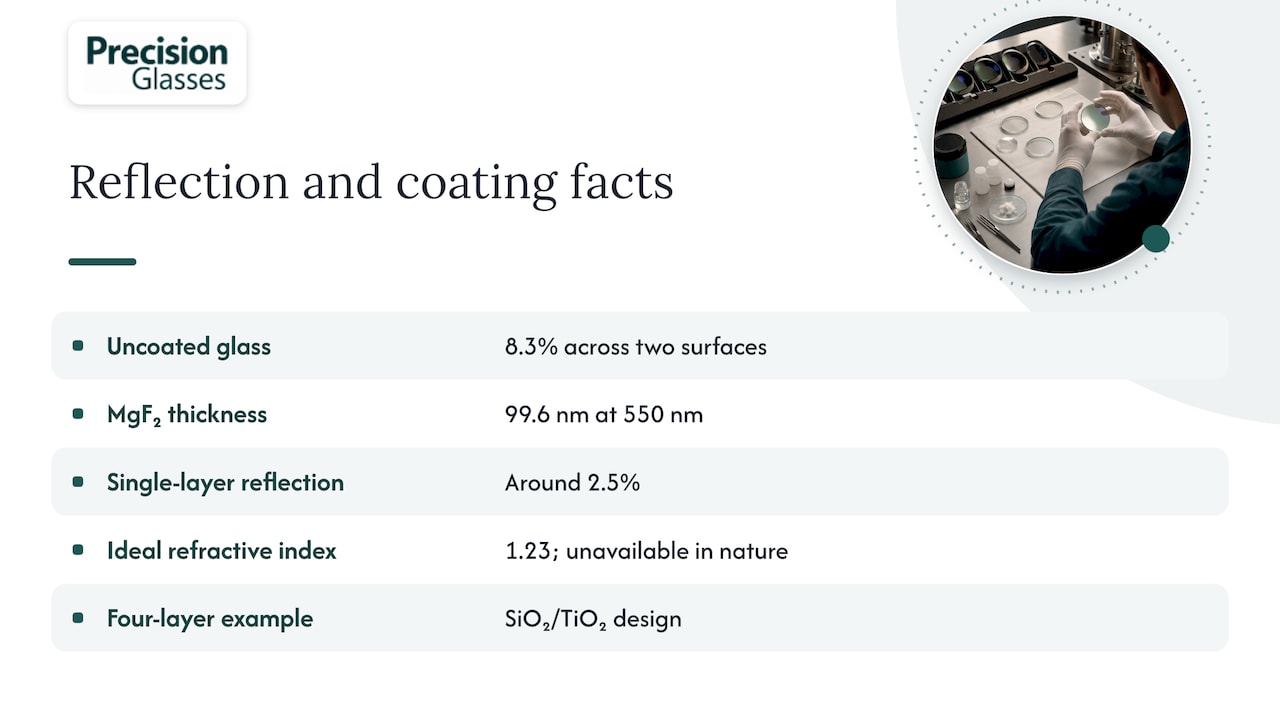
Uncoated glass reflects about 8.3% of incident light across its two surfaces, according to Fraunhofer IST. A single quarter-wave layer of magnesium fluoride, about 99.6 nm thick for a 550 nm design wavelength, brings that down to around 2.5%. Going much lower needs a stack of several layers: Fraunhofer’s example is a four-layer SiO2/TiO2 design.
The reason one layer is not enough is physical. Fraunhofer notes that a perfect single-layer effect would need a coating material with a refractive index of 1.23, which nature does not provide. Real materials cancel reflection only partially, and they do so best at the design wavelength. Away from it, some wavelengths reflect more than others, and that imbalance is what the eye reads as a tint.
So “colour-neutral” is not a claim that reflection is zero. It means the reflected spectrum is flat enough, across the visible range, that the residual light looks grey or near-white rather than green, gold or blue. For a display cover, a sensor window or a cockpit instrument lens, that distinction decides whether the part looks consistent next to its neighbours.
For a wider grounding in how these coatings work, see our technical guide to anti-reflective coating.
Reflected colour and transmitted colour are different measurements
Teams often write “neutral” on a drawing without saying which colour they mean. The two are measured differently and can disagree.
A 2022 review of sol-gel AR coatings in the Journal of Sol-Gel Science and Technology gives a clear example. Two-layer coatings raised integrated transmittance from 91.83% to about 94.85%, with single-side reflection of 0.95 to 0.98%. Three-layer designs reached 0.59 to 0.60% single-side reflection. Their transmitted colour was neutral (b* below 1), yet their reflected colour was slightly blue, with b* between −3.72 and −5.40.
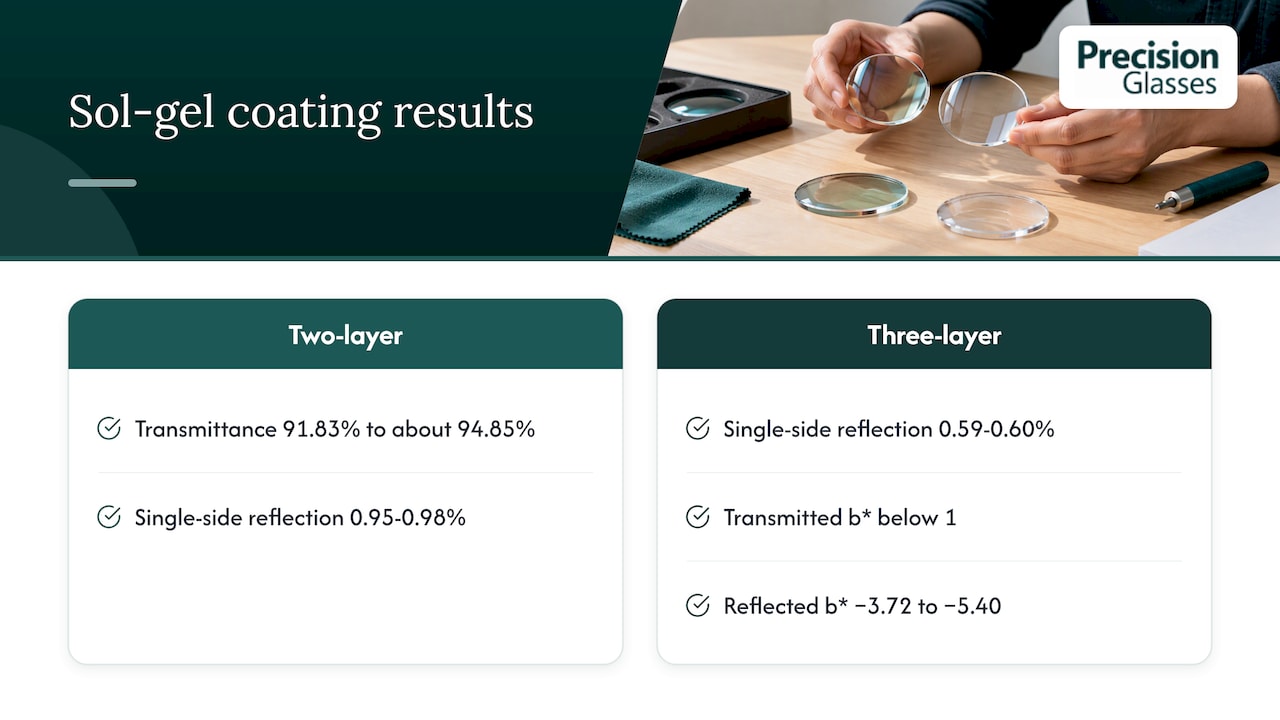
That is the trade-off in one data set. A design that is excellent on reflectance and transmission can still carry a visible reflected tint. If your product is viewed in reflection, such as a front-of-display cover, a dashboard glass or a lit panel, the reflected b* and a* values matter as much as the reflectance figure.
If the part is a window in a sealed instrument and only transmitted light matters, you can relax the reflected-colour limit and spend the margin on reflectance or durability. State which case applies.
Why the colour changes with angle and geometry
A coating that looks neutral when viewed straight on can look different at an angle. Research published in Optics Letters explains the mechanism: at oblique incidence the reflectance maxima shift toward shorter wavelengths, and on inclined or curved surfaces the coating thickness itself varies. Both effects distort colour. The same paper reports that a near-neutral AR coating deposited by atomic layer deposition gave uniform colour across complex-shaped substrates.
For specification, this means three things:
- State the viewing angle range. A head-up display cover, a handheld scanner window and a wall-mounted panel are seen at very different angles.
- State the geometry. Flat windows, curved covers and shaped components do not behave alike, and the coating process needs to suit the part.
- Specify the substrate. Glass type, surface finish and any prior processing such as chemical strengthening or ceramic printing change what the coating sees and how it is applied.
Glass preparation matters before coating starts. Our services include CNC glass machining, edge finishing, toughened glass and display glass, so cutting, finishing and coating can be specified against one drawing. See our services for the full list.
What to put in the specification
A colour-neutral requirement that can be accepted or rejected needs numbers. Use this as a checklist for the drawing or RFQ.
| Parameter | What to state | Why it matters |
|---|---|---|
| Wavelength band | Visible (for example 400 to 700 nm) or a narrower band | Sets the range the coating is tuned across |
| Average reflectance | Per surface or total, over the band | Defines the AR performance itself |
| Transmittance | Minimum over the band | Drives optical throughput |
| Reflected colour | L*a*b* limits, illuminant and observer | Defines what “neutral” means in reflection |
| Transmitted colour | L*a*b* limits | Matters for colour-critical displays and lighting |
| Angle of incidence | Range, such as 0 to 30° | Colour shifts as angle increases |
| Coated surfaces | One side or both | Both-sided coating roughly halves total reflectance loss |
| Durability category | See below | Fixes the environmental tests |
| Cleaning method | Intended cleaning in service | Sets abrasion expectations |
Two points on the table. First, always name the illuminant and observer when quoting colour values, otherwise two labs can report different numbers for the same part. Second, specify both-sided coating deliberately: Fraunhofer’s worked example applies the identical stack to both surfaces, which is how the reflection loss of the whole pane is reduced.
Durability: tie the coating to the environment
A colour-neutral coating is only useful if it stays neutral in service. Abrasion, humidity, salt and temperature cycling can alter a thin-film stack and shift its colour.
The UK implementation of the international standard, BS ISO 9211-3:2024, published by BSI on 29 February 2024, sets out categories of use (A to D, plus O) and identifies which environmental tests are needed to prove an optical coating meets its specification. Test methods are drawn from the ISO 9022 series (cold, heat and humidity, salt mist, dust, solar radiation, mould growth and others) and from ISO 9211-4 for abrasion, adhesion and water resistance. BS ISO 9211-4:2022 defines those abrasion, adhesion and water-resistance methods.
The earlier 2008 edition of the standard describes the categories in plain terms, and the category definitions remain a useful guide:
- Category B: controlled environment, with mild abrasion from carefully controlled cleaning.
- Category C: normal outdoor ambient conditions, and cleaning without severe abrasion.
- Category D: severe outdoor conditions, uncontrolled cleaning and a risk of severe abrasion.
The category applies to the whole coating and substrate combination, not to the coating alone. A coating that passes on one glass may not on another, so the test pieces must represent the production part.
Two of our guides go deeper on this. Environmental testing for glass covers what engineers should specify, and three abrasion tests for glass coatings explains why a single abrasion method rarely tells the full story. Cleaning also affects colour over time, so agree a method early: our note on cleaning AR-coated glass sets out what suits optical components.
How to check that a part meets the colour requirement
A colour-neutral claim is verified in three steps, and each should be written into the purchase documents.
- Agree the measurement method. Name the instrument type, illuminant, observer, angle and the surfaces measured. Measure reflected and transmitted colour separately.
- Define the acceptance limits. Give a colour box in L*a*b* (a* and b* limits) for each case that matters, and a minimum transmittance and maximum reflectance.
- Control the lot. Require batch-level traceability so any measured result links back to the glass lot, the coating run and the inspection record. If a field issue appears, the lot can be identified and checked.
Traceable production, ISO 9001 certification and advanced inspection are part of how we work, and these records give an audit-ready trail for regulated programmes in medical, defence and aerospace. Documented export compliance is available for programmes that ship across borders.
For prototype work, remember that colour is sensitive to process. A prototype coated in a small run should be reviewed against the same limits that apply at volume. We scale manufacturing from prototype to volume, so the specification you validate early can carry through to production.
AR or anti-glare: pick the right solution first
Some colour complaints are really a choice of the wrong surface treatment. AR coating reduces reflection by optical interference. Anti-glare (AG) treatment scatters reflected light with a textured surface, which softens glare but changes sharpness. Which one suits a given display or window depends on lighting conditions and image clarity needs. Our comparison, anti-glare or anti-reflective glass, sets out how to decide. Both are available to us as coated glass options (AR and AG).
Cost and what drives it
Price varies with coating complexity, surface count, part size and test scope. Tighter colour limits generally mean more demanding designs and more inspection. Our guide to AR coating cost explains the drivers for procurement teams, and we quote each project against its specification.
Precision Glasses: coated glass built to your specification
We manufacture custom precision glass components for medical devices, defence, aerospace, automotive dashboards, lighting, electronics and marine technology. Our coated glass range covers AR and AG, and sits alongside display glass, optical windows and covers, CNC glass machining, toughened and laminated glass and custom components. Optical components such as lenses, beam splitters and optical filters are listed on our optical components page.
If you have a drawing or a specification with colour limits, send it to us through our services page and we will respond with the route from prototype to volume.

Our perspective
Colour-neutral is a specification, not an adjective. When a drawing says “neutral” and nothing else, two people read two different requirements, and the argument starts at incoming inspection.
We prefer to settle it at the start. Name the viewing angle, say whether reflected or transmitted colour is critical, give the limits in numbers, and choose the durability category from the real environment. Once those are on paper, the part can be made, measured and accepted without debate.
This is where a manufacturer that controls the whole route matters. Glass that is cut, finished, strengthened and coated under one quality system, with ISO 9001 certification, batch-level traceability and inspection records, gives engineers and procurement officers evidence they can put in front of an auditor. We design our process around that, from prototype to volume.
Send us the specification you have, even if it is incomplete. We would rather help you tighten it than receive a part list that leaves the colour to chance.
Alexandra
FAQ
Can an AR coating be completely colourless?
No. Available coating materials only partly cancel reflection, as Fraunhofer IST explains, so some residual light always reflects. Multilayer design makes that residue spectrally flat enough to read as neutral, within limits you define.
Why does my coated glass look a different colour from the side?
At oblique angles the reflectance peaks of a multilayer shift toward shorter wavelengths, and thickness can vary on curved surfaces. Research in Optics Letters describes both effects. Specify the viewing angle range and the part geometry so the design accounts for them.
Which durability category should I choose?
Choose it from the real environment and cleaning regime. Category B suits controlled environments with careful cleaning, C suits normal outdoor conditions, and D suits severe conditions with uncontrolled cleaning, per the ISO 9211-3 definitions. The category applies to the coating and substrate together.
What should I send with an RFQ for colour-neutral AR glass?
Send the drawing, glass type, coated surfaces, wavelength band, reflectance and transmittance targets, colour limits with illuminant and observer, viewing angle range, durability category and quantities. The more complete it is, the faster the quote and the fewer revisions.
Sources
- Fraunhofer IST: How do you make glass invisible
- Industrial applications of sol-gel derived coatings, Journal of Sol-Gel Science and Technology
- Antireflection coating with consistent near-neutral colour, Optics Letters
- BS ISO 9211-3:2024 preview
- BS ISO 9211-4:2022 preview
- ISO 9211-3:2008 category definitions