
Setup and tooling, secondary machining, tight tolerances, coatings, and inspection or traceability requirements drive the price of custom glass more than the raw material itself. Low volumes amplify all of these, sometimes pushing prototype unit cost far above production cost. Rationalising tolerances early and requesting a specification-driven quote is the single most effective way to control what you pay.
TL;DR:
- Custom glass costs are mainly driven by setup, tooling, secondary machining, coatings, and inspection, which can significantly increase the unit price for low-volume orders.
- Specifying tolerances, material type, and process details clearly in a detailed RFQ reduces pricing surprises and helps avoid costly revisions or rework later.
- Choosing the simplest design that meets functionality, rationalizing tolerances, and consolidating operations can substantially lower manufacturing expenses.
- Rapid turnaround and rush orders often increase costs through expedited processing, but skipping pilot batches or inspection steps heightens yield and schedule risks.
- Regional factors like energy, labor, and material sourcing influence prices, so quotes should be scrutinized for lead time and quality assurance, not just headline costs.
Table of Contents
- What drives custom glass cost at the factory level?
- How much does custom glass cost by complexity and quantity?
- What should go into an RFQ for an accurate custom glass quote?
- Which design choices lower custom glass cost without hurting performance?
- How do lead times and yield risk affect total project cost?
- Do custom glass prices vary by region?
- How do costs compare across custom glass material types?
- What hidden fees show up in a custom glass quote?
- How much does rushing a custom glass order add to the cost?
- An editorial view on where procurement teams actually lose money
- Request a specification review before your next production run
- Sources
What drives custom glass cost at the factory level?
Material choice sets a baseline, but it rarely decides the final invoice. Standard borosilicate or soda lime glass is inexpensive per kilogram. Speciality grades, such as zero-expansion glass ceramics used in stable optical mounts or scientific instrumentation, carry a premium that reflects tighter chemical composition control and lower production volumes across the industry. Buyers evaluating these materials should weigh purchase price against lifetime stability, since the cheapest option on the invoice is not always the cheapest option in service, particularly where thermal drift or recalibration downtime carries its own cost.
Setup and tooling amortisation matters just as much. A production run using precision glass moulding spreads mould costs across thousands of parts, but a short run absorbs the same tooling investment across far fewer pieces, inflating unit price. Moulding also removes many grinding and polishing steps, though it demands high-quality moulds and anti-adhesion coatings to protect yield.
Secondary operations frequently cost more than the glass blank they start with. CNC machining, edge grinding, drilling, and precise polishing are labour and machine-time intensive, and ultra-precision machining is inherently low-throughput, which raises cost further on tight-tolerance or large-aperture parts. Coatings, whether anti-reflective, conductive, or protective, add discrete process and test steps rather than a simple material surcharge.
Finally, inspection and traceability carry fixed costs regardless of part size:
- Metrology reports and dimensional verification against drawing tolerances
- Batch-level documentation for regulated sectors such as medical or defense
- Certificates of conformance and material certification
- Sampling plans and acceptance criteria agreed before production
How much does custom glass cost by complexity and quantity?
Prototype pricing and production pricing rarely sit on the same curve. A single prototype absorbs the full setup, programming, and first-article inspection cost, while a production batch spreads that same overhead across hundreds or thousands of units. This is why a five-piece order can cost several times more per part than a five-thousand-piece order of the identical design.
Rather than quoting absolute figures, which shift with material, region, and supplier capacity, it helps to think in relative complexity tiers:
- Basic flat blank, loose tolerances, no secondary operations. This is your reference point, closest to raw material and cutting cost.
- Standard machined part with edgework and moderate flatness control. Expect a noticeable multiplier over the basic blank once CNC time and finishing enter the process.
- Precision part with positional holes, tight flatness (measured in micrometres), and a single coating layer. Each added feature compounds cost rather than adding a flat fee, because each one typically requires its own fixture, inspection step, or process pass.
- High-specification optical or sensor component with multiple coatings, chemical strengthening, and full batch traceability. This tier carries the highest multiplier and the longest inspection chain.
Adding positional holes to a flat part, tightening flatness specifications, or specifying an anti-reflective coating each shift a part up a tier, sometimes more than one. Energy and raw-material exposure also move baseline pricing across the glass manufacturing cost curve, where energy alone can represent a meaningful share of production cost. Treat these tiers as internal screening ranges for budgeting, not as a substitute for a formal quote once your specification is fixed.
What should go into an RFQ for an accurate custom glass quote?
Quote variance between suppliers usually comes down to what was left out of the request, not disagreement over the work itself. A complete RFQ package removes ambiguity before anyone picks up a grinding wheel.
Your drawing package needs to specify datums, flatness callouts, surface form limits, and positional tolerances using standard GD&T conventions, since verbal descriptions of “tight tolerance” get interpreted differently by every supplier you approach. Material specification should state chemical composition, coefficient of thermal expansion targets where relevant, required optical properties, and any certification the end application demands.
On the manufacturing side, spell out exactly which operations must be completed in-house versus subcontracted, what metrology reports you require at delivery, and what acceptance sampling plan applies to the batch. Commercial details matter just as much: batch size, target lead time, packaging requirements, shipping constraints, and any export control classification that affects who can quote at all.
A tight RFQ checklist covers:
- Full GD&T drawing with datums and tolerance callouts
- Material grade, composition, and certification requirements
- Required coatings, surface finishes, and functional specifications
- Metrology and inspection reporting expectations
- Batch size, lead time, and delivery terms
Pro Tip: Always ask suppliers to state their assumed yield and scrap allocation in writing on the quote itself. Understanding per-unit cost math and NRE allocation this way exposes whether a low headline price is hiding an aggressive scrap assumption that will surface later as a change order.
Reviewing the glass component design guide before finalising drawings often catches tolerance conflicts that would otherwise surface mid-quote.
Which design choices lower custom glass cost without hurting performance?
Over-specification is the most common, and most avoidable, source of inflated quotes. A tolerance tightened out of habit rather than functional need adds inspection burden and machining time for no real benefit.
- Rationalise every tolerance against actual functional requirement, not a default “tight is safer” instinct.
- Standardise blank sizes across product variants so suppliers can nest parts efficiently and cut scrap.
- Consolidate secondary operations with a single supplier rather than splitting machining, coating, and inspection across three vendors.
- Apply coatings and speciality finishes only where they deliver a required optical or functional property, not as a default addition.
- Use a pilot batch, backed by supplier process modelling, instead of iterative one-off prototyping to find the right process window.
Surrogate modelling and numerical process optimisation can materially cut the number of trial runs needed for complex optics, which lowers both development cost and the calendar time before production ramp-up. That is a lever many buyers never ask their supplier to pull.
How do lead times and yield risk affect total project cost?
Prototypes take the longest per unit because tooling, fixturing, and first-article inspection happen once against a single part. Pilot batches exist to stabilise the process before committing to full production, and skipping this step is a common reason projects slip. Production ramps deliver the lowest unit cost but only after the process has been validated at scale.
Low-throughput machining and slow feed rates on high-precision passes stretch schedules further, particularly on complex geometries. Unexpected scrap during any of these stages cascades quickly: a batch that fails inspection midway through a run does not just cost the scrapped pieces, it consumes the remaining schedule slack too.
- Build a pilot run into your timeline rather than treating it as optional.
- Ask suppliers whether they use process or surrogate modelling to shorten trial cycles.
- Require statistical batch testing rather than spot-checking a handful of parts.
- Confirm scrap allocation up front so yield risk does not become a schedule surprise.
Do custom glass prices vary by region?
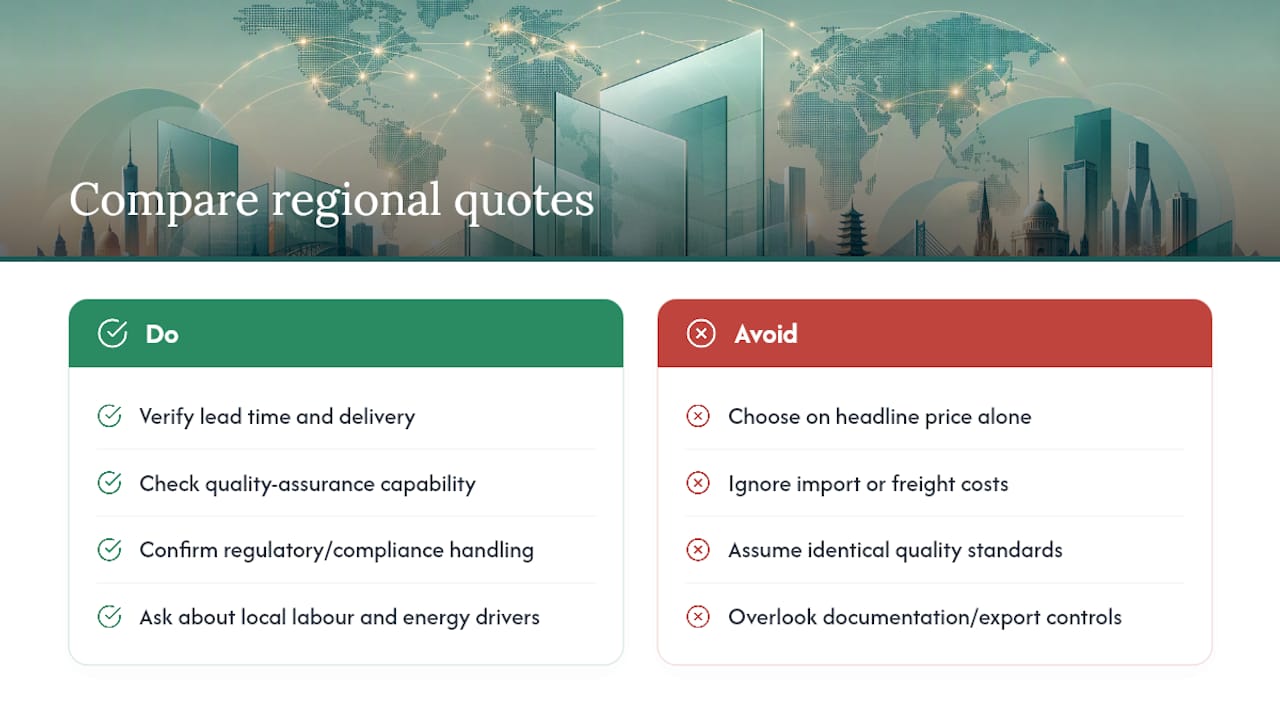
Regional pricing differences come from a handful of structural factors rather than arbitrary supplier margin. Energy cost is one of the largest, since glass melting and processing are energy-intensive, and energy alone can account for a substantial share of total production cost depending on the plant and region. A supplier operating where industrial energy prices are higher will carry that through to quoted pricing, particularly on melt-intensive or high-temperature processes like moulding.
Labour cost and the availability of skilled precision machinists shift quotes too, especially for parts that rely heavily on manual polishing, inspection, or fixturing rather than fully automated lines. Regions with a concentrated base of precision optics or technical glass manufacturers tend to offer more competitive secondary-operation pricing simply because more capacity is chasing the same work.
Raw material sourcing plays a role as well. Speciality glass grades, such as zero-expansion ceramics or high-purity optical glass, often come from a small number of global producers, so freight distance and import duties can add cost regardless of where the finishing work happens. Regulatory and export control regimes add another layer for defense and aerospace buyers, since compliance documentation and restricted material handling carry their own administrative cost that varies by jurisdiction.
None of this means regional comparison shopping is pointless. It does mean a quote from a lower-cost region needs scrutiny on lead time, communication overhead, and quality assurance capability, not just headline price, since a cheaper unit cost that arrives late or fails inspection is not actually cheaper.
How do costs compare across custom glass material types?
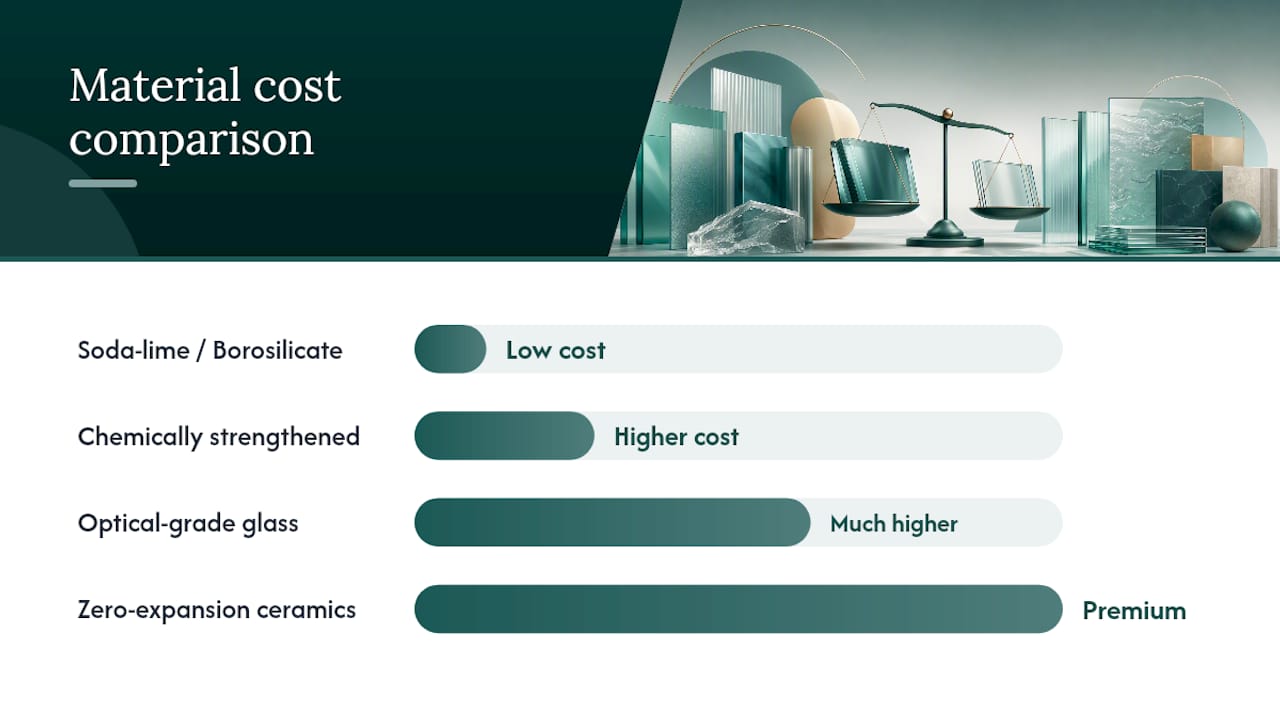
Material selection changes your cost baseline before a single machining pass happens. Standard borosilicate and soda lime glasses sit at the affordable end, suited to housings, windows, and structural applications where extreme thermal or optical performance is not required.
Chemically strengthened glass costs more than untreated equivalents because it adds a dedicated ion-exchange or tempering process step, but it earns that premium through impact resistance for display and touchscreen applications where a standard blank would be too fragile in service. Optical-grade glass, ground and polished to tight surface form and transmission specifications, costs substantially more than commodity glass because every additional decimal place of precision adds inspection and process time.
Zero-expansion glass ceramics sit at the premium end of the scale. These materials hold dimensional stability across temperature swings that would distort ordinary glass, which matters enormously in scientific instrumentation and precision optical mounts. Evaluating them purely on purchase price misses the point: a lower-spec material that drifts out of tolerance and forces recalibration or downtime can cost more over the life of the instrument than the higher-priced ceramic would have cost up front.
The practical takeaway is not to default to the cheapest material category, nor to over-specify the most exotic one out of caution. Match the material to the functional requirement, then let the technical glass options within that category compete on process and lead time.
What hidden fees show up in a custom glass quote?
Several charges catch buyers off guard because they rarely appear on a first-pass estimate, only surfacing once a formal quote or purchase order arrives.
Non-recurring engineering (NRE) and tooling fees for moulds, fixtures, or custom programming are often quoted separately from per-piece price, and they do not shrink just because your order volume is small. First-article inspection charges can apply on top of standard unit pricing, particularly for regulated sectors requiring full dimensional reports before production release.
Custom sizing itself carries a premium over standard stock dimensions. Custom cut and tempered glass typically costs more than standard sizes because of setup time, yield loss during cutting, and the edgework required once a non-standard shape leaves the cutting table. Post-tempering constraints add another layer: once glass is chemically or thermally strengthened, further machining is often impossible, so any drilling or edge shaping must happen before that step or not at all, and getting the sequence wrong means scrapping the part.
Packaging and freight for fragile, precision-tolerance components tend to cost more than standard shipping, particularly for export orders requiring documentation or restricted-material handling. Rework and re-inspection fees can also apply if a batch fails an agreed acceptance sampling plan, so it pays to clarify warranty and rework terms before the order is placed rather than after a failed shipment arrives.
How much does rushing a custom glass order add to the cost?
Expedited processing rarely adds a flat surcharge. It compresses a schedule that was already built around a specific sequence of setup, processing, and inspection, and compressing that sequence costs money in several places at once.
Rush orders often force a supplier to reprioritise machine time away from other scheduled work, which shows up as a premium on your invoice or a longer wait for a slot to open at all. Skipping or shortening a pilot batch to save time increases yield risk, since the process window that a pilot would normally validate gets tested for the first time during the production run itself. That is a trade worth thinking through carefully, because a failed production batch under time pressure costs far more than the days saved by skipping the pilot.
Inspection and documentation can become a bottleneck too. Full metrology reporting and batch traceability take time regardless of how urgently the parts are needed, and rushing this step is rarely advisable for medical, defense, or aerospace applications where the documentation is not optional. The realistic move for genuinely urgent orders is to flag urgency at the RFQ stage, not after the quote arrives, so the supplier can plan capacity and set expectations on both price and risk before committing to a delivery date.
An editorial view on where procurement teams actually lose money
Three actions separate teams that control cost from teams that get surprised by it. First, finalise functional tolerances before requesting quotes, not during the quoting process, since every revision after quoting resets supplier assumptions about machining time and yield. Second, prepare a complete RFQ package with GD&T, material specification, and inspection requirements in one document, not scattered across emails. Third, request a pilot-batch quote that states assumed yield and NRE explicitly, in writing, before committing to production volume.
Suppliers who use process modelling and statistical batch testing can outperform those relying on trial-and-error, and that difference may compound over a multi-year contract. If your current specification package feels incomplete, a specification review can be an effective way to close the gap before it becomes a costly change order.
— Alexandra
Request a specification review before your next production run
Some companies work directly with engineering and procurement teams to reduce cost and schedule risk before a single mould is cut. That means a specification review that catches over-tolerancing before it reaches the shop floor, pilot runs that validate process windows instead of guessing at them, and full metrology reporting with batch-level traceability built into every delivery.
For demanding applications in medical, defense, aerospace, automotive, lighting, electronics, and marine fields, an upfront review can help prevent change orders and yield surprises that inflate a project’s real cost well beyond the original quote. Precision Glasses’ manufacturing workflow is built around exactly the specification-driven process this article recommends: drawing review, tolerance rationalisation, pilot batch, and then production, with inspection data attached at every stage.
If your next order involves a new geometry, a tightened tolerance, or a material you have not specified before, request a specification review and quote through Precision Glasses before finalising your RFQ. It is the single step most likely to bring your final invoice in line with your original budget.
Sources
- Surrogate modelling for multi-objective optimisation in high-precision LiDAR glass optics (RWTH Aachen)
- Precision glass molding: toward optimal fabrication of optical lenses (Springer Nature review)