
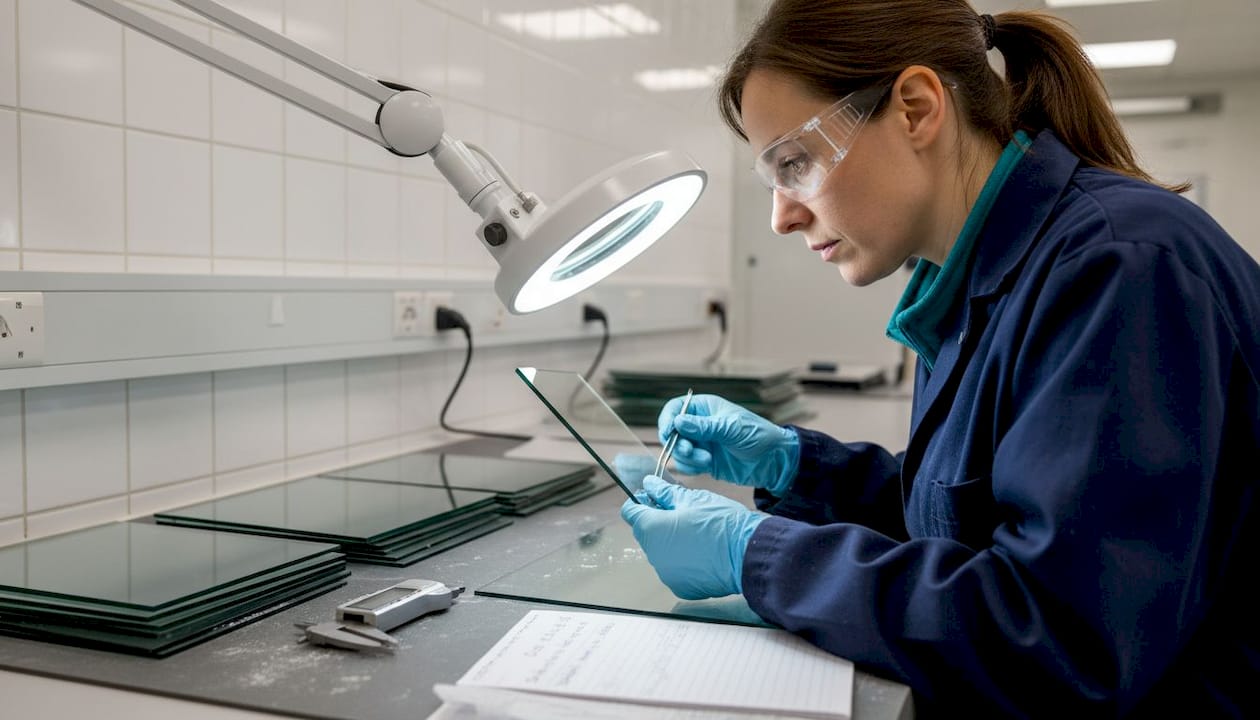
Display glass is frequently treated as a background material, an afterthought compared to the electronics or optics it supports. Yet for engineers specifying components for defence instrumentation, medical devices, aerospace cockpits or automotive dashboards, the glass itself is a precision component. Its thickness tolerances, surface flatness and edge integrity directly govern whether a system performs or fails in the field. This article cuts through the assumptions, defines what display glass truly is, and explains how its engineering, quality assurance and application-specific design make it indispensable for specialist industries.
Table of Contents
- What is display glass and why does it matter?
- Materials and engineering challenges for high-precision display glass
- Quality assurance and testing: meeting industry standards
- Practical applications and trends in specialist industries
- A fresh perspective: why display glass is not just ‘glass’
- Explore expert solutions for high-precision display glass
- Frequently asked questions
Key Takeaways
| Point | Details |
|---|---|
| Precision is vital | Display glass must meet ultra-thin tolerances and high edge strength to perform reliably in specialist devices. |
| Application-specific challenges | Each industry imposes unique demands on display glass, from thermal stability to durability and defect control. |
| Rigorous quality assurance | Advanced measurement and inspection processes ensure display glass meets international standards. |
| Choosing the right provider | Expert technical glass partners help engineers and procurement managers source solutions tailored to their industry needs. |
What is display glass and why does it matter?
Display glass is not a single product. It is a category of highly engineered sheet glass manufactured to precise dimensional and optical specifications for use in screens, instrument panels, control interfaces and sensing windows. In consumer electronics, these requirements are strict. In defence, medical, aerospace and automotive applications, they are considerably more demanding.
The properties that define display glass for industrial use are measurable and tightly controlled:
- Thickness tolerances often specified to ±0.02 mm or better
- Total Thickness Variation (TTV) below 10 μm across the panel
- Surface flatness critical for optical clarity and laminate bonding
- Edge strength typically in the range of 100 to 200 MPa for ultra-thin variants
- Thermal compatibility to withstand operational temperature swings without distortion
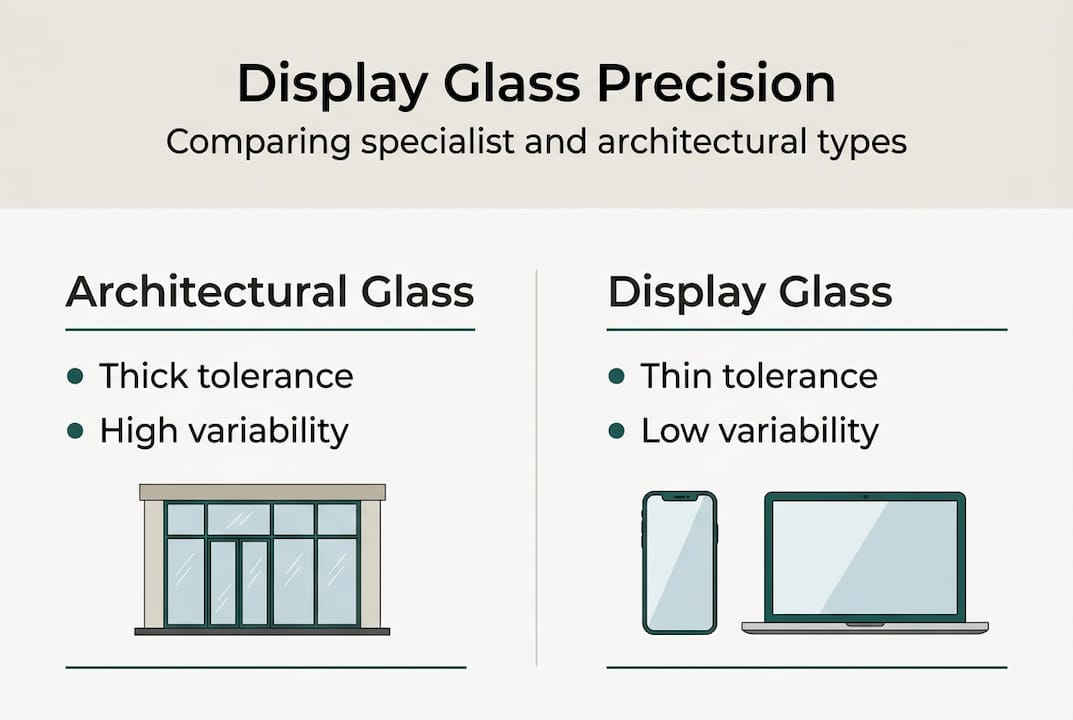
The contrast with architectural glass is stark. A standard float glass pane may have thickness variation of several hundred micrometres. For a military display or a medical diagnostic screen, such variation would introduce parallax error, weaken bond lines, or compromise the sealing of a sterile interface.
| Property | Architectural glass | Display glass (specialist) |
|---|---|---|
| Thickness tolerance | ±0.2 mm | ±0.02 mm or better |
| TTV | >100 μm | <10 μm |
| Edge strength | 20–50 MPa | 100–200 MPa |
| Surface finish | Commercial | Optical grade |
| Thermal stability | Moderate | High (application-specific) |
Understanding medical glass terminology is particularly valuable for engineers specifying glass for diagnostic equipment, where optical clarity and dimensional consistency directly affect measurement accuracy.
In practice, display glass serves a wide range of specialist roles. Military vehicle displays must withstand vibration, shock and wide temperature extremes. Surgical monitors require chemically resistant surfaces and precise flatness for accurate imaging. Automotive instrument panels demand glass that survives thermal cycling between cold starts and high operating temperatures. Aircraft cockpit displays must meet optical and structural requirements simultaneously.
Ultra-thin glass processing confirms that display glass must meet strict thickness tolerances and high edge strength requirements to prevent faults during handling and use. This is not a theoretical concern. It is a documented engineering challenge with direct consequences for system reliability.
Materials and engineering challenges for high-precision display glass
Having established what display glass is, the next step is to understand the materials and engineering hurdles that define its performance.
Three principal glass families are used in specialist display applications, each with distinct advantages:
- Soda-lime glass: Low cost, widely available, but limited in thermal and chemical resistance. Suitable for lower-demand applications.
- Aluminosilicate glass: Higher strength and scratch resistance, often chemically toughened. Preferred for thin, high-strength displays.
- Borosilicate glass: Superior thermal stability and low coefficient of thermal expansion (CTE). Used where temperature extremes are a primary concern.
The coefficient of thermal expansion is a critical parameter in laminate assemblies. When two glass layers with different CTEs are bonded together, temperature changes cause differential expansion. This mismatch creates internal stress, leading to bowing, delamination or cracking. Engineering the laminate stack so that all materials share compatible CTEs is a fundamental step in display glass design.
| Glass type | CTE (×10⁻⁶/°C) | Typical use |
|---|---|---|
| Soda-lime | 8.5–9.0 | General displays |
| Aluminosilicate | 6.5–8.0 | High-strength mobile/defence |
| Borosilicate | 3.3–4.5 | Aerospace, scientific |
Manufacturing precision at this level requires controlled scribing. Ultra-thin glass processing confirms that glass under 1 mm thickness requires increased tilt angles and precision scoring with a 100° wheel to maintain crack propagation within approximately 100 μm. Any deviation introduces micro-cracks that reduce edge strength dramatically and increase the risk of in-service failure.
Surface and edge finishing are equally critical. Grinding and polishing remove sub-surface damage from cutting. Chemical toughening via ion exchange compresses the surface layer, increasing fracture resistance. CNC-machined edges, when executed correctly, add strength and geometric accuracy that manual processes cannot replicate.

Pro Tip: When reviewing glass supplier capabilities, ask specifically about their scoring wheel specifications and crack depth measurement process for ultra-thin substrates. This single data point reveals whether they have genuine process control or are simply cutting to size.
For procurement teams, optimising glass sourcing at the specification stage prevents costly rework later. Engaging a specialist manufacturer early, when material selection and tolerances are still being defined, is consistently more effective than retrofitting a specification to available stock. Our technical glass range is engineered precisely for these demands, and our team at Precision Glass is available to support specification reviews.
Quality assurance and testing: meeting industry standards
With materials and engineering challenges defined, it is crucial to ensure glass meets the highest standards for industrial use.
Quality assurance for specialist display glass is a structured, multi-stage process. Each stage targets specific failure modes relevant to the intended application. The following steps represent the standard quality flow we apply for defence and medical clients:
- Incoming material inspection: Raw glass is measured for bulk thickness, TTV and surface condition before entering production.
- Dimensional verification: Cut and edged panels are checked against tolerance specifications using calibrated optical measurement.
- Edge strength testing: Modulus of rupture testing confirms edge strength falls within the required 100 to 200 MPa range.
- Surface defect inspection: Automated vision systems and trained manual inspectors identify scratches, inclusions and chips to defined acceptance criteria.
- Flatness measurement: Interferometric or contact measurement confirms TTV is within specification, typically below 10 μm.
- Thermal cycling validation: Where specified, panels undergo thermal cycling to confirm dimensional stability across the operational temperature range.
- Final release and certification: Documentation confirming compliance with client specification and relevant standards accompanies every shipment.
High precision applications demand TTV below 10 μm and edge strength between 100 and 200 MPa. These are not arbitrary figures. They represent the threshold below which critical applications begin to see measurable reliability degradation.
Automated inspection equipment removes subjectivity from defect detection. However, manual inspection by experienced technicians remains important for complex geometries and low-volume specialist components, where context and engineering judgement add value that automation alone cannot provide.
Pro Tip: When qualifying a new glass supplier, request sample panels from their standard production run rather than specially prepared samples. Standard production output tells you far more about their real-world process capability than curated specimens.
Our product range includes precision display glass solutions across multiple formats. Products such as our PG0418-5MP, 25020-5MP, PG0618-5MP and PG0512-12MP are manufactured and inspected to the demanding tolerances specialist industries require. Our broader optical components portfolio extends these principles across a wider range of applications.
Practical applications and trends in specialist industries
Rigorous quality assurance enables display glass to fulfil demanding roles across specialist industries.
Each sector has specific requirements that shape both the material selection and the manufacturing process:
- Defence: Rugged displays for armoured vehicles, handheld tactical devices, and secure communications equipment. Glass must resist impact, chemical exposure and wide temperature variation while maintaining optical clarity.
- Medical: Diagnostic screens, surgical monitors and touch interfaces for sterile environments. Smooth, non-porous surfaces are mandatory for infection control, and optical accuracy affects diagnostic confidence.
- Automotive: Instrument panels, head-up display substrates and driver monitoring system windows. Glass must survive thermal cycling, UV exposure and vibration over a vehicle’s service life.
- Aerospace: Cockpit displays and mission-critical avionics interfaces. Both optical performance and structural integrity are non-negotiable. Weight reduction pressures mean thinner glass is increasingly specified.
- Electronics: Next-generation screens, virtual and augmented reality optics, and wearable devices. Display glass in these applications is often at the absolute limit of what manufacturing can achieve in terms of thinness and strength simultaneously.
“Engineering solutions must respond to increasingly thinner, stronger, and thermally stable glass requirements.” This observation from ultra-thin glass research captures the central challenge facing display glass manufacturers in 2026. The market does not stand still.
The trend across all sectors is towards thinner substrates with higher strength and better thermal stability. This creates a genuine engineering tension. Thinner glass is inherently less robust. Achieving higher edge strength in thinner sections requires more controlled manufacturing and more sophisticated finishing. It is precisely this challenge that separates specialist suppliers from general glazing manufacturers.
Explore our technical glass products to see how these requirements are addressed in practice across a range of industry-specific formats.
A fresh perspective: why display glass is not just ‘glass’
After years of working with engineers across defence, medical and aerospace programmes, one observation stands out. The biggest risk in display glass specification is not choosing the wrong material. It is treating glass as a commodity.
When procurement teams select glass purely on unit price, without specifying TTV, edge strength or CTE compatibility, they transfer the risk downstream. Device failures, warranty claims and programme delays are frequently traced back to a glass specification that was never properly defined in the first place.
The counterintuitive truth is that investing in higher-precision glass, with tighter tolerances and documented quality assurance, almost always reduces total programme cost. Fewer rejects during assembly. Fewer field failures. Greater confidence in qualification testing.
Engineers who treat display glass as a precision component from the earliest design stage, rather than a late-stage procurement item, consistently see better outcomes. Our guidance on precision sourcing tips provides practical frameworks for building glass specification into your procurement process in a way that protects both performance and budget.
Display glass is not just glass. It is the interface between your technology and the world it operates in. Treat it accordingly.
Explore expert solutions for high-precision display glass
For professionals ready to act, specialist resources and expert support are critical when sourcing display glass for demanding applications.

At Precision Glass, we work directly with engineers and procurement managers across defence, medical, aerospace, automotive and electronics sectors to deliver display glass solutions that meet exacting specifications. Our technical glass range covers a broad spectrum of formats, thicknesses and material types, all manufactured and inspected to the tolerances specialist industries demand. If you are at the specification stage or reviewing an existing supplier, our optimising glass sourcing guide is a practical starting point for structuring your requirements and evaluating supplier capability with confidence.
Frequently asked questions
What makes display glass different from ordinary glass?
Display glass undergoes stringent controls for thickness, surface flatness, edge strength and thermal compatibility, making it suitable for demanding industrial applications. Industry standards confirm high precision demands TTV below 10 μm and edge strength between 100 and 200 MPa for critical applications.
Why is edge strength important in ultra-thin display glass?
Edge strength prevents cracking and failure during handling and use, especially in glass below 1 mm thickness. Edge strength of 100 to 200 MPa is considered the minimum threshold for durable ultra-thin glass in specialist applications.
How is display glass tested for quality in specialist industries?
Display glass is tested for thickness, TTV, edge strength, surface defects and thermal stability using a combination of automated vision systems and manual inspection. Measurement of TTV and defect inspection are industry-standard requirements across defence, medical and aerospace supply chains.
Which industries require high-precision display glass?
Defence, medical, aerospace, automotive and advanced electronics sectors all require high-precision display glass to ensure reliability and safety. Display glass is essential in military, medical, automotive, aerospace and electronics applications where failure is not an acceptable outcome.
Recommended
- Precision Glass – Medical – Defense – Engineering – Security – Optical – Automotive – Electronic
- Technical Glass – Precision Glass
- How to optimise glass sourcing for precision: 5 key steps – Precision Glass
- Medical glass terminology explained for device engineers – Precision Glass
- Custom flexible shaft benefits: boost precision and reliability