Glass is not an afterthought in photonic systems. It is, in many cases, the single factor that determines whether a system operates within specification or fails entirely. From fibre optic networks carrying data at terabit speeds to airborne infrared sensors and AI chip interconnects, the glass underpinning these technologies must meet tolerances measured in nanometres and perform reliably across extreme conditions. Yet procurement decisions still regularly treat glass as a commodity. This guide sets out why that assumption is dangerous, and how engineers and procurement professionals can make informed, specification-driven selections for demanding photonic applications.
Table of Contents
- Why glass matters in photonics
- Types of glass used in photonics
- Modern fabrication techniques for precision glass
- Choosing glass for advanced and sector-specific photonic applications
- Glass selection in photonics: what most procurement guides get wrong
- How specialist support can optimise your photonic glass solution
- Frequently asked questions
Key Takeaways
| Point | Details |
|---|---|
| Glass enables reliable photonics | Tailored glass compositions support low-loss, stable performance across critical photonics sectors. |
| Specialty types serve unique needs | Sapphire, fused silica, and chalcogenide glass each address specific optical, thermal, or mechanical requirements. |
| Fabrication shapes precision | Laser etching, advanced moulding, and 3D methods allow unprecedented optical component quality and miniaturisation. |
| Sector-specific selection is key | Successful projects require matching glass type and processing to unique demands of aerospace, medical, and electronic systems. |
| Expert input avoids costly mistakes | Involving skilled fabricators ensures specifications deliver needed performance, not just catalogue convenience. |
Why glass matters in photonics
Photonics is the science of generating, controlling, and detecting light. Glass is central to it. No other class of materials combines high optical transparency, low absorption, low scattering, chemical and thermal stability, and a tunable refractive index in a single, scalable, cost-effective form. As the photonics material fundamentals from ProPlate confirm, glass is essential across fibres, lenses, waveguides, and substrates precisely because these properties can be engineered to tight specifications.
Polymer optics offer low cost but degrade rapidly under UV exposure and at elevated temperatures. Silicon and gallium arsenide support high refractive indices but are opaque in the visible range and brittle in ways that complicate post-processing. Glass occupies a performance space that alternatives cannot easily replicate, particularly in applications requiring broadband transparency, dimensional stability, and long service life.
The role of glass in advanced optical systems is clearest when you examine failure modes. In a medical imaging device, a substrate with insufficient chemical resistance will degrade under sterilisation cycles, introducing scatter that corrupts image data. In a defence sensor, a window material with the wrong coefficient of thermal expansion (CTE) will introduce stress birefringence under rapid thermal cycling, distorting the wavefront. The consequences of a poor glass choice are rarely immediate and obvious. They appear as gradual performance drift, increased maintenance frequency, or unexpected field failures under conditions that were perfectly predictable at the design stage.
“Glass’s unique combination of tuneable refractive index, low optical loss, and environmental resilience makes it the foundational material across photonic integration platforms, from consumer fibre networks to mission-critical aerospace sensors.”
The integration of glass into photonic systems takes several forms:
- Optical fibres: High-purity fused silica drawn to micrometre-scale diameters for signal transmission
- Precision lenses and windows: Polished to surface roughness below 1 nm for imaging and sensing
- Waveguides: Thin glass layers deposited or etched to guide light within integrated circuits
- Substrates: Flat glass panels used as the base layer for electronic and photonic device fabrication
- Microfluidic platforms: Borosilicate glass chips for biological sample handling under optical interrogation
Types of glass used in photonics
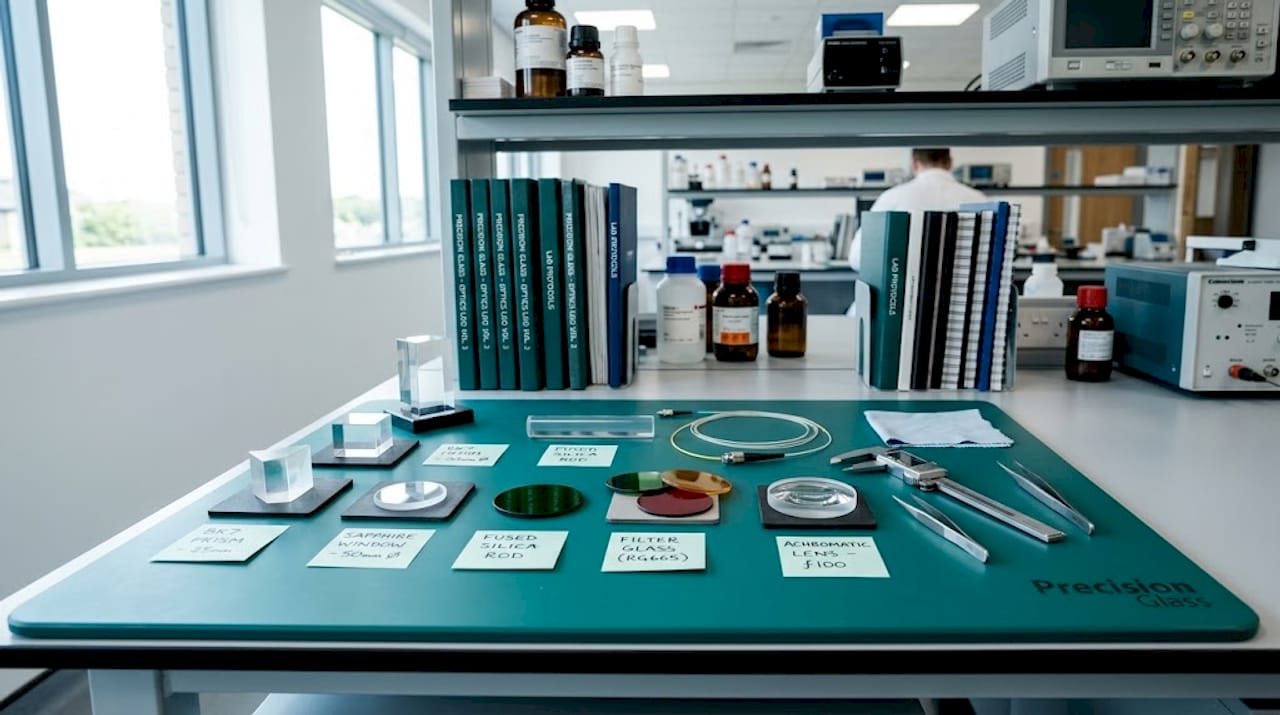
Not all glass performs equally. The choice between standard optical glass and a highly specialised composition can mean the difference between a working prototype and a deployable system. As research confirms, traditional glass types such as BK7 serve well in visible-range applications where cost and machinability are priorities, whilst fused silica, sapphire, and chalcogenide glasses address the UV, high-power, and long-wave infrared (LWIR) extremes respectively.
| Glass type | Key properties | Typical photonics application | Primary sectors |
|---|---|---|---|
| BK7 (borosilicate crown) | Low cost, good visible transmission, easy to polish | Lenses, windows, beamsplitters | Medical, general optics |
| Fused silica | Exceptional UV and IR transmission, very low CTE | Laser optics, UV lithography | Semiconductor, aerospace |
| Sapphire | Extreme hardness, broad transmission, high thermal stability | High-pressure windows, domes | Defence, aerospace |
| Borosilicate (Borofloat) | Chemical resistance, biocompatible, thermal shock resistance | Microfluidics, lab-on-chip | Medical devices, research |
| Chalcogenide glass | Mid-IR and LWIR transparency (2–15 µm), low phonon energy | Thermal imaging, IR fibres | Defence, automotive |
| Glass core substrates (AF32, Eagle XG) | Low CTE, ultra-flat, high dimensional stability | AI chip interposers, photonic ICs | Electronics, AI hardware |
| Magnesium fluoride (MgF2) | Broad UV-VUV transmission, low refractive index | Domes, antireflection elements | Aerospace, defence |
Sector alignment matters enormously here. Defence and aerospace programmes overwhelmingly specify sapphire and MgF2 for exterior optical elements, where hardness and broad spectral range are non-negotiable. Medical device teams rely on borosilicate for its biocompatibility and resistance to autoclave sterilisation. The electronics and AI sectors are currently driving rapid adoption of glass core substrates, where low CTE and ultra-flat surfaces enable precise photolithographic patterning of chip-scale photonic interconnects. Automotive and lighting applications increasingly call for low-loss RF glass interposers as photonic integration enters vehicle sensing platforms.
Explore how tailored glass solutions for aerospace differ substantially from those destined for consumer electronics, even when the visual form factor appears similar. Equally, emerging glass technologies are creating new options for both sectors as material science advances.
Pro Tip: Procurement teams frequently default to BK7 for early-stage R&D because it is low-cost and readily available. This is a rational short-term decision, but it creates serious risk if the system eventually migrates to a UV or LWIR application. Specifying the correct glass type from the concept stage, even if higher-grade material is sourced later, prevents costly redesigns driven by material incompatibility.
Modern fabrication techniques for precision glass
Selecting the right glass composition is only the first step. The fabrication processes applied to raw glass determine whether its theoretical properties translate into delivered performance. The full glass fabrication processes sequence typically moves through the following stages:
- Batch melting and forming: Raw materials are melted at controlled temperatures to produce homogeneous glass blanks, with striation and bubble content tightly monitored.
- Rough shaping: CNC grinding removes bulk material to approximate the target geometry, with careful management of sub-surface damage that can propagate during fine polishing.
- Precision grinding and polishing: Progressive reduction of surface roughness, from tens of micrometres down to sub-nanometre Ra values for photonic-grade optics.
- Annealing: Controlled slow cooling to relieve internal stress and achieve homogeneous refractive index distribution across the blank.
- Chemical strengthening or toughening: Ion exchange or thermal processes increase surface compressive stress, improving mechanical durability.
- Post-processing: Coating deposition (antireflection, high-reflectance, filter coatings), laser etching, through-glass via (TGV) drilling, and surface functionalisation.
Advanced fabrication methods are reshaping what is achievable. As documented in recent fabrication methodology research, femtosecond laser ablation and etching can achieve sub-micrometre surface roughness on complex three-dimensional geometries without mechanical contact. Two-photon polymerisation followed by sintering enables the creation of glass photonic crystals with sub-wavelength periodic structures. Direct ink writing allows gradient-index (GRIN) optics to be produced in three dimensions, enabling functionalities that flat optics cannot replicate. Through-glass vias with copper patterning support high-density electrical and optical interconnects in glass substrates.
Review the complete glass manufacturing workflow for a step-by-step explanation of how each stage intersects with optical performance targets.
| Fabrication method | Achievable tolerance | Best suited glass type | Performance impact |
|---|---|---|---|
| CNC precision grinding | ±5–10 µm form accuracy | Fused silica, BK7, sapphire | Sets overall geometry |
| Magnetorheological finishing | Surface figure to λ/20 | Fused silica, ULE | Wavefront quality |
| Femtosecond laser etching | Sub-µm roughness, 3D features | Fused silica, borosilicate | Enables integrated waveguides |
| Ion exchange strengthening | Compressive layer 50–100 µm | Borosilicate, aluminosilicate | Mechanical durability |
| TGV laser drilling | Via diameter from 50 µm | Borosilicate, AF32 | Enables photonic IC substrates |
Pro Tip: Fabrication tolerances that appear acceptable on paper can cause invisible system failures. A surface roughness specification of Ra 1 nm seems tight but is routinely achievable. The real risk lies in sub-surface damage from grinding, which scatters light internally. Unless sub-surface damage depth is specified and inspected, polishing to the correct Ra value does not guarantee optical performance. Always specify both surface and sub-surface quality metrics together.
Choosing glass for advanced and sector-specific photonic applications
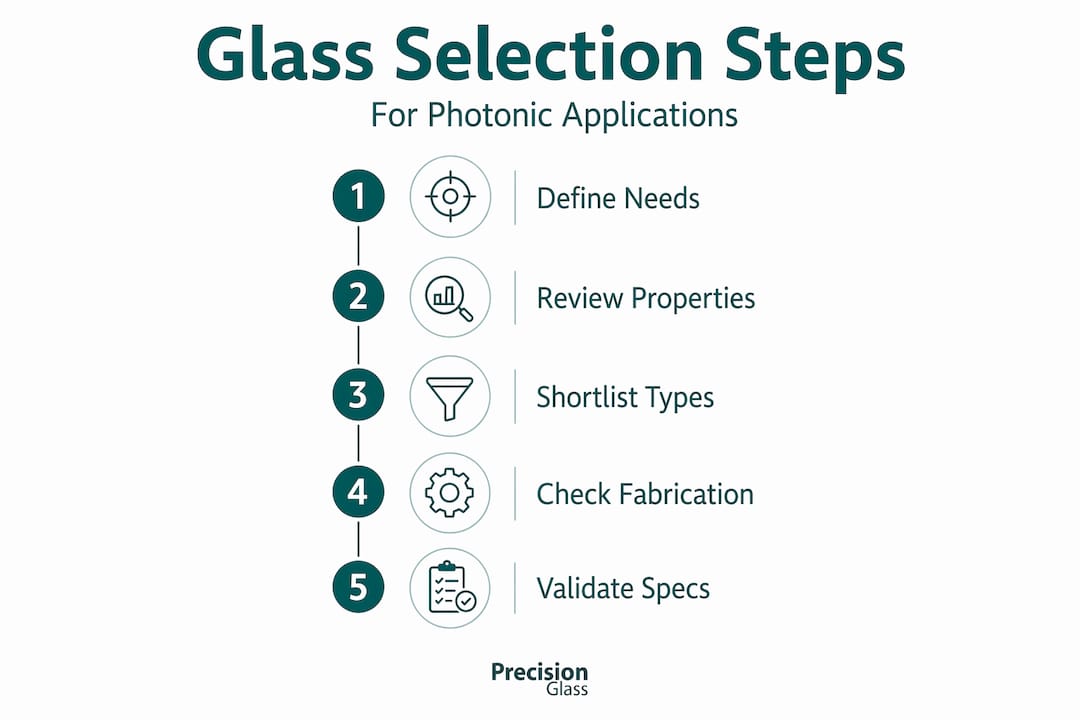
With glass types and fabrication methods clarified, the practical question becomes: how do you select the right specification for your application? The answer requires balancing several interdependent parameters, and the correct weighting of those parameters differs by sector.
As procurement case studies confirm, defence and aerospace teams typically prioritise mechanical durability, thermal stability, and broadband optical transmission. MgF2 domes for airborne optical systems and sapphire high-pressure windows represent the standard at the demanding end of this spectrum. These specifications are driven not by cost optimisation but by the requirement to maintain performance across pressure differentials, vibration loads, and thermal excursions that would destroy a standard optical glass component within hours.
In the medical device sector, the critical parameters shift substantially. Biocompatibility under repeated sterilisation, chemical resistance to biological reagents, and dimensional stability at the microfluidic scale govern material selection. Borosilicate and Borofloat glasses meet these requirements reliably, and their well-documented performance in biological environments reduces the regulatory validation burden for device manufacturers.
For glass in electronics procurement, the priorities are dimensional precision, ultra-low CTE, and surface flatness at the nanometre scale. AI chip manufacturers currently specify glass core substrates because the CTE of advanced glass compositions matches that of silicon far more closely than traditional organic laminate substrates. This CTE matching reduces thermally induced stress at the chip-to-substrate interface, directly improving device yield and long-term reliability.
Performance figures that procurement teams should track include optical loss, measured in dB per metre, surface roughness in Ra (nm), CTE in parts per million per degree Celsius (ppm/°C), and birefringence in nm/cm. Low-loss germano-silicate photonic integrated circuits have achieved 0.08 dB/m at 1064 nm, with quality factors reaching 463 million, setting a benchmark for what is achievable in waveguide applications.
Key factors to balance when specifying glass for photonics:
- Optical performance: Transmission range, refractive index, homogeneity, and birefringence
- Thermal performance: CTE match with adjacent materials, thermal conductivity, and operating temperature range
- Mechanical requirements: Hardness, flexural strength, and resistance to pressure or impact
- Chemical environment: Resistance to sterilisation agents, atmospheric conditions, and surface coatings compatibility
- Post-processing compatibility: Suitability for coating deposition, laser structuring, and bonding processes
- Supply chain realities: Availability in the required form factor, lead time, and qualification status
Working with an experienced glass manufacturing partner from the design stage ensures that specifications are achievable within budget and schedule, rather than discovered to be marginal during qualification testing.
Glass selection in photonics: what most procurement guides get wrong
Most procurement guides for photonic glass focus on material properties in isolation. They list transmission curves, CTE values, and hardness ratings, then recommend matching those figures to application requirements. That approach is necessary but not sufficient.
The error that repeatedly causes project failures is treating glass selection as a one-off decision rather than an iterative, system-level activity. Glass interacts with every downstream process: the coatings applied to it, the adhesives used to bond it, the thermal cycles it undergoes in service, and the mechanical loads it bears during integration. A glass that performs brilliantly in isolation can introduce catastrophic wavefront error when bonded into an athermal housing using an adhesive with an incompatible modulus. This is not a rare edge case. It is a routine failure mode that experienced fabricators encounter regularly.
The equally problematic counterpart is the cost-only procurement approach. As the evidence from specialist photonic material sourcing confirms, procurement teams that optimise purely on unit cost consistently encounter downstream costs that dwarf the initial saving. These include re-qualification testing when a lower-grade glass fails environmental screening, redesign costs when tolerances prove unachievable in cheaper compositions, and the reputational and contractual consequences of field failures in defence or medical systems.
What deep collaboration with a precision fabricator actually unlocks is specification rigour. When you engage a specialist partner early, you define not just the glass type but the full set of process-linked requirements: polishing sequence, inspection criteria, handling protocols, and packaging specifications. This approach to sourcing precision alternatives treats glass as the system-critical component it genuinely is, rather than a commodity line item purchased against the lowest quote.
Our position, developed through working with engineers across defence, medical, and electronics programmes, is straightforward. Glass deserves the same rigorous specification process as any other safety-critical or performance-critical component in your system. The cost of getting it right at specification is always lower than the cost of redesigning around a glass failure at qualification.
How specialist support can optimise your photonic glass solution
When your programme requires glass that performs consistently at the edge of what is physically achievable, the difference between a reliable supply partner and an off-the-shelf catalogue order is substantial.
At Precision Glasses, we design, fabricate, and supply custom glass components for defence, aerospace, medical, automotive, and electronics applications. Our technical glass range covers standard and highly specialised compositions, with meticulous quality assurance at every stage of the glass fabrication process. Whether you are specifying a sapphire window for an airborne sensor, a borosilicate microfluidic chip for a diagnostic platform, or a low-CTE glass substrate for AI photonic integration, our team works alongside your engineers to define and deliver the right solution. Download our advanced glass specification guide or contact us directly to discuss your programme requirements.
Frequently asked questions
What properties make glass suitable for photonics?
Glass offers high transparency and low loss across a wide spectral range, chemical and thermal stability, and a refractive index that can be tuned through composition, making it ideal for optical paths and photonic device integration.
Which glass type is best for aerospace photonic systems?
Sapphire and magnesium fluoride (MgF2) are the standard choices for aerospace, offering hardness, thermal stability, and broad optical transmission. MgF2 domes and sapphire windows are well-established in airborne optical system specifications.
How does fabrication impact glass performance in photonics?
Femtosecond laser etching and precision moulding achieve sub-micrometre surface quality and complex three-dimensional geometries, directly determining how closely delivered optical performance matches the design specification.
What are typical benchmarks for low-loss photonic glass?
Germano-silicate waveguides achieve 0.08 dB/m at 1064 nm with quality factors exceeding 400 million, whilst glass photonic crystals approach near-total reflectance, both representing current state-of-the-art performance benchmarks.
Why involve a specialist glass fabricator in photonic design?
A specialist fabricator aligns material selection with process capability from the outset, preventing the costly downstream failures that result from generic glass choices applied to precision photonic requirements.
Recommended
- The vital role of glass in advanced optical systems – Precision Glass
- Advanced glass specifications: Guide for engineers and buyers – Precision Glass
- Optical vs protective glass: key differences for industry – Precision Glass
- Glass in electronics: Performance, reliability and procurement insights – Precision Glass