
Sourcing precision glass components for aerospace, defence, and specialised industrial programmes is hampered when manufacturers either refuse non-standard materials or fail to support tight tolerances for custom geometries. Suppliers often obscure their actual process capabilities and will only disclose material or coating constraints after you have submitted full engineering drawings, leaving procurement teams in a bind. This comparison details five providers’ technical scope, compliance strengths, and project engagement practices so you can shortlist the manufacturer that best matches your sector requirements and in-house engineering demands.
Table of Contents
- Glassprecision
- Global Precision Optics
- E.R. Precision Optical
- Evaluating Top Precision Glass Component Manufacturers
Glassprecision

At a Glance
Glassprecision handles prototype work through high-volume runs using precision CNC machining, optical coatings, toughening and precision finishing for defence, aerospace, medical and automotive applications. The company emphasises traceable certification and project-level quality control rather than commodity glass supply.
Core Features
- Custom glass components manufacturing from drawings tailored to strict tolerances for optical and structural parts.
- Precision CNC machining and finishing that supports complex geometries and small apertures.
- Coated optical and protective glass products for specific spectral or abrasion needs.
- High-volume production capabilities alongside support for small-batch and prototype runs.
Key Differentiator
Glassprecision’s principal distinction is its certification-backed manufacturing for highly demanding sectors. That focus places quality control, traceability and sector-specific compliance at the centre of project delivery rather than treating certifications as an optional add on.
Pros
- Deep technical expertise in precision glass manufacturing helps teams translate mechanical drawings into producible parts without repeated redesign cycles.
- The ability to handle complex geometries reduces the number of suppliers you must coordinate when a part needs combined machining and finishing.
- Long-standing experience recognised in aerospace and defence offers familiar processes for procurement teams that must meet accreditation checks.
- Comprehensive quality assurance and certification processes make it simpler to archive inspection records for audits and acceptance testing.
- Flexible order quantities let R&D teams move from a single prototype to a verified production lot without switching vendors.
Cons
- Longer lead times are possible for highly specialised or complex projects, which can affect programme schedules if designs change late in development.
Who It’s For
Procurement managers, engineers and R&D teams at Defence, Aerospace, Medical and Automotive firms who need custom glass parts that must meet formal quality and certification requirements. Not aimed at buyers seeking off-the-shelf glazing or commodity glass panels.
Unique Value Proposition
In house capability for CNC machining, coatings and precision finishing means you manage one supplier rather than multiple specialists. According to the company, Glassprecision pairs those processes with decades of expertise and a production workflow geared to certification and repeatability.
Real World Use Case
An aerospace systems team submits a drawing for a ballistic optical window. Glassprecision fabricates prototype samples, applies a specified coating and delivers batch documentation for acceptance tests. The same supplier then scales to a production run with retained process records.
Pricing
Not applicable. The site is informational only and pricing is provided per project. Projects that require bespoke coatings, tight tolerances or certification traceability will be quoted as customised work rather than on a catalogue price list.
Website: https://glassprecision.com
Global Precision Optics
At a Glance
Global Precision Optics works with infrared substrates such as germanium and zinc selenide and can produce glass and plastic optics up to 14 inches in diameter, a capability some suppliers will not accept.
The company states it has more than 30 years of experience and advertises rapid prototyping, with most projects completed within 1–2 weeks; that timeframe appears repeatedly in their literature.
Core Features
- Custom fabrication of spherical lenses, windows, mirrors, wedges and domes for UV, visible and IR spectral bands.
- Wide material compatibility including fused silica, Zerodur, germanium, silicon and polymer substrates such as acrylic and polycarbonate.
- In-house substrate fabrication and coating services to deliver finished optics without multiple vendors.
Key Differentiator
GPO’s real speciality is working with unconventional and difficult materials and rescuing projects other suppliers reject. That focus makes it a narrower option than generalist manufacturers such as Glassprecision: choose GPO when material choice or unusual optical shapes are the primary constraint.
Pros
- Extensive material range allows designs that need IR substrates or polymer optics rather than standard visible glass, which reduces assembly risk when specific transmission properties are required.
- The in-house coating and substrate work mean fewer handoffs and easier control of surface quality and spectral performance for precision optical assemblies.
- The team’s experience with large diameters and complex shapes reduces iteration for prototypes and short production runs, saving engineering time on novel designs.
- Reputation for tackling rejected or difficult projects suggests a willingness to engineer bespoke fixtures and processes rather than forcing a stock solution.
Cons
- No online configuration or instant quotation tool is available; procurement will require direct technical discussion and drawings.
- The vendor does not publish pricing; budgets must be estimated via a formal RFQ and custom quote process.
- Lead times and costs for very large or exceptionally complex orders are not specified in public materials, so scheduling certainty may be limited until detailed scope is agreed.
When It May Not Fit
If you need off-the-shelf optics with published pricing and immediate procurement for small volumes, GPO’s custom development model is a poor match; it suits bespoke programmes with engineering buy‑in rather than quick commodity buys.
Who It’s For
Manufacturers, defence contractors and research laboratories requiring bespoke, high‑precision optical components in non‑standard materials or complex geometries. Ideal when optical material selection and custom coatings drive system performance.
Real World Use Case
GPO states it can take a defence imaging prototype through design, coating and production, scaling from a single prototype to production volumes the company advertises as up to 10,000 units; the end result is a single‑vendor optical assembly streamlining qualification.
Pricing
Pricing is not published; the vendor issues custom quotes based on material, tolerances and volume. Expect to submit drawings and specifications for a scoped estimate and to discuss tooling or coating needs directly with engineering.
Website: https://globalprecisionoptics.com
E.R. Precision Optical
At a Glance
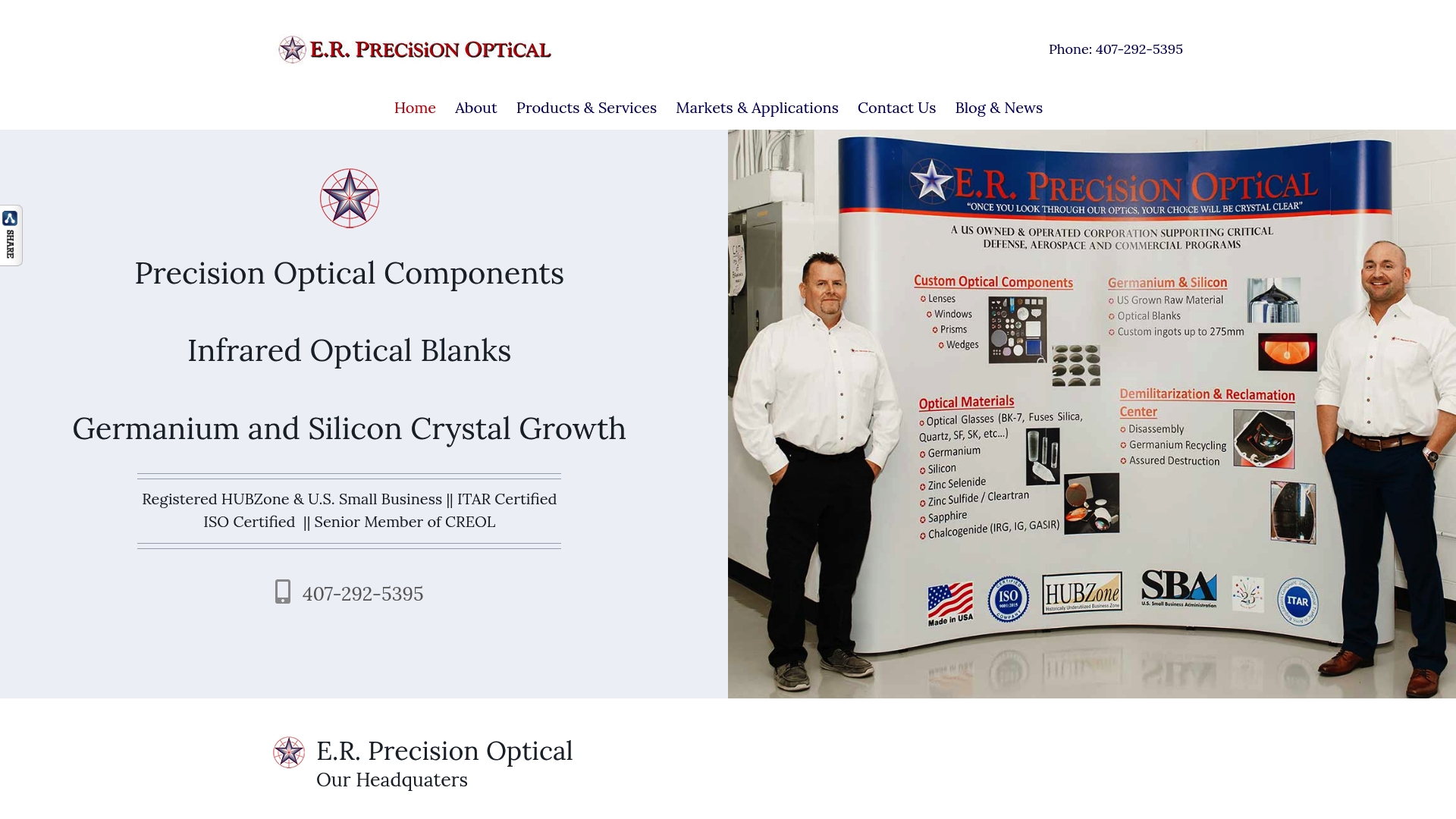
Recycling and demilitarisation of radioactive germanium coatings sits alongside crystal growth and precision optics at ERPOC, a HUBZone site in Apopka, Florida. The vendor advertises quick turnaround for US clients while holding formal registrations that matter in defence supply chains.
Core Features
Custom crystal growth for germanium and silicon is paired with fabrication of lenses, prisms, mirrors, filters, windows, and waveplates. ERPOC operates 5-axis CNC centres and in-line metrology for tight tolerances, plus assembly services that close the loop from blank to module.
The facility offers recycling and demilitarisation for hazardous optoelectronic components, a capability few small suppliers list on their service menu.
Key Differentiator
A US-based HUBZone manufacturer with integrated crystal growth, fabrication, assembly, and recycling capability is ERPOC’s defining angle. That vertical scope reduces handovers between suppliers and keeps sensitive, ITAR-controlled work physically inside a single, registered site.
Pros
- ISO 9001:2015 certified facility, which supports traceability and documented quality workflows for defence and aerospace contracts. This matters when procurement teams audit supplier controls.
- ITAR registered and HUBZone qualified, enabling bidders to present a domestic, compliant supplier for government solicitations.
- End-to-end capability from crystal pulling through to assembly reduces lead-time risk that arises when blanks and machining are split across vendors.
- Includes specialised services such as recycling and demilitarisation for hazardous germanium coatings, useful for equipment life‑cycle programmes.
Cons
- Public information on pricing and specific lead times is limited; you will need a bespoke quote and schedule to evaluate cost and delivery risks.
- There are no substantive third-party user reviews publicly available to corroborate performance or delivery consistency.
- The focus is narrowly industrial; ERPOC is unsuitable for consumer or low‑precision applications.
When It May Not Fit
If you require a single vendor to handle large scale optics production across multiple international sites, ERPOC’s US‑centric, HUBZone model will feel constrained. If your procurement demands published, line‑item pricing or short two‑week starts, the custom-quote approach and advertised turnaround windows may not match your timetable.
Who It’s For
Defence contractors, aerospace prime suppliers, semiconductor integrators, and research institutions that must source ITAR‑capable, traceable optical materials and components. Buy this when contract compliance and in-country processing outweigh commodity pricing pressure.
Real World Use Case
A defence systems integrator contracted ERPOC to supply infrared optical blanks and precision prisms for a targeting pod. ERPOC grew germanium boules, machined blanks to specification, performed final metrology, and handled the disposal of legacy germanium coatings under a demilitarisation remit.
Pricing
Pricing is not specified in public materials; ERPOC operates on a quote basis typical of custom manufacturing. Expect pricing to vary by material, crystal size, tolerance, and whether recycling or demilitarisation services are included.
Website: https://eroptics.com
Evaluating Top Precision Glass Component Manufacturers
In specialised fields requiring precision and quality, selecting the right manufacturer is crucial. Here, we compare three key players in the precision glass manufacturing sector: Glassprecision, Global Precision Optics (GPO), and E.R. Precision Optical (ERPOC).
High-Requirements Quality Control and Certification
Glassprecision distinctly excels in delivering certified, traceable components for high-standard applications. This feature appeals to aerospace and defence sectors where compliance and quality control are non-negotiable. On the other hand, while ERPOC’s HUBZone and ITAR compliance present a competing certification advantage, its scope may not cover as diverse operational sectors as Glassprecision does. GPO stands out when unconventional materials or extraordinary shapes are the focus, rather than stringent quality systems.
Material Specialisation and Handling Capabilities
For diverse or demanding material utilisation, GPO offers expertise, particularly with IR substrates and complex geometries. Their ability to process unconventional materials broadens design possibilities, albeit at the cost of needing detailed technical engagement upfront. ERPOC specialises uniquely in recycling and demilitarisation alongside their crystal growth and optical assembly services, adding value for sustainability-focused and mission-specific programmes.
Best Fit
- Glassprecision: If your priority is certification, traceability, and the capability to handle complex designs for critical industries, this is your go-to vendor.
- Global Precision Optics: The choice for projects requiring IR materials or distinctive optical technology that other suppliers might not accommodate.
- E.R. Precision Optical: Suited for enterprises prioritising domestic, ITAR-controlled production along with niche recycling and demilitarisation features.
Our Pick
Glassprecision is recommended for its broad yet deeply compliant production processes and certification assurance, vital for sectors like aerospace and defence. For users needing quick turnaround using specialist materials or domestic production, GPO and ERPOC respectively offer compelling alternatives. Thus, while Glassprecision aligns best with those looking for sector-specific quality and reliability, the choice ultimately depends on the unique requirements of the intended application.
Precision Glass Components Manufacturers Compared
Explore the highlighted attributes of providers in the precision glass manufacturing industry to select the option best suited to your project needs.
| Manufacturer | Core Feature | Key Differentiator | Best For | Pricing | Notable Limitation |
|---|---|---|---|---|---|
| Glassprecision | Custom CNC machining and coatings | Certification-backed manufacturing for quality | Defence, Aerospace, Medical and Automotive projects | Not disclosed | Potential longer lead times for highly complex projects |
| Global Precision Optics | Fabrication of unique optical geometries | Expertise in unconventional materials | Manufacturers with unique material or geometry needs | Not disclosed | No online configuration or instant quotation tool available |
| E.R. Precision Optical | Crystal growth and ITAR-certified fab | Integrated HUBZone-compliant facility for ITAR | Defence and Aerospace contracts needing traceability | Not disclosed | Limited information on pricing and specific lead times publicly available |
Discover Precision Glass Solutions Beyond glassmeadows.com Alternatives
When searching for reliable glass component manufacturers, challenges such as meeting strict quality certifications, managing complex geometries, and securing traceable production processes emerge as key concerns highlighted in the article on glassmeadows.com alternatives. Glassprecision addresses these pain points directly by offering custom precision glass components with a focus on aerospace, defence, medical, and automotive sectors where consistency and compliance are critical.
Explore how Glassprecision’s in-house CNC machining, optical coatings, and rigorous quality assurance simplify your supply chain and reduce redesign cycles. Visit https://glassprecision.com now to connect with a partner who understands your industry’s demanding standards and delivers certified, tailored glass components. Request a project consultation today and receive fabrication insights that will keep your schedules on track.
Frequently Asked Questions
How does Glassprecision ensure the quality of its glass components?
Glassprecision is focused on quality assurance and traceability in its manufacturing process. The company emphasises certification-backed manufacturing for highly demanding sectors, ensuring comprehensive quality assurance and easier archiving of inspection records for audits. For teams working in regulated industries, this means a reliable supplier that meets rigorous compliance standards.
What is the difference between Glassprecision and Global Precision Optics regarding material capabilities?
Global Precision Optics excels in custom fabrication of optical components using unconventional materials like germanium and zinc selenide. While Glassprecision provides high-precision glass components and certification for aerospace and defence applications, Global Precision Optics is best suited for projects where infrared substrates or non-standard materials are needed. Teams should choose based on their specific material requirements.
Can I use Glassprecision for small-batch production if I need precision optical components?
Yes, Glassprecision supports both high-volume production and small-batch runs without compromising on quality. The company’s flexible order quantities allow R&D teams to efficiently transition from a single prototype to a verified production lot. This flexibility is ideal for projects requiring both prototyping and production capabilities.
Does Glassprecision offer quicker turnaround times for prototypes compared to E.R. Precision Optical?
While E.R. Precision Optical advertises a quick turnaround for US clients, Glassprecision may experience longer lead times for highly specialised or complex projects. Therefore, if rapid prototype delivery is crucial for your schedule, it may be worth considering options like E.R. Precision Optical, especially for less complex designs.
What specific certifications does Glassprecision hold for compliance in manufacturing?
Glassprecision operates with traceable certification and project-level quality control tailored to sectors like defence, aerospace, and medical. This commitment to compliance means they ensure that all parts meet stringent quality standards required by procurement teams working in sensitive industries. Engaging with Glassprecision guarantees adherence to these essential standards.