

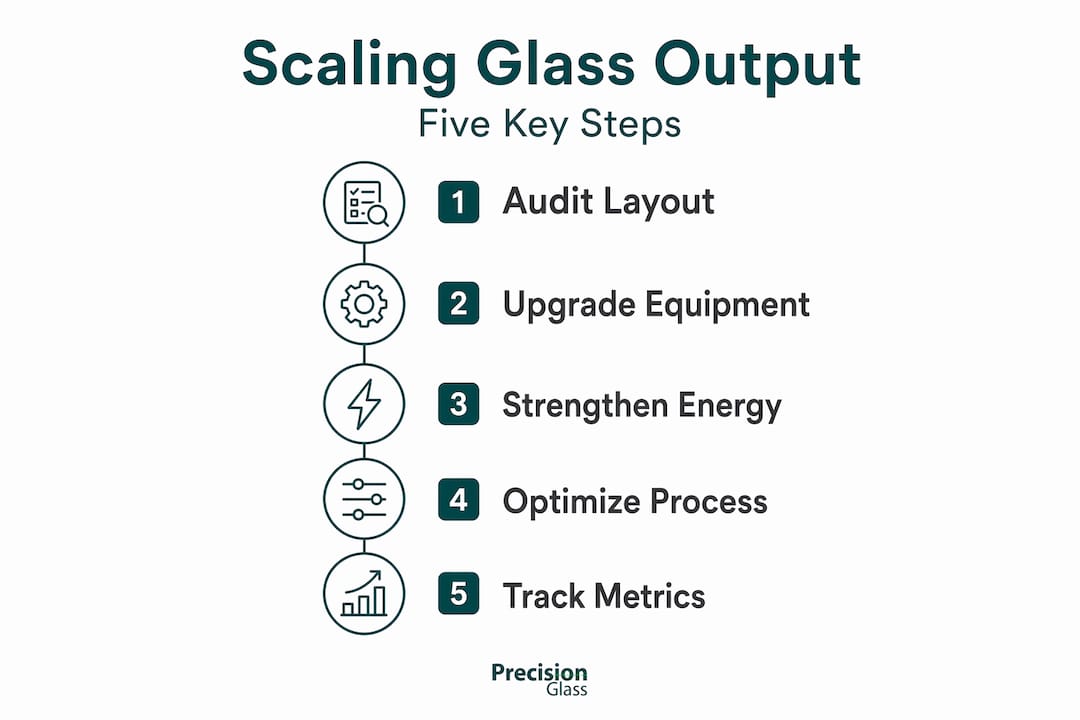
Scaling glass output is one of the most technically demanding challenges in manufacturing. Production managers who have successfully tackled how to achieve large-volume glass production, known in the industry as high-volume glass fabrication, understand that the obstacles go far beyond simply buying a larger furnace. Furnace capacity limits, inefficient plant layouts, inconsistent batch transitions, and energy infrastructure gaps collectively suppress throughput long before a single pane or container reaches inspection. This guide addresses each of those constraints with concrete strategies, recent case study data, and technology integrations that are already delivering results in working plants.
Table of Contents
- Key takeaways
- How to achieve large-volume glass production: foundational requirements
- Process optimisation and technology integration
- Troubleshooting common issues in large-scale manufacturing
- Measuring success and planning continuous improvement
- An engineer’s perspective on scaling glass production
- How Glassprecision supports industrial-scale glass manufacturing
- FAQ
Key takeaways
| Point | Details |
|---|---|
| Layout planning drives throughput | Applying SLP methodology can reduce operator travel distances by over 50%, directly increasing material flow efficiency. |
| End-to-end upgrades are non-negotiable | Scaling furnace capacity without upgrading batching, forming, and annealing lines rarely produces sustained output gains. |
| AI agents cut quality recovery time | Autonomous control agents reduce out-of-spec recovery from up to 20 minutes down to roughly 2 minutes, protecting throughput. |
| Hybrid energy systems enable scale and sustainability | Combining renewable electricity with biofuel allows plants to maintain very high volumes whilst reducing emissions. |
| Changeovers carry multi-day yield costs | Batch transitions must be planned as multi-day ramp-up events, not simple downtime windows, to protect effective yield. |
How to achieve large-volume glass production: foundational requirements
Before you can scale output, you need to audit three foundational pillars: plant layout, equipment capacity, and energy infrastructure. Skipping this audit and moving straight to procurement is the most common and costly mistake in industrial glass production processes.
Plant layout and material flow
The physical arrangement of your plant has a disproportionate influence on throughput, one that most production managers underestimate relative to equipment upgrades. Applying Systematic Layout Planning (SLP) combined with discrete-event simulation has been shown to reduce worker travel distances by over 52% and improve relative adjacency efficiency to 90%. In practical terms, that means less congestion, lower operator fatigue, and faster material movement between process stages.
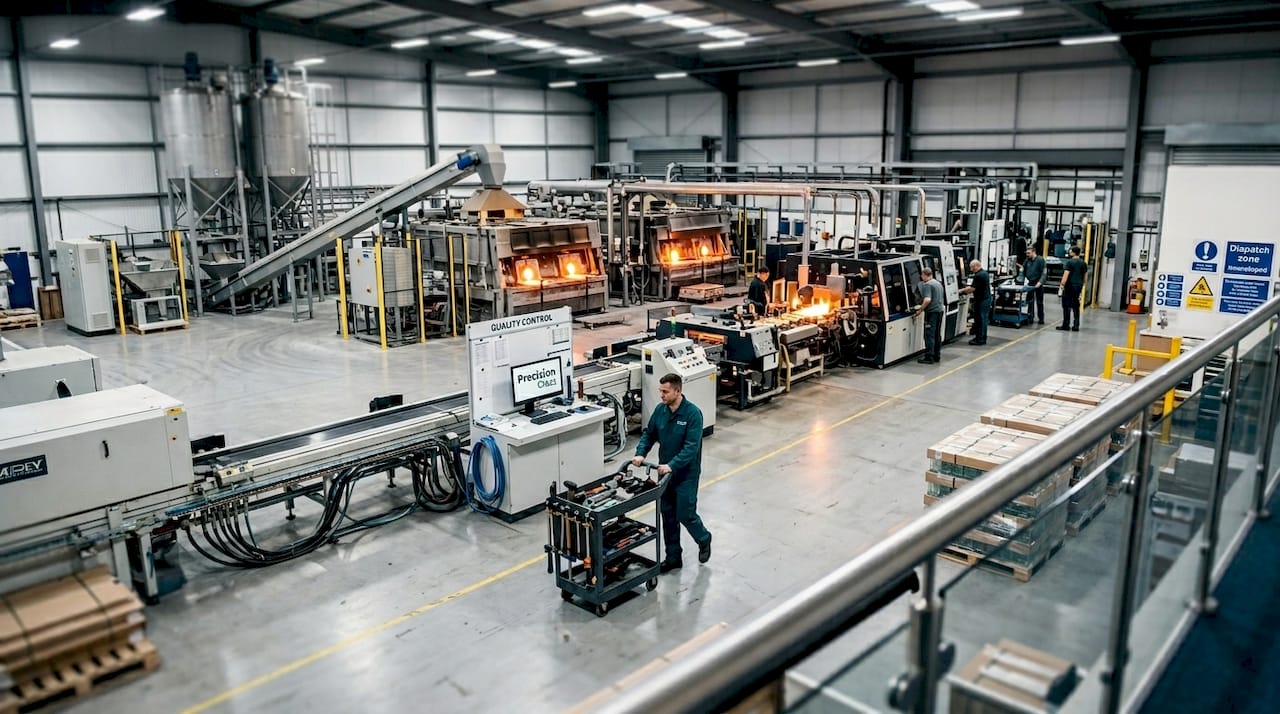
A well-executed layout planning approach maps the sequence of operations from raw material intake through to inspection, then positions equipment to minimise backtracking and cross-traffic. The goal is a logical, uninterrupted flow from batching to melting to forming to annealing.
Pro Tip: Run a discrete-event simulation of your current layout before committing to any equipment investment. The simulation will reveal congestion points and bottlenecks that would otherwise only surface after capital has already been spent.
Equipment capacity: the full-line view
Furnace upgrades are the headline investment, but they are only one component of a functioning high-volume system. The Stoelzle Glass USA Monaca project illustrates this clearly. Their $100 million upgrade increased melting capacity to 400 tons per day with an 80% larger furnace, but the project also included complete upgrades to the batching house, delivery systems, forming machines, annealing lehrs, and inspection lines. Plants that upgrade furnace capacity alone without addressing the downstream process stages consistently fail to translate that investment into sustained throughput gains.
The prerequisite checklist for a full-capacity upgrade looks like this:
- Furnace size and pull rate increase to match target daily volume
- Batching house capacity and automation to feed the increased melt rate
- Forming machine speed and configuration aligned to new throughput targets
- Annealing lehr length and temperature profiling matched to forming output
- Inline inspection systems rated for the higher line speed
Energy infrastructure
Continuous glass furnace operation runs 24 hours a day, 7 days a week, because shutdowns for short periods are impractical when furnaces hold hundreds of tonnes of molten glass. That reality places enormous, unrelenting demands on your energy supply. Before scaling, you must confirm that your electrical, gas, and thermal infrastructure can sustain that load without interruption.
| Energy system | Advantage | Constraint |
|---|---|---|
| Natural gas (conventional) | Proven reliability, lower capital cost | Higher emissions, price volatility |
| Full electrification | Zero direct emissions | Pull-rate limits, cullet restrictions |
| Hydrogen blending | Flexibility with lower emissions | Higher system complexity and cost |
| Hybrid (electric + biofuel) | Decarbonisation with operational flexibility | Requires dedicated oxygen production |
Verallia’s Zaragoza plant demonstrates what hybrid infrastructure looks like at scale: a furnace combining 70% renewable electricity with 30% biofuel to produce 1.3 million containers per day across multiple colour lines. The site required dedicated electrical and oxygen infrastructure to make it function reliably at that volume.
Process optimisation and technology integration
With the foundational infrastructure in place, the focus shifts to executing high-volume output consistently. The following steps address the primary process levers available to production engineers.
Upgrade forming machines and annealing lehrs together. Forming speed and annealing capacity must be matched. Increasing gob delivery rate without extending lehr dwell time or improving temperature uniformity causes thermal stress defects that add to cullet rates and undermine the efficiency gains you were targeting.
Deploy autonomous control agents on forming lines. Reinforcement-learning agents trained on operator expertise can reduce out-of-spec recovery time from 20 minutes to 2 minutes. That single improvement can add hours of effective production time per shift. The agents monitor multidimensional forming parameters simultaneously, making corrections at a speed and consistency that manual intervention cannot match. For more on how digital controls affect quality and throughput stability, the principles apply equally across container and flat glass lines.
Integrate real-time data monitoring across all process stages. Sensors on the furnace, forehearths, forming machines, and lehrs feed a central monitoring dashboard. When you can see pull rate, glass temperature, and forming pressure on a single screen, process engineers can identify developing instabilities before they cause significant yield losses.
Plan changeovers as multi-day production events. Batch transitions in large-scale manufacturing are not simple product switches. Changeover times of 4 to 8 hours are common, and yield depressions lasting several days follow each transition. Campaign planning, where you run long, uninterrupted production runs of a single product before switching, is the standard approach for minimising this cost. Schedule changeovers to align with planned maintenance windows wherever possible.
Use production line automation components to reduce operator dependency on repetitive tasks. Automated gob weight control, servo-driven IS machine adjustments, and automated palletising all free skilled operators to focus on process monitoring rather than routine physical tasks. Reviewing top automation components used by high-volume manufacturers can help you prioritise which integrations will deliver the fastest return.
Pro Tip: When commissioning autonomous forming agents, run them in shadow mode alongside manual operators for two to four weeks before handover. This allows the system to build an accurate baseline of your specific glass composition and forming conditions before it takes control.
Troubleshooting common issues in large-scale manufacturing
Even well-prepared plants encounter operational problems when output volumes increase. Recognising these issues early is what separates a managed slowdown from a prolonged production crisis.
Furnace pull rate limitations. When demand exceeds furnace capacity, the temptation is to push melt rate beyond design limits. Doing so degrades glass quality, increases seed and stone defect rates, and shortens furnace campaign life. The correct response is to review your demand forecast, adjust campaign scheduling, and plan a furnace upgrade rather than compromising melt quality.
Inefficient material flow causing congestion. As output volume rises, the same plant layout that functioned adequately at lower throughput begins to create bottlenecks. Pallets stack in aisles, forklift routes cross, and operators spend more time travelling than working. Revisiting the SLP analysis at each significant production increase milestone is good practice.
Energy supply constraints. Electrification of glass furnaces faces real physical limits. Electrification is constrained by pull-rate limits and cullet restrictions, meaning that plants pursuing rapid decarbonisation must plan the energy transition carefully to avoid compromising melt stability. Hydrogen blending and hybrid systems add flexibility but require specialist engineering and infrastructure investment to implement safely.
Process instability during changeovers. The extended yield impact of product changeovers is frequently underestimated. Production managers who budget only for the direct downtime of a changeover are consistently surprised by the multi-day recovery period that follows. Building that recovery time into production forecasts, and using AI-assisted controls to accelerate the re-stabilisation process, are the two most effective mitigation strategies.
Measuring success and planning continuous improvement
Implementing changes without measuring their impact is a common failure mode in scaling projects. These are the performance indicators that matter most in mass production of glass environments.
| Metric | Baseline target | Optimised target |
|---|---|---|
| Operator travel distance per shift | Existing benchmark | Reduction of 50% or more |
| Out-of-spec recovery time | 15 to 20 minutes | Under 3 minutes |
| Effective throughput (tons/day) | Pre-upgrade figure | 25%+ improvement |
| Changeover yield loss | Untracked | Quantified and forecast |
| Energy intensity (GJ/tonne) | Pre-upgrade figure | Reduction of 20%+ |
Beyond tracking these numbers, simulation tools play a central role in continuous improvement. Discrete-event simulation models allow process engineers to test layout changes, campaign schedules, and equipment configurations virtually before committing to physical changes. That capability is particularly valuable when planning the next round of capacity upgrades in a plant that cannot afford extended downtime.
Sustainable practices should be built into the long-term improvement roadmap rather than treated as a separate compliance exercise. The Verallia Zaragoza example shows that hybrid furnace technology can deliver both high volume and meaningful emissions reduction simultaneously. Planning your energy infrastructure with that dual objective in mind now will reduce the cost of compliance with future environmental regulations.
An engineer’s perspective on scaling glass production
What I find consistently underappreciated in large-volume scaling projects is how much plant layout influences final throughput. In my experience working across industrial glass production environments, engineers spend months debating furnace specifications and almost no time on flow path analysis. The data is unambiguous: a 52% reduction in travel distances translates directly to less congestion and faster cycle times. That is not a secondary benefit. It is a primary throughput lever.
The autonomous agent deployments I have observed on forming lines have been the most convincing technology integration I have seen in recent years. Watching a system correct a weight deviation and restore forming stability in under two minutes, when the same correction would take an experienced operator 15 to 20 minutes, changes how you think about glass fabrication precision. The consistency alone justifies the implementation cost.
My one caution is on decarbonisation targets. There is real pressure to electrify rapidly, and I understand the regulatory and reputational drivers. But the physical constraints on furnace electrification are genuine. Pushing electrification faster than your infrastructure and cullet supply can support will compromise melt quality and pull rates. Hybrid systems, as Verallia has demonstrated, are currently the more pragmatic path to aligning scale with sustainability.
— Alexandra
How Glassprecision supports industrial-scale glass manufacturing
For production managers and engineers working on scaling projects, having a manufacturing partner with deep technical expertise makes a measurable difference.
Glassprecision specialises in precision-engineered glass solutions for demanding sectors including defence, aerospace, medical devices, automotive, and electronics. Whether you need custom technical glass products designed to exact specifications or guidance on component design that will perform reliably at scale, Glassprecision brings the technical knowledge and production discipline your project requires. Explore the full range of Glassprecision’s capabilities and contact the team to discuss how they can support your high-volume manufacturing goals.
FAQ
What is the first step in scaling glass production capacity?
Conduct a full plant layout audit using Systematic Layout Planning before committing to equipment purchases. Layout inefficiencies are the most common hidden bottleneck in high-volume glass fabrication environments.
How long does a product changeover take in large-scale glass manufacturing?
Direct changeover time typically runs 4 to 8 hours, but the associated yield depression can last several days as the furnace and forming line restabilise. Campaign planning minimises this impact.
Can autonomous AI agents improve quality in high-volume glass production?
Yes. Reinforcement-learning agents deployed on forming lines have reduced out-of-spec recovery times from up to 20 minutes down to approximately 2 minutes, significantly improving effective uptime and consistency.
What energy systems best support large-volume glass production?
Hybrid systems combining renewable electricity with biofuel or hydrogen currently offer the best balance of high-volume output, operational reliability, and emissions reduction, as demonstrated by Verallia’s Zaragoza plant.
Why is end-to-end line upgrading necessary when scaling furnace capacity?
Increasing furnace pull rate without simultaneously upgrading the batching house, forming machines, annealing lehrs, and inspection systems creates downstream bottlenecks that prevent the furnace investment from translating into actual throughput gains.