

Glass composition, defined as the specific chemical compounds and processing additives that determine physical performance, is the single most critical variable in any precision glass specification. The materials in glass determine thermal behaviour, mechanical strength, chemical durability, and optical clarity. For engineers working across aerospace, defence, medical devices, and electronics, understanding glass composition is not background knowledge. It is a design constraint. This guide covers the major raw materials, common glass types, key manufacturing processes, and specialised formulations used in high-performance applications.
1. What are the major raw materials used in glass production?
Soda-lime glass composition typically contains 70–74% silica by weight. Silica sand (SiO₂) forms the structural backbone of the glass network, creating a disordered lattice of SiO₄ tetrahedra. Without silica, no stable glass network forms.
Soda ash (sodium carbonate, Na₂CO₃) acts as a flux, lowering the melting point and making the melt workable. Limestone (calcium carbonate, CaCO₃) stabilises the network and improves chemical durability. Without limestone, soda-lime glass would dissolve slowly in water.
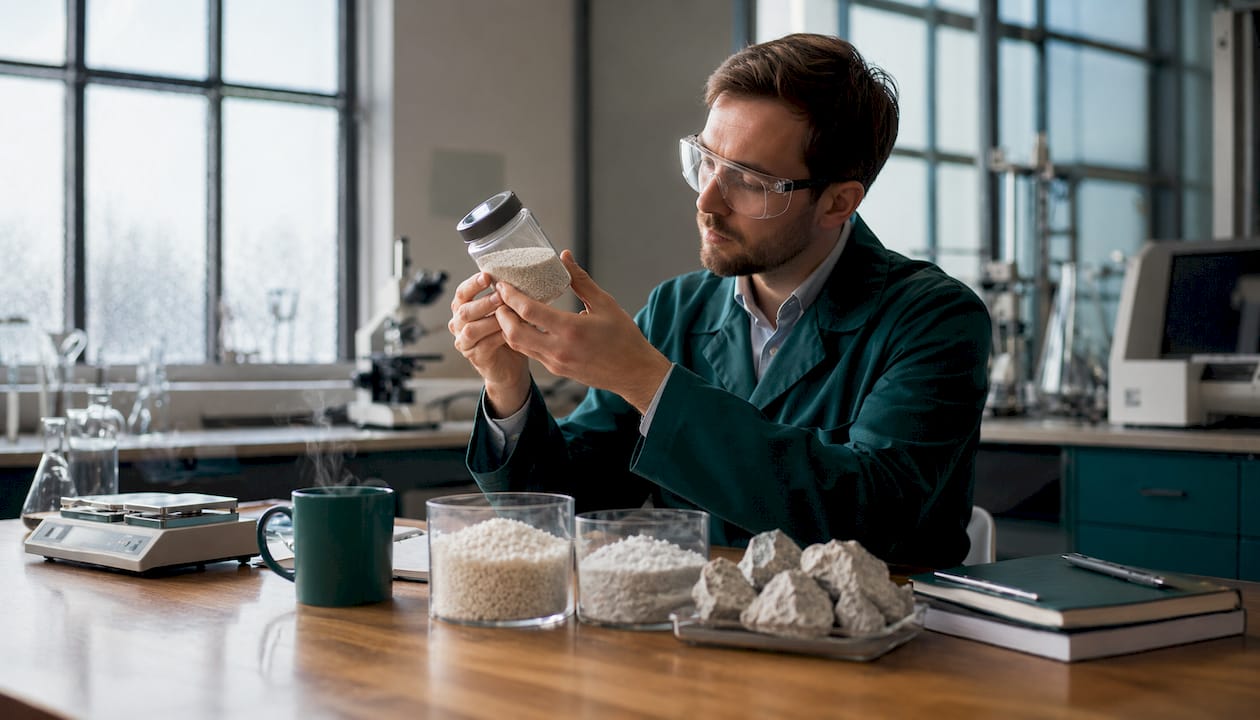
Minor additives include magnesium oxide, which tightens the glass network and reduces susceptibility to devitrification, and aluminium oxide, which increases network connectivity and chemical resistance. Particle size distribution of raw material batches critically influences reaction kinetics during melting. Poor control results in defects and inconsistent glass quality.
Industrial melting temperatures range between 1,500°C and 1,700°C, with melting stages lasting 24–48 hours. That duration reflects the time required for complete dissolution of silica grains and homogenisation of the melt.
- Silica sand (SiO₂): primary network former, 70–74% by weight in standard formulations
- Soda ash (Na₂CO₃): flux reducing melting temperature
- Limestone (CaCO₃): stabiliser improving chemical durability
- Magnesium oxide (MgO): reduces devitrification risk
- Aluminium oxide (Al₂O₃): enhances network connectivity and durability
| Raw material | Primary function | Typical content |
|---|---|---|
| Silica sand | Network former | 70–74% |
| Soda ash | Flux | 12–16% |
| Limestone | Stabiliser | 8–12% |
| Aluminium oxide | Durability enhancer | 0–3% |
| Magnesium oxide | Devitrification control | 0–4% |
Pro Tip: Specify raw material purity and particle size distribution in your procurement documents. Batch inconsistency at this stage propagates through the entire melt and cannot be corrected downstream.
2. Which types of glass materials are used in technology and aerospace?
The four glass families most relevant to high-tech and aerospace applications each offer a distinct balance of properties. Selecting the wrong type at the design stage creates failures that no post-processing step can remedy.
Soda-lime-silicate glass is the most widely produced glass type. Its density is approximately 2.52 g/cm³ and its thermal expansion coefficient sits around 9 ppm/K. It suits applications where cost and workability matter more than extreme thermal or chemical performance, such as automotive dashboards and display covers.
Borosilicate glass incorporates boron trioxide (B₂O₃), which dramatically reduces thermal expansion. This makes it resistant to thermal shock, a property critical in laboratory instruments, lighting components, and aerospace sensor housings. Borosilicate is the standard choice when components face rapid temperature cycling.
Aluminosilicate glass replaces much of the boron with aluminium oxide. The result is higher chemical durability and greater mechanical strength than borosilicate, at the cost of higher processing temperatures. It is the preferred substrate for chemically strengthened cover glass in electronics and for high-temperature aerospace glazing.
Fused quartz (also called quartz glass) is produced from pure silica with no network modifiers. Its density is 2.203 g/cm³ and its thermal expansion coefficient is just 0.55 ppm/K. That near-zero expansion makes it indispensable in semiconductor fabrication, precision optics, and high-temperature aerospace components.
| Glass type | Density (g/cm³) | Thermal expansion (ppm/K) | Key strength |
|---|---|---|---|
| Soda-lime-silicate | 2.52 | ~9 | Cost, workability |
| Borosilicate | ~2.23 | ~3.3 | Thermal shock resistance |
| Aluminosilicate | ~2.53 | ~4–6 | Chemical durability, strength |
| Fused quartz | 2.203 | 0.55 | Purity, heat resistance |
The atomic-level structure of glass directly governs how each type behaves under thermal and mechanical load. Engineers who treat glass type selection as a procurement afterthought routinely encounter avoidable field failures.
3. How do manufacturing processes and additives influence glass properties?
Glass composition sets the ceiling for performance. Manufacturing processes determine how close the finished component gets to that ceiling.
Annealing is the controlled slow cooling of glass through its transition temperature range. Precise annealing controls residual stresses, which directly influences structural reliability. A poorly annealed component carries internal tension that reduces effective strength and can cause spontaneous fracture under service loads.
Tempering involves reheating annealed glass and then quenching it rapidly with air. Tempered glass is approximately four times stronger than annealed glass. The rapid cooling creates a surface compression layer that must be overcome before tensile failure can initiate. When tempered glass does break, it shatters into small blunt fragments rather than sharp shards.
Chemical strengthening uses an ion-exchange process, typically immersing glass in a potassium salt bath. Larger potassium ions replace smaller sodium ions at the surface, creating a compressive stress layer without the thickness limitations of thermal tempering. This method suits thin glass components in electronics and medical devices.
- Specify annealing rate and temperature range in fabrication drawings, not just final dimensions.
- Choose tempering for structural glazing and safety applications where fragment behaviour matters.
- Choose chemical strengthening for thin substrates below 2 mm where thermal tempering is impractical.
- Audit fining agent residues. Sodium sulfate assists bubble removal but improper management causes chemical instability or surface haze on precision components.
- Confirm that aluminium oxide content is specified for components requiring long-term chemical resistance.
Glass strength is statistical, influenced by surface flaws and residual stresses. Engineers must apply fracture probability models rather than single fixed strength values when designing safety-critical components.
Pro Tip: For defence and aerospace components, request annealing records as part of the quality documentation package. Annealing temperature logs are the fastest way to identify the root cause of premature field failures.
4. What are specialised glass materials used in medical and defence applications?
Medical and defence applications demand glass formulations that go well beyond standard soda-lime compositions. The performance requirements in these sectors are non-negotiable.
Medical glass must combine chemical durability with biocompatibility and the ability to withstand repeated sterilisation cycles. Borosilicate glass meets pharmaceutical container standards precisely because its low alkali content prevents leaching into drug formulations. Aluminosilicate compositions offer additional durability for surgical instruments and implantable optical components. Aluminium oxide incorporation enhances chemical durability, which is critical for components exposed to aggressive sterilisation agents.
Lead-free optical glass has replaced traditional lead crystal in precision optical systems. Barium oxide and zinc oxide serve as high-refractive-index modifiers without the toxicity and regulatory burden of lead. These alternatives deliver the optical density required for lenses and prisms in medical imaging and defence optics.
Laminated and bulletproof glass combines multiple glass plies with polymer interlayers, typically polyvinyl butyral (PVB) or polycarbonate. The polymer absorbs energy on impact and prevents fragment ejection. Defence vehicles and security glazing rely on this construction to meet ballistic resistance standards.
- Borosilicate for pharmaceuticals: low alkali leaching, autoclave-compatible
- Aluminosilicate for surgical tools: high strength, chemical resistance
- Barium oxide and zinc oxide optics: lead-free, high refractive index
- Laminated constructions: multi-ply glass with PVB or polycarbonate for ballistic resistance
- Precision optical glass: controlled refractive index and Abbe number for imaging systems
Annealed glass compressive strength reaches 700–900 MPa. That figure represents the upper bound under ideal conditions. Residual stresses from poor processing reduce effective strength well below this range, which is why managing stress states is non-negotiable in critical environments.
5. Which mixed materials and minor compounds enhance industrial glass?
Minor constituents in glass formulations often deliver disproportionate performance gains. The difference between a standard industrial component and a high-reliability one frequently comes down to a 1–3% compositional adjustment.
Magnesium oxide tightens the glass network and reduces the tendency for devitrification during slow cooling. This matters in thick glass sections where cooling rates are inherently uneven. MgO also improves chemical durability without significantly raising the melting temperature.
Aluminium oxide reduces non-bridging oxygens in the silicate network. Non-bridging oxygens are the weak points where chemical attack initiates. By replacing them with bridging bonds, Al₂O₃ raises both chemical durability and viscosity at high temperatures, which supports forming precision shapes.
Colouring agents such as chromium oxide (green), cobalt oxide (blue), and iron oxide (amber or green) are incorporated at concentrations below 1% by weight. Each agent integrates into the glass network differently. Chromium substitutes into octahedral sites, while cobalt occupies tetrahedral positions. These structural differences affect not just colour but also UV absorption and thermal properties.
Fining agents beyond sodium sulfate include arsenic trioxide and antimony oxide for high-purity optical glass. These agents release oxygen at high temperatures, promoting bubble coalescence and rise. Their use requires careful management because residues affect surface chemistry and long-term stability.
The trade-off between workability and durability is real. Higher alumina content improves durability but raises viscosity, demanding higher furnace temperatures and more energy. Every compositional decision carries a cost implication alongside the performance benefit.
Environmental considerations now influence raw material sourcing. Arsenic and antimony-based fining agents face regulatory pressure in several markets. Sulphate-based alternatives are gaining ground, though they require tighter process control to avoid the surface haze issues noted earlier.
Key takeaways
Glass composition and manufacturing process together determine every performance outcome, making material specification the most consequential decision in any precision glass component design.
| Point | Details |
|---|---|
| Silica is the foundation | SiO₂ forms 70–74% of standard glass and defines the network structure. |
| Glass type drives thermal performance | Fused quartz at 0.55 ppm/K thermal expansion outperforms soda-lime glass at 9 ppm/K for aerospace use. |
| Tempering multiplies strength | Tempered glass is approximately four times stronger than annealed glass through surface compression. |
| Strength is probabilistic | Design safety-critical components using fracture probability models, not single fixed strength values. |
| Minor additives matter | Aluminium oxide at 1–3% significantly improves chemical durability and network connectivity. |
Why glass material selection is harder than most engineers expect
The most common mistake I see in glass specification is treating composition as a commodity decision. Engineers specify dimensions, tolerances, and surface finish with great care, then accept whatever glass type the fabricator offers as standard stock. That approach fails in demanding applications.
The probabilistic nature of glass strength is the insight that changes how you design. A compressive strength of 700–900 MPa sounds reassuring. But tensile strength varies with surface condition, residual stress, and flaw distribution. Two components from the same batch can fail at very different loads. The only responsible approach is to design using fracture probability models and to specify annealing quality as a contractual requirement, not an assumption.
Fining agent management is another area where I have seen otherwise well-specified components fail qualification. Sodium sulfate residues on precision optical surfaces cause haze that no polishing step can fully remove. The fix is upstream process control, not downstream remediation.
My practical advice: treat the glass composition guide as a living document in your project. Update it as you learn more about the service environment. The engineers who get this right are the ones who ask their fabricator for material certificates, annealing records, and compositional analysis before the first prototype is approved.
— Alexandra
Precision Glasses: tailored glass solutions for critical industries

Precision Glasses works with engineers and product developers across aerospace, defence, medical devices, automotive, and electronics to specify and fabricate glass components that meet exact performance requirements. From technical glass fabrication to precision optical components, the team brings material expertise and process discipline to every project. Whether you need borosilicate for thermal shock resistance, aluminosilicate for chemical durability, or fused quartz for high-purity optical applications, Precision Glasses provides the glass fabrication processes and quality documentation your application demands. Explore the full range of sectors and capabilities at glassprecision.com.
FAQ
What are the primary materials in glass?
The primary materials in glass are silica sand (SiO₂), soda ash (Na₂CO₃), and limestone (CaCO₃). Silica forms 70–74% of standard soda-lime glass by weight and acts as the structural network former.
What is the difference between borosilicate and soda-lime glass?
Borosilicate glass contains boron trioxide, which reduces thermal expansion to approximately 3.3 ppm/K compared to 9 ppm/K for soda-lime glass. This makes borosilicate the preferred choice for applications involving rapid temperature changes.
Why is glass strength described as statistical?
Glass strength varies with surface flaws, residual stresses, and stress state rather than following a fixed value. Engineers designing safety-critical components must use fracture probability models to account for this variability.
How does aluminium oxide improve glass durability?
Aluminium oxide reduces non-bridging oxygens in the glass network, replacing weak points with bridging bonds. This increases both chemical durability and resistance to environmental attack, which is critical for medical and high-tech applications.
What is the role of annealing in glass manufacturing?
Annealing is the controlled slow cooling of glass through its transition temperature range to relieve residual stresses. Precise annealing is essential for structural reliability, particularly in components used in defence, aerospace, and medical environments.