

A single delayed shipment of borosilicate glass can halt an aerospace assembly line for weeks. In healthcare, a substandard optical component can compromise diagnostic accuracy. These are not hypothetical risks. Procurement managers in regulated, high-stakes sectors face supply chain fragility every day, and the consequences of poor sourcing decisions are measured in production downtime, compliance failures, and lost contracts. Traditional supplier management, built on static approved-vendor lists and reactive auditing, simply cannot keep pace with today’s volatile materials market. This guide presents a structured, actionable framework to help you tighten your glass sourcing strategy, from initial specification through to ongoing performance monitoring.
Table of Contents
- Assessing your organisation’s glass sourcing needs
- Building a robust supplier pipeline
- Ensuring quality: Closing the loop on defects, contamination, and compliance
- Verifying results: Monitoring, adapting, and future-proofing your sourcing strategy
- Our expert view: Beyond the checklist—what delivers lasting results in glass sourcing
- Streamline your next glass procurement with our solutions
- Frequently asked questions
Key Takeaways
| Point | Details |
|---|---|
| Know your specs | Define quality, certification, and recycled content requirements clearly for best results. |
| Diversify suppliers | Build a wider, geographically spread approved supplier list to manage risk. |
| Enforce strict audits | Vet for contamination, quality, and regulatory compliance to avoid costly mistakes. |
| Use data-driven tools | Leverage AI and analytics for better sourcing decisions and to stay ahead of changes. |
| Monitor continuously | Regularly review supplier performance and adapt your pipeline to ensure long-term success. |
Assessing your organisation’s glass sourcing needs
Now that you understand the risks of an unreliable supply chain, let’s start by establishing exactly what your organisation needs. Clarity at this stage prevents costly misalignments later.
Different sectors demand fundamentally different glass types. Aerospace and defence applications typically require borosilicate glass for its thermal stability, or sapphire glass for extreme hardness and scratch resistance. Medical device manufacturers often specify chemically strengthened glass with tightly controlled surface flatness. Electronics and optical sectors may require specialty forms such as float glass with ultra-low iron content. Understanding which technical glass types your application demands is the non-negotiable starting point.
Certification requirements are equally critical. For aerospace, AS9100 is the baseline standard. Medical applications require ISO 13485 compliance, with CE marking for European markets and ASTM standards for dimensional and chemical properties. These are not bureaucratic formalities. They represent verified process controls that directly affect product safety and regulatory approval.
When specifying measurable requirements, focus on the following:
- Refractive index tolerance: For optical components, suppliers must maintain tolerances of ±0.0001 refractive index, which requires AS9100 certification and demonstrated expertise in materials like borosilicate and sapphire.
- Surface flatness and roughness: Expressed in nanometres or fringe values depending on application.
- Chemical purity: Specified as parts per million for contaminants such as iron, sodium, and potassium.
- Dimensional tolerances: Typically ±0.01 mm or tighter for precision-cut components.
Sustainability criteria are increasingly part of procurement mandates. Specifying a minimum cullet (recycled glass) percentage in raw material inputs is now standard practice in progressive procurement programmes.
| Specification | Aerospace | Medical | Optical |
|---|---|---|---|
| Primary material | Borosilicate, sapphire | Chemically strengthened | Low-iron float, fused silica |
| Key certification | AS9100 | ISO 13485, CE | ISO 10110 |
| Tolerance level | ±0.01 mm | ±0.05 mm | ±0.0001 RI |
| Sustainability input | Cullet where permitted | Cullet where permitted | Low-energy melt preferred |
Pro Tip: Build your specification document before approaching any supplier. A precise technical brief eliminates ambiguity and accelerates the qualification process significantly.
Building a robust supplier pipeline
With requirements in hand, the next step is to develop a supplier pipeline built for reliability and flexibility.
Geographical and technical diversity in your supplier base is not a luxury. It is a risk management necessity. When a single-source supplier faces production disruption, whether from logistics delays, raw material shortages, or regulatory issues, your entire production schedule is exposed. Diversifying across regions and technical capabilities means you retain options when conditions shift.
Practical steps to build a resilient pipeline include:
- Map your current exposure. Identify which materials are single-sourced and which suppliers represent more than 40% of your volume for any one material.
- Double your qualified supplier count for critical materials. Aim for at least two fully audited and approved suppliers per specification.
- Conduct structured supplier audits. Assess contamination control protocols, certification validity, production capacity, and lead time reliability.
- Evaluate technical capability alignment. A supplier certified for standard float glass may not have the CNC grinding or polishing capability your application requires.
- Formalise qualification documentation. Approved Supplier Lists should include audit dates, certification expiry, and performance scores.
The comparison between manual and AI-driven sourcing is stark. Manual processes rely on relationship networks and periodic reviews, which creates blind spots. AI-driven sourcing tools and diversified supplier networks measurably mitigate supply chain volatility, particularly for critical materials in high-precision sectors.
| Approach | Speed | Transparency | Risk detection | Cost |
|---|---|---|---|---|
| Manual sourcing | Slow | Low | Reactive | Low upfront |
| AI-driven sourcing | Fast | High | Predictive | Higher upfront |
Our supplier qualification services are designed to support procurement teams navigating exactly this process, from initial technical assessment through to full approval documentation.
Pro Tip: Maintain a minimum of two approved suppliers per critical material at all times. If one supplier fails an audit or faces capacity constraints, you need a qualified alternative ready to activate immediately.
Ensuring quality: Closing the loop on defects, contamination, and compliance
Having established a diverse supplier network, your next challenge is ensuring consistent quality.

Contamination is the single greatest quality risk in glass sourcing. Non-ferrous metal contamination must remain below 20 ppm to meet quality and regulatory standards, and using high-quality cullet can reduce energy use by 20 to 30% and cut emissions by up to 600 tonnes of CO2 per 1,000 tonnes of cullet processed. The sustainability case is compelling, but only when contamination is rigorously controlled.
Key tools and practices for quality control include:
- Optical sorters to identify and remove discoloured or contaminated glass fragments before processing.
- Metal detectors and X-ray systems to screen for ferrous and non-ferrous inclusions.
- Incoming inspection protocols with defined acceptance criteria for each specification.
- Supplier audit schedules that include unannounced visits to verify process consistency.
- Closed-loop recycling programmes that track cullet provenance and contamination history.
The case for closed-loop recycling deserves particular attention. When your organisation returns post-production glass waste to a certified supplier for reprocessing, you gain traceability over the recycled input, which reduces contamination risk compared to open-market cullet sourcing.
“Even trace levels of alkali contamination can trigger devitrification in precision glass, causing catastrophic structural defects that are invisible until the component fails under load.” This is not a theoretical concern. Qualifying suppliers via audits for contamination and compliance, including ISO, CE, and ASTM standards, is essential, and avoiding alkali traces is a non-negotiable requirement for high-precision applications.
Review your full product range requirements against these contamination thresholds and build them explicitly into your supplier contracts and incoming inspection criteria. Vague quality clauses are unenforceable. Specific numerical limits are not.
Verifying results: Monitoring, adapting, and future-proofing your sourcing strategy
Quality is only as good as your ongoing oversight. Here is how to keep your process future-proof.
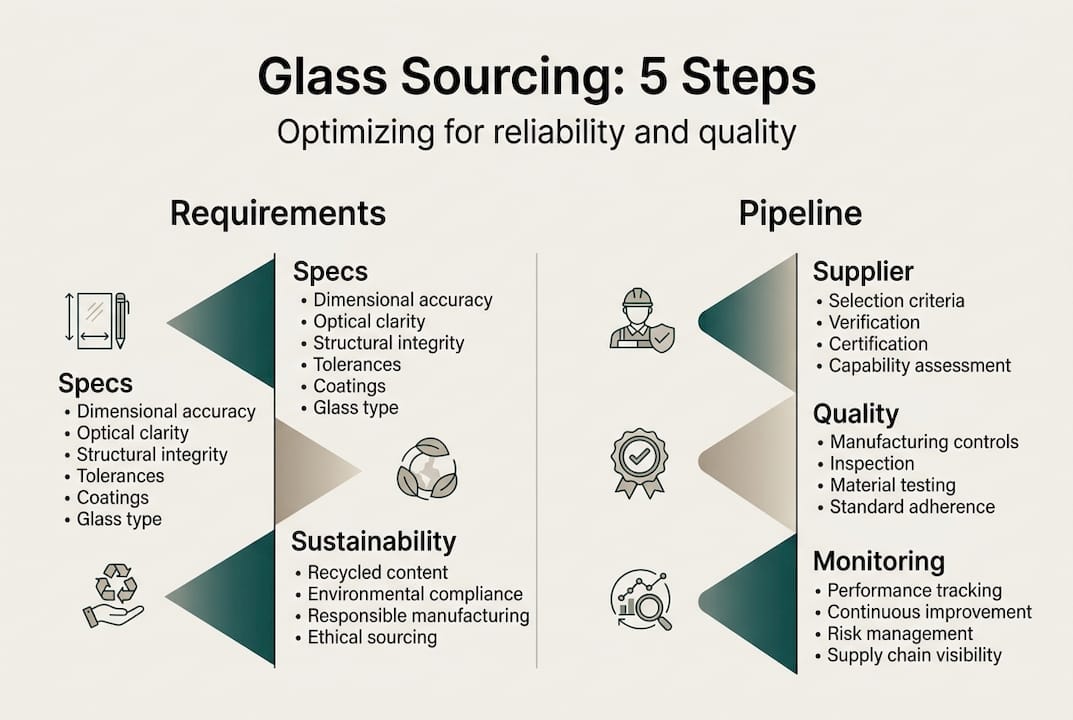
Performance monitoring must be systematic, not episodic. Waiting for a defect to surface on the production line is far too late. Establish incoming quality metrics that are tracked per delivery, per supplier, and per material specification. Key performance indicators should include rejection rate, on-time delivery, certification compliance, and response time to non-conformance reports.
A structured continuous improvement checklist keeps your sourcing programme disciplined:
- Review supplier scorecards quarterly. Compare performance across all approved suppliers for each material category.
- Set trigger thresholds for renegotiation. If a supplier’s rejection rate exceeds 1.5% over two consecutive quarters, initiate a formal review.
- Monitor market signals. Raw material price indices, geopolitical developments, and energy cost fluctuations all affect glass supply reliability.
- Leverage AI analytics for predictive insight. Strategic sourcing via AI and expanded pipelines directly counters volatility, outperforming traditional manual approaches in both speed and accuracy.
- Conduct annual full-pipeline reviews. Reassess whether your approved supplier list still reflects the best available options technically, commercially, and geographically.
Adapting your strategy proactively, rather than reactively, is what separates high-performing procurement functions from those that manage crises. The industry-specific glass needs of aerospace, defence, and healthcare are evolving. Your sourcing strategy must evolve with them.
Pro Tip: Set calendar reminders for certification expiry dates across all approved suppliers. An expired AS9100 or ISO certificate discovered mid-project can trigger a compliance hold that delays your entire programme.
Our expert view: Beyond the checklist—what delivers lasting results in glass sourcing
Checklists and audit frameworks are valuable. We use them ourselves. But in our experience working with procurement teams across defence, aerospace, and medical sectors, the organisations that consistently achieve the best sourcing outcomes do something that no checklist can capture: they build genuine technical partnerships with their suppliers.
A certified supplier is not automatically a reliable one. Certification confirms that a quality management system exists. It does not confirm that the system is applied rigorously to your specific specification, your tolerances, or your contamination thresholds. We have seen defect-free qualification batches followed by production runs with persistent non-conformances, because the dialogue stopped after approval.
The most effective procurement managers we work with treat supplier relationships as ongoing technical collaborations. They share production forecasts, flag specification changes early, and visit facilities regularly. They challenge suppliers on process improvements and expect to be challenged in return.
Market dynamics in 2026 are shifting quickly. Energy costs, raw material availability, and regulatory requirements are all in flux. Agility matters. Explore our expert consultancy for complex sourcing to understand how a collaborative, technically grounded approach can deliver results that static processes simply cannot.
Streamline your next glass procurement with our solutions
If you are ready to put these principles into action, our team can help streamline your process.
At Glass Precision, we support procurement managers in regulated, high-precision sectors with tailored solutions that go beyond standard supply. From technical glass sourcing for aerospace and defence to optical glass components for medical and scientific applications, our manufacturing capability is built around your specification, not the other way around.

Our bespoke sourcing support includes consultation, sample provision, and full qualification documentation to accelerate your approval process. Whether you are qualifying a new supplier, managing a complex specification, or reviewing your sourcing strategy, we are ready to work with you directly. Contact our team to request samples or schedule a technical consultation at your convenience.
Frequently asked questions
What certifications should glass suppliers have for aerospace or medical applications?
Suppliers should hold AS9100 for aerospace and ISO 13485 or CE certification for medical glass, with demonstrated tolerances of ±0.0001 refractive index for high-precision applications. Certification alone is not sufficient; verified process capability for your specific material is equally important.
How does using recycled glass (cullet) impact quality and sustainability?
High-quality cullet reduces energy use by 20 to 30% and cuts CO2 emissions by up to 600 tonnes per 1,000 tonnes processed, but contamination must remain below 20 ppm non-ferrous metals to avoid manufacturing defects. Traceability of cullet provenance is essential for precision applications.
What are the main advantages of AI-driven supplier selection?
AI sourcing tools identify high-performing suppliers, predict supply chain disruptions, and build resilience against market volatility far more effectively than manual processes. They also provide greater transparency across the supplier pipeline, which supports compliance documentation.
What contamination levels are acceptable in high-precision glass sourcing?
Non-ferrous metal contamination must remain below 20 ppm to meet quality and regulatory standards in high-precision glass manufacturing. Even trace alkali contamination can trigger devitrification and cause structural failure in finished components.



One Response
https://shorturl.fm/aCRls