

Sapphire glass is defined as a synthetic single crystal of pure aluminium oxide (Al₂O₃), grown under controlled conditions to produce a material with exceptional hardness and optical clarity. It is not conventional glass at all. Technically, it is a monocrystalline technical ceramic that scores 9 on the Mohs hardness scale, second only to diamond. That single property explains why aerospace engineers, watchmakers, and medical device manufacturers all reach for it when performance cannot be compromised. Understanding what sapphire glass is, how it is made, and where it performs best gives you a clear framework for evaluating it against other transparent materials.
What is sapphire glass and how does it differ from regular glass?
Sapphire glass is a synthetic aluminium oxide crystal with a Mohs hardness of 9, placing it far above standard soda-lime glass (Mohs 5–6) and mineral glass (Mohs 7). That gap is not trivial. A material at Mohs 9 resists scratching from almost every substance encountered in daily or industrial use, including steel, sand, and most ceramics.
The term “sapphire glass” is widely used in consumer and industrial contexts, but the accurate industry term is synthetic sapphire or sapphire crystal. It shares its chemical composition with the gemstone sapphire found in nature, but the synthetic version is grown deliberately for technical applications rather than mined. Colour, inclusions, and impurities are eliminated during production, yielding a material far more consistent than anything found in the ground.
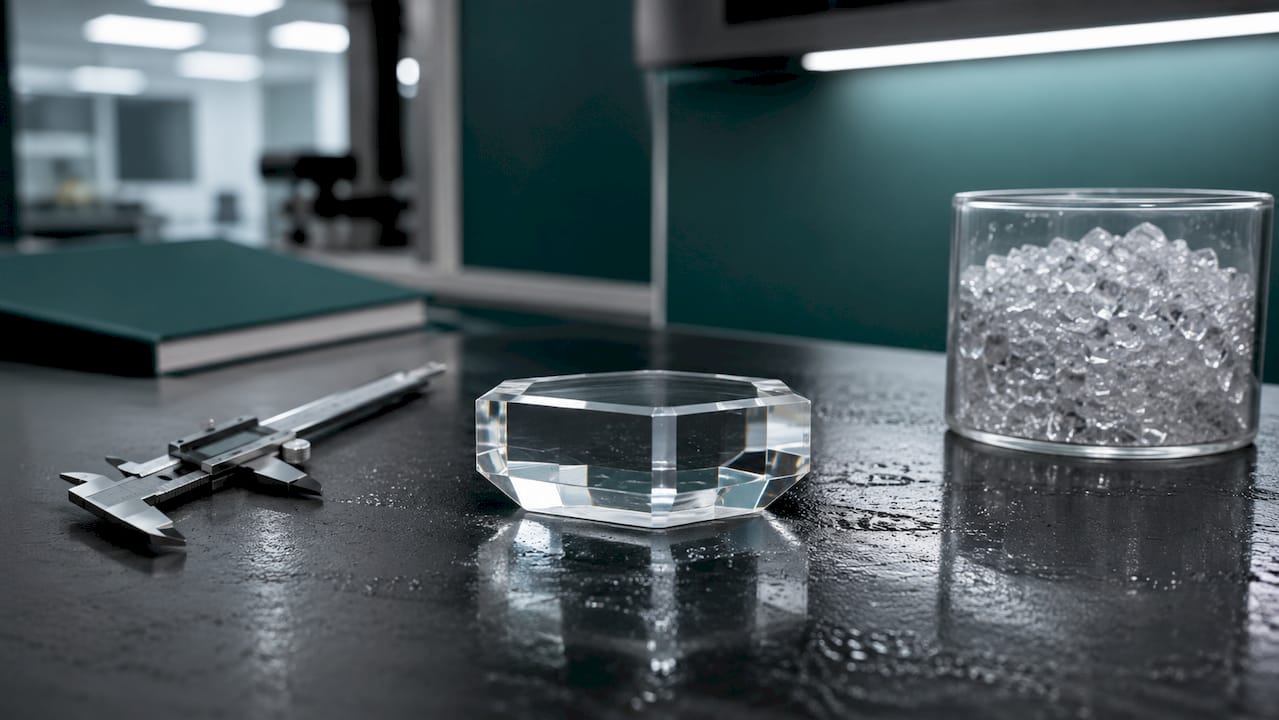
Regular glass is an amorphous solid. Sapphire is a crystalline solid. That structural difference governs everything from how each material fractures to how it transmits light. Engineers selecting materials for high-precision optical components must understand this distinction before specifying either material.
How is sapphire glass made?
Synthetic sapphire production involves growing a single crystal of aluminium oxide from a molten or vapour state. The process is slow, controlled, and fundamentally different from melting sand to make conventional glass. Four main crystal growth methods are used commercially:
- Verneuil process — The oldest method, developed in the early 20th century. Aluminium oxide powder is melted in a flame and dripped onto a seed crystal, building up a boule over several hours. It is the lowest-cost method but produces crystals with more internal stress.
- Czochralski process — A seed crystal is dipped into molten aluminium oxide and slowly pulled upward while rotating. This produces large, high-quality boules used in semiconductor and optical applications.
- Edge-defined film-fed growth (EFG) — Molten aluminium oxide is drawn through a shaped die, allowing near-net-shape production of sheets, tubes, and rods. This reduces the amount of grinding and polishing required afterwards.
- Heat exchanger method (HEM) — Aluminium oxide is melted in a crucible and cooled from the bottom up via a heat exchanger. HEM produces very large, low-defect crystals suited to demanding optical and defence applications.
Each method trades off crystal size, defect density, production speed, and cost. Synthetic sapphire production costs 3–10 times more than standard tempered glass and takes days rather than hours. That cost premium reflects the energy required to reach aluminium oxide’s melting point of approximately 2,030–2,050°C and the precision needed to grow a defect-free crystal.
Pro Tip: When specifying sapphire for a project, ask your supplier which growth method was used. EFG-grown material suits flat windows and covers; HEM-grown material is preferred where optical homogeneity across a large aperture is critical.
The finished boule or sheet is then sliced, ground, and polished to the required dimensions and surface finish. CNC machining and lapping bring surfaces to optical flatness. The result is a component that looks like glass but behaves like a ceramic.
What are the key properties of sapphire glass?
Sapphire’s properties set it apart from every other transparent material used in engineering. The combination of hardness, thermal stability, and optical transmission is unique.
Mechanical properties
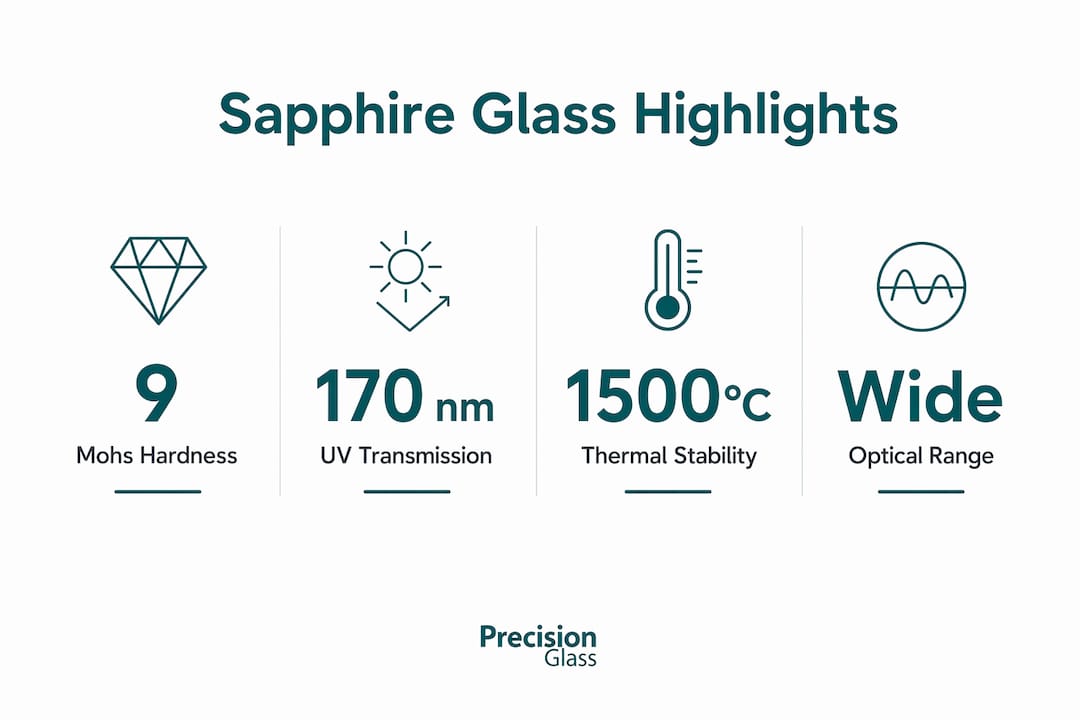
Sapphire’s Mohs hardness of 9 means it resists surface scratching from virtually all common abrasives. This is the property most cited in consumer contexts, but it matters equally in industrial settings where optical windows are exposed to particulate contamination, cleaning agents, or mechanical contact. Sapphire is very hard but brittle. It resists scratching but can crack or shatter under sharp impact, particularly when force is applied to an edge or corner. This brittleness is the primary mechanical trade-off engineers must account for in component design.
Thermal and chemical properties
Sapphire withstands operating temperatures up to 1,500°C and pressures up to 2,000 bar. No conventional glass comes close to either figure. Sapphire is also chemically inert to most acids, alkalis, and solvents, making it suitable for harsh chemical environments where standard optical glass would degrade.
Optical properties
| Property | Sapphire value |
|---|---|
| Refractive index | ~1.77 |
| UV transmission | From ~170 nm |
| Infrared transmission | To ~5.5 µm |
| Operating temperature | Up to 1,500°C |
Sapphire transmits light from the ultraviolet through to the mid-infrared, a range no single conventional glass covers. That broad transmission spectrum makes it the material of choice for spectroscopy, laser optics, and sensor windows. The refractive index of approximately 1.77 is higher than standard glass (~1.52), which increases surface reflectivity. Anti-reflective (AR) coatings applied by physical vapour deposition address this, but those coatings are softer than the sapphire itself and become the component’s most vulnerable surface.
Pro Tip: If scratch resistance is the primary reason you are specifying sapphire, think carefully before adding an AR coating. The coating will scratch before the sapphire does. For applications where both low reflectivity and scratch resistance are needed, discuss coating hardness specifications with your supplier.
What are the advantages and limitations of sapphire glass?
Sapphire offers a clear performance advantage over mineral glass and tempered glass in several categories, but it is not the right choice for every application. A balanced assessment matters for sound material selection.
Advantages
- Scratch resistance. Sapphire’s Mohs 9 hardness means everyday abrasives cannot mark its surface. Long-term optical clarity is preserved without the micro-abrasions that haze mineral glass over time. This is why premium watchmakers specify sapphire crystals as standard.
- Thermal stability. The ability to operate at 1,500°C and 2,000 bar opens applications that no glass can serve.
- Broad optical transmission. UV to mid-infrared transmission in a single material simplifies optical system design.
- Chemical inertness. Sapphire survives exposure to aggressive chemicals that would etch or dissolve conventional glass.
Limitations
- Brittleness. High hardness and low toughness are linked in ceramics. Sapphire fractures under sharp impact rather than deforming. Component geometry must account for this.
- Cost. Production is 3–10 times more expensive than tempered glass. For high-volume consumer applications, this cost is often prohibitive.
- High reflectivity. The refractive index of ~1.77 requires AR coatings for most optical uses, adding cost and a potential failure point.
- Weight. Sapphire is denser than most glass types, which matters in weight-sensitive aerospace and wearable applications.
Consumer preferences and cost mean sapphire has not displaced strengthened glass in mass-market smartphones, despite its superior hardness. The brittleness risk and unit cost make strengthened glass a more practical choice for devices designed to survive drops. Sapphire wins where scratch resistance and environmental durability outweigh cost and impact risk. Reviewing glass selection criteria for industry helps clarify when that trade-off favours sapphire.
Where is sapphire glass used across industries?
Sapphire’s combination of hardness, thermal stability, and optical transmission makes it valuable across a wide range of sectors. Its applications span from consumer products to some of the most demanding environments in engineering.
Watchmaking
The watch industry is the largest consumer of sapphire crystal by volume. Luxury and mid-range watches use sapphire as the cover glass because it maintains optical clarity free from micro-abrasions caused by everyday wear. Mineral glass hazes over years of use; sapphire does not. This is the clearest demonstration of sapphire’s long-term value over lower-cost alternatives.
Consumer electronics
Premium smartphones use sapphire for camera lens covers, where the lens sits flush with the device body and contacts surfaces constantly. A scratched camera lens degrades image quality permanently. Sapphire prevents that degradation without requiring a protective case over the lens.
Aerospace and defence
Sapphire windows serve as sensor covers, missile dome windows, and high-pressure optical cells in aerospace and defence systems. The ability to withstand extreme temperatures and pressures while maintaining optical transmission is irreplaceable in these roles. No polymer or conventional glass survives the combined thermal, pressure, and abrasive environment of a hypersonic sensor window. Precision Glasses supplies sapphire and technical glass components to aerospace and defence sectors where these specifications are non-negotiable.
Semiconductor manufacturing
Sapphire wafers serve as substrates for growing gallium nitride (GaN) LEDs and other compound semiconductors. The crystal structure and thermal properties of sapphire make it an ideal base for epitaxial growth processes that require a stable, flat, chemically inert surface at elevated temperatures.
Medical devices
Sapphire is used in surgical instrument windows, endoscope optics, and laser delivery components. Its chemical inertness allows sterilisation with aggressive agents, and its scratch resistance maintains optical performance through repeated cleaning cycles. Emerging applications in implantable sensors and diagnostic equipment are expanding sapphire’s role in medical technology.
| Industry | Primary sapphire application |
|---|---|
| Watchmaking | Crystal cover glass |
| Consumer electronics | Camera lens covers |
| Aerospace and defence | Sensor windows, dome optics |
| Semiconductor | LED substrate wafers |
| Medical devices | Endoscope optics, surgical windows |
For engineers evaluating material options across these sectors, the range of engineered glass types available for high-precision applications provides useful context alongside sapphire.
Key takeaways
Sapphire glass is a synthetic monocrystalline ceramic with Mohs hardness 9, broad optical transmission, and thermal stability to 1,500°C, making it the preferred material where scratch resistance and environmental durability are non-negotiable.
| Point | Details |
|---|---|
| Material classification | Sapphire is a monocrystalline ceramic, not glass; its crystalline structure governs its mechanical and optical behaviour. |
| Hardness advantage | A Mohs rating of 9 gives sapphire scratch resistance far beyond mineral or tempered glass. |
| Manufacturing cost | Production costs 3–10 times more than tempered glass due to slow crystal growth at temperatures above 2,000°C. |
| Key limitation | High hardness comes with brittleness; sapphire resists scratching but can fracture under sharp impact. |
| Broadest use case | Aerospace, defence, medical, and watchmaking sectors rely on sapphire where long-term optical clarity and environmental resistance are required. |
Why sapphire glass deserves more credit than it gets
Alexandra’s perspective
The conversation about sapphire glass tends to collapse into two camps: watch enthusiasts who treat it as a luxury signal, and smartphone reviewers who dismissed it after a few high-profile brittleness incidents. Neither view captures the material accurately.
What I find genuinely underappreciated is sapphire’s thermal and pressure performance. The ability to maintain optical clarity at 1,500°C and 2,000 bar is not a marginal improvement over conventional glass. It is a different category of capability entirely. Engineers working on hypersonic sensors or high-pressure chemical reactors are not choosing between sapphire and tempered glass on cost grounds. They are choosing sapphire because nothing else works.
The brittleness concern is real but manageable. Successful sapphire component design accounts for edge geometry, mounting stress, and impact load paths from the outset. The failures that make headlines almost always trace back to designs that treated sapphire as a drop-in replacement for glass rather than as a distinct material with its own mechanical behaviour.
The AR coating question is where I see the most avoidable mistakes. Specifying sapphire for scratch resistance and then applying a soft AR coating negates the primary advantage. If your application needs both low reflectivity and surface durability, that tension needs to be resolved at the design stage, not patched with a coating after the fact.
Manufacturing costs will fall as EFG and HEM processes mature and production volumes increase. When that happens, sapphire will move into applications currently served by strengthened glass, particularly in medical and industrial sensing. The material’s performance ceiling is far higher than its current market share suggests.
— Alexandra
Precision Glasses: sapphire and technical glass for demanding applications

Precision Glasses designs, fabricates, and supplies custom sapphire and technical glass components for industries where standard materials are not sufficient. Our capabilities cover the full production process, from crystal selection and CNC machining through to polishing, coating, and quality assurance. We serve aerospace, defence, medical device, semiconductor, and electronics clients who require components built to exact specifications with consistent, documented quality.
If your application demands the hardness, thermal stability, or optical transmission that only sapphire delivers, we can help you specify and produce the right component. Explore our precision glass solutions or review our technical glass capabilities to understand how we approach demanding material requirements. Contact us to discuss your project.
FAQ
What is sapphire glass made from?
Sapphire glass is made from pure aluminium oxide (Al₂O₃) grown as a synthetic single crystal. It is not conventional glass but a monocrystalline ceramic produced through controlled crystal growth processes such as Czochralski or EFG.
Is sapphire glass scratch resistant?
Sapphire glass is highly scratch resistant, rating 9 on the Mohs hardness scale. Only diamond and a small number of other materials can scratch it, making it one of the most durable transparent materials available.
What is the difference between sapphire glass and mineral glass?
Mineral glass rates approximately 7 on the Mohs scale and scratches over time with everyday use. Sapphire rates 9 and maintains optical clarity far longer, but it is more brittle and significantly more expensive to produce.
Why is sapphire glass used in aerospace applications?
Sapphire withstands temperatures up to 1,500°C and pressures up to 2,000 bar while maintaining optical transmission from ultraviolet to mid-infrared wavelengths. No conventional glass matches that combination of thermal, pressure, and optical performance.
Does sapphire glass break easily?
Sapphire resists scratching but is brittle under sharp impact. It can crack or shatter if struck at an edge or corner, which is why component design must account for impact load paths and mounting stress from the outset.