

The assumption that glass is fragile and unsuitable for demanding military applications is one of the most persistent misconceptions in procurement circles. Understanding why glass for the defence industry matters requires looking beyond window panes and recognising glass as an engineered material. From armoured vehicle optics to blast-resistant command centre glazing, glass underpins a remarkable range of defence systems. This guide sets out the material science, certification standards, and procurement considerations that defence professionals need to make confident, well-informed decisions about glass selection.
Table of Contents
- Key takeaways
- Why glass for the defence industry is a materials question
- Ballistic and protective glass for defence
- Optical glass in surveillance and targeting systems
- Procurement considerations for defence glass
- My perspective on glass innovation in defence
- How Glassprecision supports defence glass requirements
- FAQ
Key takeaways
| Point | Details |
|---|---|
| Glass is structurally suited to defence | Advanced glass types offer optical clarity, thermal stability, and mechanical durability exceeding many alternative materials. |
| Composites cut weight without losing protection | Glass-polymer laminates can reduce thickness and weight significantly while meeting EN 1063 no-spall certification standards. |
| Certification must match threat modelling | UL 752 and EN 1063 certifications address specific threats; procurement teams must align glass specification to the actual risk profile. |
| Optical materials vary by spectral need | Sapphire, germanium, and chalcogenide glass each serve different spectral bands, with distinct trade-offs in weight and temperature tolerance. |
| Coatings extend operational service life | Anti-reflective and diamond-like carbon coatings maintain optical quality and surface integrity across thermal cycling and abrasive field conditions. |
Why glass for the defence industry is a materials question
The question of why glass matters in defence begins with material properties, not tradition. Glass offers a combination of characteristics that few other materials can match across both optical and structural applications. Procurement officers who treat glass as a commodity risk specifying the wrong type entirely.
The key physical and optical properties that make glass suited to defence applications include:
- Optical clarity and spectral transmission. Defence imaging materials must retain optical alignment under mechanical shock, vibration, and temperature extremes. Many optical glasses transmit across visible, near-infrared, and mid-infrared bands, making them indispensable for sensor systems.
- Mechanical hardness. Sapphire, rated 9 on the Mohs scale, transmits from UV to mid-IR and withstands temperatures up to 1,000°C, making it the material of choice for missile nose domes and vehicle periscopes exposed to abrasive conditions.
- Thermal stability. Borosilicate glass maintains dimensional and optical stability across wide temperature ranges, resisting thermal shock that would fracture standard soda-lime glass.
- Lightweight strength. Modern glass compositions and composites offer structural performance at lower mass than steel or ceramic alternatives, a genuine advantage in airborne and vehicle-mounted systems.
- Chemical inertness. Glass does not corrode, degrade with most chemical agents, or absorb moisture in the same way polymers do, supporting long operational service lives.
The specialist glass types used across defence programmes include borosilicate for structural and optical windows, sapphire for hardened protective and imaging applications, chalcogenide glass for long-wave infrared transmission, and germanium for thermal imaging in ground and airborne platforms.
Pro Tip: When evaluating glass material selection for a new programme, map the spectral requirements of each subsystem first. A single glass type rarely serves every role within one platform.
Ballistic and protective glass for defence
Protective glazing for armoured vehicles, command posts, and installations is where the role of glass in defence tech becomes most visible to the public, yet it remains one of the least understood areas in procurement.

Modern bullet-resistant glazing is not a single pane of thick glass. It is a precisely engineered laminate. A typical assembly combines multiple glass layers with polymer interlayers, most commonly polycarbonate, bonded under heat and pressure. Glass-polymer composites reduce thickness and weight by up to 50% compared to traditional monolithic laminates while meeting EN 1063 no-spall standards. Spall resistance matters enormously in occupied spaces: a glazing panel that stops a round but sends glass fragments inward has failed its protective purpose.
The comparison between legacy and modern ballistic glass assemblies is instructive:
| Feature | Traditional laminated glass | Modern glass-polymer composite |
|---|---|---|
| Weight | High | Reduced by up to 50% |
| Thickness | 40mm or more for higher threat levels | Significantly thinner for equivalent protection |
| Spall resistance | Variable | EN 1063 no-spall achievable |
| Thermal insulation | Moderate | Improved |
| Retrofit suitability | Limited | Higher compatibility with existing frames |
Polycarbonate layers absorb and dissipate impact energy in ways laminated glass alone cannot, allowing thinner, lighter panels that still meet UL 752 certification requirements. UL 752 is the primary North American standard for ballistic performance, structured in tiers from handgun calibres up through high-powered rifle rounds.
Procurement officers must understand that UL 752 certification addresses ballistic resistance specifically. It does not cover forced entry, blast overpressure, or combined multi-threat scenarios. For installations facing compound threats, specifications must draw on additional standards such as EN 13541 for blast resistance.
Pro Tip: Review the protective glass guide for procurement teams before drafting technical requirements. Specifying the correct standard at tender stage avoids costly redesign later.
Historically, heavy ballistic assemblies forced structural compromises on vehicles and buildings, requiring reinforced frames and limiting design options. The shift to composite laminates has given design teams far more flexibility without compromising the threat rating.
Optical glass in surveillance and targeting systems
The role of glass in defence imaging is arguably its most technically demanding application. Sensors, targeting systems, and reconnaissance equipment require glass that performs consistently across spectral bands and survives the mechanical stresses of field deployment.
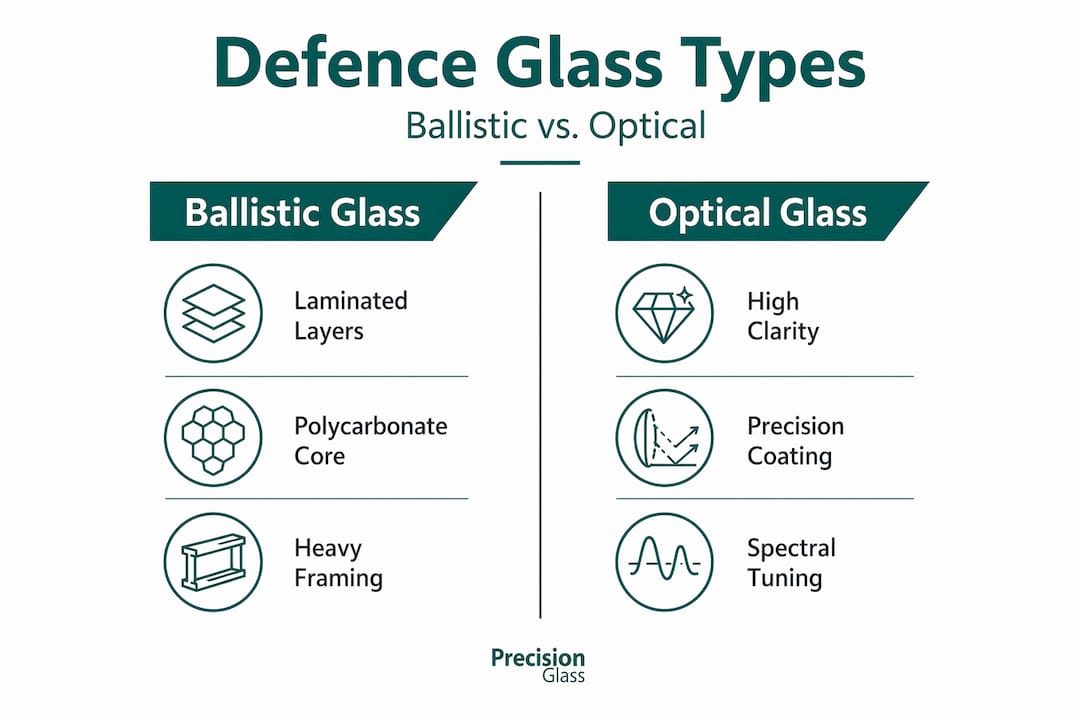
Defence electro-optical and infrared (EO/IR) programmes cannot readily substitute glass with alternative materials. EO/IR imaging programmes require maintaining optical alignment under vibration and temperature shifts, which constrains material substitution even when alternatives show comparable optical throughput on paper.
The main optical glass materials used in defence imaging are:
| Material | Spectral band | Key advantage | Key limitation |
|---|---|---|---|
| Germanium | Long-wave IR (LWIR) | High LWIR transmission | Thermal runaway above 100°C; high density |
| Sapphire | UV to mid-IR | Extreme hardness, 1,000°C tolerance | High cost and machining difficulty |
| Chalcogenide glass | Mid to long-wave IR | Flexible forming, lower cost than Ge | Lower mechanical strength |
| Zinc selenide | Mid-IR | Excellent transmission, low absorption | Fragile; requires careful handling |
| Borosilicate | Visible to near-IR | Thermal stability, low cost | Limited IR transmission |
Germanium is the most common material in LWIR defence optics but carries real operational penalties. Its high density adds weight that matters acutely in UAV payloads, and its thermal runaway behaviour constrains use in high-temperature environments. Procurement teams specifying germanium optics for UAV applications should model the thermal environment carefully before committing to a design.
Surface coatings are not optional for defence optical glass. Anti-reflective and diamond-like carbon coatings maintain transmission quality and protect surfaces against wear, moisture, and thermal cycling in field conditions. An uncoated germanium or sapphire optic degrades measurably faster under operational exposure, increasing maintenance costs and reducing system availability.
For those specifying optical assemblies, Glassprecision’s glass coating methods and performance resource outlines which coating types suit different spectral ranges and environmental exposures.
Procurement considerations for defence glass
Translating material science into a defensible procurement specification requires structured thinking. The benefits of glass in military applications are only realised when the right type is specified against the right threat and operational profile.
Define the threat model precisely. Ballistic glass specifications must start with the specific threat: calibre, velocity, and expected engagement geometry. A panel rated for UL 752 Level 3 (.44 Magnum) will not perform the same as one rated for Level 8 (7.62mm rifle). Do not allow cost pressure to drive down threat ratings without documented operational risk acceptance.
Account for multi-threat environments. Most real-world defence installations face compound risks. Ballistic, blast, and forced-entry threats require separate or combined standards. Specifying for only one threat type can leave systems exposed in ways that are not immediately visible during acceptance testing.
Assess manufacturing capability and lead times. Precision optical glass components for defence are not off-the-shelf items. Advanced glass specifications, particularly for infrared optics, require specialist fabrication with CNC grinding and polishing to tight tolerances. Engage your glass manufacturer early in the design phase, not at the procurement stage.
Factor in coatings and surface treatments from the outset. Coatings affect optical performance, mechanical resistance, and maintenance requirements. Specifying an optical window without defining the coating is an incomplete specification.
Consider lifecycle cost, not just unit cost. Glass composites may carry a higher initial cost than monolithic alternatives, but their durability, reduced weight penalties, and lower maintenance frequency frequently produce better total ownership costs over a platform’s service life.
For a structured approach to material selection across precision applications, Glassprecision’s advanced glass specifications guide for engineers and buyers covers the technical detail that procurement teams need at the specification stage.
My perspective on glass innovation in defence
I have worked closely with defence procurement teams and optical systems engineers for long enough to recognise a pattern. The professionals who get glass selection right are the ones who stop treating it as a passive material and start engaging with it as an engineered solution. That shift in thinking changes every conversation from “what is the cheapest compliant option” to “what delivers the best operational outcome over the platform’s life.”
What I find consistently underestimated is the role of coatings. Teams spend considerable effort specifying the substrate glass type and certification level, then treat the coating as an afterthought. In practice, the coating is often the determining factor in how long the optical or protective assembly actually performs in field conditions. I have seen germanium optics lose significant transmission within months of deployment simply because the coating specification was vague.
The most consequential development I see coming is not in the glass substrates themselves. It is in the integration of smart coatings that adapt to environmental conditions, self-heal minor surface damage, and provide active filtering. For procurement officers writing five-year or ten-year contracts, these capabilities deserve attention now, even if they are not yet in widespread production.
My clear advice is this: verify certifications against the actual threat model, engage manufacturers with genuine defence fabrication experience, and treat coatings as a primary specification item rather than a secondary one. The material science is ready. The question is whether procurement processes keep pace.
— Alexandra
How Glassprecision supports defence glass requirements

Defence applications demand glass components that meet precise specifications without compromise. Glassprecision designs and fabricates precision glass for the full range of defence requirements, from ballistic and protective glazing to high-performance optical components for imaging and surveillance systems. Our meticulous approach to quality assurance spans every stage, from material selection and CNC fabrication through to polishing, toughening, and final inspection. Explore our technical glass products to see the range of certified, tailored solutions we supply to defence and security programmes. For procurement teams assessing compliance and certification, our quality standards and processes page sets out the verification frameworks we maintain. Contact Glassprecision to discuss your programme’s requirements directly.
FAQ
What makes glass suitable for ballistic protection?
Modern ballistic glass uses laminated composites combining glass layers with polycarbonate interlayers. These structures absorb and dissipate impact energy while meeting standards such as UL 752 and EN 1063, with no-spall variants preventing dangerous fragmentation inside protected spaces.
Which glass materials are used in defence infrared optics?
Germanium is the most widely used material for long-wave infrared defence optics, while sapphire serves mid-infrared and visible applications. Chalcogenide glass and zinc selenide are also used depending on spectral range and weight requirements.
Does UL 752 certification cover all defence threats?
No. UL 752 covers ballistic resistance only, validated by standardised penetration and spall testing. Forced entry and blast protection require separate certifications such as EN 13541, and multi-threat environments may need assemblies specified to several concurrent standards.
Why are coatings critical for defence optical glass?
Coatings such as anti-reflective treatments and diamond-like carbon protect glass surfaces against wear, moisture, and thermal cycling, maintaining optical transmission quality throughout the operational service life of the component.
How should procurement officers approach glass specification for defence?
Start with a precise threat model, identify all relevant certification standards, engage a specialist glass manufacturer early in the design process, and specify coatings as a primary performance requirement rather than a finishing detail.