Light transmission in glass is rarely as straightforward as a single percentage figure suggests. Engineers and researchers working across optics, materials science, and product development frequently encounter the assumption that a higher Visible Light Transmission value automatically delivers better performance. It does not. The physical interactions governing how glass affects light, including refraction, absorption, scattering, and coating effects, create a set of trade-offs that demand precise, application-specific evaluation. This guide addresses those interactions in depth, covering measurement methodology, glass typology, advanced bonding technologies, and the design decisions that separate adequate glass specification from genuinely optimised optical performance.
Table of Contents
- Key takeaways
- Fundamental principles of light transmission in glass
- Glass types and their effect on light transmission
- Advanced technologies and measurement in transmission research
- Trade-offs and design considerations by application
- Measuring and optimising transmittance for engineering projects
- My perspective on where glass optics is heading
- Precision glass solutions for demanding optical applications
- FAQ
Key takeaways
| Point | Details |
|---|---|
| VLT is not the whole picture | High transmittance values must be evaluated alongside diffusion, haze, and spectral filtering for accurate performance assessment. |
| Glass composition governs behaviour | Thickness, tinting, surface treatment, and coatings each modify how light transmittance in materials translates to real-world optical outcomes. |
| Coatings reshape spectral performance | The effects of glass coating on light extend beyond glare reduction to UV blocking, energy harvesting, and laser safety. |
| Measurement method matters | Photopically weighted transmission reflects human eye sensitivity more accurately than simple spectral averages for visibility-critical applications. |
| Trade-offs are unavoidable | Engineers must balance maximum light transmission in windows or devices against efficiency, safety, and durability requirements. |
Fundamental principles of light transmission in glass
At its core, light transmittance in materials describes the fraction of incident light that passes through a medium without being absorbed or scattered. For glass, this is expressed as a percentage and measured across a defined spectral range, most commonly the visible spectrum from roughly 380 nm to 780 nm.
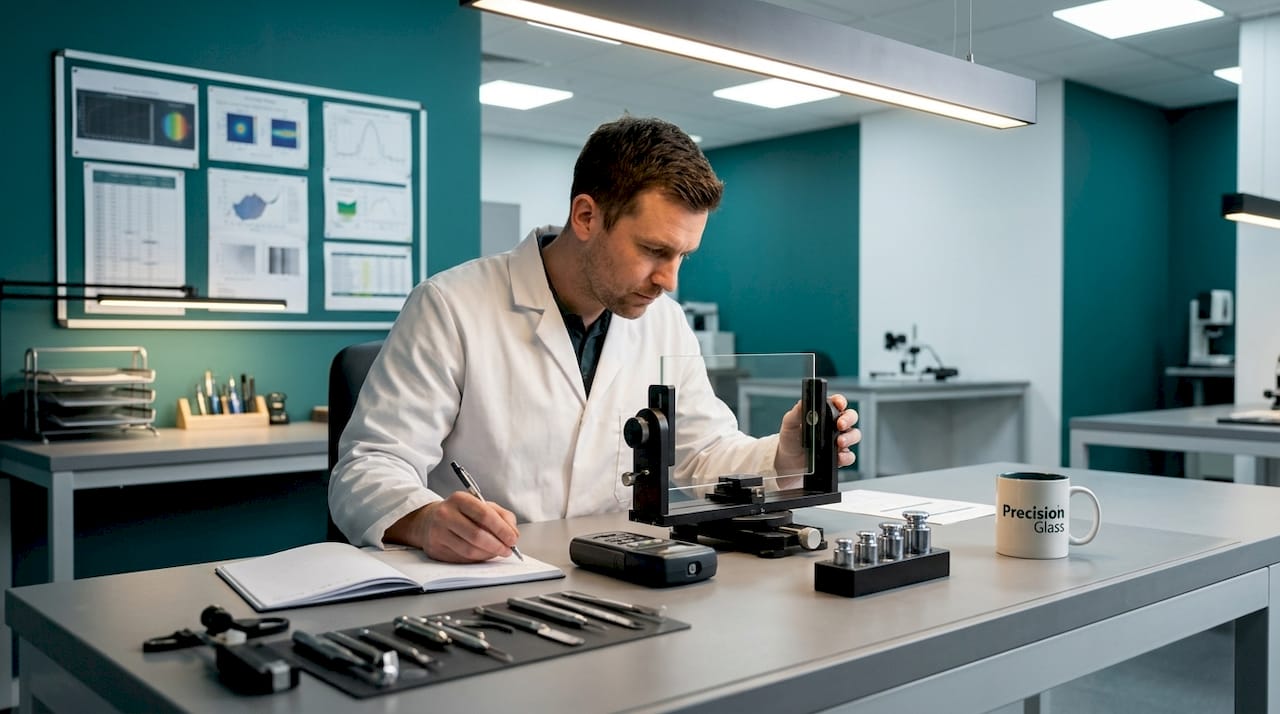
Three phenomena compete whenever light meets a glass surface. Reflection occurs at each air-to-glass interface, typically removing around 4% per surface for standard silicate glass due to the refractive index mismatch. Absorption converts photon energy into heat within the bulk material, and its magnitude depends on glass composition and thickness. Scattering redistributes light in non-specular directions, which becomes significant in frosted or opal glass.
Glass light refraction is governed by the refractive index, which for common optical glass sits around 1.50. This means light slows to approximately 67% of its vacuum speed as it propagates through the medium, a consequence of molecular interaction rather than any change in individual photon velocity. The distinction matters for modelling wave propagation in compound optical assemblies.
Measurement of transmittance follows two main conventions worth distinguishing:
- Simple average transmission: Averages spectral transmittance across the visible range with equal weighting at each wavelength.
- Photopically weighted transmission: Weights each wavelength according to the human eye’s sensitivity curve, producing values that better reflect perceived brightness under daylight conditions.
The difference between these two figures can reach several percentage points for tinted or coated glass, which is why specifying the measurement convention in a datasheet is not optional — it is a source of genuine discrepancy between suppliers.
Pro Tip: When comparing transmittance data from different manufacturers, always confirm whether the quoted VLT figure is photopically weighted or a simple spectral average. Using the wrong figure in an optical model introduces systematic error from the outset.
Glass fabrication techniques, including polishing quality, surface flatness, and residual stress from toughening, all influence optical behaviour beyond what bulk composition alone predicts. Meticulous control at each production stage is what separates precision optical glass from commodity architectural glass.
Glass types and their effect on light transmission
The choice of glass type is one of the most consequential decisions in any optical or architectural specification. Different manufacturing routes produce materials with substantially different transmission and diffusion characteristics.
Clear, frosted, and opal glass compared
| Glass type | Typical VLT range | Diffusion characteristic | Primary application |
|---|---|---|---|
| Clear float glass | 85–92% | Specular (minimal scatter) | Optical assemblies, display covers |
| Frosted glass | 70–85% | Surface diffusion, reduced glare | Lighting diffusers, privacy glazing |
| Opal glass | 30–60% | Internal volume diffusion | Decorative lighting, signage |
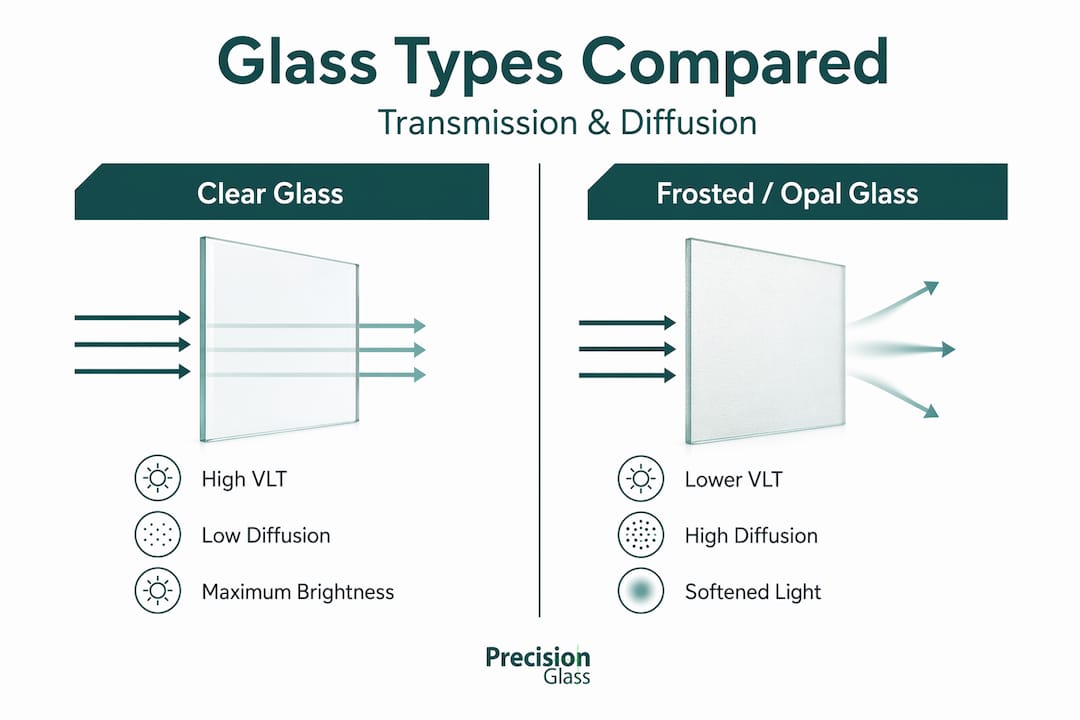
Frosted glass diffuses light at its surface, reducing directional glare without dramatically cutting total brightness. Opal glass achieves diffusion through internal scattering agents embedded during manufacture, producing a softer and more uniform output but at notably lower transmission. Neither is inferior. They serve distinct purposes, and selecting between them requires knowing whether the application demands directionality or uniformity.
Glass thickness has a direct effect on both absorption and diffusion. Thicker glass increases internal diffusion and absorbs proportionally more light, particularly in iron-rich compositions where even a few additional millimetres produce a visible green tint in transmitted light. For applications demanding maximum light transmission in windows or optical panels, ultra-clear low-iron glass reduces this absorption substantially.
The role of coatings in modifying transmission
The effects of glass coating on light extend well beyond simple anti-reflection treatment. Modern coating categories include:
- Anti-reflection coatings: Reduce surface reflection losses to below 0.5% per surface, increasing overall transmission beyond the uncoated baseline.
- Low-emissivity coatings: Selectively block near-infrared wavelengths while maintaining high visible transmittance, used widely in energy-efficient architectural glazing.
- UV-blocking films: Specialised molecular treatments can block harmful ultraviolet radiation while preserving visible clarity, with some treatments enhancing UV transmittance by approximately 2% where UV transmission is the design objective.
- Electrochromic and photochromic coatings: Allow dynamic adjustment of transmittance in response to voltage or light intensity, relevant to smart glazing and adaptive optics.
Clear tempered glass maximises brightness relative to its thickness, while frosted or textured tempered glass diffuses output. The toughening process itself introduces birefringence, which can create optical artefacts visible under polarised light. This is a known constraint in precision optical and display applications where tempered glass is otherwise attractive for its mechanical strength.
Pro Tip: For high-power laser delivery systems or medical imaging assemblies, specify whether the tempered glass in your design has been characterised for birefringence. Standard supplier datasheets rarely include this parameter without a direct request.
Advanced technologies and measurement in transmission research
Research into light transmission in glass has moved beyond passive material characterisation. Two areas in particular are reshaping what engineers can achieve.
Quantum-controlled wavefront shaping
Quantum entanglement-based wavefront shaping represents one of the more remarkable developments in optical science. By exploiting quantum correlations between photon pairs, researchers can selectively transmit entangled photons through otherwise opaque or highly scattering media, effectively making turbid materials transparent for specific photon states. This is not yet a production-ready technology, but its implications for biomedical imaging through tissue and secure optical communications through complex media are significant.
Optical bonding and chalcogenide adhesives
In the infrared optical domain, a persistent engineering challenge has been achieving low-loss connections between lenses and components. Liquid-like chalcogenide glass adhesives address this directly. Transmission improvements using this bonding approach have taken combined lens assembly performance from below 50% to above 80%, with the bonded assemblies remaining stable across 206 thermal cycles and three months of continuous operation. This durability profile makes chalcogenide bonding directly relevant to defence and aerospace optics where long-term reliability is non-negotiable.
Key measurement parameters for engineering practice
When characterising glass for precision applications, the following parameters require simultaneous assessment:
- VLT (Visible Light Transmission): Values above 70% are typical for high-transparency applications; photovoltaic glass often targets around 50% VLT to balance energy generation with view quality.
- Optical Density (OD): Critical for laser safety applications. VLT alone does not determine safety; OD quantifies attenuation at specific laser wavelengths and must be specified alongside VLT in any safety-critical design.
- Haze percentage: Measured as the proportion of transmitted light deviating more than 2.5 degrees from the incident beam. Low haze is essential for display covers and optical windows; higher haze is intentional in diffuser applications.
- Spectral transmittance curve: A full wavelength-resolved transmission plot reveals absorption bands and coating effects invisible in a single headline figure.
The vital role of glass in advanced optical systems now extends to applications that require simultaneous optimisation of all these parameters, something that generic glass suppliers are not equipped to address with the precision that defence, aerospace, and medical sectors demand.
Trade-offs and design considerations by application
Understanding how glass affects light is only useful if it translates into better design decisions. Every application imposes a different hierarchy of priorities.
Architectural and façade glazing: Maximum light transmission in windows competes with solar heat gain control, privacy requirements, and in some cases energy generation. Perovskite photovoltaic glass achieves laboratory efficiencies exceeding 14 to 15% at VLT values above 70%, though commercial products currently deliver 5 to 12%. The chemical composition of the perovskite layer is tuned to shift this balance, placing the optimisation squarely in materials engineering territory.
Automotive glazing: Laminated windscreens must maintain high forward visibility while filtering UV, supporting heads-up display optics, and meeting pedestrian safety impact standards. Tinting and interlayer selection directly affect how glass affects light across the visible and near-infrared spectrum, with implications for camera-based driver assistance systems that operate at wavelengths the human eye does not detect. An automotive glass fabrication guide covers these fabrication-to-performance dependencies in practical engineering terms.
Medical and diagnostic optics: Endoscope objectives, surgical lighting covers, and diagnostic imaging windows require high transmission across specific spectral bands with minimal distortion. Diffusion is typically undesirable, and spectral purity is critical. Coatings must be biocompatible in some cases. The trade-offs in clarity and energy efficiency that dominate architectural specification give way here to spectral fidelity and surface quality as primary criteria.
Defence and aerospace optics: Laser safety windows, targeting optics, and sensor covers must manage OD requirements for specific threat wavelengths while maintaining operator visibility. Coatings must survive thermal cycling, humidity, and mechanical shock. This is where the inadequacy of relying on VLT alone becomes most consequential.
Semiconductor and electronics manufacturing: UV lithography optics and wafer inspection systems demand extremely low absorption at specific UV wavelengths, driving the use of synthetic fused silica rather than conventional glass. Transmission homogeneity across the aperture is as important as average transmission value.
Pro Tip: Before finalising a glass specification, prepare a transmittance budget that accounts for every interface, coating layer, and bulk absorption contribution across the relevant spectral band. A single component meeting spec can still underperform in a multi-element assembly if the cumulative losses were not modelled.
Measuring and optimising transmittance for engineering projects
Accurate measurement is the foundation of reliable glass specification. Follow this sequence to avoid the most common errors:
Define the spectral range and weighting convention first. Specify whether you require photopic VLT, simple spectral average, or full spectral transmittance data across a defined range such as 400 to 2500 nm for solar applications.
Measure at multiple points across the glass aperture. Transmission homogeneity matters in optics. A single-point measurement misses spatial variation from coating non-uniformity or bulk inclusions.
Characterise haze separately from transmittance. A glass sample can have high VLT and high haze simultaneously, which is acceptable for diffuser panels but disqualifying for display covers.
Account for thickness and temperature dependencies. Document the glass thickness at which measurements were taken and note whether the material shows significant thermal variation in transmittance, relevant for high-power applications.
Verify coating durability under service conditions. Anti-reflection and functional coatings degrade under UV exposure, humidity cycling, and abrasion. Transmittance at commissioning is not the same as transmittance after 10,000 hours of service.
Reference applicable quality standards. ISO 9050 covers solar and light transmittance of glass in building. EN 207 governs laser protective devices. Aligning measurement to the correct standard avoids specification ambiguity. The glass manufacturing quality standards that apply to precision optical components go beyond these building standards in their surface quality and homogeneity requirements.
Optimisation strategies typically involve iterating between coating selection, glass composition, and thickness to satisfy the transmittance budget within mechanical and cost constraints. Working with a manufacturer who integrates optical modelling with fabrication capability significantly reduces the iteration cycles required.
My perspective on where glass optics is heading
I’ve spent considerable time working at the intersection of materials specification and optical systems engineering, and the most persistent problem I encounter is not technical. It is that engineers anchor too heavily on VLT as a proxy for optical quality.
The industry habit of leading with a single VLT figure is understandable, but it obscures the parameters that actually determine whether a component performs in service. I’ve seen laser safety enclosures specified to a high VLT and later found to offer inadequate OD at the relevant wavelength. I’ve seen architectural glass selected for its impressive transmission figure, only to create glare problems that required expensive retrofitting.
What I find genuinely interesting right now is the convergence of photovoltaic glass research and advanced optical bonding. The emerging glass technologies in aerospace and medical sectors suggest that within a few years, dynamically tuneable transmission will become a standard engineering parameter rather than a research curiosity. Electrochromic systems are already mature enough for commercial façades; the question is how quickly the same control capability migrates into defence optics and medical instrumentation.
My practical advice: treat the transmittance specification as a multi-dimensional problem from the start of a project. Define the spectral bands that matter, the acceptable haze range, the OD requirements if relevant, and the service environment. That framework will guide glass selection far more reliably than any single headline figure.
— Alexandra
Precision glass solutions for demanding optical applications
When transmittance performance is non-negotiable, the specification process and the manufacturing process must be aligned from day one. Glassprecision designs and fabricates precision glass components with meticulous control over composition, coating, surface quality, and thickness tolerance for clients across defence, aerospace, medical devices, automotive, and electronics sectors.

Whether your project requires anti-reflection coated optical windows, laser safety glass with verified OD performance, or photovoltaic-integrated architectural panels, Glassprecision’s engineering team works to your specification rather than around a standard catalogue. Explore the full range of precision glass products and sectors we serve, or review our engineered glass types to identify the starting point for your application. Contact us to discuss bespoke solutions where transmittance, durability, and precision are equally weighted requirements.
FAQ
What is a typical VLT range for high-transparency glass?
High-transparency glass typically achieves VLT above 70%, while photovoltaic or shading glass operates around 50% to balance light admission with energy generation or solar control performance.
Why is Optical Density important alongside VLT?
VLT measures broadband visible transmission, but OD quantifies attenuation at specific wavelengths. For laser safety windows, OD and wavelength protection determine actual safety, not VLT alone.
How does glass thickness affect light transmission?
Increased thickness raises bulk absorption and, in textured or frosted glass, increases diffusion. Thicker tempered glass absorbs proportionally more light and reduces brightness relative to thinner equivalents of the same composition.
What is the difference between photopically weighted and average VLT?
Photopic weighting accounts for human eye sensitivity across the visible spectrum, producing a transmittance figure that better reflects perceived brightness. Simple spectral averaging treats all wavelengths equally, which can overstate or understate perceived performance depending on the glass’s spectral shape.
Can glass coatings improve UV transmittance rather than block it?
Yes. Molecular hydrogen loading treatments applied to synthetic quartz glass can improve UV transmittance by approximately 2%, which is significant for UV lithography and photonic applications where maximising transmission at short wavelengths is the design priority.