
Glass for EMI shielding is defined as a transparent, electrically conductive material engineered to attenuate electromagnetic interference while preserving optical clarity. The industry term is “EMI shielding glass,” though the function is sometimes described as RF shielding glass or electromagnetic interference shielding glass. Per ASTM F3057, high-performance laminated variants achieve around 45 dB attenuation across 35 MHz to 18 GHz. Optical clarity is maintained at visible light transmittance above 80%, making it viable for displays, secure facilities, and medical equipment where both signal control and visibility are non-negotiable.
What is glass for EMI shielding and how is it constructed?
EMI shielding glass is a glass substrate combined with one or more conductive layers that block electromagnetic waves. The conductive element is the active component. Without it, standard glass offers no meaningful electromagnetic attenuation.
Three primary conductive technologies are used in production today.
Transparent conductive oxides (TCOs) such as indium tin oxide (ITO) are deposited as thin films directly onto the glass surface. ITO coatings deliver 20–40 dB shielding effectiveness and transmittance of 80–90%, but they are scratch-sensitive and require a protective cover layer in rugged environments.
Metal micro-meshes use fine grids of silver or copper embedded in or laminated onto the glass. The mesh openings are small enough to block electromagnetic waves while remaining largely invisible to the human eye. This approach typically achieves higher shielding values than ITO alone.
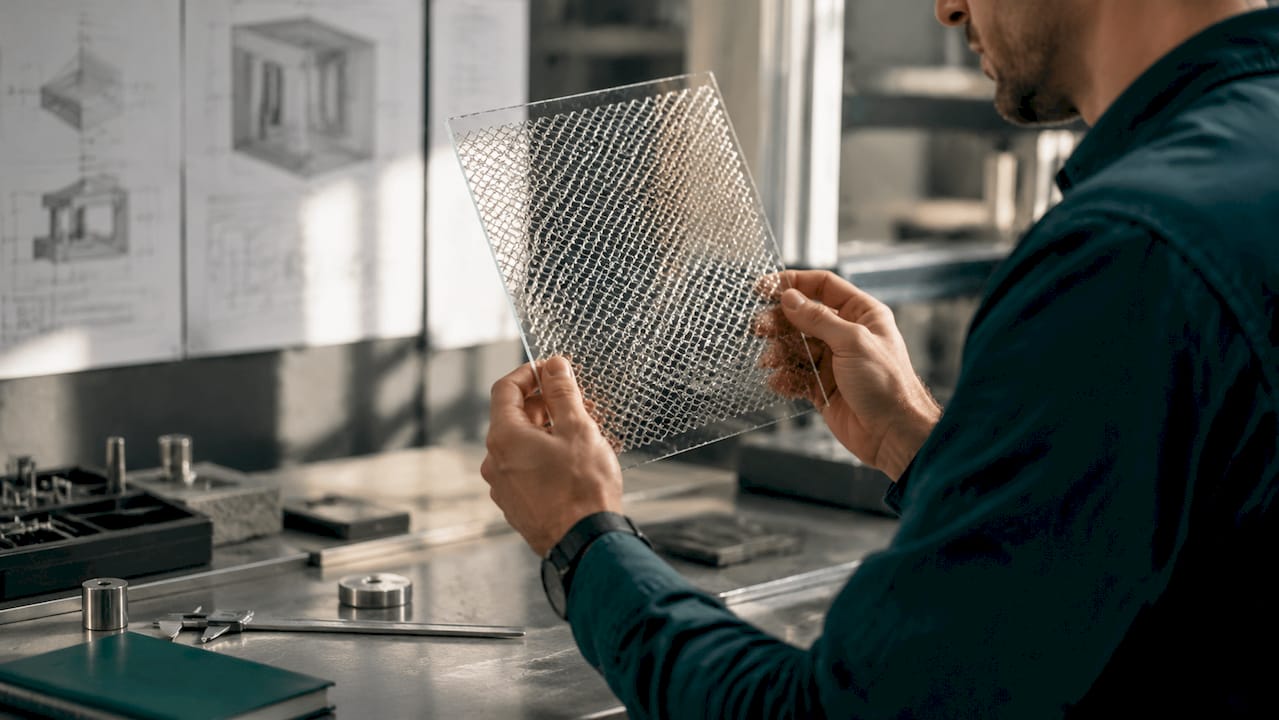
Laminated assemblies bond conductive interlayers between two glass panes. Laminated EMI glass provides continuous edge-to-edge shielding, eliminating the gaps that film-only or mesh-only solutions can leave at the edges. This construction is preferred for high-security installations.
| Technology | Typical SE (dB) | Transmittance | Key limitation |
|---|---|---|---|
| ITO coating | 20–40 | 80–90% | Scratch sensitivity |
| Metal micro-mesh | 30–50+ | 75–85% | Visible moiré at certain angles |
| Laminated conductive interlayer | Up to 45 | 70–85% | Higher thickness and cost |
Pro Tip: When specifying ITO-coated glass for field-deployed equipment, always request a hard-coat protective layer. Without it, routine cleaning will degrade the conductive film and reduce shielding effectiveness over time.
The glass selection process for electronics involves balancing these trade-offs against the specific frequency range and optical requirements of your application.
How does EMI shielding glass work to block interference?
The shielding mechanism relies on the interaction between electromagnetic waves and a continuous conductive network. When an electromagnetic wave strikes the conductive layer, it induces electrical currents within the material. Those induced currents generate an opposing field that reflects or absorbs the incoming wave.
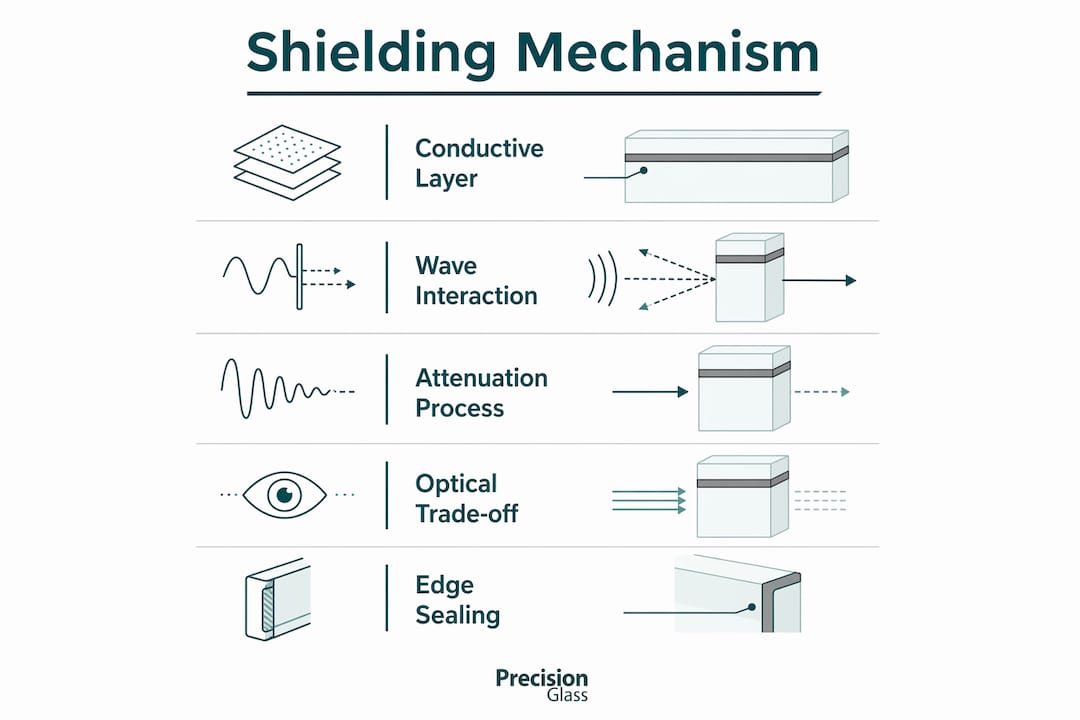
The trade-off between conductivity and optical clarity is the central engineering challenge. A thicker or denser conductive layer improves shielding but reduces light transmission. The design goal is to find the minimum conductivity needed to meet the shielding specification without sacrificing the required transmittance.
Shielding effectiveness (SE) is measured in decibels (dB). Each 10 dB increase represents a tenfold reduction in electromagnetic field intensity. A 30 dB rating blocks 99.9% of the incident field. A 45 dB rating blocks over 99.99%. These figures matter when specifying glass for environments governed by MIL-STD-461 or similar defence and government standards.
Three physical mechanisms contribute to total SE:
- Reflection: The conductive surface reflects incident electromagnetic energy back towards the source. This is the dominant mechanism in most metallic coatings.
- Absorption: Energy is converted to heat within the conductive material. Thicker or more resistive layers absorb more.
- Multiple internal reflections: Waves that penetrate the first interface bounce between internal surfaces, losing energy with each reflection.
The glass itself contributes negligibly to shielding. All attenuation comes from the conductive element. This is why edge sealing is critical. Conductive gaskets or silicone seals are required at every frame joint to prevent electromagnetic leakage around the glass perimeter. A gap of even a few millimetres can reduce effective SE by 20 dB or more.
What are the key performance properties of EMI shielding glass?
Performance specifications for EMI shielding glass cover four measurable properties: shielding effectiveness, visible light transmittance, sheet resistance, and physical thickness.
Shielding effectiveness ranges from 20 dB for basic ITO-coated panes to 45 dB for high-specification laminated assemblies. The 45 dB figure, validated against ASTM F3057 across a wide frequency range, represents the current practical ceiling for commercially available transparent shielding glass.
Visible light transmittance sits above 80% for most qualified products. This threshold is the accepted minimum for applications where operators need clear visual access to displays or through windows. Products optimised for maximum shielding may drop to 70–75% transmittance, which is acceptable for some security applications but not for high-brightness display environments.
Sheet resistance for conductive coatings typically falls in the 5–15 ohm per square range. Lower sheet resistance means higher conductivity and better shielding, but also greater optical absorption. Sheet resistance is the single most useful figure for comparing coating technologies during procurement.
Thickness for specialised EMI shielding glass ranges from 0.65 mm to 2.2 mm. Thinner profiles suit consumer electronics and touchscreen overlays. Thicker laminated assemblies are used in architectural glazing for secure facilities.
Pro Tip: Always request spectral transmittance data alongside the headline visible light transmittance figure. A product may pass the 80% threshold in the visible range but absorb heavily in the near-infrared, which affects camera systems and optical sensors behind the glass.
Understanding light transmission in glass is particularly relevant when specifying glass for sensor-integrated displays or imaging systems.
Where is EMI shielding glass used and why does it matter?
EMI shielding glass is deployed wherever a transparent barrier must also control electromagnetic signals. The applications divide into four broad categories.
Electronic displays and touchscreens. Consumer electronics, industrial HMIs, and medical monitors all generate and receive electromagnetic signals. EMI shielding glass prevents the display from radiating interference that disrupts adjacent circuitry, and protects the touchscreen from external noise that degrades touch accuracy. The glass selection criteria for electronics in this category prioritise thin profiles and high transmittance.
Secure facilities and government buildings. SCIF (Sensitive Compartmented Information Facility) construction requires windows that prevent electromagnetic signals from leaking classified information. EMI shielding glass replaces conventional glazing in these environments, meeting NSA and government standards for signal security. The glass must integrate with conductive window frames and gaskets to form a complete Faraday cage around the room.
Medical equipment. MRI suites use shielded glass windows to maintain the electromagnetic isolation of the scanning room while allowing clinical staff to observe patients. Surgical theatres with sensitive electronic equipment also use shielding glass to prevent interference between devices. Reliability is non-negotiable in these environments.
Aerospace and defence. Cockpit displays, radar operator stations, and avionics bays use EMI shielding glass to protect sensitive electronics from both external interference and internal cross-talk between systems. Optimising glass for defence applications involves meeting MIL-SPEC requirements for both shielding and optical performance simultaneously.
The advantage of EMI shielding glass over solid metal shielding is straightforward: it provides attenuation without blocking the line of sight. Metal panels achieve higher SE values, but they are opaque. Where visibility matters, shielding glass is the only viable solution.
What future developments are shaping EMI shielding glass?
The next generation of EMI shielding glass is being driven by two forces: the higher frequencies of 5G and emerging 6G networks, and the demand for thinner, lighter form factors in consumer and wearable electronics.
Research into MXene and carbon-based nanomaterials is the most active area of development. MXene films offer high electrical conductivity at very low thickness, which means higher SE without the optical penalty of thicker metal coatings. Carbon nanotube networks are being explored for flexible glass substrates.
Key development directions include:
- Thinner conductive films that maintain 40+ dB SE at sub-micron thickness
- Multifunctional coatings that combine EMI shielding with anti-reflective and anti-fingerprint properties in a single layer
- Flexible and curved glass substrates compatible with modern industrial and consumer device designs
- Improved environmental durability, particularly resistance to humidity and UV degradation in outdoor installations
- Manufacturing scale-up for nanomaterial-based coatings, which currently face cost barriers for high-volume production
The challenge is that higher-frequency shielding requires finer conductive structures, which are harder to manufacture at scale. The industry is not yet at the point where nanomaterial-based products routinely replace ITO or metal mesh in production. For most procurement decisions in 2026, ITO coatings and laminated metal mesh remain the practical choices.
Key takeaways
EMI shielding glass is defined by the combination of its conductive technology, shielding effectiveness in decibels, and visible light transmittance, and all three must be specified together to select the right product for a given application.
| Point | Details |
|---|---|
| Core definition | EMI shielding glass combines a glass substrate with a conductive layer to attenuate electromagnetic waves while maintaining optical clarity. |
| Performance benchmark | High-specification laminated glass achieves 45 dB attenuation per ASTM F3057, with visible light transmittance above 80%. |
| Technology choice | ITO coatings suit thin-profile applications; laminated metal mesh assemblies suit high-security or high-SE requirements. |
| Integration is critical | Conductive gaskets and sealed frames are required at every joint to prevent electromagnetic leakage around the glass perimeter. |
| Future direction | MXene and carbon-based nanomaterials are under active research but ITO and metal mesh remain the production-ready options in 2026. |
Why I think engineers underestimate the integration problem
Most procurement conversations about EMI shielding glass focus entirely on the glass itself. The SE figure, the transmittance value, the thickness. Those are the numbers that appear in datasheets, and they are the numbers that get compared in specification reviews.
The integration problem gets far less attention, and it is where most shielding failures actually occur. I have seen installations where high-specification laminated glass was fitted into aluminium frames with no conductive gaskets, because the frame contractor was not briefed on the electromagnetic requirements. The glass was performing at 45 dB. The installed system was performing at perhaps 15 dB, because the signal was leaking around every edge joint.
The glass is only one component of a shielding enclosure. The frame material, the gasket specification, the method of fixing, and the treatment of any penetrations through the frame all determine the actual SE of the installed system. A 45 dB glass in a poorly integrated frame will underperform a 30 dB glass in a properly sealed one.
My recommendation is to involve your glass specialist at the frame design stage, not after the frame has been specified. The conductive gasket detail, the overlap between the glass conductive layer and the frame, and the edge deletion tolerance of the coating all need to be coordinated before fabrication begins. Retrofitting these details is expensive and often impossible without replacing components.
The other underestimated factor is durability. ITO coatings are electrically excellent but physically fragile. If your application involves any risk of surface contact, abrasion, or chemical exposure, specify a hard-coat protective layer from the outset. The SE of a scratched ITO coating degrades in ways that are not always visible to the eye but are very visible in a post-installation shielding test.
— Alexandra
Precision Glasses: custom EMI shielding glass for demanding applications
Precision Glasses fabricates technical glass solutions for defence, aerospace, medical, and electronics applications where both shielding performance and optical quality are specified to exacting tolerances.

We work with engineers and procurement specialists from the design stage, advising on coating technology, lamination configuration, thickness, and integration requirements to meet your specific SE and transmittance targets. Our quality assurance process covers every stage from substrate selection through to final shielding verification. Whether you need a single prototype or a production run, contact Precision Glasses to discuss your EMI shielding glass requirements.
FAQ
What is EMI shielding glass?
EMI shielding glass is a transparent glass substrate coated or laminated with a conductive material, such as ITO or metal mesh, that attenuates electromagnetic interference while maintaining visible light transmittance above 80%.
How effective is glass at blocking electromagnetic interference?
High-performance laminated EMI shielding glass achieves up to 45 dB attenuation across 35 MHz to 18 GHz per ASTM F3057, which blocks over 99.99% of incident electromagnetic field intensity.
What is the difference between ITO-coated and laminated EMI glass?
ITO coatings offer 20–40 dB SE with high transmittance but are scratch-sensitive. Laminated assemblies with conductive interlayers reach up to 45 dB SE and provide continuous edge-to-edge shielding, making them the preferred choice for high-security applications.
Does the glass frame affect shielding performance?
Yes. Conductive gaskets and sealed frame joints are required to prevent signal leakage around the glass perimeter. Without proper edge sealing, the installed SE can be significantly lower than the glass specification.
Is glass for EMI shielding used in medical environments?
EMI shielding glass is used in MRI suite observation windows and surgical theatres to maintain electromagnetic isolation while allowing clinical staff to observe patients and equipment through the barrier.