
Tempered glass, also known as toughened glass, is a safety glass processed by controlled heat treatment to become 4 to 5 times stronger than standard annealed glass. When it breaks, it shatters into small, blunt granular pieces rather than large, jagged shards, which dramatically reduces the risk of serious injury. To qualify as safety glass under current standards, fully tempered 6mm glass must achieve a minimum surface compression of 69 MPa, with safety classification beginning at surface stress above 100 MPa. These benchmarks are not arbitrary. They reflect decades of engineering research into how glass behaves under mechanical and thermal load, and they form the foundation of building codes and product specifications across defence, automotive, medical, and architectural sectors.
What is tempered glass and how does the tempering process work?
Thermal tempering begins with annealed glass, which is ordinary, slowly cooled glass with no internal stress. This is the starting material for virtually all toughened glass production. The annealed sheet is cut, edged, and finished to its final dimensions before any heat treatment begins.
The glass then enters a tempering furnace, where it is heated to between 600°C and 700°C. At this temperature, the glass softens slightly but does not melt. The precise temperature window is critical. Too low and the stress profile will be insufficient; too high and the glass distorts or develops optical defects.
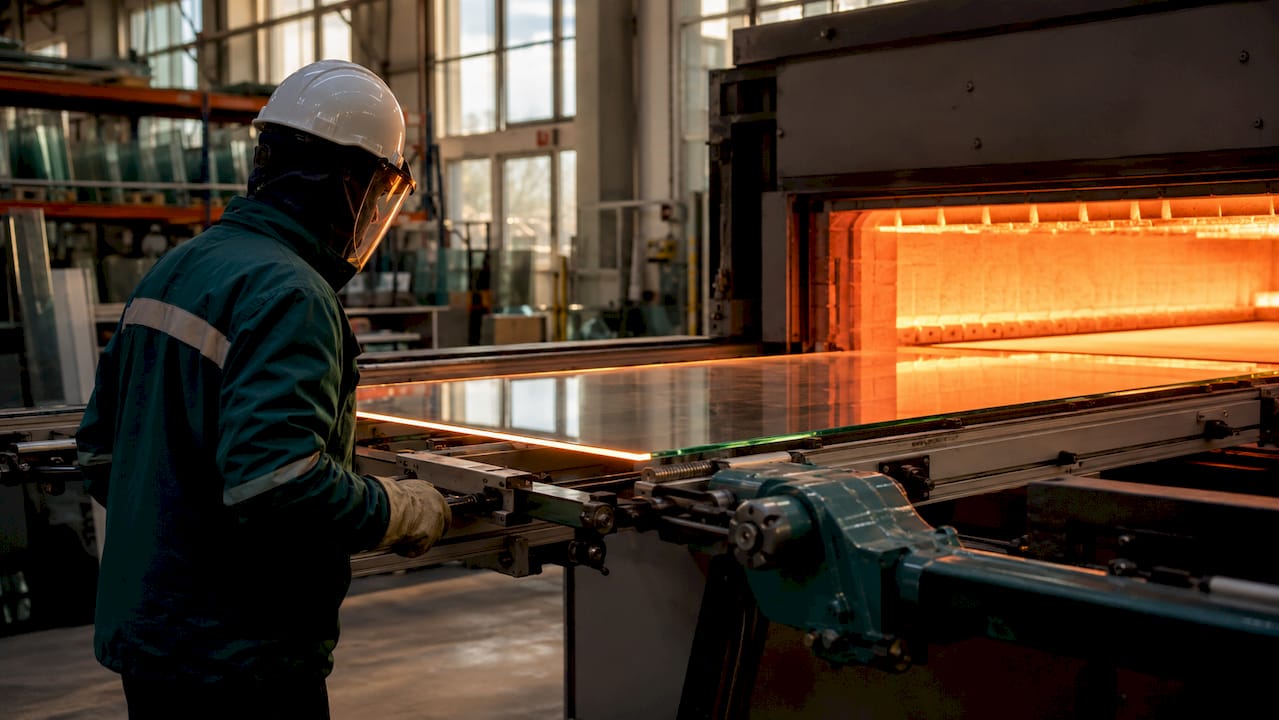
Once the glass reaches the target temperature, it is rapidly cooled using high-pressure air jets in a process called quenching. The outer surfaces cool and solidify first, contracting quickly. The inner core remains hot and continues to contract as it cools, pulling against the already rigid surfaces. This creates a permanent state of compressive stress on the outer surfaces and tensile stress in the core. That stress profile is what gives toughened glass its strength and its distinctive breakage pattern.
The manufacturing steps, in order, are:
- Cut and shape the annealed glass to final dimensions, including all holes, notches, and cutouts.
- Edge finish by grinding and polishing all edges to remove micro-cracks that could propagate during tempering.
- Clean thoroughly to remove dust, oils, and surface contaminants that cause defects during heating.
- Heat in a roller or air-float furnace to 600°C–700°C, with precise dwell time based on glass thickness.
- Quench with high-pressure air jets applied uniformly across both surfaces simultaneously.
- Inspect for optical distortion, surface stress uniformity, and dimensional accuracy before dispatch.
Surface cleanliness and perfect edge finishing before tempering are critical. Dust or poor edges cause defects on cooling that lead to premature failure. This is why reputable manufacturers treat pre-tempering preparation with the same rigour as the tempering itself. You can see how this fits into a broader precision glass manufacturing workflow that covers furnace parameters, quenching control, and final inspection.
Pro Tip: Never assume that a glass component can be modified after tempering. All drilling, cutting, and shaping must be completed and verified before the glass enters the furnace. Any post-tempering modification causes immediate, catastrophic shattering.
How does tempered glass compare to regular and heat-strengthened glass?
The differences between glass types are not merely academic. They determine which product is appropriate for a given application, and choosing incorrectly carries real safety and structural consequences.
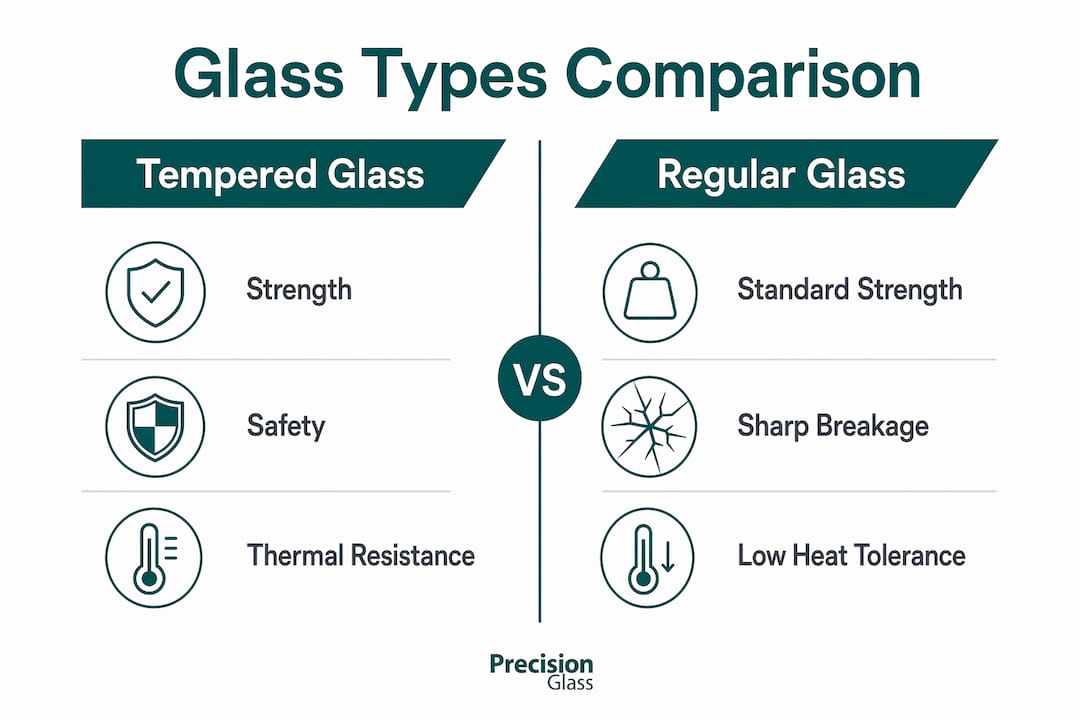
Fully tempered glass has 3 to 4 times the mechanical and thermal stress resistance of annealed glass of the same thickness. Heat-strengthened glass, by contrast, achieves around 1.5 to 2 times the strength of annealed glass. That difference exists because heat-strengthened glass is cooled more slowly during quenching, producing a lower surface compressive stress. The slower cooling yields moderate strength but a breakage pattern that produces larger, sharper fragments, which is less safe than fully toughened glass.
The breakage behaviour is the most practically significant distinction. Annealed glass breaks into large, sharp shards that cause deep lacerations. Toughened glass shatters into granular blunt pieces with lower mass and maximum size, reducing momentum and penetration depth. This is why building codes in the UK and internationally mandate toughened glass in locations where human impact is foreseeable, such as low-level glazing, shower enclosures, and vehicle windows.
| Property | Annealed glass | Heat-strengthened glass | Fully tempered glass |
|---|---|---|---|
| Relative strength | 1× baseline | 1.5–2× annealed | 3–5× annealed |
| Surface compression | Minimal | Moderate | 69 MPa minimum |
| Breakage pattern | Large, sharp shards | Moderate-sized pieces | Small, blunt granules |
| Post-breakage safety | Low | Moderate | High |
| Thermal shock resistance | Low | Moderate | Up to 250°C |
| Post-fabrication cutting | Possible | Possible | Not possible |
Key distinctions worth noting for specification purposes:
- Fully toughened glass is the only type classified as safety glass under most international standards.
- Heat-strengthened glass is not a substitute for toughened glass in safety-critical applications.
- Annealed glass remains appropriate for interior, low-risk glazing where breakage risk is minimal.
- Chemical tempering, an alternative to thermal tempering, uses ion exchange to achieve surface compression and is used for thin glass in electronics and medical devices.
Understanding glass durability in engineering requires knowing which type of glass is appropriate for each load case, not simply specifying the strongest option by default.
What are the uses and benefits of tempered glass across industries?
Toughened glass is used wherever strength, safety, and thermal resistance must coexist. Common applications include vehicle side and rear windows, architectural glazing, shower doors, mobile device screens, oven doors, and public transport windows. Each of these applications exploits a specific combination of properties that annealed glass cannot provide.
One underappreciated advantage is thermal shock resistance. Toughened glass withstands thermal shock up to 250°C without fracturing. This makes it the correct choice for oven doors, industrial lighting housings, and any environment where rapid temperature changes occur. Annealed glass of the same thickness would crack under the same thermal load.
Toughened glass also retains the same optical clarity as annealed glass after tempering. This matters in applications where visual performance is non-negotiable, such as automotive dashboards, medical imaging equipment, and architectural facades. The tempering process does not alter light transmission or introduce significant distortion when the furnace parameters are correctly controlled.
The principal benefits of toughened glass are:
- Strength. Four to five times stronger than annealed glass of equal thickness, resisting mechanical impact and wind load.
- Safety on breakage. Fragments with lower momentum and penetration depth reduce injury risk significantly compared to annealed glass shards.
- Thermal resistance. Withstands rapid temperature changes up to 250°C, suitable for high-heat environments.
- Optical clarity. No reduction in light transmission or visual quality after correct tempering.
- Regulatory compliance. Meets building code requirements for safety glazing in the UK, EU, and internationally.
- Design flexibility. Available in a wide range of thicknesses and can be combined with coatings, laminates, or interlayers before tempering.
Pro Tip: When specifying toughened glass for architectural or industrial use, always confirm the surface compression value with the manufacturer. A product labelled “tempered” that falls below 69 MPa surface compression does not meet the safety glass threshold and should not be used in safety-critical locations.
What limitations apply to tempered glass in fabrication and installation?
The single most important limitation is absolute. Tempered glass cannot be cut, drilled, or otherwise mechanically processed after tempering without shattering. The internal stress balance is disrupted the moment the surface is breached, causing immediate, total fragmentation. Every dimension, hole, notch, and edge profile must be finalised before the glass enters the furnace.
This constraint has direct implications for project planning. Design changes after tempering mean scrapping the component entirely and starting again. For complex components used in defence, aerospace, or medical devices, this can be costly and time-consuming. Thorough design review before fabrication begins is not optional; it is the only way to avoid waste.
Installation introduces a separate set of risks:
- Zero-clearance mounting induces edge stress from thermal expansion and mechanical load transfer, which can trigger sudden glass rupture despite the glass’s inherent strength.
- Forced fits in frames cause stress concentration at the edges, leading to premature cracking or failure.
- Inadequate edge cover exposes the most vulnerable part of the glass to mechanical contact and moisture ingress.
- Incorrect glazing compounds that harden and grip the glass can transmit frame movement directly to the glass edge.
- Thermal bridging in metal frames without thermal breaks can create localised temperature differentials that exceed the glass’s thermal shock tolerance.
Quality control during production is equally important. Inspection for optical distortion, surface stress uniformity using polarised light or scattered light measurement, and dimensional accuracy must occur before dispatch. Reviewing quality standards in glass manufacturing gives a clear picture of what a rigorous inspection programme looks like in practice.
Key takeaways
Tempered glass is the correct choice for any application where strength, safety on breakage, and thermal resistance must be achieved simultaneously without sacrificing optical clarity.
| Point | Details |
|---|---|
| Core strength advantage | Toughened glass is 4 to 5 times stronger than annealed glass of equal thickness. |
| Safety breakage pattern | Fragments are small, blunt, and low-mass, reducing penetration depth and injury risk. |
| Manufacturing constraint | All cutting, drilling, and shaping must be completed before tempering; post-tempering modification causes shattering. |
| Thermal performance | Toughened glass withstands thermal shock up to 250°C, making it suitable for high-heat environments. |
| Installation risk | Zero-clearance mounting and forced fits create edge stress that can cause sudden rupture even in correctly tempered glass. |
Why the industry still underestimates tempering precision
The tempering process looks straightforward on paper: heat the glass, cool it fast, and the stress profile forms automatically. In practice, the margin for error is far narrower than most procurement teams appreciate.
I have seen projects where the glass met the minimum 69 MPa surface compression threshold on paper but showed visible roller wave distortion because the furnace dwell time was not adjusted for a change in glass thickness mid-run. The glass passed the stress test and failed the optical test. For an automotive dashboard or a medical display, that is not an acceptable outcome.
The other misconception I encounter regularly is that toughened glass is unbreakable. It is not. It is significantly stronger than annealed glass and far safer when it does break, but it can still fracture under sufficient impact or edge stress. The safety benefit comes from how it breaks, not from an assumption that it will not. Engineers who understand this distinction specify toughened glass correctly. Those who do not tend to over-specify it in some areas and under-specify it in others.
The future of toughened glass in high-performance industries lies in combining thermal tempering with advanced coatings, laminates, and chemical strengthening for thin substrates. The emerging glass technologies being developed for aerospace and medical applications are already pushing beyond what standard thermal tempering can achieve alone. That is where the most interesting engineering work is happening right now.
— Alexandra
Precision Glasses: toughened glass for demanding applications
Precision Glasses supplies precision-engineered toughened glass components for sectors where standard specifications are not sufficient. Our work spans medical, defence, automotive, and optical applications, each requiring meticulous attention to surface compression values, edge finishing, and dimensional accuracy.

Every component we produce undergoes thorough inspection for stress uniformity, optical clarity, and dimensional conformance before dispatch. If your project requires toughened glass that meets exacting technical standards, our team is ready to review your specifications and advise on the most appropriate glass type, thickness, and treatment for your application. Contact Precision Glasses to discuss your requirements with our glass fabrication specialists.
FAQ
What is the tempered glass definition in simple terms?
Tempered glass is a type of safety glass that has been heat-treated to be 4 to 5 times stronger than ordinary glass and to break into small, blunt pieces rather than sharp shards.
Can tempered glass be cut after it has been made?
No. Toughened glass cannot be cut, drilled, or shaped after tempering. Any mechanical processing after the tempering process causes immediate, complete shattering due to disruption of the internal stress balance.
What is the difference between tempered and heat-strengthened glass?
Fully tempered glass achieves 3 to 5 times the strength of annealed glass and breaks into granular fragments, while heat-strengthened glass reaches only 1.5 to 2 times the strength and produces larger, sharper pieces on breakage.
Is tempered glass safe to use in buildings?
Yes. Toughened glass is classified as safety glass under UK and international building codes when it meets the minimum surface compression of 69 MPa. Its granular breakage pattern significantly reduces injury risk compared to annealed glass.
What temperature can tempered glass withstand?
Toughened glass resists thermal shock up to 250°C, making it suitable for oven doors, industrial lighting, and other high-heat environments where annealed glass would fracture.