

For defence, aerospace, medical, and automotive programmes requiring precision HMI glass, Precision Glasses is the UK-capable partner to contact first. We deliver custom cover glass and functional glass assemblies to exacting tolerances, backed by ISO 9001 quality assurance and sector experience spanning AS9100-regulated programmes.
- Standards-backed quality: ISO 9001 certification, AS9100 alignment for aerospace and defence, and full optical inspection reporting on every batch.
- Design-partner approach: we engage at the specification stage, not just at order fulfilment, so glass properties are matched to your sensor, haptic, and EMI requirements from the outset.
- UK supply capability: domestic fabrication and NPI support, reducing lead-time risk and simplifying procurement for UK-based programmes.
Request a capability statement or quote directly at glassprecision.com.
Table of Contents
- Why does HMI glass choice affect your whole system?
- What specifications must you include in an HMI glass brief?
- Which manufacturing processes should you verify before placing an order?
- What quality standards and testing should you request from a supplier?
- What are typical lead times and the main cost drivers?
- How do you choose a UK HMI glass manufacturer?
- Precision Glasses: a UK-capable HMI glass partner
- Key takeaways
- The case for treating your glass supplier as a design partner
- Work with Precision Glasses on your next HMI programme
- Useful standards and technical references
Why does HMI glass choice affect your whole system?
The glass in a human-machine interface is not a passive cover. Its thickness, flatness, and surface treatments directly determine capacitive sensor sensitivity, optical transmittance, and EMI shielding effectiveness. Choose the wrong substrate and you introduce ghost touches, transmission loss, or mechanical failure under environmental stress — problems that are expensive to diagnose once a system is in production.
Industrial capacitive systems require treating glass manufacturers as system-design partners because glass properties affect haptic, visual, and acoustic feedback alongside sensor behaviour. A 0.1 mm increase in cover glass thickness, for example, reduces capacitive coupling and can push a sensor design outside its reliable detection threshold. That is a system-level consequence, not a glass-only variable.
Early collaboration between glass maker and sensor designer reduces risks such as ghost touches and transmission loss in high-EMI environments. Treating the glass manufacturer as a system-design partner from the concept stage — rather than a late-stage supplier — is the single most effective way to prevent integration failures in regulated programmes.
Pro Tip: Schedule a technical workshop with your glass manufacturer before finalising sensor stack tolerances. Aligning glass flatness, total thickness variation (TTV), and coating conductivity at that stage prevents costly redesigns during validation.
What specifications must you include in an HMI glass brief?
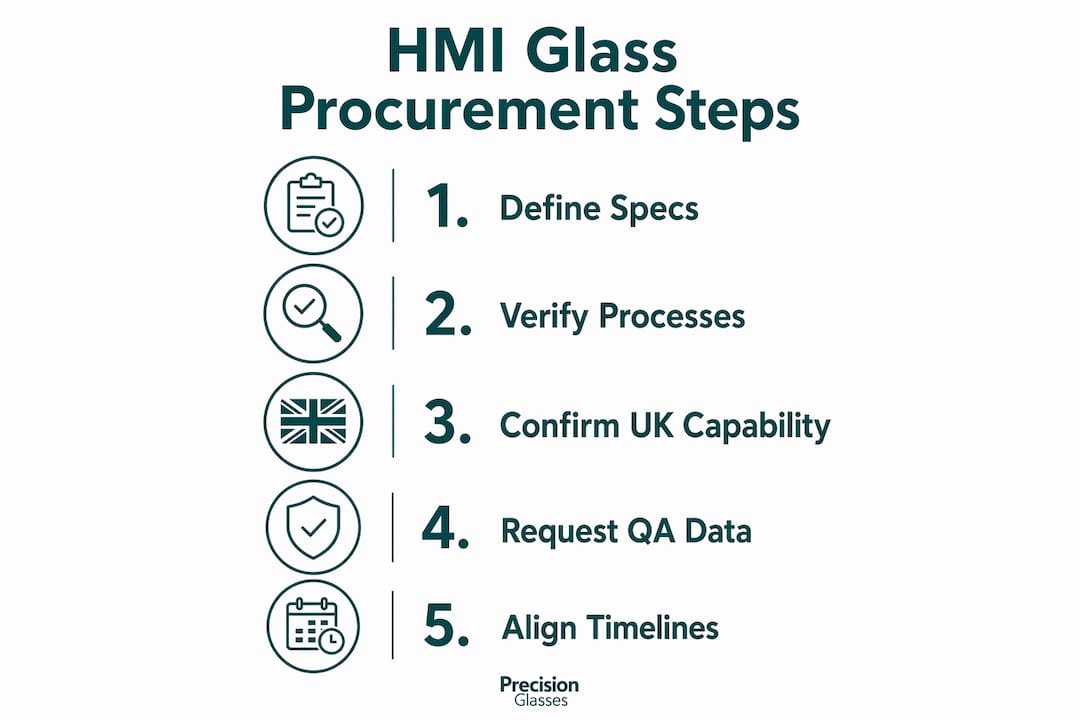
The fields that materially change manufacturability and final performance are often omitted from early RFQs, leading to non-comparable quotes and avoidable redesigns. A precise brief is the procurement team’s most effective tool.
Required specification fields:
- Application sector and regulatory environment (defence, aerospace, medical, automotive)
- Intended sensor type (projected capacitive, resistive, optical)
- Optical requirements: minimum transmittance (%), maximum haze (%)
- Nominal thickness and tolerance (e.g. 1.1 mm ±0.05 mm)
- Flatness and total thickness variation targets
- Edgework: ground, polished, bevelled, or chamfered; corner radii
- Cutouts, holes, or recesses with positional tolerances
- Coatings required: anti-reflective (AR), anti-fingerprint (oleophobic), antimicrobial, conductive traces for touch sensing
- EMI and grounding requirements: shielding effectiveness target, grounding tab positions
- Bonding or assembly notes: optical bonding, frame adhesive, gasket interface
Common custom cover glass treatments include AR, oleophobic, antimicrobial, and chemically strengthened substrates. Specifying which are mandatory versus preferred helps manufacturers price accurately and flag process constraints early.
| Parameter | Prototype target | Volume production target |
|---|---|---|
| Thickness tolerance | ±0.05 mm | ±0.05 mm |
| AR coating transmittance | minimum transmittance (%) | minimum transmittance (%) |
Include your programme timeline, target annual volumes, and any IP or confidentiality requirements in the RFQ cover note. Manufacturers use volume data to advise on tooling investment and process routing.
Which manufacturing processes should you verify before placing an order?
Procurement must verify five core capabilities: CNC machining, laser processing, thermal or chemical strengthening, thin-film deposition, and optical bonding. Each maps directly to a performance requirement, and a supplier missing one will either subcontract it (introducing quality risk) or decline the work.

Laser scribing and CNC grinding handle precision cutouts and edge profiles. Laser scribing achieves tighter positional tolerances on internal apertures than mechanical scribing, particularly in thin substrates below 1.5 mm. Ion-exchange chemical strengthening is the preferred route for cover glass below 2 mm, delivering compressive surface stress without the distortion risk of thermal tempering.
| Capability | Industry-recognised threshold | Why it matters |
|---|---|---|
| Optical flatness | λ/4 | Prevents sensor sensitivity variation across the active area |
| Thickness tolerance | ±0.05 mm | Maintains consistent capacitive coupling |
| Edge strength (after processing) | — | Meets mechanical durability requirements for field use |
| AR coating uniformity | — | Ensures consistent optical performance |
| Bonding void content | — | Prevents delamination under thermal cycling |
In-house sensor manufacture and glass fabrication under one roof improves availability and quality control. Suppliers who manufacture glass sensors in-house avoid the procurement fragility that comes with multi-tier subcontracting — a material consideration for long-run defence and medical programmes.
Check whether the supplier holds UK production capability or relies on offshore fabrication with UK finishing. For programmes subject to ITAR, export controls, or NHS supply-chain requirements, domestic production is often a contractual necessity, not a preference. Assembly and sight-glass sealing interfaces should also be confirmed at this stage for enclosed or pressurised installations.
What quality standards and testing should you request from a supplier?
Standards and testing are non-negotiable for regulated sectors. A supplier who cannot provide traceable batch documentation, calibrated optical test data, and a named certification body should not progress past the RFQ stage.
Certifications to request:
- ISO 9001 — baseline quality management; mandatory for any precision glass supplier
- AS9100 — aerospace and defence quality management; required for programmes under EASA, MOD, or equivalent authority
- ISO 13485 — medical device quality management; required for IVD, surgical, and patient-monitoring applications
- RoHS and REACH compliance — materials declarations for all coatings, adhesives, and substrates
Testing checklist per batch:
- Optical metrology: interferometry for flatness and TTV, spectrophotometry for transmittance and haze
- AR/anti-reflection verification: measured reflectance and transmittance at specified wavelengths
- Environmental testing: thermal cycling (per IEC 60068-2-14 or equivalent), salt-spray where specified
- Mechanical: impact resistance, scratch hardness (Mohs or Vickers), adhesion cross-cut test for coatings
- EMI verification: shielding effectiveness measurement where conductive coatings are present
Each batch acceptance report should contain: measured values against drawing tolerances, optical test data with calibration traceability, material certificates, process sign-off by a named quality engineer, and lot identification for full traceability. Precision Glasses publishes its quality assurance approach for buyers who want to review the framework before requesting samples.
Callout: Regulated programmes in aerospace and medical routinely require first-article inspection (FAI) reports in addition to batch certificates. Confirm this requirement in your RFQ and ask whether the supplier’s QMS covers FAI as a standard deliverable.
What are typical lead times and the main cost drivers?
Prototype glass components typically require a few weeks from approved drawing to delivery. Small pilot batches take somewhat longer once tooling is confirmed. Volume production lead times vary depending on coating complexity and substrate availability, but generally require several weeks to plan for a new part number entering production.
Typical NPI cycle:
- Design review and DFM (design for manufacture) feedback — 1–2 weeks
- Prototype fabrication and optical inspection — 3–5 weeks
- Customer test and approval — customer-controlled
- Pilot batch with full QA documentation — 4–6 weeks
- Volume production release — ongoing
Primary cost drivers:
- Tooling and NRE (non-recurring engineering): CNC programmes, jigs, and inspection fixtures
- Material grade: optical-grade borosilicate or aluminosilicate versus standard soda-lime
- Coating complexity: single AR layer versus multi-layer AR plus conductive plus oleophobic stack
- Tight tolerances: sub-±0.05 mm thickness and flatness below λ/4 increase yield losses
- Inspection requirements: FAI, 100% optical inspection, and third-party certification add cost
- Lot size: NRE amortises rapidly; a £3,000 tooling cost across 50 units adds £60 per unit, but across 500 units it adds £6 per unit
Pro Tip: Request a detailed NRE breakdown in your first quotation. Suppliers who bundle tooling into unit price make it difficult to compare quotes and obscure the true cost of low-volume prototype runs.
The touch display customisation process at Precision Glasses follows this NPI structure, with design review built into the first engagement step.
How do you choose a UK HMI glass manufacturer?
Focus on design-partner capability, proven sector experience, and documented QA. A supplier who can only quote from a drawing — rather than contribute to the specification — will cost you more in redesign cycles than any unit-price saving justifies.
Procurement questions to ask:
- Which certifications do you hold, and can you provide current certificates?
- Do you perform optical metrology in-house or subcontract it?
- What is your standard NPI process, and at what stage do you issue DFM feedback?
- Can you supply first-article inspection reports as a standard deliverable?
- What is your sample and prototype policy, and what are the associated costs?
- How do you handle IP and confidentiality for new part numbers?
- What warranty or acceptance terms apply to batch deliveries?
Red flags to watch for:
- No traceable certifications or expired certificates presented without explanation
- Unwillingness to share optical test data or batch inspection reports
- No defined NPI process — quoting from drawing only, with no DFM stage
- Ambiguous or absent warranty terms for coating adhesion and dimensional conformance
- Offshore fabrication presented as UK supply without clarity on where processing occurs
A minimum RFQ technical data pack should include: dimensioned drawing with GD&T callouts, optical specification table, coating stack description, environmental test requirements, and an indication of expected annual volume. Request a sample acceptance plan — a document stating the measurements, methods, and pass/fail criteria for each batch.
Precision Glasses: a UK-capable HMI glass partner
Precision Glasses is a UK-capable precision HMI glass manufacturer serving defence, aerospace, medical, automotive, lighting, and electronics programmes. Our core capabilities cover custom cover glass, functional glass assemblies, multi-layer coatings (AR, conductive, oleophobic), optical bonding, and full batch test reporting. We work with engineered glass types suited to the optical and mechanical demands of each sector.
Our NPI engagement follows three structured steps:
- Discovery: technical workshop to review your specification, sensor stack, and environmental requirements; DFM feedback issued within the same session where possible.
- Prototype: fabrication of agreed sample quantities with full optical metrology and inspection report; customer approval gate before proceeding.
- Pilot and volume: pilot batch with FAI documentation, followed by volume production under the agreed quality plan.
Pro Tip: Bring your sensor designer to the discovery session. Aligning glass TTV and coating conductivity with the sensor’s detection threshold at that stage eliminates the most common source of integration failure.
Request a capability statement, technical data sheet, or quotation at glassprecision.com.
Key takeaways
Precision HMI glass selection requires early supplier engagement, complete specifications, and verified QA documentation — not just a unit price comparison.
| Point | Details |
|---|---|
| Specify completely | Include thickness, flatness, coatings, EMI needs, and sector in every RFQ to get comparable, accurate quotes. |
| Verify five core capabilities | CNC, laser processing, strengthening, thin-film deposition, and optical bonding must all be confirmed in-house. |
| Demand traceable QA | ISO 9001, AS9100 or ISO 13485 certificates and batch optical metrology reports are non-negotiable for regulated programmes. |
| Understand NRE amortisation | Tooling costs divide across unit volume — request a separate NRE line in every quotation to compare suppliers fairly. |
| Precision Glasses | A UK-capable partner offering custom HMI glass, multi-layer coatings, optical bonding, and full NPI support for regulated sectors. |
The case for treating your glass supplier as a design partner
The most persistent mistake we see in HMI programmes is treating glass as a commodity line item. Engineers finalise the sensor stack, define the mechanical envelope, and then ask a glass supplier to cut a substrate to size. By that point, the glass thickness is fixed, the coating stack is an afterthought, and EMI requirements have never been discussed with the person fabricating the cover. The result is a validation phase full of surprises.
The programmes that run cleanly are the ones where the glass manufacturer is in the room during the sensor design review. Glass composition, TTV, and surface conductivity are not independent variables — they interact with the sensor’s detection algorithm in ways that only become visible during integration testing if they have not been resolved earlier. One anonymised medical device client reduced their validation cycle by several weeks after moving the glass specification discussion to the concept phase, allowing the sensor designer and glass team to agree on TTV and coating resistance targets before any tooling was committed.
That is the model we advocate and the one we practise at Precision Glasses.
Work with Precision Glasses on your next HMI programme
Precision Glasses delivers custom HMI display glass fabrication for UK defence, aerospace, medical, and automotive programmes, with domestic production capability, ISO 9001 quality assurance, and a structured NPI process that engages at the specification stage. For buyers who need a supplier that contributes technically rather than simply fulfilling a drawing, we are the right conversation to start.

Review our sector capabilities and request a quotation or capability statement at glassprecision.com. For quality documentation and certification details, visit our quality assurance page.
Useful standards and technical references
- ISO 9001:2015 — quality management systems; the baseline certification to request from any precision glass supplier. Published by ISO; available via BSI (bsigroup.com).
- AS9100 Rev D — aerospace quality management standard; mandatory for defence and aerospace supply chains. Published by SAE International; recognised by the UK CAA and MOD.
- ISO 13485:2016 — medical device quality management; required for glass components used in IVD, surgical, or patient-monitoring equipment. Published by ISO; enforced in the UK by the MHRA.
- RoHS Directive (2011/65/EU, as retained in UK law) — restricts hazardous substances in electrical and electronic equipment; applies to coatings and adhesives. UK implementation via the Electrical Equipment (Safety) Regulations 2016.
- REACH Regulation (EC 1907/2006, as retained in UK law) — chemical substance registration and restriction; applies to glass coatings and bonding agents. Administered in Great Britain by the HSE.
- IEC 60068-2 series — environmental testing standards (thermal cycling, humidity, vibration, salt spray); the reference test methods to specify in acceptance plans.
- BSI (bsigroup.com) — UK national standards body; source for ISO and BS EN standards relevant to glass, optics, and quality management.
- Precision Glasses publishes technical resources on touchscreen glass selection and EMI shielding for glass that expand on the specification and testing topics covered here.