

What is Optiwhite glass and why does it matter for precision applications?
Pilkington Optiwhite™ is a registered low-iron float glass produced by carefully limiting iron oxide content to achieve ultra-high light transmission and complete colour neutrality. Unlike standard clear float, it carries virtually no green tint, making it the material of choice wherever optical accuracy is non-negotiable.
Key characteristics that define Optiwhite glass for high-precision use:
- Iron oxide content held below 0.01% total iron oxides, eliminating the colour cast inherent in conventional float glass
- Thickness range from 2 mm to 19 mm, supporting design flexibility across structural and optical components
- Superior light transmission, measurably higher than standard clear float at equivalent thickness
- Colour neutrality, critical for medical imaging panels, display systems, and defence optics where true colour rendition affects operational decisions
- Compatibility with secondary processing including toughening, laminating, CNC edge work, and coating application
For defence, aerospace, medical, and electronics clients, these properties are not aesthetic preferences. They are specification requirements.
Table of Contents
- How Optiwhite glass manufacturing works: process, quality, and customisation
- Precision Glasses: your UK partner for Optiwhite glass components
- Key takeaways
How Optiwhite glass manufacturing works: process, quality, and customisation
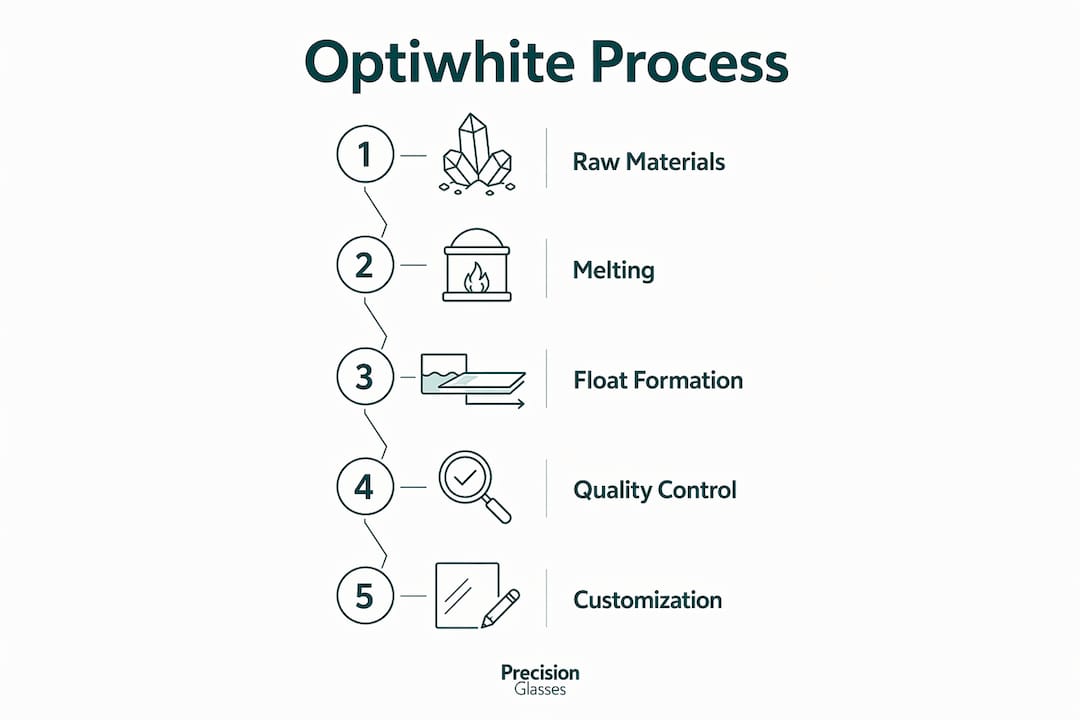
Producing high clarity glass to Optiwhite standards demands tight process control at every stage, from raw material selection through to final inspection.

Raw material selection and melting
Low-iron float glass begins with carefully sourced silica sand and batch materials chosen for naturally low iron content. The melting process is tightly controlled to maintain a precise redox ratio, the balance between ferrous (Fe²⁺) and ferric (Fe³⁺) iron states. For low infrared-absorbing glass suited to ballistic viewing covers and sensor windows, the optimal redox ratio typically falls in the range of 0.005–0.15, with FeO held between 0.0005 and 0.015 wt%. Specifying a generic “clear glass” without these parameters risks failing critical infrared or radiation performance thresholds in defence and medical devices.
Quality control and testing
Rigorous quality assurance at Precision Glasses encompasses spectral transmission testing, surface flaw detection, and redox ratio verification. These checks confirm that each component meets the exacting optical and mechanical specifications demanded by aerospace, medical, and defence procurement. Consistent manufacturing quality control processes are what separate a certified Optiwhite component from a generic low-iron alternative.
Radiation and infrared performance
In radiation-prone environments, low-iron glass attenuates low-energy X-rays while maintaining colour neutrality, a balance that lead glass cannot offer without sacrificing transparency. For night-vision and sensor applications, iron content and redox ratio directly govern infrared transmission characteristics.
Customisation and lead times
| Parameter | Optiwhite capability |
|---|---|
| Thickness range | 2 mm – 19 mm |
| Edge finishing | Ground, polished, CNC profiled |
| Secondary processing | Toughening, laminating, coating |
| Radiation performance | Low-energy X-ray attenuation with full optical clarity |
| Lead time considerations | UK-based production reduces supply chain risk for critical projects |
Production capacity and lead times are a genuine procurement concern for defence and aerospace programmes. Sourcing from a UK-based custom glass manufacturer removes the delays and compliance uncertainties that come with overseas supply chains.
Precision Glasses: your UK partner for Optiwhite glass components

Precision Glasses delivers bespoke technical glass components to defence, aerospace, medical, automotive, lighting, and electronics clients across the UK. Our manufacturing process covers design consultation, fabrication to precise client specifications, and rigorous quality assurance before delivery. Every Optiwhite component we produce undergoes spectral transmission testing and surface inspection, so you receive material that performs exactly as specified, on time, every time.
Working with a UK-based Optiwhite glass supplier means shorter lead times, direct technical dialogue, and supply chain resilience for mission-critical programmes. Contact Precision Glasses today to discuss your specification requirements and request a tailored quotation.
Key takeaways
Optiwhite glass requires iron oxide content below 0.01% and a precisely controlled redox ratio to deliver the optical clarity and infrared performance that defence, aerospace, and medical applications demand.
| Point | Details |
|---|---|
| Iron content is the defining variable | Total iron oxides below 0.01% eliminate green tint and preserve colour neutrality across all thicknesses. |
| Redox ratio governs infrared performance | A ratio of 0.005–0.15 is required for low infrared absorption in ballistic and sensor applications. |
| Generic clear glass is insufficient | Without certified iron and redox specifications, components risk failing optical or radiation performance thresholds. |
| UK sourcing reduces programme risk | Domestic production shortens lead times and removes overseas compliance uncertainty for critical industrial projects. |
| Precision Glasses | Supplies custom Optiwhite components with full spectral testing and on-time delivery for defence, aerospace, and medical clients. |