
Industrial oleophobic coating glass is a fluorinated, nanoscale surface treatment applied to precision glass to resist oils, fingerprints and contamination while preserving optical clarity. The procurement verdict is straightforward: never accept a coated component without measurable oil contact-angle data, documented abrasion-cycle performance and a stated surface-activation and curing process. Coated glass suppliers should provide specification-driven coated glass built to exactly those testable criteria.
TL;DR:
- Accept coated glass only with documented oil contact angles above 60° before and after abrasion testing to ensure durable, functional performance.
- Utilize vacuum-deposited magnetron PVD coatings for the highest abrasion resistance and durability, especially on high-value or long-lasting glass.
- Specify clear measurement methods for contact angles, abrasion cycles, and optical tolerances within RFQ documents to enforce strict quality standards.
- Ensure surface preparation includes verified plasma activation and detailed curing logs to guarantee coating bonding and consistency across production batches.
- Require traceability records such as batch reports, cure logs, and test certificates to enable field failure investigation and confirm long-term coating performance.
Table of Contents
- What oleophobic coating glass actually covers
- Setting numeric targets: contact angle, abrasion and optics
- Choosing a coating process for your part geometry and volume
- Writing procurement clauses that actually hold suppliers accountable
- Quality control that catches problems before shipment
- Why detail at the spec stage saves you a field failure later
- How a supplier supports your coating specification
- Sources
- FAQ
What oleophobic coating glass actually covers
An oleophobic coating is a fluorinated silane or fluoropolymer monolayer, typically under 10 nanometres thick, chemically bonded to the glass surface to lower its surface energy. That thinness matters: the coating changes how oils and fingerprint residue behave without adding measurable dimension to a precision part or altering its optical path.
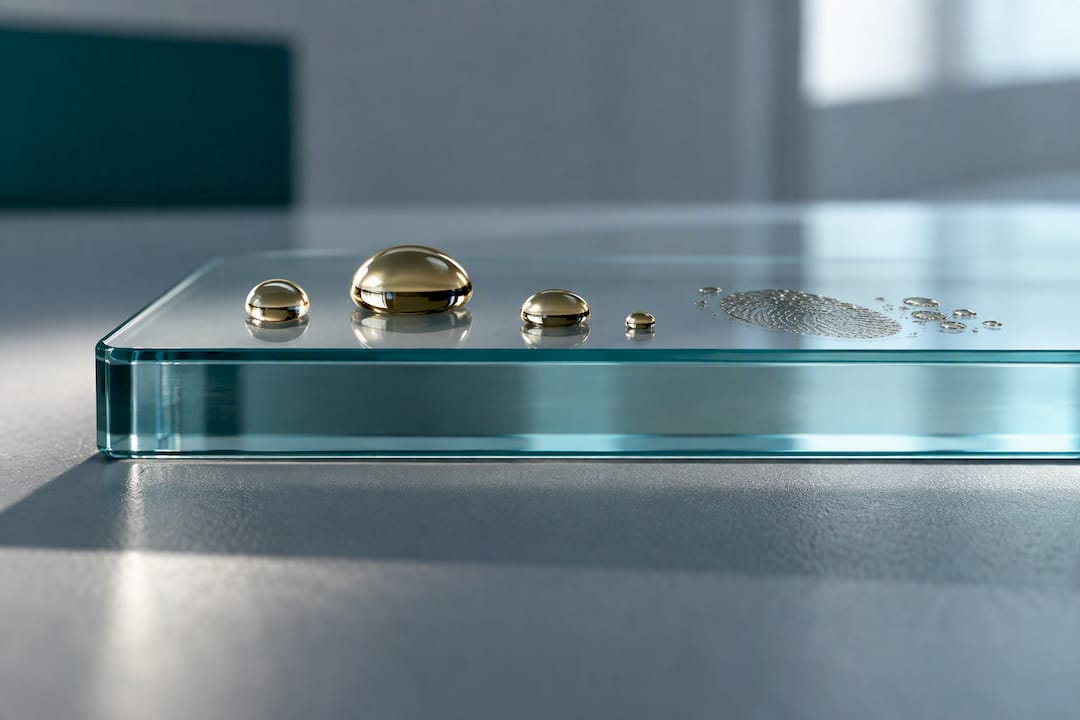
Oleophobic and hydrophobic performance are related but not interchangeable. Oleophobic behaviour is measured by oil contact angle and its hysteresis (how easily a droplet slides rather than sticks), while hydrophobic performance is measured against water. A hydrophobic glass coating can pass water-repellence tests and still smear badly under oil, grease or skin contact, which is why aerospace and medical specifications increasingly demand both figures separately rather than assuming one implies the other.
The precision-glass applications that matter here are narrow and specific:
- Capacitive touch display cover glass on instrumentation and control panels
- Sensor and camera vision windows exposed to handling and airborne contaminants
- Medical-device glass requiring resistance to skin oils and cleaning agents
- ADAS and LiDAR windows where smearing degrades detection accuracy
Setting numeric targets: contact angle, abrasion and optics
Vague language like “anti-fingerprint” or “easy-clean” has no place in an RFQ. Procurement needs three measurable categories: contact angle, mechanical durability, and optical performance, each with a stated pass threshold.
For oil contact angle, treat anything above 60° as functionally acceptable and above 75° as excellent performance for a demanding application. Water contact angle above 110° signals strong hydrophobic behaviour, useful as a secondary indicator even on a coating specified primarily for oil resistance. Both figures should be quoted as-received and after the abrasion test below, since a coating that only performs when brand new is not a coating worth specifying.
Statistic callout: Peer-reviewed testing on magnetron PVD-deposited oleophobic films demonstrates that vacuum-deposited coatings retain measurably higher abrasion resistance than simple liquid-phase alternatives when properly formulated and cured.
Abrasion benchmarking commonly follows steel wool cycling, where the coating must maintain its contact angle after multiple cycles, alongside equivalent Taber or ASTM wear tests depending on the industry sector. Build the RFQ around this checklist:
- Oil contact angle minimum stated qualitatively, pre and post abrasion
- Abrasion cycle count with pass/fail contact-angle retention
- Coefficient of friction target, particularly for touch-interface glass
- Optical transmittance and haze tolerance appropriate to the base glass and any anti-reflective coating stack
Optical tolerances deserve particular care on medical and aerospace optics, where even a small haze increase from coating thickness variation can push a component out of spec.
Choosing a coating process for your part geometry and volume
Method selection depends far more on part geometry and production volume than on coating chemistry alone. Getting this wrong is the single most common reason a coating that tested well in the lab underperforms on the production floor.
- Spray coating suits large flat parts such as display cover glass, but demands precision atomisation equipment and tight control to avoid uneven film thickness across the panel.
- Dip, flow and spin coating work well for small or geometrically complex components, where immersion or controlled rotation gives more uniform coverage than spraying can achieve on curved or recessed surfaces.
- PECVD and magnetron PVD vacuum deposition deliver the highest durability and uniformity, and the durability data on magnetron PVD oleophobic films is the clearest evidence available for specifying vacuum processes on parts that must survive years of handling.
Surface preparation decides whether any of these processes actually holds. Production guidance consistently points to plasma activation and rigorous cleanliness verification before deposition, because microscopic contamination prevents an ultrathin film from bonding durably, no matter how good the chemistry is on paper. Curing regimes then lock in performance: thermal curing at elevated temperature for a defined dwell time (commonly around 150°C for 30 minutes for some fluorinated chemistries) improves abrasion resistance substantially over coatings left to cure at room temperature only.
Pro Tip: Ask your coating supplier for the cure log, not just the finished-part test report. A contact angle reading with no curing temperature and dwell time attached tells you nothing about repeatability across production lots.
Read more on glass coating methods and industry applications if you’re weighing trade-offs between throughput and film uniformity for a specific part family.
Writing procurement clauses that actually hold suppliers accountable
A specification document is only as strong as its weakest clause. A common failure mode is a specification that names the coating type but never defines how it will be tested or accepted.
Build the clause set in this order:
- Surface preparation: state the required cleaning and activation method (plasma activation preferred for high-value optics) and require written confirmation it was performed.
- Coating chemistry class: name the chemistry family (fluorinated silane, fluoropolymer, or vacuum-deposited equivalent) rather than a trade name alone.
- Maximum film thickness: cap it in nanometres to protect optical tolerances on coated optics.
- Contact-angle minimums: state oil and water contact angle separately, pre and post abrasion.
- Abrasion test and pass criteria: name the cycle count and the contact-angle retention threshold that constitutes a pass.
- Optical transmittance and haze limits: state acceptable percentage ranges against the uncoated substrate baseline.
Test methods need naming, not assuming. Specify the contact-angle measurement method (goniometer, sessile drop), the abrasion procedure, and an adhesion test such as an ASTM D3359-equivalent tape test, plus the sampling and lot-acceptance rule (how many parts per batch get tested, and what happens on a fail).
Then lock in traceability requirements: batch reports, cure logs, supplier test certificates, and a defined non-conformance handling procedure. Without these, a coating that fails in the field six months after acceptance is impossible to trace back to a specific production run. Guidance on testable hydrophobic and oleophobic specification writing covers clause structures worth adapting directly.
Quality control that catches problems before shipment
Production-floor QC needs to be quick enough to run inline and rigorous enough to catch a bad batch before it ships. Three checks belong at every station: a water-break test to confirm surface activation worked, a dyne-pen check on incoming glass, and periodic contact-angle spot checks against the accepted minimum.
Durability sampling runs on a slower cycle but matters just as much. Pull samples for abrasion and chemical-resistance testing, and where the application involves outdoor or under-hood exposure, add accelerated weathering. Recommended QC protocols for industrial nano coatings pair these mechanical tests with adhesion checks and full optical transmittance and haze verification.
| QC check | What it verifies | Typical frequency |
|---|---|---|
| Water-break test | Surface activation completeness | Every production run |
| Contact-angle spot check | Coating uniformity against spec minimum | Per batch |
| Abrasion cycle test | Durability retention | Sampled per lot |
| Adhesion (tape test equivalent) | Bond strength to substrate | Sampled per lot |
| Optical transmittance/haze | Optical performance against baseline | Per batch |
Record everything against the batch it came from. A supplier who can hand over a full traceability chain, curing records, test certificates and agreed rework thresholds included, has already done half the work of proving the coating will survive in service.
Why detail at the spec stage saves you a field failure later
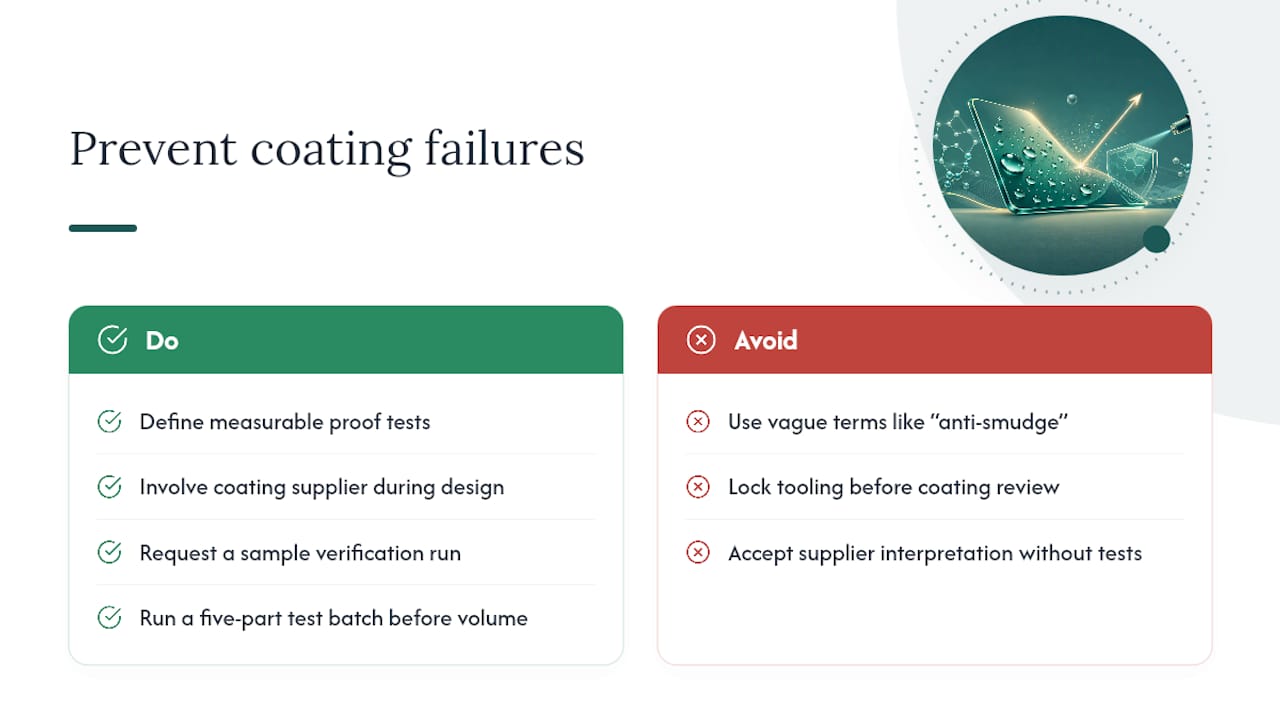
Most coating failures often trace back to a specification that named a coating but never defined how to prove it worked. Vague language like “anti-smudge” or “easy-clean” gives a supplier room to interpret the requirement however suits their process, and that gap only surfaces after parts are in the field.
The trade-off between durability, optics and manufacturability is real, and no single process wins on all three. Vacuum deposition gives the best durability but costs more and suits lower-volume, high-value parts; spray and dip methods scale cheaply but demand tighter process control to avoid uneven films. Bring your coating supplier in during design, not after tooling is locked, and always request a sample verification run before committing to volume. A five-part test batch costs far less than a field recall.
— Alexandra
How a supplier supports your coating specification
Getting a coating spec right on paper is one thing; getting a supplier who can actually manufacture and prove it is another. Some manufacturers build oleophobic-coated precision glass with documented surface-activation steps, cure logs, and batch-level traceability, so the acceptance criteria in your RFQ are things that can be demonstrated, not just promised.

Capabilities often span coated glass, CNC glass machining, edge finishing and toughened and laminated glass, sometimes backed by ISO 9001 certified, audit-ready production. If specifying oleophobic or combined AR-oleophobic windows for a display, sensor or medical-device application, suppliers may offer sample verification runs against stated contact-angle and abrasion criteria before committing to volume. Browse our coating and glass services, or if your part also involves catalogue optics, check the optical components range for lenses and filters that can be coated to the same specification. Request a technical briefing or an RFQ-ready sample through either page to get your specification checked against production reality.
Sources
- Durability of transparent oleophobic coatings deposited by magnetron PVD
- Industrial Glass Nano Coating Application Guide – 2026
- Glass in building – Coated glass – Part 2: Requirements and test methods for class A, B and S coatings
FAQ
What Is the Difference Between Oleophobic and Hydrophobic Coatings?
Oleophobic coatings repel oils and fingerprint residue, measured by oil contact angle, while hydrophobic coatings repel water, measured separately. A coating can perform well against water and poorly against oil, so demanding specs require both figures independently rather than assuming one guarantees the other.
What Oil Contact Angle Should I Specify for Industrial Glass?
Treat an oil contact angle above 60° as functionally acceptable and above 75° as excellent for demanding applications. Always require the figure measured both before and after the specified abrasion test, since a coating’s real-world value depends on retaining that angle in service.
Which Coating Process Gives the Best Durability?
Magnetron PVD vacuum deposition processes generally deliver the highest durability and uniformity, supported by peer-reviewed abrasion-resistance data. Spray, dip and spin coating remain viable for lower-cost or higher-volume production where slightly reduced durability is an acceptable trade-off.
Does Precision Glasses Supply Oleophobic-Coated Glass?
Yes, Precision Glasses manufactures oleophobic and combined AR-oleophobic coated precision glass with documented surface activation, curing records and batch traceability. Current capabilities and specification options are listed on the services page.
What Standard Should I Reference for Coated-Glass Testing?
EN 1096-2 is the normative European standard covering requirements and test methods for coatings on glass, including artificial weathering and abrasion resistance for Class A, B and S coatings. Referencing it in an RFQ gives both supplier and buyer a shared, checkable basis for acceptance testing.