
Borosilicate 3.3 and high-silica glasses lead the field in chemical durability, while soda-lime glass falls behind under alkaline or acidic exposure. Even the toughest formulations fail against hydrofluoric acid, hot concentrated phosphoric acid, and strong hot alkalis. Engineers should demand ISO 719, ISO 720, ISO 695, or ISO 8424 test evidence rather than marketing claims, and suppliers can supply testable specifications and traceable samples on request.
TL;DR:
- Borosilicate 3.3 and high-silica glasses offer the best chemical resistance, especially against water, acids, salts, and organic solvents, but fail against hydrofluoric acid and strong hot alkalis.
- Test results from ISO 719, 720, 695, and 8424 vary significantly depending on test conditions, specimen form, and classification, so specification details must specify the test method and parameters.
- Cumulative exposure from repeated alkaline cleaning cycles causes more damage than a single lab test, making batch traceability and test evidence essential for reliable quality control.
- Optical and display components require testing of haze, transmittance, and scatter, not just dissolution figures, since visual degradation can occur independently of mass loss.
- Suppliers should provide testable, traceable samples with full raw data and accreditation to ensure the glass’s chemical durability matches application-specific field conditions.
Table of Contents
- Which glass types offer the best chemical resistance?
- Why does test temperature change how glass corrodes?
- What do ISO 719, 720, 695, and 8424 actually measure?
- How should engineers write a chemical resistance spec?
- What do engineers get wrong about chemical resistance testing?
- Perspective: match the durability metric to the application
- Get testable evidence before you specify
- Sources
- FAQ
Which glass types offer the best chemical resistance?
Composition dictates behaviour long before any coating or treatment gets involved. Silica (SiO2) content forms the network backbone that resists dissolution, boron oxide (B2O3) lowers thermal expansion without sacrificing durability, and alumina (Al2O3) reinforces the network against ion exchange. Glasses with more of the first two and less soda tend to survive harsher chemistries for longer.
Here’s how the common families stack up against real exposure conditions:
- Soda-lime glass: cheap and easy to form, but the high sodium content makes it vulnerable to leaching in water and alkaline cleaning solutions over repeated cycles.
- Borosilicate 3.3: over 80% silica, and it resists water, acids, salts, halogens, and organic solvents well, though hydrofluoric acid, hot concentrated phosphoric acid, and strong alkaline solutions still cause appreciable corrosion.
- Aluminosilicate glass: alumina boosts mechanical strength and ion-exchange resistance, making it a common choice for chemically strengthened cover glass.
- High-silica glass: near-pure silica content gives outstanding resistance across almost every chemistry except hydrofluoric acid and superheated alkalis.
- Specialist optical glasses: formulations vary enormously, and some low-silica optical types corrode readily under caustic exposure despite excellent optical performance.
A supplier’s claim that a glass is “chemically resistant” means little without three things attached: the ISO classification achieved, the test method used to get there, and the condition of the specimen tested (powder, plate, ground, or polished). Our glass selection guide breaks down how to match composition data to your application before you commit to a material.
Pro Tip: If your process involves repeated alkaline cleaning cycles, avoid specifying soda-lime purely on cost. The cumulative attack from dozens of wash cycles behaves very differently to a single lab soak test, and soda-lime rarely survives that cumulative exposure as well as the datasheet implies.
Why does test temperature change how glass corrodes?
Chemical attack on glass starts with ion exchange: hydrogen ions from the solution swap places with sodium or potassium ions in the glass network, leaching alkali out of the surface. This leaves behind a silica-rich layer that, under the right conditions, slows further attack by acting as a partial barrier.
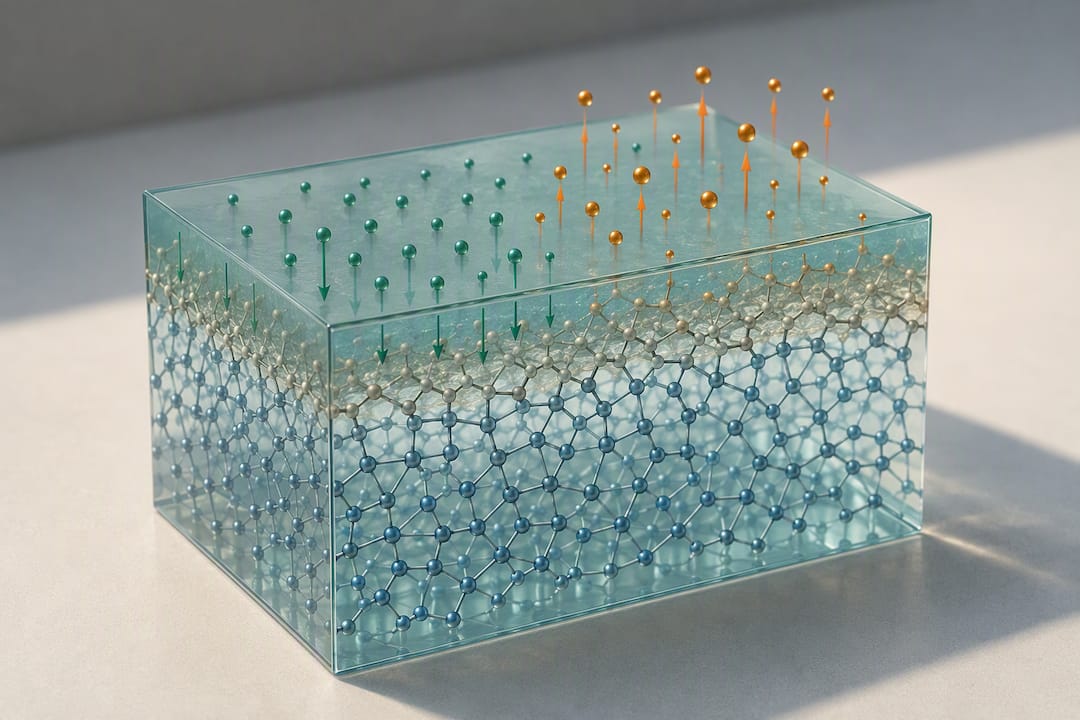
That slowdown is not permanent. Aqueous alteration research identifies distinct kinetic regimes: an initial fast dissolution stage, a much slower residual-rate stage once the passivation layer forms, and in some cases a resumption of rapid attack if secondary phases precipitate and disrupt that protective layer.
Several variables control which regime dominates:
- pH shifts the dominant mechanism between ion exchange and network dissolution.
- Temperature accelerates every reaction rate, often non-linearly.
- Redox conditions and solution saturation determine whether by-products redeposit or wash away.
Accelerated tests that push temperature or concentration too far can shift the mechanism entirely, which means the result no longer predicts real service behaviour.
What do ISO 719, 720, 695, and 8424 actually measure?
Reading a lab report correctly means knowing which standard applies to which glass and what the numbers represent. ISO 719 tests hydrolytic resistance at 98°C and classifies less-resistant glasses like soda-lime by the alkali extracted, measured through titration. ISO 720 runs the same principle at 121°C, aimed at more resistant glasses such as borosilicate, and its classes are not interchangeable with ISO 719 results.
Statistic to know: ISO 719 and ISO 720 use distinctly different temperature conditions between their tests, and treating the two classification scales as equivalent is one of the most common specification errors procurement teams make.
For alkali and acid resistance, two further standards apply:
- ISO 695 measures resistance to a boiling mixed-alkali solution, reported alongside full specimen and method detail because alkali attack is highly sensitive to concentration and exposure time.
- ISO 8424 covers raw optical glass resistance to acidic solutions, using surface and powder methods to assign SR-S or SR-P classes.
A spec that names only “ISO tested” without the edition, specimen form, and reported metric tells you almost nothing worth acting on.
How should engineers write a chemical resistance spec?
A usable specification names the exact glass designation, not a generic family name, and pairs it with the ISO test and edition applied. Beyond that, it needs specimen geometry and surface finish (ground powder behaves very differently from a polished plate), the exact exposure chemistry including reagent, concentration and pH, temperature, duration, and the acceptance metric with its tolerance band.
Qualification testing and batch verification serve different purposes, and treating them as interchangeable is a common procurement mistake. Qualification proves the design works under worst-case exposure; batch verification confirms ongoing production consistency, usually on a smaller sample count with traceability back to melt or lot number.
Ask suppliers for these measurables, not just a pass/fail statement:
- Mass loss and titrated Na2O equivalent, reported with measurement uncertainty.
- Allowable visual or optical change, defined numerically rather than by description.
- Full raw data alongside the summary report, not just the final classification.
- Evidence of accredited lab testing, similar in spirit to the traceability NIST maintains through its SRM 208.1 reference material for calibrating durability test equipment.
Pro Tip: Always request batch traceability and sample retention alongside the test report. A single glowing certificate proves nothing about the batch actually shipped to your line, and disputes over chemical failures almost always come back to this gap. Our guide to precision glass manufacturing workflow walks through how traceability gets built into production from the start.
What do engineers get wrong about chemical resistance testing?
Mass loss tells you part of the story, not the whole one. For display and optical components, gloss retention, transmittance, and haze can decouple entirely from dissolution figures, meaning a part can pass a mass-loss threshold while looking visibly degraded.
A single short soak test is not qualification. Real-world failure usually comes from cumulative exposure, not one event, so acceptance testing should mirror the actual cycle count a part will see in service.
Common failure modes worth watching for:
- Cumulative alkali attack from repeated cleaning cycles that a one-off soak test never reveals.
- Localised corrosion from deposit build-up rather than uniform surface loss.
- Coating delamination triggered by chemical exposure the coating itself was never rated against.
Pro Tip: Request haze, transmission, reflectance, and scatter data alongside mass loss for any optical or display part. These indicators are not interchangeable, and a supplier reporting only one gives you an incomplete picture. Our notes on optimising glass durability expand on how to weigh these metrics against each other for different applications.
Perspective: match the durability metric to the application
Mass-loss and hydrolytic classes matter most for containers and sterilisation-heavy uses. Optical metrics, gloss, transmittance, haze, matter more for displays and windows than dissolution figures ever will. Coated or functional glass needs both measured together, and acceptance limits should reflect the chemistry your product will actually meet in the field, not a generic lab benchmark.
— Alexandra
Get testable evidence before you specify
There are other routes to sourcing chemically durable glass, including buying to a generic family specification and hoping the batch matches the datasheet. Some suppliers take a different route: supplying specification-grade components with test reports, batch traceability, and quality control behind every order, so you are not qualifying blind.

Our capabilities cover custom optical and technical glass, coated glass including AR/AG treatments, and toughened or laminated builds where chemical exposure meets mechanical demands. Every order carries batch-level traceability, and we can work directly against the ISO test evidence your project specifies rather than a generic claim of resistance. If you are speccing components for medical, aerospace, defense, or electronics applications where chemical exposure is a real design constraint, browse our glass fabrication services or request a specification review against your exact exposure conditions, temperature, reagent, and duration included.
Sources
- ISO 720:2020 – Glass — Hydrolytic resistance of glass grains at 121 °C — Method of test and classification
- Glass types & properties | DWK Life Sciences
- Aqueous alteration of silicate glass: state of knowledge and perspectives (npj Materials Degradation, 2021)
FAQ
Is glass chemically resistant?
Most glass resists everyday chemicals well, particularly water, salts, and common solvents, but resistance varies sharply by family, as detailed in discussions of glass hardware durability. Borosilicate and high-silica glasses hold up far better than soda-lime under prolonged or aggressive exposure, and the ISO 719 and ISO 720 standards exist precisely because “resistant” needs a measurable classification.
Why don’t chemicals react with glass?
Glass’s silica network forms strong, largely inert chemical bonds that most acids and neutral solutions cannot easily break. Attack usually starts as ion exchange, where hydrogen ions swap with sodium in the glass surface, rather than a direct chemical reaction with the silica backbone itself.
What glass can withstand 1,000 degrees?
High-silica and certain borosilicate formulations tolerate extreme heat far better than soda-lime glass, though exact thermal limits depend on the specific composition and thickness. This is a separate property from chemical resistance, and a supplier should provide thermal shock data alongside any chemical test report; our note on thermal shock tolerances covers how the two properties interact in practice.
What chemicals can damage glass?
Hydrofluoric acid attacks virtually all glass types regardless of composition, and hot concentrated phosphoric acid along with strong hot alkaline solutions cause appreciable corrosion even in durable borosilicate 3.3 formulations. Elevated temperature and concentration make every one of these chemistries considerably more aggressive.