
The right coating family for an optical window depends on three variables: spectral band, substrate, and mechanical exposure. Broadband multilayer AR suits visible and NIR imaging, tuned narrowband stacks (850 nm, 905 nm, 1550 nm) suit laser and LIDAR sensing, and moth-eye metasurfaces solve LWIR transmission losses on silicon. For high-wear scanner and industrial windows, DLC or laminated sapphire overlays matter more than the AR stack itself. Before writing an RFQ, define your target wavelength band, substrate, and environment, and demand spectrophotometer or FTIR transmission data from any supplier.
TL;DR:
- Coating choice must be tailored to the specific spectral band, substrate, and environment, with clear specifications on transmission and durability for reliable performance.
- Multilayer dielectric AR coatings perform best for visible and NIR imaging, while narrowband coatings are essential for laser and LIDAR applications; moth-eye metasurfaces excel in LWIR but have practical performance limits.
- Substrate material and thermal process compatibility heavily influence coating design, with silicon and germanium requiring textured solutions due to high refractive indices, and sapphire offering durability at a higher cost.
- Durability testing should include cycle-based abrasion, hardness measurements, and adhesion verification, as optical performance alone does not guarantee long-term field success.
- RFQs should specify measurable spectral and mechanical criteria upfront, demand raw test data, and consider manufacturing constraints like deposition method and batch size to ensure field-ready optical windows.
Table of Contents
- How optical window coatings change transmittance and reflectance
- Which coating technology fits which sensor application?
- Does the substrate limit which coatings you can use?
- How do you specify durability for coated windows?
- What should you require in an optical coating RFQ?
- What manufacturing constraints affect coating cost and lead time?
- How Precision Glasses engineers and verifies coated optical windows
- Why engineers overrate broadband and underrate the spec sheet
- Get an RFQ for custom coated optical windows
- Sources
- FAQ
How optical window coatings change transmittance and reflectance
Every uncoated glass or crystal surface loses light to Fresnel reflection: the fraction of light bounced back at an interface because of the mismatch between the refractive indices of air and the substrate. Higher-index materials lose far more. Silicon windows used in wafer-level LWIR packages can lose a significant portion of transmission at a single uncoated air-silicon interface, which is why bare silicon sensors underperform without treatment.
Anti-reflective coatings work by inserting thin dielectric layers whose thickness and index are tuned so reflected waves from each interface cancel through destructive interference. A classic quarter-wave single layer reduces reflectance at one wavelength; multilayer stacks extend that cancellation across a broader band by impedance-matching the substrate to air in stages.
Two design constraints matter for engineers:
- Angle and polarisation sensitivity increase as incidence departs from normal, so a coating specified at 0° AOI can underperform at higher angles such as 30° or 45°.
- Narrowband stacks achieve deeper minima at a single wavelength but degrade faster off-band, while broadband designs trade peak performance for a flatter response across the full spectrum.
Which coating technology fits which sensor application?
Multilayer dielectric AR coatings, typically alternating layers of materials like magnesium fluoride and tantalum pentoxide, remain the default choice for visible and near-infrared imaging windows, routinely pushing average transmittance above 99% across the visible band on fused silica or BK7.
For laser-based sensing, coatings tuned to a centre wavelength and narrow bandwidth outperform broadband designs. Specialist NIR AR coatings tuned to 850 nm improve transmission through acrylic and polycarbonate windows in machine-vision and proximity sensors, and equivalent designs exist for 905 nm automotive LIDAR and 1550 nm telecom-band systems. Specify centre wavelength and bandwidth explicitly, not just “NIR AR.”
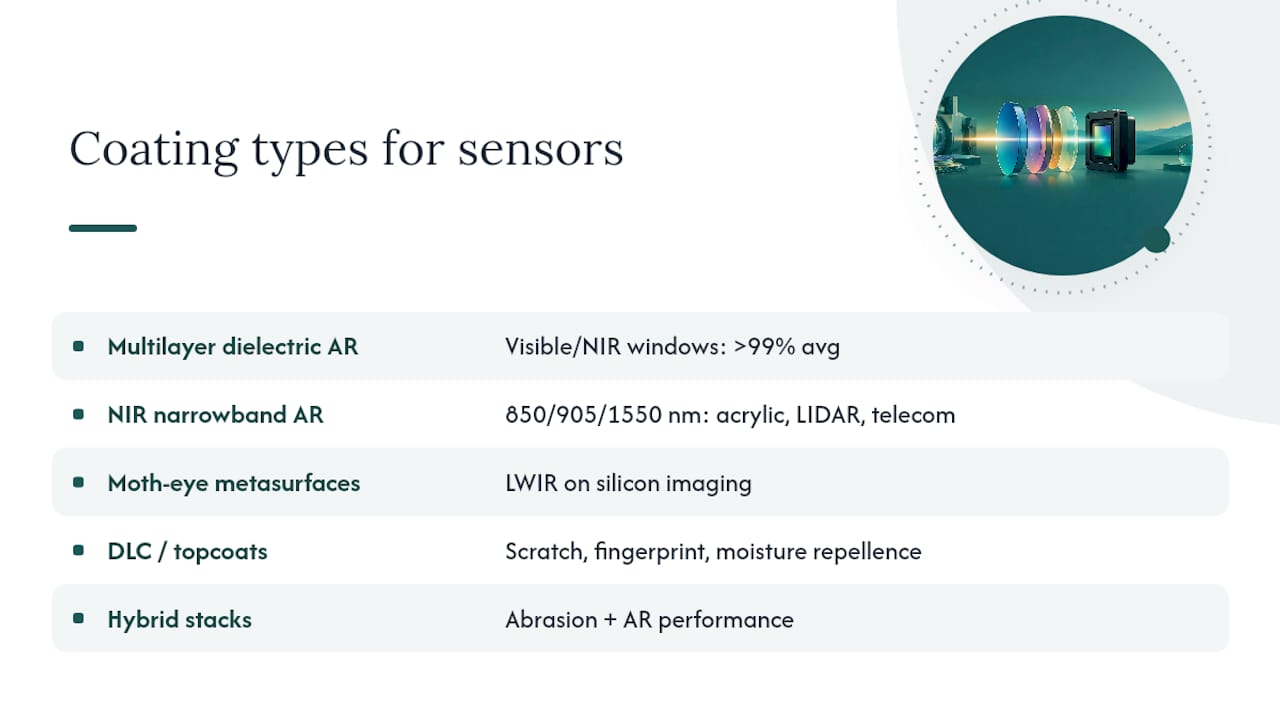
LWIR imaging on silicon substrates presents a harder problem, and this is where moth-eye metasurfaces have made the biggest recent gains.
Wear resistance is a separate problem from optical performance. DLC (diamond-like carbon) and similar superhard films protect high-contact scanner windows from scratching, while hydrophobic and oleophobic topcoats shed fingerprints, dust, and moisture that would otherwise scatter light.
Pro Tip: A hybrid stack often beats a single “best” coating. Pair a hard DLC or oxide base layer with a thin optical AR topcoat, or laminate an ultrathin sapphire overlay onto the coated substrate, so you get abrasion resistance and spectral performance in one assembly rather than choosing between them.
Does the substrate limit which coatings you can use?
Substrate index and thermal behaviour set hard limits on coating design before you even consider optical performance. BK7 (index around 1.52) and fused silica (around 1.46) allow relatively gentle index steps to air, which keeps AR stacks thin and forgiving. Silicon (index around 3.4) and germanium create a much larger index contrast, driving higher Fresnel loss and demanding either thicker multilayer stacks or a structured solution like moth-eye texturing.
Thermal budget matters just as much as optics. Some evaporated thin films cannot survive the temperatures used in wafer bonding or soldering steps downstream, which rules them out for certain wafer-level sensor packages regardless of optical merit.
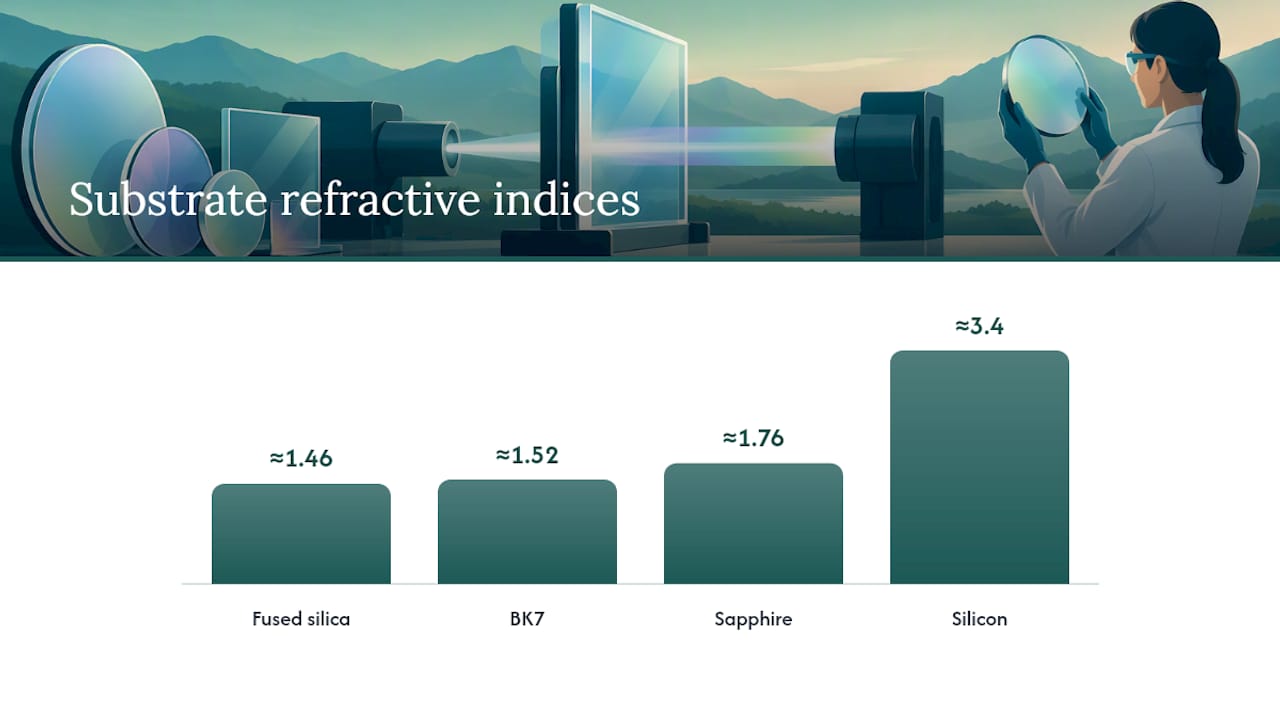
Sapphire brings its own trade-off: excellent hardness and a wide transmission window, but a high refractive index (around 1.76) and machining cost that make full sapphire plates expensive for large windows. That’s why laminating an ultrathin sapphire layer onto a lower-cost substrate using index-matched optical bonding has become a practical compromise for high-traffic scanner windows, delivering near-sapphire surface hardness without the material cost of a solid plate.
Key substrate notes worth flagging in any spec:
- Silicon and germanium need either high-layer-count AR stacks or metasurface texturing to control reflectance.
- Wafer-level CMOS and MEMS packages restrict which deposition temperatures and adhesives are usable.
- Index-matching adhesive choice affects both optical loss and long-term bond reliability under thermal cycling.
How do you specify durability for coated windows?
Optical performance is only half the specification. A coating that hits 99.5% transmittance on day one but scratches through in three months of field use has failed the job, so durability testing belongs in every RFQ alongside spectral data.
Diamond-like carbon coatings have a long track record in barcode scanner windows, where some commercial product lines have historically been sold with multi-year scratch-resistance warranties. Laminated sapphire overlays sit at the other end of the cost-versus-hardness curve: harder still, at a materials premium, but often justified for windows handling constant contact abrasion in industrial or retail scanning environments.
Order your durability testing this way when you write the RFQ:
- Request Taber abrasion cycle counts and the transmittance loss measured after those cycles, not just a pass/fail claim.
- Ask for Berkovich or Knoop hardness figures on the coating, not the substrate alone.
- Require an adhesion test report (tape pull or cross-hatch, per your applicable standard) with photographic evidence of the coating adhesion test result.
- Cross-check any warranty claim against the actual test data provided. A warranty without cycle counts and hardness numbers behind it is a marketing claim, not an engineering specification.
- Build a cleaning and replacement interval into the design from day one so field maintenance costs are predictable rather than reactive.
What should you require in an optical coating RFQ?
Turn the physics into pass/fail numbers before you send a request for quote. A realistic target for a broadband visible/NIR AR stack on fused silica is average transmittance above 99% across the design band, with reflectance below 0.5% at the peak wavelength. For LWIR moth-eye or metasurface designs, expect the achievable ceiling to sit closer to what’s been demonstrated experimentally rather than idealised marketing figures.
One fabricated wafer-level LWIR sensor using double-sided moth-eye texturing on silicon reached roughly 85% average transmission, up from about 54% bare, and produced a measured 46.7% responsivity boost in the finished device. That is the kind of number worth demanding from any LWIR coating supplier claiming broadband performance.
Documents to request alongside the quote:
- Full transmittance and reflectance spectra from spectrophotometer or FTIR measurement, not a single-wavelength number.
- Test conditions stated explicitly: angle of incidence, polarisation state, and measurement bandwidth.
- Adhesion and abrasion test reports tied to a named standard, with raw cycle and hardness data attached.
What manufacturing constraints affect coating cost and lead time?
Deposition method drives both cost and achievable tolerance. Sputter and PVD (physical vapour deposition) processes give tight, repeatable layer control for multilayer AR stacks and dominate high-volume production. E-beam evaporation suits smaller runs and certain hard-oxide layers. Moth-eye and other metasurface AR structures typically require nanoimprint lithography or similar patterning steps, which adds tooling cost upfront but scales well once the master pattern exists.
Batch size changes your economics more than most engineers expect. Small prototype runs carry proportionally higher QA overhead per unit, while volume production amortises traceability and inspection costs across thousands of parts. Surface preparation before coating, cleanliness, edge protection during handling, and correct storage between deposition and assembly all affect yield just as much as the coating chemistry itself. Optical bonding and index-matching adhesives used to integrate coated windows into sensor housings also need thermal and outgassing compatibility checks before you lock a design.
How Precision Glasses engineers and verifies coated optical windows
Custom AR and protective coatings for sensor windows, scanner glass, and precision optics are fabricated with batch-level traceability and test documentation that clients can hand to their own quality teams. Capabilities span the full range of coated glass services, from broadband AR through toughened and laminated constructions.
Verification runs through several checks before a design reaches production:
- Spectral transmittance and reflectance measurement across the specified band.
- Adhesion and abrasion testing tied to documented cycle counts and hardness figures.
- Batch traceability records suited to regulated procurement environments.
Engagement typically follows several steps: specification review, a sample coating run for qualification, performance sign-off against RFQ criteria, and handover to production once the sample passes. That sequence protects both sides from committing to volume before the optics actually perform.
Why engineers overrate broadband and underrate the spec sheet
Most procurement conversations about optical window coatings start with the wrong question: “which coating is best?” There is no universal best. A tuned 905 nm stack that performs beautifully on a LIDAR window would be the wrong choice on a broadband visible imaging system, and a moth-eye LWIR solution is wasted money on a window that never sees anything past 1,000 nm.
The conventional advice, “specify AR coating, add hard coat if needed,” treats optics and durability as an afterthought bolted onto a component that was already designed. That ordering is backwards. Spectral band and mechanical environment should shape the substrate choice first, then the coating stack, not the reverse.
What the evidence in this article actually supports is narrower and more useful: demand transmittance and reflectance spectra measured under stated angle and polarisation conditions, demand abrasion and adhesion numbers rather than warranty language, and treat a supplier’s willingness to hand over raw FTIR traces as a better signal of competence than any marketing claim about “advanced coating technology.” Engineers who write RFQs around measurable numbers get windows that perform in the field, not just on a datasheet.
— Alexandra
Get an RFQ for custom coated optical windows
This service offers a practical alternative to sourcing AR coatings and hard-wearing overlays from separate suppliers and hoping they integrate cleanly. Every coated window, from tuned NIR AR stacks to DLC-protected scanner glass and laminated sapphire overlays, comes with batch-level traceability and test documentation built into the fabrication process, so the spectral and durability data your RFQ demands can be part of the quote.

If you’re specifying sensor windows, scanner glass, or protective optics for defence, aerospace, medical device, or industrial applications, start by reviewing the coated glass services available, or browse optical components including filters and beam splitters that pair with custom windows. Send your target wavelength band, substrate preference, and durability requirements, and request a sample coating run to qualify performance before committing to volume.
Sources
- Broadband sub‑micron moth‑eye anti‑reflection coatings on silicon for wafer‑level CMOS–SOI–MEMS thermal infrared sensors
- Diamonex diamond‑like coated glass for barcode scanners
FAQ
What Is an Optical Coating?
An optical coating is a thin film, or stack of thin films, deposited on a glass or crystal surface to change how it transmits, reflects, or absorbs light at chosen wavelengths. Anti-reflective coatings reduce Fresnel losses at each interface, while hard or hydrophobic topcoats protect the surface without significantly altering its optical path.
What Are Optical Windows?
Optical windows are flat or curved glass, crystal, or polymer components that let light pass into or out of a sensor, camera, or instrument enclosure while sealing it from the environment. They are typically specified by substrate, thickness, flatness, and the coating applied to control transmittance across a target wavelength band.
What Are the Different Types of Optical Glass?
Common optical glass types include BK7 and fused silica for visible and near-infrared systems, sapphire for extreme hardness and wide transmission range, and silicon or germanium for infrared and thermal imaging. Each substrate has a different refractive index, which directly changes how much anti-reflective coating design is needed to control Fresnel loss.
What Is Optical Thin Film?
Optical thin film refers to layers, often only tens to hundreds of nanometres thick, deposited on a substrate using methods such as sputtering, evaporation, or nanoimprint patterning. The layer thickness and refractive index are engineered so that light waves reflecting from each boundary interfere destructively, reducing overall reflectance across a target band.
How Do Optical Coatings Work?
Optical coatings work primarily through thin-film interference: layers of precise thickness and index cause reflected light waves from different interfaces to cancel each other out, cutting reflectance and boosting transmittance. Structured surfaces like moth-eye metasurfaces achieve a similar effect without discrete layers, using a gradient index profile that measurably improved LWIR transmission on silicon from around 54% to 85% in double-sided form during testing.