

Germanium transmits strongly across 2–14 μm, covering both the 3–5 μm mid-wave infrared (MWIR) and 8–12 μm long-wave infrared (LWIR) thermal imaging bands. The critical caveat: transmission is highly temperature sensitive. Free-carrier absorption increases with temperature, degrading throughput noticeably above 100°C and causing rapid, near-total loss above 200°C. For a 3 mm uncoated window at room temperature, expect transmission above 45% in the 2–14 μm band. The refractive index sits near 4.0 across mid-IR wavelengths, confirmed by NIST minimum-deviation refractometry with combined standard uncertainties of 1.5×10⁻⁵ to 4.2×10⁻⁵ over 2–14 μm.
Three immediate design rules follow from this:
- Specify optical-grade, high-resistivity germanium to minimise free-carrier absorption.
- Set an explicit maximum operating temperature in your drawing, well below 100°C for sustained use.
- Require anti-reflection (AR) coatings and state thickness precisely — both directly determine throughput.
Table of Contents
- What is the refractive index of germanium, and how much does Fresnel loss matter?
- How are germanium index and transmission data measured?
- Does germanium degrade chemically or under humidity?
- How does mounting stress affect germanium transmission?
- Key takeaways
- A manufacturer’s perspective on specifying germanium correctly
- Useful sources for germanium optical data
What is the refractive index of germanium, and how much does Fresnel loss matter?
Germanium’s refractive index is approximately 4.0 across the mid-IR, which is among the highest of any common IR optical material. The NIST refractometry study measured precise values using minimum-deviation refractometry at 22.000°C, yielding a Sellmeier fit valid over 2–14 μm with combined standard uncertainties ranging from 1.5×10⁻⁵ at shorter wavelengths to 4.2×10⁻⁵ at 14 μm. Two representative index values from published data: n ≈ 4.025 at 5.2 μm and n ≈ 4.004 at 11 μm, illustrating that dispersion across the thermal bands is modest.
The SPIE Field Guide to Infrared Optical Materials notes that the IR optics community has historically relied on older index databases, and recommends using updated Sellmeier fits from modern high-purity material measurements for tighter optical designs.
Fresnel reflection at normal incidence for a single uncoated surface:
R = [(n − 1) / (n + 1)]²
For n = 4.0: Fresnel reflection at each surface causes substantial loss.
A two-surface uncoated window therefore transmits significantly less than full intensity due to Fresnel losses alone, before any bulk absorption. This is why AR coatings are not optional for most applications.
Key points for optical design:
- Budget Sellmeier uncertainties of up to 4.2×10⁻⁵ at 14 μm when modelling stray-light or wavefront error.
- dn/dT for germanium is approximately 396×10⁻⁶ /°C, meaning a 50°C temperature rise shifts the optical path length measurably in a focused system.
- Use the NIST Sellmeier coefficients in preference to older database values when designing to tight tolerances.
How are germanium index and transmission data measured?
Minimum-deviation refractometry is the method behind the most precise published index data for germanium. A prism of the material is rotated to find the angle of minimum deviation for a monochromatic beam; the geometry directly yields the refractive index. The NIST study cited throughout this article performed these measurements at a controlled temperature of 22.000°C, producing Sellmeier fit coefficients valid over 2–14 μm with the low uncertainties noted earlier. Temperature control to millikelvin precision is what separates this data from older published values.
Spectrophotometry produces the transmission spectra you see on manufacturer datasheets. A double-beam instrument measures transmittance at each wavelength, typically on a polished plane-parallel sample of defined thickness. Mounting matters: stress-induced birefringence from over-clamped samples can introduce artefacts, particularly near the band edges.
“The IR optics community has historically relied on older index databases for germanium. Updated Sellmeier fits from modern high-purity material measurements are recommended for tighter optical designs.” — SPIE Field Guide to Infrared Optical Materials
Authoritative sources for raw data:
- Continental Trade infosheet: — Transmission range, temperature thresholds, density, and dn/dT.
- SPIE Field Guide (Infrared Optical Materials): — Optical property summary, design notes, and Sellmeier discussion.
- ScienceDirect peer-reviewed study: — Experimental evidence of optical degradation with elevated temperature and thermal cycling.
Does germanium degrade chemically or under humidity?
Germanium is chemically stable under normal ambient conditions. It does not oxidise rapidly at room temperature, and bulk transmission is unaffected by brief humidity exposure. However, prolonged exposure to moisture can cause surface degradation on uncoated or poorly polished surfaces, manifesting as micro-etching that increases scatter and reduces transmission at the surface. This is a surface effect, not a bulk one, and it is mitigated by AR or DLC coatings that act as moisture barriers.
At elevated temperatures, the picture changes. The ScienceDirect study on optical degradation documents progressive performance loss with repeated thermal cycling, which is relevant for optics in heated enclosures or systems that power-cycle frequently. Oxidation at the surface becomes measurable above approximately 500°C, well above the thermal runaway regime for optical transmission, so the practical concern for most IR system engineers is free-carrier absorption long before surface oxidation becomes relevant.
For field optics in humid or contaminated environments, specify a DLC or CVD diamond overcoat. These coatings are chemically inert, impermeable to moisture, and add meaningful abrasion resistance without significantly altering the AR performance of the underlying coating stack.
How does mounting stress affect germanium transmission?
Germanium is a brittle, single-crystal semiconductor with no plastic deformation at room temperature. Mounting-induced strain from over-constrained cells, adhesive shrinkage, or differential thermal expansion between the optic and its mount can introduce birefringence. In most IR imaging applications, germanium is used for intensity transmission rather than polarisation-sensitive work, so modest birefringence is tolerable. The more serious risk is stress-induced wavefront error, which degrades image quality in high-resolution thermal cameras.
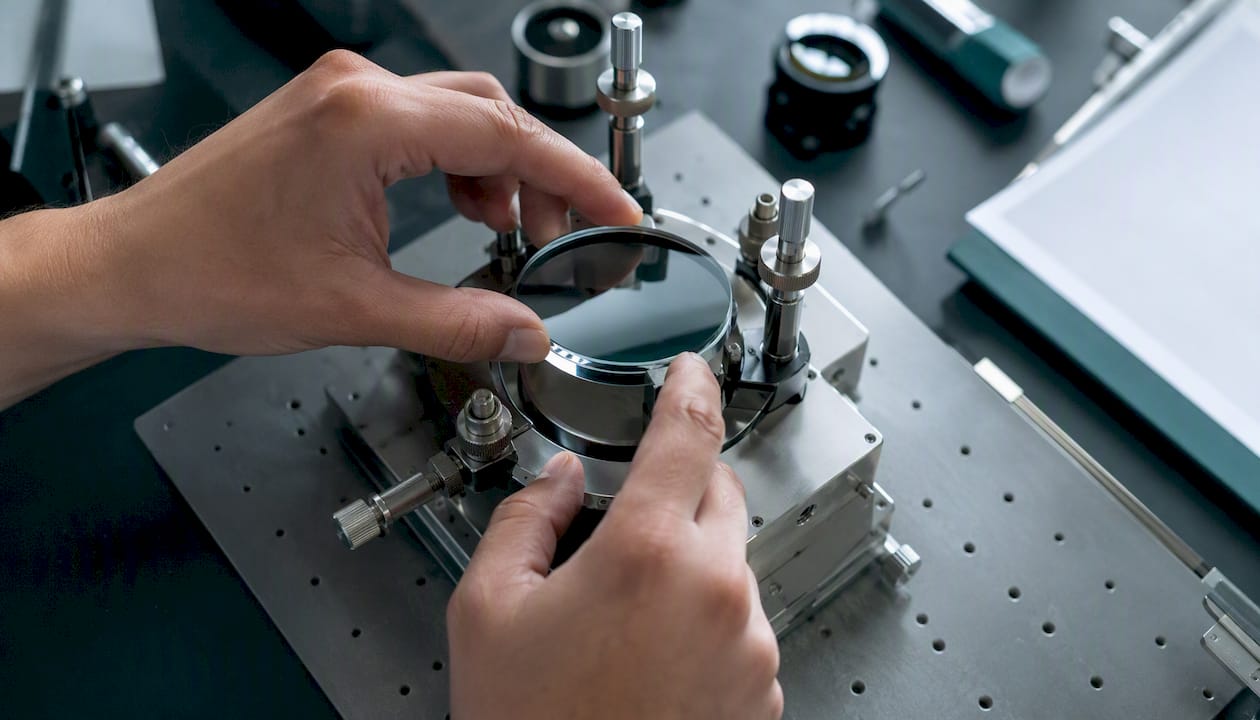
The practical rules are straightforward. Use a three-point or compliant mounting arrangement rather than a rigid press-fit cell. If adhesive bonding is used, select a low-modulus, low-shrinkage compound and allow adequate cure time before optical testing. For optics that will experience thermal cycling, calculate the differential expansion between the Ge element (thermal expansion coefficient approximately 5.9×10⁻⁶ /°C) and the mount material, and verify that the resulting stress remains within acceptable limits across the full operating temperature range.
Surface finish also interacts with mounting: a poorly polished edge can act as a stress concentrator under radial clamping force, increasing the risk of fracture during thermal cycling. Specify a chamfer or edge bevel on the drawing, and confirm with your supplier that edge finishing is included in the fabrication scope. Precision Glasses routinely includes edge finishing and surface inspection as part of its quality assurance process for optical window components.
Key takeaways
Germanium is an excellent IR optical material for the 3–5 μm and 8–12 μm thermal bands, but its high refractive index and temperature-sensitive absorption demand precise specification of resistivity, thickness, coatings, and operating temperature limits.
| Point | Details |
|---|---|
| Transmission range | Usable from ~1.8–14 μm in practice; above 45% across 2–14 μm at room temperature for optical-grade material. |
| Temperature limit | Transmission degrades slowly above 100°C and rapidly above 200°C; specify a maximum operating temperature on every drawing. |
| Fresnel loss | Uncoated Ge loses ~36% per surface; AR coatings are required for any system with a transmission budget. |
| Resistivity specification | High-resistivity optical-grade Ge minimises free-carrier absorption; always require a measured resistivity value on the certificate of conformity. |
| Measurement data | Use NIST Sellmeier coefficients (valid 2–14 μm, uncertainties 1.5×10⁻⁵ to 4.2×10⁻⁵) in preference to older database values for tight optical designs. |
A manufacturer’s perspective on specifying germanium correctly
The most avoidable failures in germanium optic procurement come from three omissions: no resistivity requirement, no measured transmission curve on the certificate, and no stated operating temperature. Each one looks like a minor oversight on a drawing but creates real problems at acceptance testing or, worse, in the field.
Resistivity is not a cosmetic parameter. It directly controls free-carrier absorption and therefore the thermal margin of your assembly. A window that passes a room-temperature transmission test can still fail in a heated enclosure if the resistivity was never specified and the supplier shipped lower-grade material. Require a numeric resistivity value and the measurement method on every certificate of conformity.
Measured transmission spectra matter for the same reason. A pass/fail statement against a minimum threshold tells you nothing about where in the band the material is absorbing or how close to the limit the batch sits. A full spectrum, from 2 μm to beyond 14 μm, takes minutes to acquire and gives you a baseline for incoming inspection and for diagnosing any field degradation later.
For assemblies destined for heated enclosures or thermally cycled environments, specify a thermal soak test: bring the assembly to its maximum rated operating temperature, hold it for a defined period, then re-measure transmission before and after. This single procedural step catches the majority of thermal runaway risks before the assembly reaches the customer.
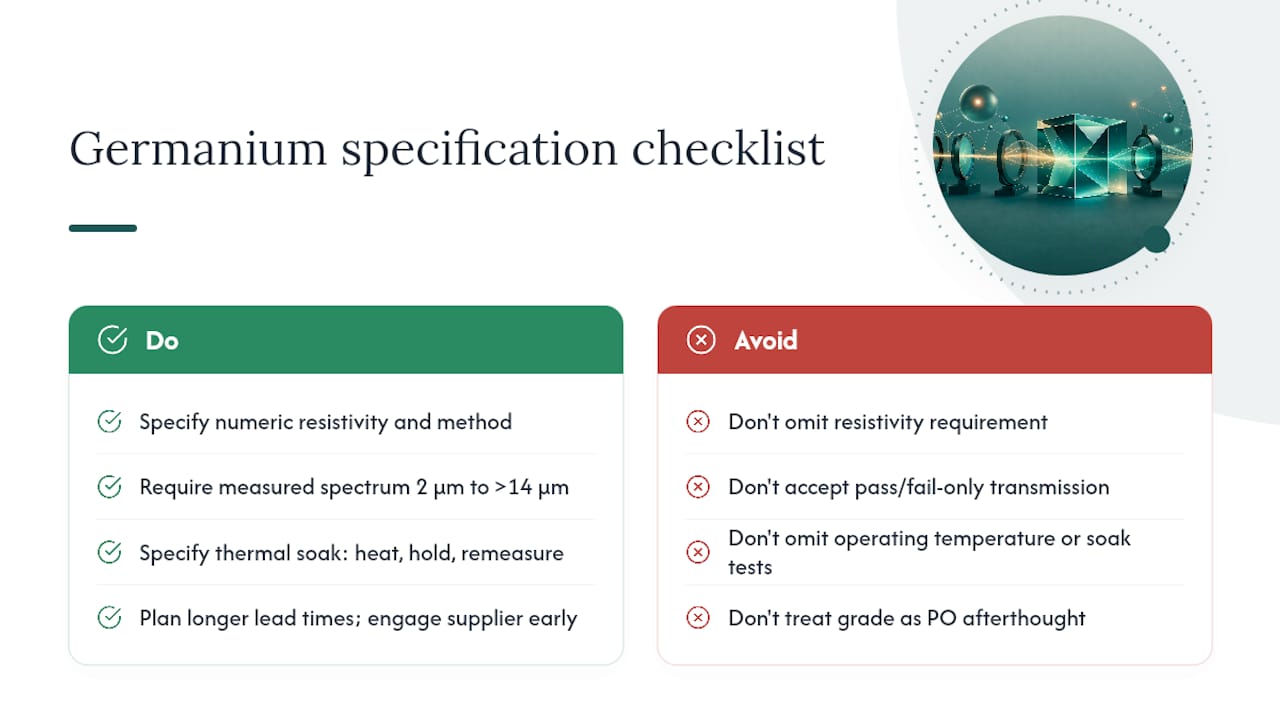
Lead times for optical-grade Ge blanks are typically longer than for common glass materials. Plan procurement accordingly, and engage your supplier early on resistivity and grade requirements rather than treating them as afterthoughts on the purchase order.
Precision Glasses supplies custom optical components for defence, aerospace, and medical imaging applications, with full batch traceability, measured transmission reporting, and surface inspection as standard. If you are specifying germanium windows or lenses and want to discuss grade selection, coating options, or acceptance test requirements, our technical team is available to support your design review.

Useful sources for germanium optical data
The following sources provide raw spectra, Sellmeier coefficients, and measurement methodology for germanium optics:
- Germanium datasheet — Continental Trade
- Germanium and silicon datasheet — Hellma Materials
- Index of refraction of germanium — NIST
- Field Guide to Infrared Optical Materials — SPIE
- Optical degradation of germanium with elevated temperature — ScienceDirect
- DOI: Field Guide to Infrared Optical Materials — SPIE