

Glass coating is one of the most consequential yet persistently misunderstood areas of precision glass engineering. Many experienced engineers default to selecting the hardest available coating, assuming maximum hardness equates to maximum suitability. In practice, this approach frequently leads to poor throughput, unnecessary cost overruns, and specifications that fail under real-world conditions. This article clarifies what glass coating is, how it works, how key methods compare, and what decision-makers in defence, medical, automotive, and electronics manufacturing genuinely need to know to specify correctly.
Table of Contents
- Understanding glass coating: Principles and performance factors
- Technologies and methods: Comparing sol-gel, PVD, and other glass coating approaches
- Industry applications: Glass coating in defence, medical, automotive, and electronics
- Choosing the right glass coating: Practical considerations for engineers and buyers
- What most buyers miss about glass coating trade-offs
- Explore advanced glass coating solutions for your industry
- Frequently asked questions
Key Takeaways
| Point | Details |
|---|---|
| Glass coating defined | Glass coatings are engineered surface layers that enhance durability, clarity, and resistance in critical applications. |
| Technology trade-offs | Different methods like sol-gel and PVD prioritise scalability, hardness, and throughput depending on your sector needs. |
| Sector impact | Defence, medical, automotive, and electronics industries rely on tailored coatings to deliver reliable, high-performance glass products. |
| Selection criteria | Engineers should weigh performance, environment, volume, and cost before specifying a coating solution. |
| Common misconception | Hardest coating is not always best; practical fit and manufacturing throughput often matter more. |
Understanding glass coating: Principles and performance factors
Glass coating refers to the application of an engineered surface layer onto a glass substrate to alter or enhance its functional properties. The coating may be a single layer or a complex multi-layer stack, depending on the target performance. Each layer is designed to contribute specific characteristics, whether that means increasing surface hardness, controlling light transmission, resisting chemical attack, or reducing friction.
The range of properties that coatings can improve is substantial:
- Optical clarity and anti-reflection: Coatings reduce unwanted surface reflections to improve light transmission, which is critical for diagnostic optics, display glass, and sensor windows.
- Surface hardness: Engineered coatings significantly increase resistance to abrasion, important for touchscreen displays and automotive dashboard glass.
- Chemical resistance: Coatings create a barrier against aggressive cleaning agents, bodily fluids in medical environments, and industrial solvents.
- Durability and weathering resistance: Coatings extend service life in outdoor, high-temperature, or high-humidity environments.
- Electrical and thermal management: Specialist coatings enable or restrict electrical conductivity and manage heat distribution across glass surfaces.
As research confirms, glass coatings are essential for improved optical clarity, surface hardness, and resistance in advanced technical glass. This is not simply relevant to solar applications. The same principles apply directly to defence optics, medical imaging, and electronic display panels.
The substrate itself plays a decisive role. Borosilicate glass behaves differently under coating processes compared to soda-lime or aluminosilicate glass. Thermal expansion coefficients, surface roughness, and pre-treatment quality all influence how effectively a coating bonds and performs over time. You can explore these interactions in detail through our optical coatings explained resource, which covers the technology and testing behind high-performance coatings.
Understanding your operating environment is equally important. A coating that performs flawlessly in a controlled laboratory setting may degrade rapidly under thermal cycling, UV exposure, or mechanical vibration in a field deployment. This is why our precision glass fabrication approach integrates environmental performance criteria from the earliest design stages.
“Coatings engineered for mission-critical applications must be specified against real-world operational conditions, not simply catalogue-listed properties. The difference between a coating that lasts and one that fails is almost always in the specification detail.”
Pro Tip: Match your coating specification to your end-use environment and required service life, not simply to the highest headline hardness value available. A coating optimised for throughput and environmental resistance will outperform a theoretically harder coating that degrades rapidly in your specific application.
Our manufacturing workflow guide provides further context on how coating requirements are integrated into the fabrication sequence from the outset.
Technologies and methods: Comparing sol-gel, PVD, and other glass coating approaches
Selecting the right coating technology is not simply a matter of picking the best-performing process in isolation. It is about matching process capability to production requirements, component geometry, coating performance, and cost constraints. The four principal technologies you are likely to encounter are sol-gel, physical vapour deposition (PVD), chemical vapour deposition (CVD), and spray coating.
Sol-gel is a wet chemistry process. A precursor solution is applied to the glass surface and then cured, typically through heating, to form a solid oxide layer. It is highly scalable, low in capital cost, and straightforward to apply to large-format or irregularly shaped glass. However, the resulting coatings are generally less dense and exhibit lower hardness than coatings deposited by vacuum processes.
PVD (physical vapour deposition) involves depositing material in a high-vacuum chamber by physically ejecting target material onto the glass surface. This produces extremely dense, hard coatings with excellent adhesion. PVD is the preferred method for precision optical components, defence optics, and high-wear display surfaces. The significant constraint is throughput. Processing large glass panels by PVD is time-consuming and capital-intensive.
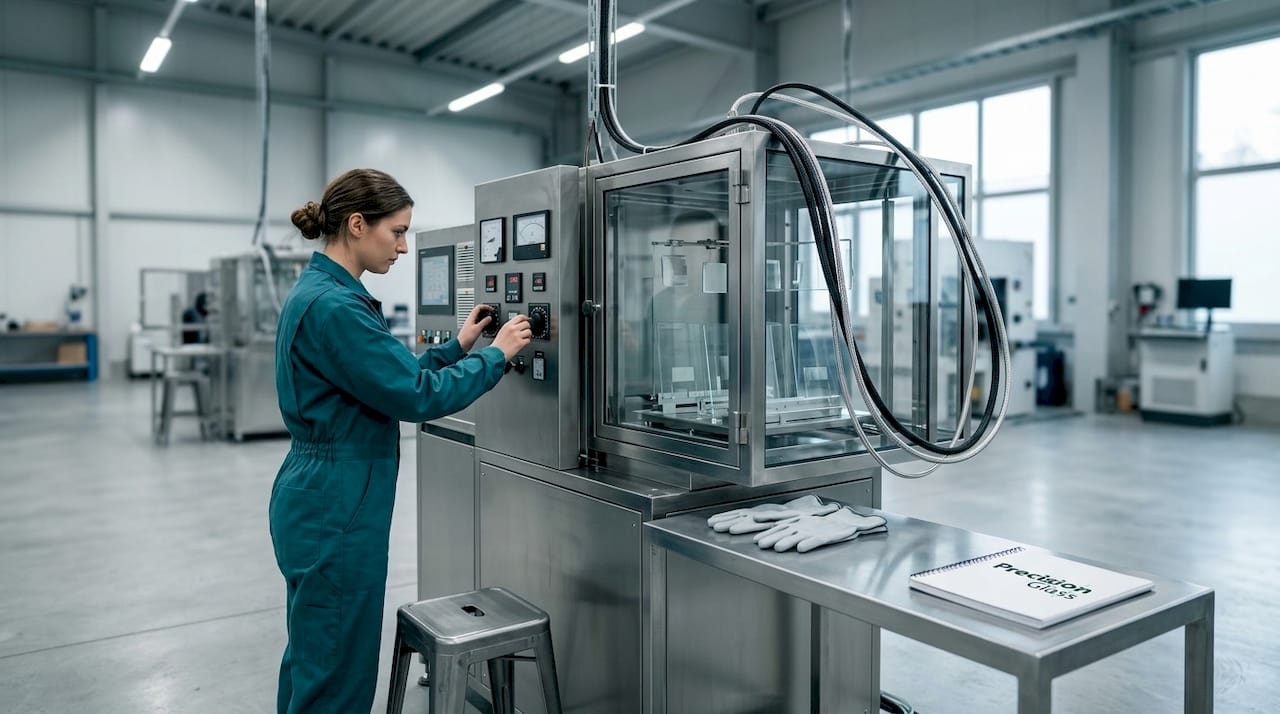
CVD (chemical vapour deposition) uses reactive gas-phase chemistry to deposit coating material onto the substrate. It offers excellent coverage of complex geometries and strong layer uniformity. It is widely used in electronics and semiconductor-adjacent glass applications where layer thickness control is critical.
Spray coatings represent the most accessible but least controlled approach. They are appropriate for high-volume, lower-specification applications where cost is the primary driver.
| Coating method | Relative cost | Hardness | Throughput | Best suited for |
|---|---|---|---|---|
| Sol-gel | Low | Moderate | High | Large-format glass, solar, automotive |
| PVD | High | Very high | Low | Precision optics, defence, medical |
| CVD | Medium to high | High | Medium | Electronics, complex geometries |
| Spray coating | Very low | Low to moderate | Very high | High-volume, low-specification |
Research confirms that sol-gel is scalable and low-cost but delivers inferior hardness versus PVD, while vacuum PVD is denser but has lower throughput compared to atmospheric sol-gel for jumbo glass. This trade-off is central to every procurement decision in this space.
When selecting a coating method, evaluate the following:
- Component size and geometry: Large-format panels favour sol-gel or spray; small, precision optical elements favour PVD or CVD.
- Required hardness and density: High-wear, high-stress applications demand PVD or CVD.
- Volume and lead time: High-volume production typically requires methods with strong throughput, such as sol-gel or spray.
- Regulatory and certification requirements: Medical and defence sectors may impose specific process traceability requirements that favour vacuum processes.
- Total cost of ownership: Factor in yield, rework rates, and service life, not just unit coating cost.
For guidance on how coating selection integrates with sourcing strategy, our resource on optimising glass sourcing covers this systematically. Additionally, for display glass applications across automotive and electronics, visit our display glass solutions page for sector-specific detail.
Industry applications: Glass coating in defence, medical, automotive, and electronics
By understanding technology choices, you can apply these insights to industry-specific challenges. Coating technology translates differently across sectors, and the performance requirements vary enormously between a defence vehicle window and a medical imaging lens.
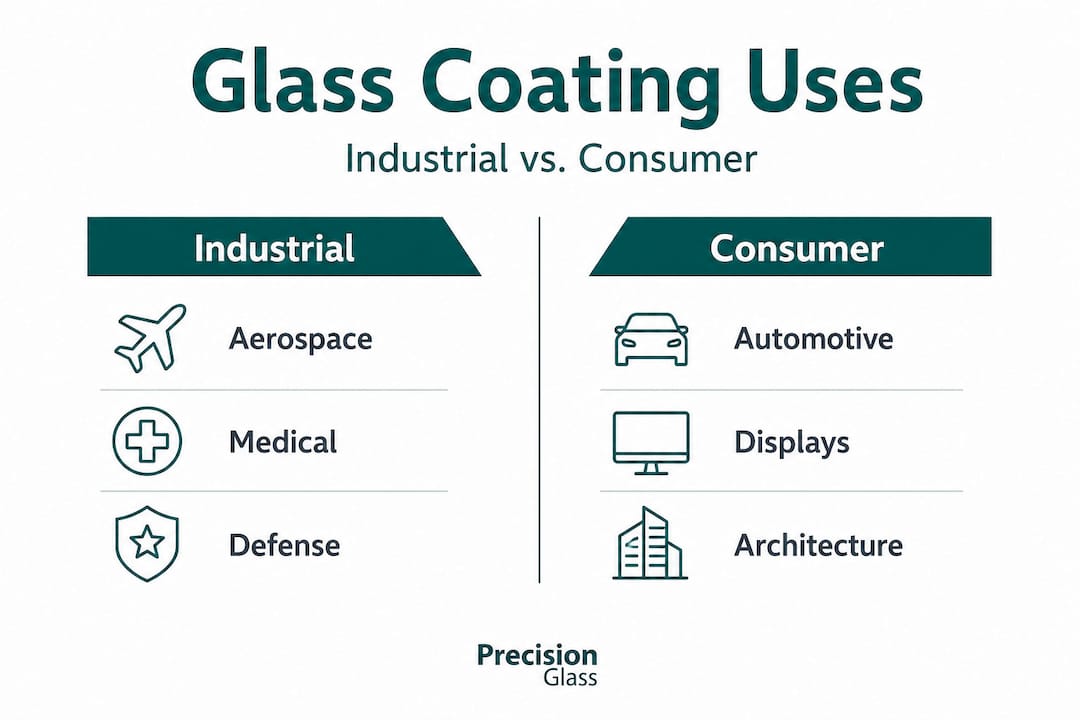
As established in specialist research, glass coatings are pivotal for mission-critical medical devices, aerospace optical elements, secure defence windows, and automotive display glass. The table below shows how this plays out in practice.
| Sector | Coating technology | Required property | Real-world outcome |
|---|---|---|---|
| Defence | PVD multi-layer | Blast and impact resistance | Secure vehicle and facility windows that maintain integrity under extreme stress |
| Medical | PVD anti-reflective | Optical clarity and biocompatibility | Diagnostic optics with minimal light loss and contamination resistance |
| Automotive | Sol-gel or PVD | Anti-glare and scratch resistance | Dashboard displays readable in direct sunlight with sustained surface quality |
| Electronics | CVD or PVD | Electrical isolation and optical clarity | Circuit-adjacent glass components that manage heat and maintain transmission |
Integrating glass coating into your manufacturing workflow requires a structured approach. The following steps represent best practice for engineering and procurement teams:
- Define the performance specification. Start with operational requirements: temperature range, mechanical loads, optical tolerances, chemical exposure, and expected service life.
- Select the substrate. The substrate must be compatible with the chosen coating process. Confirm compatibility with your glass fabricator at the outset.
- Choose the coating technology. Based on your performance and throughput requirements, identify the process that best fits.
- Specify surface preparation standards. Coating adhesion is directly affected by surface cleanliness and roughness. Define pre-treatment protocols clearly.
- Set quality assurance criteria. Define measurable acceptance criteria for coating thickness, adhesion, optical performance, and durability before production begins.
- Plan for testing and validation. Environmental simulation, accelerated ageing, and mechanical testing should be included in the qualification programme.
For the latest innovations in aerospace and medical glass technologies, including recent advances in coating performance, visit our aerospace and medical glass innovations page. For electronics-specific considerations, our glass in electronics insights resource provides procurement and performance guidance.
Choosing the right glass coating: Practical considerations for engineers and buyers
Applying industry examples, your next challenge is to navigate practical selection. The criteria that matter most will depend on your application, but the following framework applies across sectors.
Research confirms that throughput, hardness, and cost are central to coating selection for manufacturing applications, and scalability is often favoured over density for jumbo glass. For decision-makers procuring coated glass at scale, this is a fundamental reality that must inform specifications from the beginning.
When specifying glass coatings, verify the following:
- Adhesion test requirements: Confirm what adhesion standards apply, such as cross-hatch adhesion per relevant ISO standards.
- Coating thickness tolerances: Optical coatings are particularly sensitive to layer thickness variation. Specify tolerance bands.
- Environmental testing protocols: Define whether the component requires salt spray, humidity, UV, or thermal cycling tests, and to what standard.
- Optical transmission and reflectance: For optical applications, specify allowable transmission loss and maximum reflectance across the relevant wavelength range.
- Traceability and documentation: High-value sectors such as defence and medical require full process traceability records.
- Compatibility with downstream processes: Confirm that the coating survives any subsequent bonding, sealing, or assembly steps.
A common and costly mistake is overweighting perceived hardness as the primary selection criterion. Hardness is one performance factor. Functional suitability, including whether the coating survives your assembly process, adheres reliably to your substrate, and performs at operating temperature, is the true measure of value. An exceptionally hard coating that delamaminates during assembly, or degrades under thermal cycling, is not a high-performance solution.
Pro Tip: Always validate your coating choice with application-specific performance testing before committing to volume production. Qualification testing may add time and cost at the outset, but it consistently prevents far more expensive production failures and field returns.
For a detailed framework covering advanced specification requirements, our glass specifications guide is an essential reference for engineers and procurement professionals.
What most buyers miss about glass coating trade-offs
Step back and consider what nearly everyone overlooks about glass coating technology and procurement. In our experience working with defence contractors, medical device manufacturers, and automotive tier-one suppliers, the most persistent mistake is not a technical one. It is a procurement mindset issue.
Most buyers anchor their coating selection to a single parameter, usually hardness or perceived prestige of the coating process, and then work backwards to justify that choice. PVD is often selected by default for high-specification applications, not because it is the right process for the component, but because it sounds like the highest-performance option. This leads to misallocated budget, extended lead times, and unnecessary process complexity.
“Sol-gel is scalable and low-cost but inferior hardness versus PVD; Vacuum PVD is denser but lower throughput than atmospheric sol-gel for jumbo glass.” This well-established trade-off in coating selection is frequently ignored when procurement decisions are made under time pressure or without cross-functional input.
The real-world constraint that changes everything is production volume. A defence optics programme producing fifty precision lenses per year is a completely different problem from an automotive display glass programme producing fifty thousand panels per quarter. The coating technology must fit the production reality, not just the performance aspiration.
Rapid prototyping requirements further complicate the picture. During development phases, the ability to iterate quickly often matters more than achieving maximum coating performance. Sol-gel’s low capital requirement and fast turnaround make it valuable for proof-of-concept work, even when PVD will ultimately be selected for production.
We also observe that supply chain resilience is rarely considered in coating decisions. PVD processing equipment is capital-intensive and geographically concentrated. If your sole-source PVD coating supplier experiences a disruption, your programme is at risk. Building in alternative coating routes, even where they involve modest performance compromises, is prudent programme management.
Our perspective is clear: the best coating is the one that reliably meets your functional requirements, fits your production schedule, and can be consistently procured at the right cost. Explore the full technology and testing picture through our optical coatings explained resource, and use our advanced glass specifications guide to build specifications that hold up under scrutiny.
Explore advanced glass coating solutions for your industry
At Precision Glasses, we work directly with engineering and procurement teams across defence, medical, aerospace, automotive, and electronics sectors to deliver glass coating solutions that are specified correctly from the outset. Our approach combines meticulous technical review, rigorous quality assurance, and a proven fabrication process that translates your requirements into reliable, high-performance components.

Whether you need precision optical components with multi-layer anti-reflective coatings, high-durability display glass for automotive dashboards, or specialist technical glass solutions for defence and aerospace programmes, we have the capability and expertise to deliver. Our optical glass components portfolio covers a broad range of coating technologies and substrate types. For the latest developments in sector-specific glass performance, our page on innovations in aerospace and medical glass provides current insight. Contact our technical team today to discuss your specification requirements.
Frequently asked questions
What is the main difference between sol-gel and PVD glass coatings?
Sol-gel offers scalability and lower cost but produces coatings of lower hardness and density compared to PVD, while PVD yields harder, denser layers at reduced throughput for large glass surfaces. The right choice depends on your volume, component size, and performance requirements.
Why are glass coatings critical in defence and medical applications?
In defence and medical settings, coatings are pivotal for delivering impact resistance, optical clarity, and durability that standard glass cannot achieve uncoated. These properties are non-negotiable in environments where component failure carries serious consequences.
What factors should engineers consider when choosing a glass coating?
Throughput, hardness, and cost are the primary technical and commercial factors, but engineers must also weigh environmental testing requirements, substrate compatibility, supply chain resilience, and the specific performance criteria of the end application.
Are harder coatings always the best choice?
No. Throughput, application suitability, and cost frequently determine the best coating choice in volume manufacturing, and a coating with moderate hardness that performs reliably under real operating conditions is superior to a theoretically harder coating that degrades or fails in service.
Recommended
- Optical coatings explained: technology, testing, and insights – Precision Glass
- Glass in electronics: Performance, reliability and procurement insights – Precision Glass
- Glass substrate explained: definition, roles and precision challenges – Precision Glass
- Display glass explained: precision, performance and industry solutions – Precision Glass