

What are the main types of glass tubes and key UK suppliers?
Precision glass tubes are cylindrical hollow forms produced from materials including borosilicate, quartz, aluminosilicate, and specialty glasses, each selected for specific thermal, chemical, and mechanical demands. For UK industrial and scientific professionals, the choice of material and supplier directly determines performance in the field.
Key tube types available in the UK market:
- Borosilicate glass tubes: The standard for laboratory and pharmaceutical use, valued for chemical inertness and thermal shock resistance.
- Quartz glass tubes: Used where extreme UV transmission or temperatures above 1,000°C are required, such as semiconductor processing and high-intensity lighting.
- Aluminosilicate glass tubes: Higher mechanical strength than borosilicate, suited to pressure applications and electronics.
- Specialty and profiled tubes: Rectangular, triangular, and star-shaped profiles for architectural, optical, and bespoke industrial uses.
- Soda lime glass tubes: Lower cost, used in non-critical applications such as basic laboratory glassware and decorative glass tube vases.
Standard stock lengths run to approximately 1.5 metres, with diameters spanning from a few millimetres to several centimetres depending on the production method.
Three suppliers dominate the UK market for precision tubing. The comparison below covers the core differences across material type, size range, application fit, and UK availability.
| Supplier | Material type | Size range | Application suitability | UK availability |
|---|---|---|---|---|
| John Moncrieff Ltd | Borosilicate (DURAN®), specialty (Conturax®) | Wide range, standard and custom | Industrial, laboratory, pharma, chemical processing | Direct UK supplier |
| DURAN® Standard Glass Tubes | Borosilicate (DURAN® grade) | Standard stock diameters and lengths | Labs, OEM, pharmaceutical packaging | Via John Moncrieff Ltd |
| Conturax® Glass Tubes | Specialty chemical-resistant glass | Precision custom dimensions | Extreme chemical environments, bespoke industrial | Via John Moncrieff Ltd |
How do borosilicate, quartz, and specialty glass tubes compare?
Material selection is the single most consequential decision when specifying precision tubing. Each glass type carries a distinct performance profile.
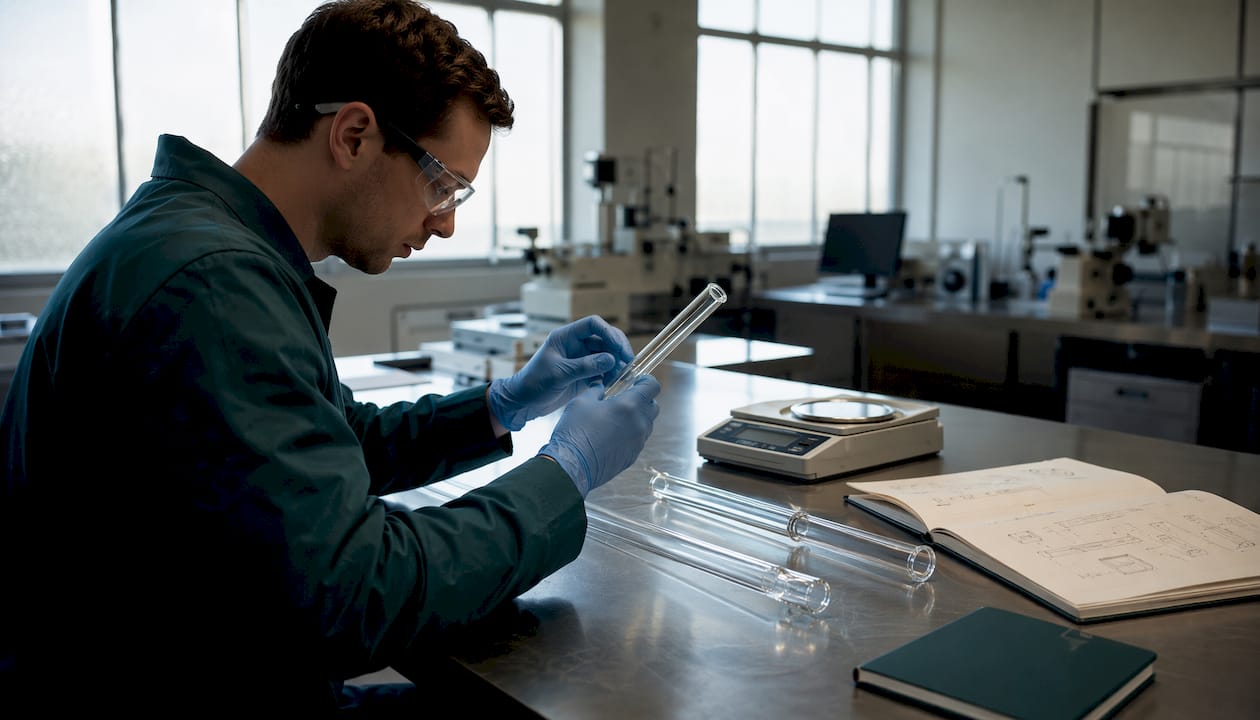
Borosilicate glass is the standard for scientific laboratories. Its superior chemical inertness and mechanical strength over soda lime glass make it the material of choice for chromatography vials, NMR tubes, and pharmaceutical primary packaging. DURAN® Standard Glass Tubes represent the benchmark here: a well-established borosilicate grade with broad OEM and laboratory adoption, available through John Moncrieff Ltd with consistent dimensional tolerances and ISO and ASTM certifications underpinning quality assurance.
Quartz tubes operate at temperatures and UV wavelengths that borosilicate cannot sustain. They are the correct choice for semiconductor diffusion furnaces, high-pressure mercury lamps, and photobioreactors where optical purity at short wavelengths is non-negotiable. The trade-off is cost: quartz is substantially more expensive than borosilicate and requires specialist fabrication.
Conturax® Glass Tubes occupy a distinct position. Designed for environments where chemical attack is severe and dimensional accuracy must be maintained under process conditions, they suit applications such as aggressive solvent handling, specialised industrial piping, and bespoke chemical plant components. John Moncrieff Ltd supplies Conturax® tubes as part of a comprehensive product range that covers both standard and extreme-duty requirements.
For large-diameter clear glass cylinders used in chemical plant (20–100 cm), centrifugation or blowing processes are employed, producing tube sections of up to one metre. Lead times for these bespoke forms are longer than standard stock, and UK buyers should confirm availability directly with the supplier.
How are precision glass tubes manufactured?
Two continuous drawing processes account for the majority of precision tube production worldwide: the Danner method and the Vello method, both developed in the early twentieth century and still the industry standard today.
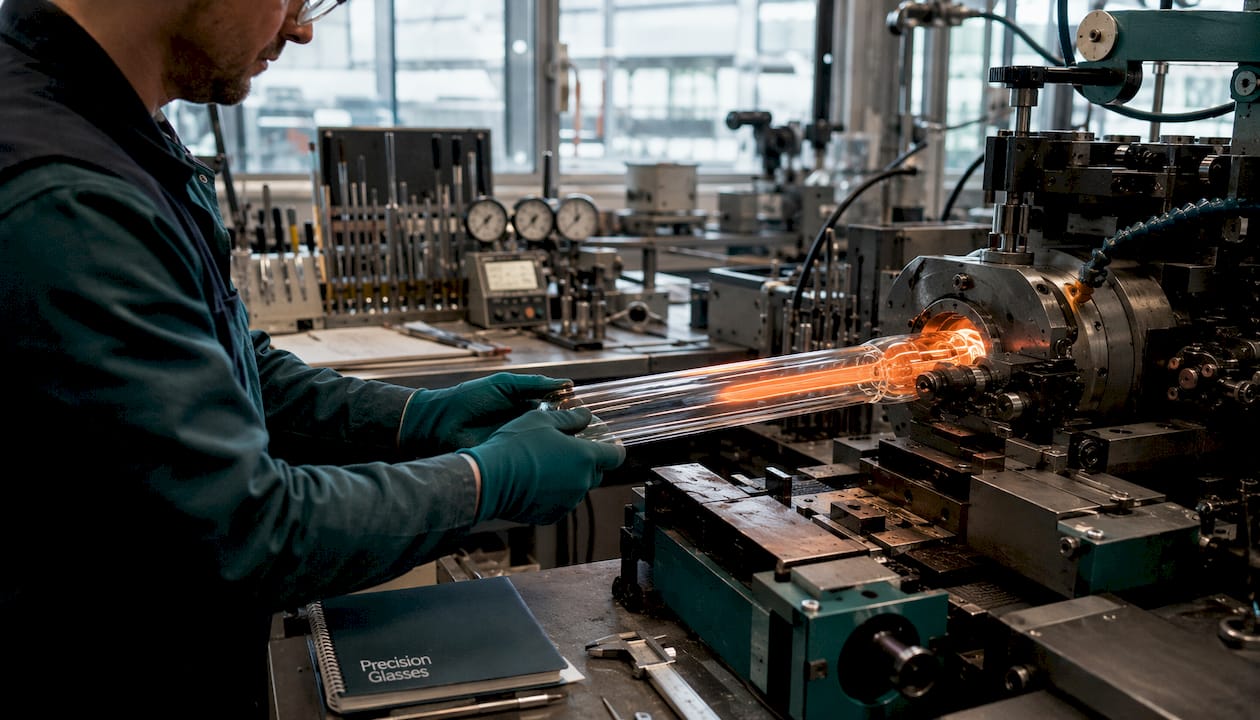
The Danner process draws molten glass over a rotating ceramic mandrel inclined downward, with compressed air blown through the hollow core to maintain the tube’s internal geometry. The Vello process feeds glass through an annular nozzle from below, with a height-adjustable hollow needle controlling the inner diameter. Vello achieves higher throughput than Danner and handles volatile glass compositions, including borosilicate, more effectively because nozzle temperatures are lower.
Key process characteristics:
- Danner and Vello methods produce thin-walled tubes with diameters from 1.5 to 70 mm, at throughputs reaching 55 tonnes per day.
- The down-draw method, a vertical variant of Vello, holds the current world record for large-diameter tube production at 460 mm, achieved by Schott AG.
- Wall thickness for large outer diameters above 250 mm reaches approximately 10 mm; smaller diameters allow up to 15 mm.
- For borosilicate at 35 mm diameter, drawing speeds of 0.3 m/min are achievable.
Secondary forming extends the utility of drawn tube stock considerably. Cutting, bending, and flame polishing are the standard techniques: a glass cutter scores and breaks stock to length, freshly cut edges are flame polished to remove sharp burrs, and controlled heating over a Bunsen or ribbon burner allows bending to precise angles. Hose barbs can be added to tube ends to improve grip and seal when connecting to plastic or rubber lines.
Pro Tip: For borosilicate tube bending, heat the section evenly along the full bend radius rather than concentrating the flame at one point. Uneven heating creates stress concentrations that cause cracking under thermal cycling in service.
How do you choose the right glass tube for your application?
The correct tube type follows directly from the operating environment. Getting this decision wrong at specification stage is far more costly than the price difference between grades.
Work through these selection criteria in order:
- Chemical resistance: If the tube contacts aggressive acids, alkalis, or solvents, borosilicate is the minimum standard. For extreme chemical duty, Conturax® specialty glass is the appropriate choice.
- Thermal requirements: Standard borosilicate handles most laboratory and industrial thermal cycling. Quartz is required above approximately 1,000°C or where UV transmission below 200 nm is needed.
- Mechanical strength: Aluminosilicate grades offer higher surface compression and are preferred where impact or pressure loading is a factor.
- Dimensional tolerances: Pharmaceutical packaging and analytical instruments demand tight bore tolerances. Confirm that the supplier’s drawn tube meets the dimensional standard your process requires, referencing ISO or ASTM specifications.
- Optical clarity: For photometric, spectroscopic, or lighting applications, drawn tube stock offers better optical clarity and more homogeneous wall thickness than moulded alternatives.
Supplier evaluation matters as much as material selection. Confirm UK stock availability, standard lead times for your required diameter, and whether the supplier can provide certified material data. For hermetic containment, the tube material alone does not determine seal integrity. Ground glass joints and EPDM seals are the critical interface, and specifying the closure system alongside the tube is standard practice for any application handling sensitive or hazardous samples.
Pro Tip: When specifying small glass tubes for analytical instruments, request a dimensional report for the specific batch. Bore diameter variation across a batch affects measurement repeatability more than the nominal specification suggests.
What expertise does Precision Glasses bring to high-precision glass tubes?
Precision Glasses works at the demanding end of the glass tube specification range, where standard catalogue stock is not sufficient. Our capabilities cover bespoke glass fabrication for defence, aerospace, medical devices, automotive, and electronics sectors, where dimensional accuracy, material traceability, and quality documentation are non-negotiable.
Our approach to precision tube work:
- Material selection support: We advise on glass type selection for critical environments, drawing on direct experience with optical, technical, and specialty glass compositions.
- Quality assurance: Our manufacturing processes align with ISO and ASTM quality standards, with full dimensional verification and material certification available.
- Bespoke fabrication: Where standard drawn tube stock does not meet your dimensional or material requirements, we design and fabricate to specification, including secondary operations such as grinding, polishing, and CNC work.
- Sector-specific expertise: Defence and aerospace applications demand material traceability and process documentation that commodity suppliers do not provide. We deliver both.
- Design collaboration: Our glass component design process integrates your engineering requirements from the outset, reducing iteration and lead time.
For applications where a standard DURAN® or Conturax® tube meets the requirement, John Moncrieff Ltd is the appropriate UK route. Where the specification exceeds what catalogue stock can deliver, Precision Glasses is the partner to engage.
Precision Glasses: bespoke precision glass tubes for critical applications
Standard catalogue tubes from John Moncrieff Ltd, DURAN®, and Conturax® cover the majority of laboratory and industrial requirements. When your application sits outside that range, Precision Glasses offers a different route.

We design and fabricate custom technical glass tubes for sectors where dimensional accuracy, material certification, and process documentation are mandatory. Defence optics, medical device components, aerospace instrumentation, and high-reliability electronics all require a level of specification control that catalogue supply cannot match. Our meticulous quality assurance process, from material selection through to final inspection, means you receive components that perform to drawing, with full traceability. If your requirement demands more than standard stock, speak to our team at glassprecision.com.
Key takeaways
Borosilicate glass tubes, particularly DURAN® grade, are the correct starting point for most UK laboratory and industrial applications, with specialty grades required only where chemical or thermal demands exceed standard borosilicate capability.
| Point | Details |
|---|---|
| Material drives selection | Borosilicate suits most lab and industrial uses; quartz and specialty grades serve extreme thermal or chemical environments. |
| Standard stock dimensions | Commercially available tubes typically come in standard lengths common in the industry, with diameters spanning a small to medium range via processes like Danner and Vello. |
| Closure systems matter | Hermetic containment depends on ground glass joints and EPDM seals, not tube material alone. |
| UK supplier landscape | John Moncrieff Ltd supplies both DURAN® Standard Glass Tubes and Conturax® specialty tubes directly to UK buyers. |
| Precision Glasses | For bespoke tube fabrication beyond catalogue stock, Precision Glasses serves defence, aerospace, medical, and electronics sectors with full quality documentation. |