A hydrophobic glass coating, in the specification sense that matters for optics and instrumentation, is an engineered surface treatment that raises water contact angle and lowers surface energy without introducing scatter or degrading transmittance. It is suitable for precision optics and sensor windows only when it meets defined optical and durability thresholds, not on the strength of a marketing claim. Precision Glasses specifies and delivers these coatings against exactly that standard.
TL;DR:
- Coatings must demonstrate sustained contact angles above 100° after specific abrasion cycles and loads, not just initial measurements.
- Reputable suppliers provide third-party test reports, batch traceability, and samples that meet standardized weathering and chemical resistance criteria.
- A maximum acceptable surface scatter is below 0.2% at 514 nm, with contact angles above 110°, maintained through at least 6,000 rubbing cycles.
- Silane-based and PFPE coatings are the primary materials used, with silanes offering covalent bonding and PFPE providing chemical inertness.
- Specification should include detailed test conditions, standards, and verifiable data, not vague claims of durability or hydrophobicity.
Table of Contents
- What is a hydrophobic glass coating in industrial optics?
- What performance metrics should you require in the spec?
- Which materials and processes hold up on optical-grade glass?
- How do you write a coating spec that a supplier can be held to?
- Why most coating failures trace back to the spec, not the chemistry
- Get sample coating trials for your precision glass components
- Sources
What is a hydrophobic glass coating in industrial optics?
Forget the consumer definition. A windscreen treatment sold at a hardware shop and a coating specified for a defence sensor window share a chemistry family but almost nothing else in terms of engineering rigour. Precision optics need contamination control, antifog behaviour and cleanability, delivered without touching haze, transmittance, or wavefront quality. That last constraint is what separates industrial-grade hydrophobic coatings from anything you would apply with a cloth.
The functional goals sit in tension with each other. A rougher surface tends to produce a higher contact angle and better roll-off, but roughness scatters light, which is unacceptable on a scanner window or an aerospace sensor cover. Chemistry durability is the other axis: a coating with a spectacular initial contact angle but weak bonding to the substrate will lose performance within a few hundred abrasion cycles, long before the component reaches end of service life. The industry’s practical answer to this trade-off is the replenishment or reservoir layer, a nanostructured top coat that holds a hydrophobic agent and continuously diffuses it to the surface as the outer layer wears, sustaining contact angle over far more cycles than a single molecular film.
Typical applications where this matters:
- Optical windows on imaging and targeting systems exposed to condensation and airborne contaminants
- Sensor covers on automotive and industrial instrumentation requiring consistent light transmission in wet conditions
- Medical device display glass that must resist fingerprint oils and repeated disinfectant wiping
- Instrument panel glass in marine and aerospace environments subject to salt spray and humidity cycling
Specifying against roughness and chemistry separately, rather than a single “hydrophobic yes/no” checkbox, is what keeps optical performance intact over the product’s life.
What performance metrics should you require in the spec?
Contact angle alone tells you almost nothing about service life. A coating can post an impressive contact angle on day one and fail within weeks if the bonding chemistry cannot survive handling and cleaning. Procurement documents should demand numbers across four categories, each backed by test data, not a single headline figure.
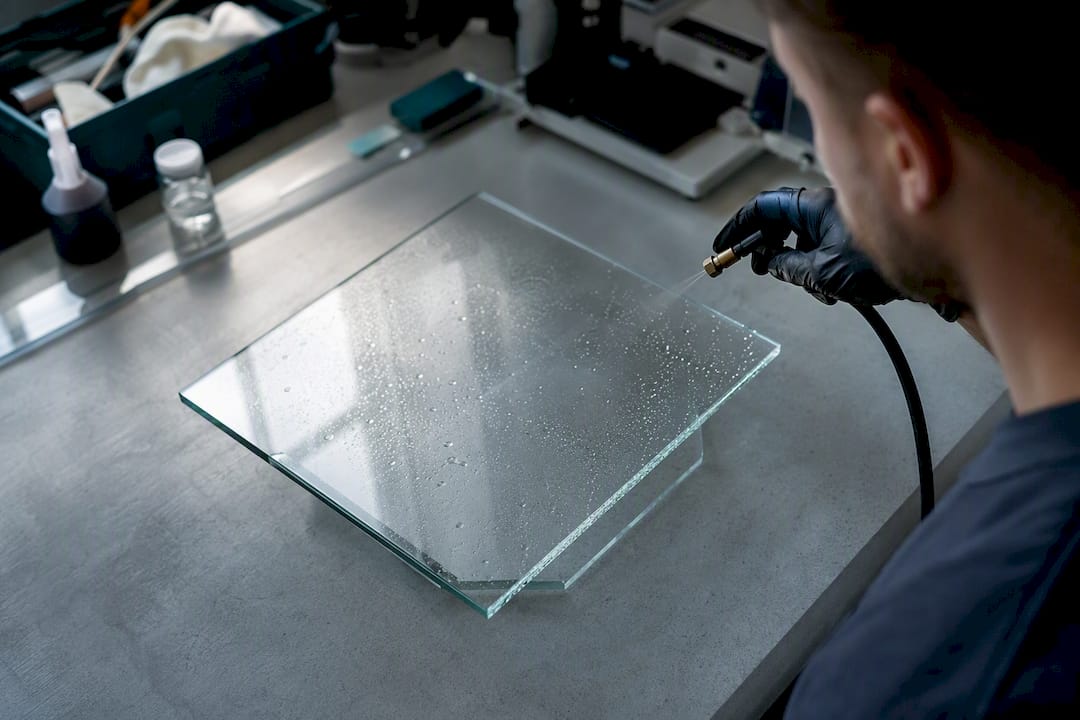
Optical performance: request contact angle (target typically 100° to above 150° depending on application), roll-off angle (under 10° is a common target for self-cleaning behaviour), transmittance across the working spectrum, and total integrated scatter or haze. Feasibility work on nano-structured reservoir coatings has demonstrated contact angles above 150° with total scatter below 0.2% at 514 nanometres, which shows the two properties are not mutually exclusive when the surface topography is engineered deliberately.
Mechanical durability: abrasion resistance under a defined method, at a defined pressure, for a defined cycle count. This is where vague language costs you later.
Chemical resistance: solvent wipe testing, cleaning agent compatibility, and salt spray exposure per a named standard.
Adhesion: cross-hatch or tape-pull testing to confirm the coating bonds to the substrate rather than sitting as a loose film.
Here is the acceptance data worth demanding, and why each figure matters:
- Contact angle after conditioning, not just as-applied. A supplier’s OPX PFPE silane data sheet reports contact angles of 110 to 115 degrees after 10,000 steel-wool rub cycles at a specified load. That is a testable claim you can write into a contract.
- Abrasion cycle count and applied force. DURALON USF’s technical data lists contact angles of 110 to 112 degrees on glass and SiO2 surfaces alongside tabulated abrasion and chemical resistance figures, giving you a second reference point for comparison.
- Reflectance retention on AR-plus-hydrophobic stacks. Vacuum-deposited hydrophobic top layers on antireflective multilayers have shown average reflectance of 0.14% across 400 to 680 nanometres while retaining contact angles above 110° through 6,000 rubbing cycles.
- Test standard reference. Weathering, abrasion and condensation resistance for coated glass fall under the EN 1096 series, with salt spray corrosion testing normally referenced against ISO 9227.
Durability claims phrased as “long-lasting” or “durable” are unenforceable. The only useful phrasing is “contact angle after X abrasion cycles under Y load”, because that is a number a lab can verify and a supplier can be held to.
When a coating fails, it rarely fails uniformly. Contact angle often degrades gradually with cycle count rather than dropping off a cliff, so ask for the full curve, pre- and post-conditioning, not a single pass/fail data point.
Which materials and processes hold up on optical-grade glass?
Two chemistry families dominate specification-grade hydrophobic coatings, and the choice between them is really a choice about how the coating fails, not just how it performs new.
Silane-based coatings bond covalently to the glass surface through the same hydroxyl chemistry used in adhesion promoters elsewhere in optics manufacturing. That covalent bond is the reason silane chemistry tends to outperform physically adsorbed films over long abrasion exposure. Practitioner data consistently shows that a high initial contact angle without genuine covalent bonding fails well before a chemically bonded equivalent reaches the same cycle count.
PFPE and fluoropolymer monolayers, the family that includes commercial products such as OPX, trade some of that bonding strength for exceptional chemical inertness and very low surface energy, which is why they turn up so often in medical and electronics applications where cleaning agent exposure is frequent.
The more interesting development sits above both of these: nano-structured top coats that combine a hard, wear-resistant outer layer with a hydrophobic agent reservoir beneath it. Rather than relying on one molecular layer, the reservoir continuously resupplies the surface as it wears, and the surface topography is engineered so the dominant spatial frequencies stay below the visible wavelength range, which is what keeps scatter low despite the added structure.
- Vacuum evaporation, suited to integrating hydrophobic layers directly into antireflective stacks with tight thickness control
- Plasma-assisted silanisation, useful where uniform coverage on complex geometries matters
- Dip and spray application, more common for larger batch runs where vacuum chamber time is a constraint
- Thermal conditioning post-deposition, which cures the bond and stabilises the final contact angle
Film thicknesses in AR-integrated hydrophobic systems typically run in the single-nanometre to low-nanometre range, so refractive index and thickness both need controlling within the same process window used for the rest of the optical coating stack.
Pro Tip: Ask your supplier for the power spectral density plot of the coated surface, not just a contact angle number. A surface engineered so its roughness features sit below visible wavelengths will scatter far less light than one with the same contact angle achieved through coarser texture.
How do you write a coating spec that a supplier can be held to?
A specification that says “hydrophobic coating required” gives a supplier almost total latitude to interpret it however suits their process. The fix is a template with explicit numbers, named standards and defined test conditions.
Build the clause around these elements:
- Target contact angle and roll-off angle, stated as values after conditioning, not as-applied
- Named abrasion test method, applied load, and required cycle count before failure
- Referenced standard for weathering and chemical resistance (EN 1096 series, ISO 9227 for salt spray)
- Required transmittance and haze/total scatter thresholds across the operating spectrum
- Sample size and conditioning protocol for acceptance testing, plus the reporting format expected back
Three pieces of supplier evidence separate a credible coating partner from one reciting a data sheet:
- Certified third-party test reports, not just in-house figures
- Representative production samples, not hand-finished demonstration pieces
- Batch-level process traceability, so a failure can be traced back to a specific run
Questions worth putting directly to a supplier before you commit: what is the bonding chemistry, and is it covalent or physically adsorbed? For advice on proper maintenance and cleaning agent compatibility, see the streak-free method for UK owners. What contact angle do you guarantee after your stated abrasion cycle count, and under what load? Is the coating compatible with the specific cleaning agents your end product will see in service? If a proprietary durability mechanism is claimed, ask for non-confidential data or reference to patent documentation that supports it.
Adjust the numbers to the application, but keep every one of them testable. Component geometry and mounting also affect coating longevity, which is worth reviewing alongside your glass component design before finalising the spec.
Why most coating failures trace back to the spec, not the chemistry
The uncomfortable truth in this field is that most hydrophobic coating failures are not chemistry failures. They are specification failures, written by teams who accepted a contact angle number without asking what happened to it after 5,000 cycles. A coating supplier will always report their best number. It is the procurement team’s job to ask for the worst one.
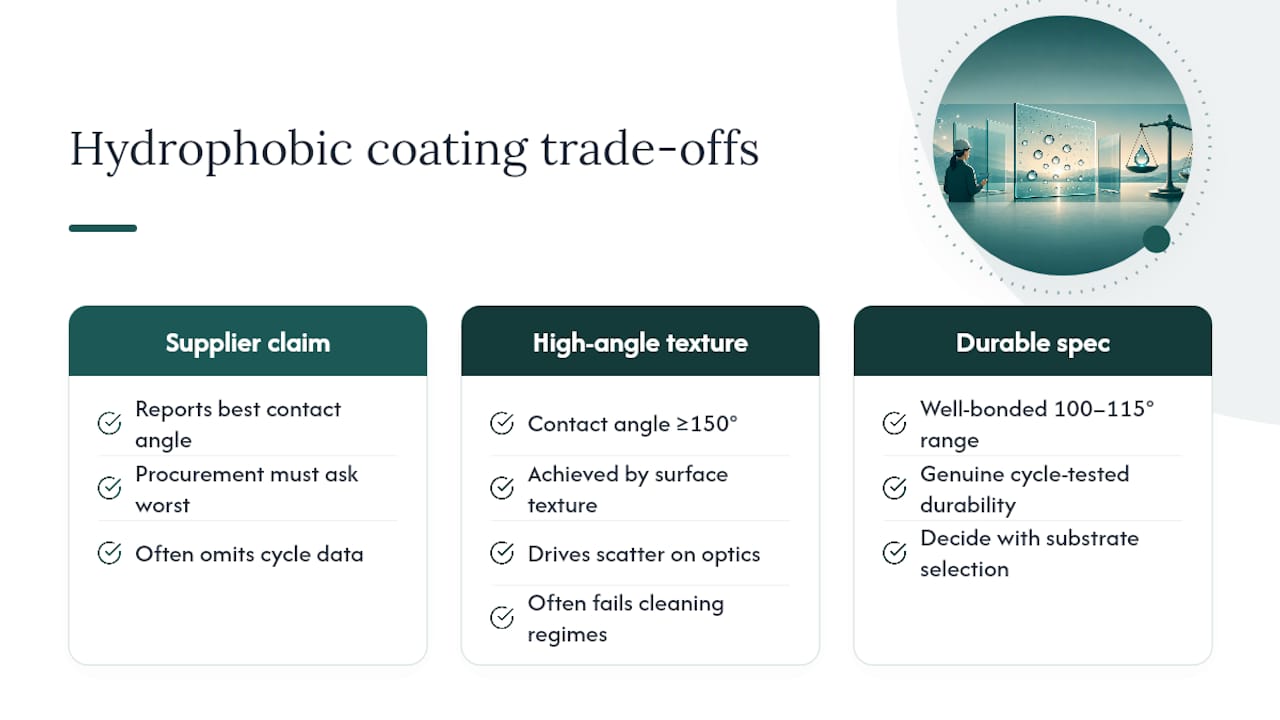
I would also push back on the instinct to chase the highest possible contact angle. Superhydrophobic surfaces above 150° usually get there through surface texture, and texture is exactly what drives scatter up on precision optics. For most industrial sensor and display applications, a well-bonded coating in the 100 to 115° range with genuine cycle-tested durability outperforms a flashier number that cannot survive the cleaning regime it will actually face in service.
The other pattern worth naming: teams treat hydrophobic coating as a bolt-on decision, applied after the glass component is already designed. It works far better as a decision made alongside substrate selection, surface finish and the rest of the optical properties that govern how the part performs. Coatings sit on a substrate, they do not replace the engineering that substrate still requires.
— Alexandra
Get sample coating trials for your precision glass components
Precision Glasses builds coated precision glass as part of the same design and fabrication process, not as a separate vendor step bolted onto finished components. That means the substrate, surface finish and coating chemistry are specified together from the start, which is exactly the coordination that prevents the durability failures described above.
For OEMs and product teams working through a specification, Precision Glasses supports prototype coating trials so you can validate contact angle, abrasion resistance and optical performance against your own acceptance criteria before committing to a production run. Explore the technical glass product range and request sample testing to see how a coating performs on your actual substrate geometry, not a generic test coupon.
Sources
- Durable ultra-hydrophobic glass coatings with optical quality (SuNyx / SVC proceedings)
- Hydrophobic top coats on AR multilayer systems (SPIE proceedings)
- OPX nano‑coating technical data sheet (PFPE silane family)
- DURALON USF technical data sheet