
ISO 10993-1 governs the biological evaluation of any glass component in a medical device. Three supporting parts do the practical work: ISO 10993-12 for sample preparation, ISO 10993-14 for degradation products from ceramics and glass, and ISO 10993-17 for toxicological risk assessment. The one action that saves reviewers the most time is simple: record the exact ISO edition you tested to and the extraction conditions you used, in the technical file, before anyone asks.
TL;DR:
- Recording the tested ISO edition and extraction conditions in the technical file is crucial because missing documentation and undisclosed coatings are the primary reasons for delays.
- Glass type, coating chemistry, thermal history, and heavy-metal content directly influence leaching profiles and must be clearly reported to satisfy compliance standards.
- Extraction ratios and testing temperatures must follow ISO 10993-12 guidelines precisely, with default conditions at 37°C for 24 hours unless justified otherwise.
- Cytotoxicity testing alone is insufficient; comprehensive chemical analysis and toxicological risk assessment are necessary for devices with prolonged or permanent contact.
- Suppliers should provide traceable, batch-level process documentation upfront to prevent delays caused by incomplete or retrospective data at testing.
Table of Contents
- What does ISO 10993 glass compliance actually require?
- Material characterisation for glass: what to report and why it matters
- Sample preparation and extraction for glass under ISO 10993-12
- Biological testing endpoints for glass and what results actually tell you
- What belongs in the technical file for glass components
- How we prepare glass materials for ISO 10993 evaluation
- The pattern behind most glass biocompatibility delays
- Get audit-ready glass components from Precision Glasses
- Standards and guidance worth reading directly
- Sources
- FAQ
What does ISO 10993 glass compliance actually require?
Biological evaluation of glass rarely fails on the biology. It fails on missing paperwork. A useful working checklist covers five things before a single sample reaches a laboratory.
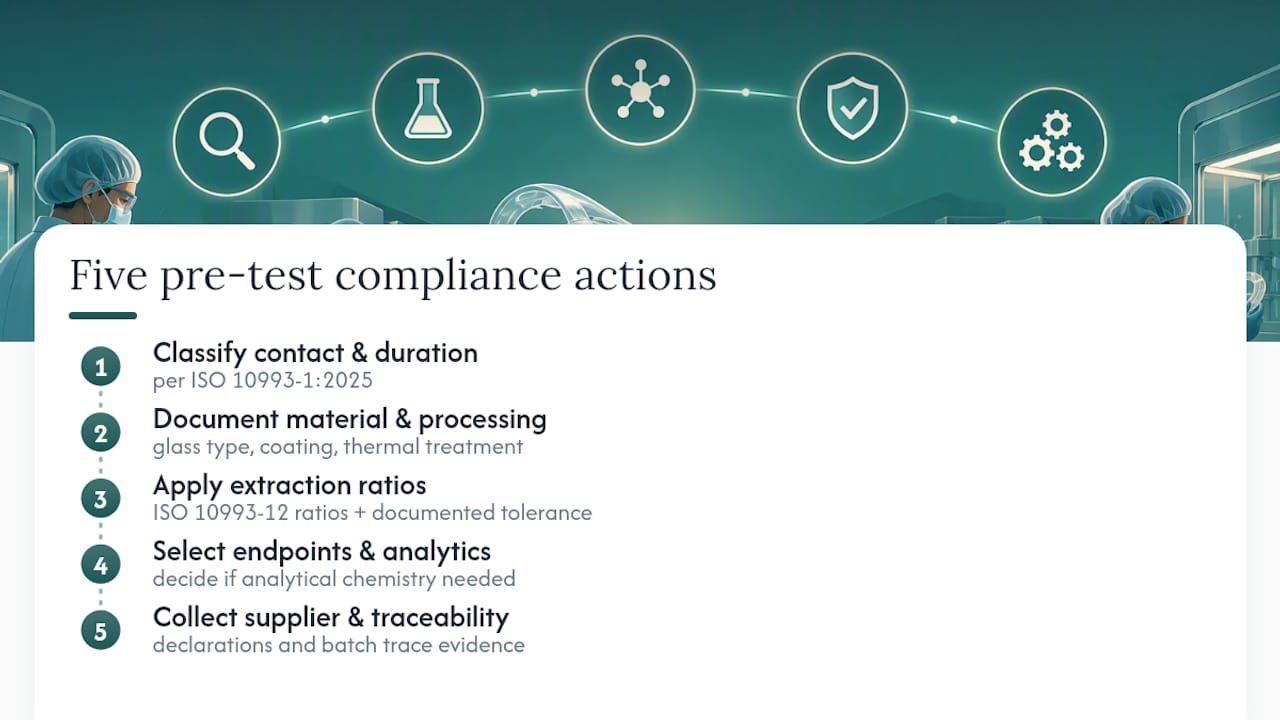
First, fix the device contact category and exposure duration against ISO 10993-1:2025, because everything downstream, including which endpoints apply, is set by that classification. Second, gather the material and processing history: glass type, coating chemistry, and thermal treatment. Third, apply the ISO 10993-12 extraction ratios with a documented tolerance and a written rationale for any deviation. Fourth, select the biological endpoints the contact category actually demands, and decide early whether analytical chemistry will be needed alongside them. Fifth, collect supplier declarations and batch traceability evidence, since a notified body will ask for the paper trail as readily as the test report.
Pro Tip: Build the supplier package before you commission testing, not after. A lab can only test what it’s given, and a missing coating datasheet is the single most common reason a cytotoxicity report gets kicked back for clarification.
Most delays in glass dossiers trace to one of two causes: an extraction condition nobody can justify, or a coating that was never disclosed to the test lab. Both are avoidable with a five-minute checklist at the design stage.
Material characterisation for glass: what to report and why it matters
Glass chemistry sets the leaching profile. Borosilicate glass, used widely in scanner and sensor windows, resists alkali extraction far better than soda-lime glass, which carries higher sodium and calcium oxide content and can shed more ions under aggressive extraction. Reviewers expect the composition family stated plainly, along with any heavy-metal content that could plausibly leach under the chosen extraction conditions.
Surface treatments matter just as much as the substrate. Anti-reflective coatings, hydrophobic layers, and chemically strengthened surfaces each introduce a distinct chemistry, and each needs its own line in the dossier: layer composition, deposition method, and process parameters such as bath temperature or dwell time for ion-exchange strengthening. A coating that is never mentioned is a coating a reviewer will eventually ask about, usually after testing is already complete.
Thermal history deserves its own paragraph too. The glass transition temperature (Tg) affects how a material behaves during extraction, particularly if elevated temperatures are chosen to accelerate the test. Extraction conditions that approach or exceed Tg risk altering the material rather than simulating clinical exposure, which undermines the whole point of the test.
For extractables and leachables, three analytical techniques do most of the work: ICP for elemental leaching, GC-MS for volatile and semi-volatile organics (relevant mainly to coatings and adhesives), and HPLC for less volatile organic species. Choosing the right combination up front, rather than retrofitting analytical chemistry after a biological result raises a question, is the difference between a smooth review and a stalled one.
Sample preparation and extraction for glass under ISO 10993-12
Extraction ratios are not a matter of preference. The published table in ISO 10993-12 specifies extraction ratios depending on the thickness and shape of the material, applying different values for thin, moderate thickness, and irregularly shaped solid materials where surface area cannot be measured reliably.
Temperature and duration choices follow a similar logic. ISO 10993-12 allows 37±1°C for 24 hours for limited-contact devices, extending to 72 hours where prolonged contact is expected. Elevated temperatures accelerate extraction but risk pushing conditions past what the glass or its coating can tolerate without changing phase, which is why 37°C remains the safer default unless a documented rationale supports going higher.
Pro Tip: Use borosilicate extraction vessels with inert PTFE liners. A standard glass tube without a liner can itself contribute leachables, contaminating a test meant to characterise your material, not the vessel.
Biological testing endpoints for glass and what results actually tell you
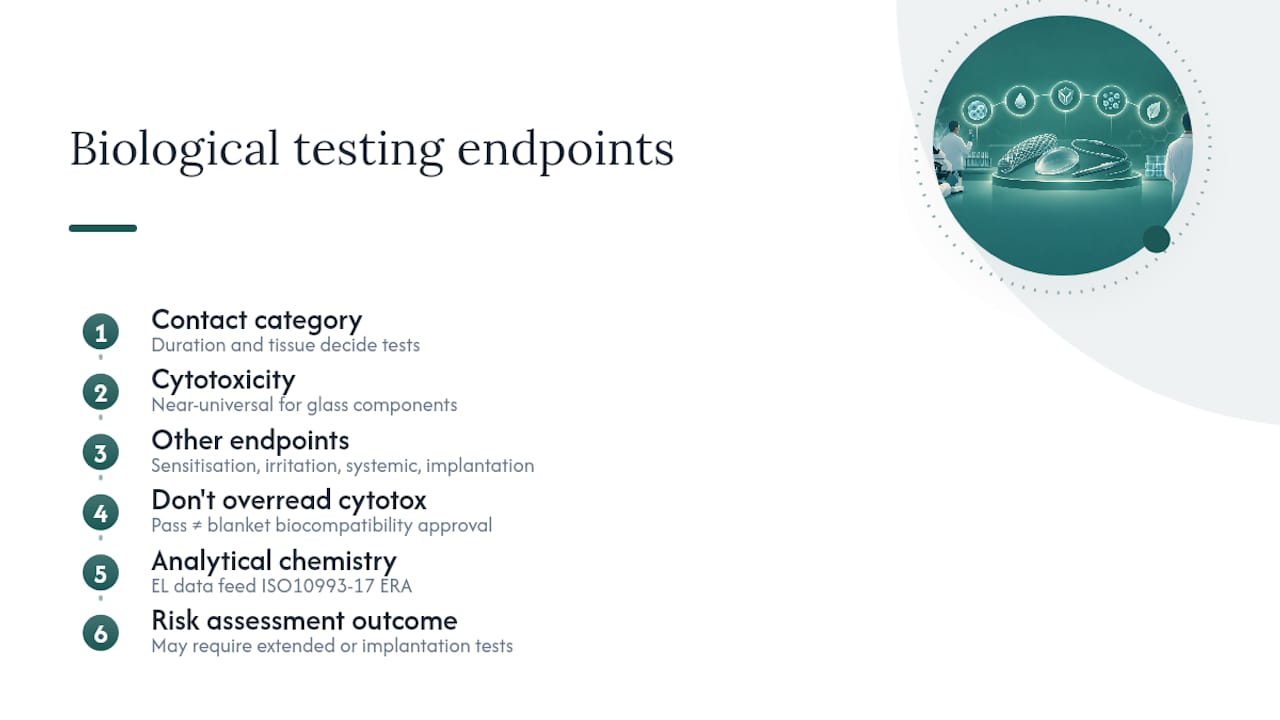
Contact category drives endpoint selection. Cytotoxicity under ISO 10993-5 is close to universal for glass components, while sensitisation, irritation, systemic toxicity, and implantation testing apply depending on contact duration and tissue type.
A passing cytotoxicity result is the most commonly misread outcome in a glass dossier. It confirms that a specific test system, under a specific extraction preparation, showed no cytotoxic response. It says nothing about sensitisation potential, systemic effects, or how a coating behaves once implanted, and treating it as a blanket biocompatibility approval is a well-documented interpretive error. Each endpoint answers one question, not the whole biological safety question.
This is where analytical chemistry earns its place. Extractables and leachables data, generated through ICP, GC-MS, or HPLC, feed directly into the toxicological risk assessment required under ISO 10993-17, which links chemical exposure levels to biological hazard thresholds. For devices with prolonged or permanent contact, that risk assessment often justifies additional testing, extended extraction durations, or implantation studies that a short-contact device would never need. Skipping it because cytotoxicity came back clean is the single most avoidable gap reviewers flag.
What belongs in the technical file for glass components
State the exact ISO edition tested against. ISO 10993-1:2025 reorganised the standard’s structure around ISO 14971 risk management, so a file citing an older edition without a transition rationale invites a query it doesn’t need to invite.
Beyond the edition, four elements make a submission defensible: full extraction conditions (ratio, temperature, duration, vessel type), materials characterisation data for the glass and any coatings, complete test reports for every endpoint claimed, and the toxicological risk assessment tying analytical results to biological hazard. Cross-reference ISO 14971 risk management explicitly rather than assuming a reviewer will infer the link. Supplier-control evidence, including audit reports or ISO 13485 supplier verification records, rounds out the package and pre-empts the most common follow-up query: how do you know the glass supplied matches the glass tested? Well-organised technical files also benefit from consistent documentation practices that keep terminology aligned across translated submissions.
How we prepare glass materials for ISO 10993 evaluation
A workable supplier package for biological evaluation contains five things: the material specification, full process history, coatings data with deposition parameters, batch traceability records, and a documented sample retention policy so a reviewer’s follow-up question doesn’t send anyone back to a supplier that may no longer stock that exact batch.
Some suppliers build this evidence into fabrication from the outset, capturing process parameters and coating specifications at the point of manufacture rather than reconstructing them retrospectively. Clear batch labelling, tied to retained samples and process logs, can reduce the number of clarification requests a technical file receives. Our quality standards documentation reflects the traceability approach we apply to every order destined for regulated devices.
The pattern behind most glass biocompatibility delays
Three problems recur across glass biocompatibility submissions: coatings that were never disclosed to the test lab, extraction conditions chosen for convenience rather than justified against clinical exposure, and supplier data that arrives incomplete after testing has already started. Materials characterisation done early, before samples are cut, catches most of this. It’s cheaper to ask a coatings supplier for a process datasheet on day one than to halt a study on day sixty. Toxicologists and testing labs work faster, and more accurately, when they receive complete material history rather than a bare glass sample and a hopeful cover letter.
— Alexandra
Get audit-ready glass components from Precision Glasses
Some manufacturers offer traceable fabrication with batch-level records captured at the point of manufacture, not reconstructed after a reviewer asks, to help close supplier-documentation gaps that stall glass biocompatibility submissions. Our coated and chemically strengthened glass, produced under ISO 9001-certified quality control, arrives with the process history and coatings data a technical file actually needs.

If you’re specifying display glass, optical windows, or custom components for a device heading into biological evaluation, request a specification review before your extraction study begins. It’s a faster route to a defensible dossier than discovering a documentation gap once testing is underway. Explore our optical components range or get in touch through the services pages to start that review now.
Standards and guidance worth reading directly
- ISO 10993-1:2025, the organising standard for biological evaluation.
- ISO 10993-12 practical guide, covering sample preparation and extraction ratios.
- ISO 10993-17:2023/Amd 1:2025, for toxicological risk assessment.
- ISO Online Browsing Platform entry for ISO 10993-12, to confirm current edition status.
- European Commission medical devices information, for EU regulatory context.
Sources
- ISO 10993-1:2025 – Biological evaluation of medical devices — Part 1
- Limitations of cytotoxicity testing and comprehensive biological evaluation
- ISO 10993-17:2023/Amd 1:2025 – Toxicological risk assessment
FAQ
What does ISO 10993 mean?
ISO 10993 is a multi-part standard series covering the biological evaluation of medical devices, run by the International Organization for Standardization. For glass components, the relevant parts are ISO 10993-1 (the organising framework), ISO 10993-12 (sample preparation), ISO 10993-14 (degradation products from ceramics and glass), and ISO 10993-17 (toxicological risk assessment).
What is the current version of ISO 10993-1?
The current edition is ISO 10993-1:2025, which restructured the standard to align more closely with ISO 14971 risk management. Manufacturers should cite this edition by number and year in the technical file rather than referring to the standard generically.
What is the purpose of ISO 10993-1:2018?
The prior ISO 10993-1 edition set out the general framework for planning biological evaluation based on device contact category and exposure duration. It has since been superseded by the 2025 edition, so any testing referencing earlier versions now needs a documented transition rationale.
What are the key differences between ISO 10993-23 and ISO 10993-10?
ISO 10993-10 historically covered both irritation and sensitisation testing together; the series later split these, with irritation testing addressed separately and sensitisation retained under 10993-10. For glass components without leachable sensitising residues, irritation testing is usually the more relevant endpoint, but the applicable scope should always be confirmed against the current edition in force.
Does Precision Glasses supply ISO 13485-aligned glass suppliers’ documentation?
Precision Glasses operates under ISO 9001 certification with traceable, batch-level production records suited to supporting ISO 10993 technical files. Current specifications and documentation options are detailed on the services page rather than published as a fixed price list.