
Glass is not the passive, inert material many assume it to be. In precision optical systems, its behaviour is profoundly shaped by how it is manufactured, handled, and exposed to mechanical or thermal stress. For technical decision-makers specifying glass for defence imaging systems, aerospace sensors, medical devices, or automotive heads-up displays, understanding how stress can alter optical behaviour is not optional. It is a fundamental engineering requirement. This guide moves from the basic properties of optical glass through to stress effects, glass type selection, and integration strategies, giving you the technical clarity needed to specify with confidence.
Table of Contents
- Understanding the fundamentals of glass optics
- How stress affects optical behaviour in glass
- Comparing optical glass types for critical applications
- Integrating optical glass into high-precision manufacturing
- The overlooked challenge: why stress mapping should guide glass selection
- Next steps: work with proven experts for optical precision
- Frequently asked questions
Key Takeaways
| Point | Details |
|---|---|
| Stress alters glass optics | Even small internal stresses can cause birefringence and affect precision in optical systems. |
| Choosing the right glass matters | Selecting glass with suitable optical and stress behaviour is essential for defence, medical, and aerospace designs. |
| Photoelasticity supports quality | Stress measurement through photoelasticity helps maintain performance in engineered glass components. |
| Manufacturing needs careful integration | Following a methodical process reduces risk and defects when incorporating optical glass into advanced workflows. |
Understanding the fundamentals of glass optics
Glass occupies a unique position in precision engineering. Unlike metals or polymers, it can transmit, refract, and filter light with extraordinary consistency, provided it is correctly specified and manufactured. However, treating all glass as optically equivalent is a serious mistake that can cost programmes significant time and resource.
The key optical properties that matter in high-precision applications are:
- Refractive index: The measure of how much glass bends light. Even small variations across a component can cause optical aberrations in imaging and sensing systems.
- Transmission: The proportion of incident light that passes through the glass. Different glass types transmit across different wavelength ranges, which is critical for infrared or UV applications.
- Absorption: Some glass absorbs certain wavelengths, affecting signal fidelity in photodetection or imaging applications.
- Birefringence: The splitting of light into two rays with different velocities as they travel through the glass. In an unstressed state, many glasses are optically isotropic, meaning their properties are the same in all directions. Introduce stress, and that changes.
The distinction between isotropic and anisotropic behaviour is fundamental. Isotropic glass transmits light identically in all directions, which is exactly what you want in precision optics. Anisotropic glass does not. Different engineered glass types respond to stress differently, and understanding that distinction early in your design process prevents costly failures downstream.
The difference between optical vs protective glass is also critical here. Protective glass prioritises mechanical robustness, while optical glass must balance mechanical integrity with highly controlled refractive and transmissive properties.
Stress can induce birefringence in glass, producing polarisation-dependent refractive index changes that degrade wavefront quality in precision optical systems.
This is not a theoretical concern. In interferometry, laser systems, and precision medical imaging, even small wavefront distortions can render a system unreliable. Precision optical systems require predictable, stable optical performance across their full operational lifetime.
How stress affects optical behaviour in glass
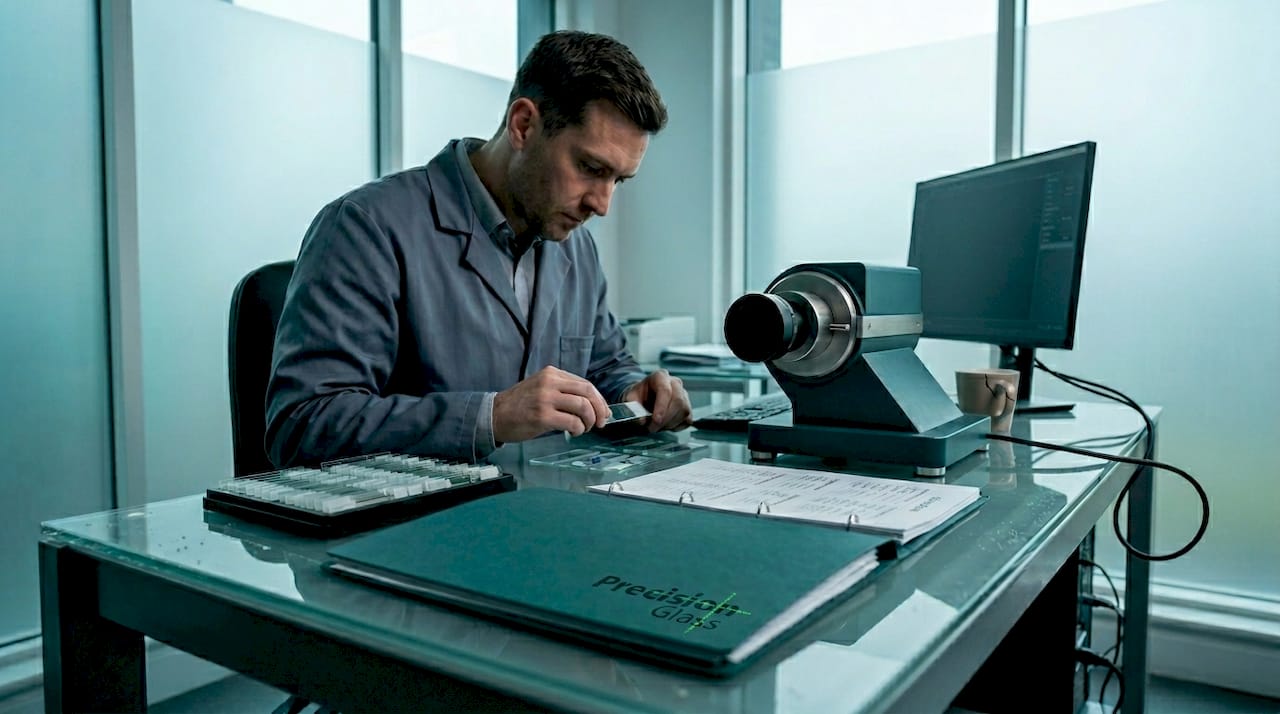
Stress is everywhere in glass manufacturing and application. It arises during the cooling phase after melting, during polishing or grinding, through mechanical clamping in assemblies, and from thermal gradients in operation. Each of these stress sources can alter the optical properties of glass in ways that are not immediately visible but are measurable and consequential.
When external or residual stress acts on a glass component, stress-optical relationships and photoelastic effects describe how the refractive index changes. Specifically, the difference in refractive index between two perpendicular directions (n1 minus n2) is proportional to the difference in principal stresses acting on the glass. The proportionality constant is the photoelastic coefficient, which varies between glass types. This means you can actually quantify the optical impact of a given stress state, and you should.
The following table summarises how birefringence values compare between stressed and unstressed glass:
| Condition | Refractive index behaviour | Birefringence level | Optical impact |
|---|---|---|---|
| Unstressed optical glass | Isotropic (uniform in all directions) | Near zero | Minimal wavefront distortion |
| Low residual stress | Slightly anisotropic | Low (less than 5 nm/cm) | Acceptable for many applications |
| Moderate stress | Anisotropic | Moderate (5 to 20 nm/cm) | Problematic in interferometry, imaging |
| High stress | Strongly anisotropic | High (over 20 nm/cm) | Severe wavefront degradation |
This table makes clear why stress management is not a secondary concern. The quality standards you apply to surface flatness and refractive index must extend equally to residual stress levels within the bulk material.
Stress detection is achieved through photoelastic analysis, where polarised light passed through the glass reveals stress patterns as colour fringes or intensity variations. This is a well-established technique, and it is a core part of the quality control in glass process that responsible manufacturers apply as standard practice.
Controlling stress begins at the manufacturing stage. Annealing, the controlled slow cooling of glass after forming, reduces residual stress significantly. The choice of annealing schedule directly affects the final stress state, and it must be tailored to the component’s intended optical performance requirements. Rushing this stage to meet delivery schedules is a false economy. Subsequent precision glass fabrication steps such as CNC grinding, polishing, and edge finishing must also be carried out with stress minimisation in mind.
Pro Tip: Always map internal stresses before integrating optical glass into high-precision systems. A thorough photoelastic stress map taken prior to assembly is far less costly than a field failure or a system recalibration after integration.
Comparing optical glass types for critical applications
Not all optical glass types respond to stress in the same way, and this distinction is critical when specifying materials for defence, medical, or aerospace programmes. Understanding the behaviour of each glass type under stress allows you to match the material to the operational environment with confidence.
Quartz glass is isotropic without external stress, but under stress becomes optically anisotropic. This property makes it excellent for applications requiring very low birefringence in an unstressed state, but it also means stress management during manufacture and integration is essential.
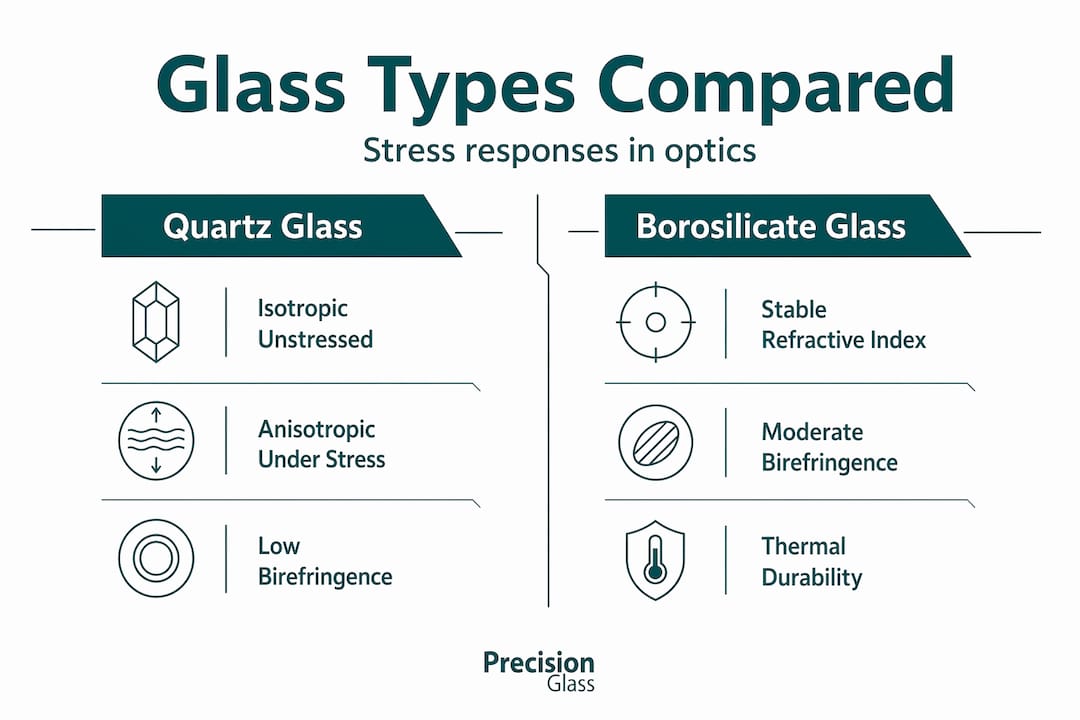
The following comparison table outlines how three common optical glass types perform across key criteria:
| Property | Quartz glass | Borosilicate glass | Soda-lime glass |
|---|---|---|---|
| Optical isotropy (unstressed) | Excellent | Good | Moderate |
| Birefringence under stress | Significant | Moderate | High |
| Thermal stability | Very high | High | Low to moderate |
| UV transmission | Excellent | Good | Poor |
| Chemical resistance | Excellent | Very good | Moderate |
| Typical applications | Laser optics, aerospace sensors, precision imaging | Laboratory instruments, defence windows, medical devices | Automotive glazing, general lighting |
| Cost | High | Moderate | Low |
This comparison is not about declaring one glass type superior. It is about matching properties to requirements. For high-altitude aerospace sensing where UV transmission and thermal stability are paramount, quartz is the appropriate choice. For defence observation windows where both mechanical robustness and controlled birefringence matter, borosilicate offers a strong balance. Soda-lime glass, while cost-effective, is typically unsuitable for applications where optical isotropy under stress is critical.
When selecting glass for precision applications, you should evaluate the following criteria:
- Birefringence specification: Define the maximum acceptable birefringence in nm/cm for your application and require certification to that value.
- Refractive index homogeneity: For imaging and interferometric systems, refractive index variation across the aperture must be controlled to tight tolerances.
- Thermal expansion coefficient: Mismatch between glass and surrounding materials generates stress during thermal cycling. Specify glass whose thermal expansion is compatible with the assembly design.
- Surface and subsurface quality: Grinding and polishing can introduce subsurface stress. Specify surface quality standards and require evidence of stress-free finishing.
- Wavelength range: Select glass whose transmission window is matched to your system’s operating wavelength.
Consulting detailed glass specifications for engineers at the specification stage prevents the costly substitution of materials later in the programme.
Integrating optical glass into high-precision manufacturing
Selecting the correct glass type is only the beginning. Successful integration into a precision system requires a structured, methodical approach that accounts for stress at every stage of the manufacturing and assembly process.
The following process provides a reliable framework for technical managers overseeing integration:
- Define optical performance requirements: Establish clear specifications for refractive index, transmission, surface quality, and maximum allowable birefringence before procurement begins. Ambiguous specifications lead to non-conforming components.
- Specify stress requirements at procurement: Require your glass supplier to certify residual stress levels, and specify the annealing grade (fine annealed, standard annealed) appropriate to your application. Do not leave this to supplier discretion.
- Commission pre-integration stress mapping: Before the glass component enters the assembly, conduct photoelastic stress analysis. This identifies any stress anomalies introduced during transit, storage, or preliminary machining.
- Apply precision machining protocols: CNC grinding and polishing must follow controlled parameters that minimise subsurface damage and stress introduction. Verify compliance through scratch-dig surface inspection and interferometric testing.
- Apply advanced optical coatings: Anti-reflection coatings, protective coatings, and filter coatings alter the surface stress state. Specify coating processes that are validated for your glass type and confirm that coating-induced stress remains within acceptable limits.
- Conduct final system-level verification: After integration, verify the optical performance of the assembly under representative mechanical and thermal loads. Wavefront testing under simulated operational conditions confirms that stress effects remain within specification.
The fact that stress can induce birefringence at any stage of this process, not just during manufacture, makes in-process verification essential rather than optional. A component that meets specification at delivery may not meet specification after mounting.
Working with experts in designing optical glass from the outset saves significant re-engineering effort. Equally, specifying advanced glass coating processes in coordination with the base glass supplier ensures that coating-induced stress is accounted for in the overall optical performance model.
Pro Tip: Collaborate with material scientists and optical engineers early in the programme to optimise glass design and minimise stress-induced defects. Early involvement prevents late-stage design changes, which are significantly more expensive to implement.
The overlooked challenge: why stress mapping should guide glass selection
Here is a perspective that many procurement teams overlook: most glass specifications focus almost entirely on bulk optical properties. Refractive index, Abbe number, transmission data. These are necessary. But they are not sufficient.
Photoelastic effects are used for measurement in precision systems precisely because stress cannot be inferred from bulk optical specifications alone. Two components made from the same glass type, to the same nominal specification, can have markedly different internal stress states depending on how they were manufactured, cooled, handled, and machined.
We have seen this pattern repeatedly across sectors we serve. A defence imaging programme specifies glass to a thorough refractive index and surface quality standard, then discovers during system integration testing that wavefront quality is degraded. The root cause, almost invariably, is stress. Stress that was never measured because it was never specified.
The solution is to treat stress mapping as a primary selection criterion, not an afterthought. Photoelastic analysis should be part of the incoming inspection protocol, not a diagnostic tool deployed only when problems emerge. This is particularly important in medical imaging, where wavefront distortion directly affects diagnostic accuracy, and in defence applications, where glass in industry sectors such as targeting and surveillance demands sustained optical performance under operationally demanding conditions.
The engineering community is increasingly aware of this. But procurement processes, often driven by cost and schedule, can deprioritise stress testing. Our view is direct: the cost of a photoelastic stress map is trivial compared to the cost of a system failure or a field retrofit. Stress mapping is not an optional extra. It is a fundamental quality gate.
Next steps: work with proven experts for optical precision
With the challenges of stress, birefringence, and glass selection clearly framed, the practical question is how to ensure your programme benefits from the right expertise at every stage.
At Precision Glasses, we design, fabricate, and supply precision optical glass components for the most demanding applications in defence, aerospace, medical devices, automotive dashboards, lighting, and electronics. Our process is built around meticulous quality assurance, including stress verification, to ensure every component meets its optical performance specification. Our technical glass products are manufactured to precise tolerances, and our optical components catalogue covers a wide range of substrate types, coatings, and geometries. Each project benefits from our structured glass quality assurance process, ensuring that what you receive matches what you specified. Contact our technical team to discuss your requirements.
Frequently asked questions
What is birefringence and why is it critical in optical glass?
Birefringence is the optical property where glass splits light into two rays with different velocities and polarisation states. As research confirms, stress induces birefringence in glass, producing polarisation-dependent refractive index changes that degrade wavefront quality, making it a critical parameter to control in precision optical systems.
How can engineers detect stress in glass before use?
Engineers use photoelastic analysis, passing polarised light through the glass to reveal stress-induced birefringence as measurable fringe patterns. Photoelastic effects are a well-established measurement technique for quantifying internal stress in optical components prior to integration.
Does all optical glass behave the same under stress?
No. Different glass types have distinct stress responses. Quartz glass is isotropic in an unstressed state but becomes optically anisotropic under stress, while borosilicate and soda-lime glass have different photoelastic coefficients and stress thresholds that affect their suitability for precision applications.
What are the main steps to integrate optical glass into manufacturing?
The process covers specification of optical and stress requirements, pre-integration photoelastic stress mapping, controlled CNC machining, application of validated coatings, and final system-level wavefront verification. Each step ensures that birefringence and wavefront degradation remain within acceptable limits throughout the manufacturing and assembly lifecycle.