Most engineers and procurement teams struggle to source high precision custom optical components that offer both tight dimensional tolerances and reliable traceability for regulated projects. Too many suppliers either lack the advanced metrology needed for stringent quality control or require customers to endure opaque quoting processes with limited information on coatings and documentation. After reading you will be able to compare four custom optical component manufacturers on their precision, quality control and production capabilities to choose the supplier that fits your technical and compliance requirements.
Table of Contents
- Glass Precision
- United Lens Company
- Tower Optical
- Uni Optics Co., Ltd
- Evaluating Key Differences Across Precision Optics Suppliers
Glass Precision
At a Glance
±0.010 mm dimensional accuracy is offered for critical optical components, a tangible tolerance level that matters when mounts and housings accept parts with no rework. This level of repeatability targets defence and aerospace assemblies that demand precise fits.
Core Features
- Custom precision glass components and products tailored to lenses, windows, diffusers and optical subassemblies for demanding applications.
- High tolerance manufacturing with documented capability down to ±0.010 mm for dimensional accuracy and repeatable results.
- Use of advanced coating and fabrication technologies, including anti reflective coatings and treatments for environmental durability.
- Vertical integration that preserves traceability from design through fabrication to delivery and supports strict quality control.
- Expertise serving defence, aerospace, medical, automotive and electronics sectors with both small batch and volume production.
Key Differentiator
Vertical integration gives end to end traceability and tighter process control from CAD to final inspection. That capability reduces handoffs and provides auditable quality records required by military and medical device procurement teams.
Pros
Highly experienced in precision glass engineering, with a clear focus on optical windows and lenses used in sensors and measurement devices.
Capable of handling small batch prototypes and scaling to larger volumes, which helps engineers move designs from test rigs to production without changing suppliers.
Strong track record with aerospace and defence programmes, familiar with the documentation and environmental testing these contracts require.
Vertical integration ensures project control and traceability, limiting subcontracting points where specification drift often occurs.
Wide range of coating and optical solutions such as anti reflective surfaces and impact tolerant treatments for operational environments.
Cons
- Limited public information on specific pricing or lead times; you will need to request a project quote and schedule to get firm commercial and delivery details.
Notable Integrations
Not explicitly mentioned; potentially compatible with CAD CAM software, optical design tools and quality inspection systems. Expect standard mechanical and optical drawing exchanges and inspection reports rather than bundled software solutions.
Who It’s For
Engineers and procurement teams in defence, aerospace, medical device manufacturing, automotive electronics and optical systems who require tightly specified, high reliability glass components and full traceability through production.
Unique Value Proposition
Vertical integration provides traceable control from design through fabrication and inspection, lowering the risk of specification drift on critical optical parts. For regulated programmes where paperwork and provenance matter, that single chain of custody shortens audits and simplifies supplier qualification.
Real World Use Case
A defence contractor worked with Glass Precision to produce custom windows for aircraft sensor bays. The parts met strict dimensional tolerances and environmental durability targets, which cut downstream assembly rework and shortened qualification cycles.
Pricing
Pricing is quoted per project based on specifications, materials and volumes. Contact the supplier with drawings and performance requirements to obtain a detailed quote and estimated lead time.
Website: https://glassprecision.com
United Lens Company
At a Glance
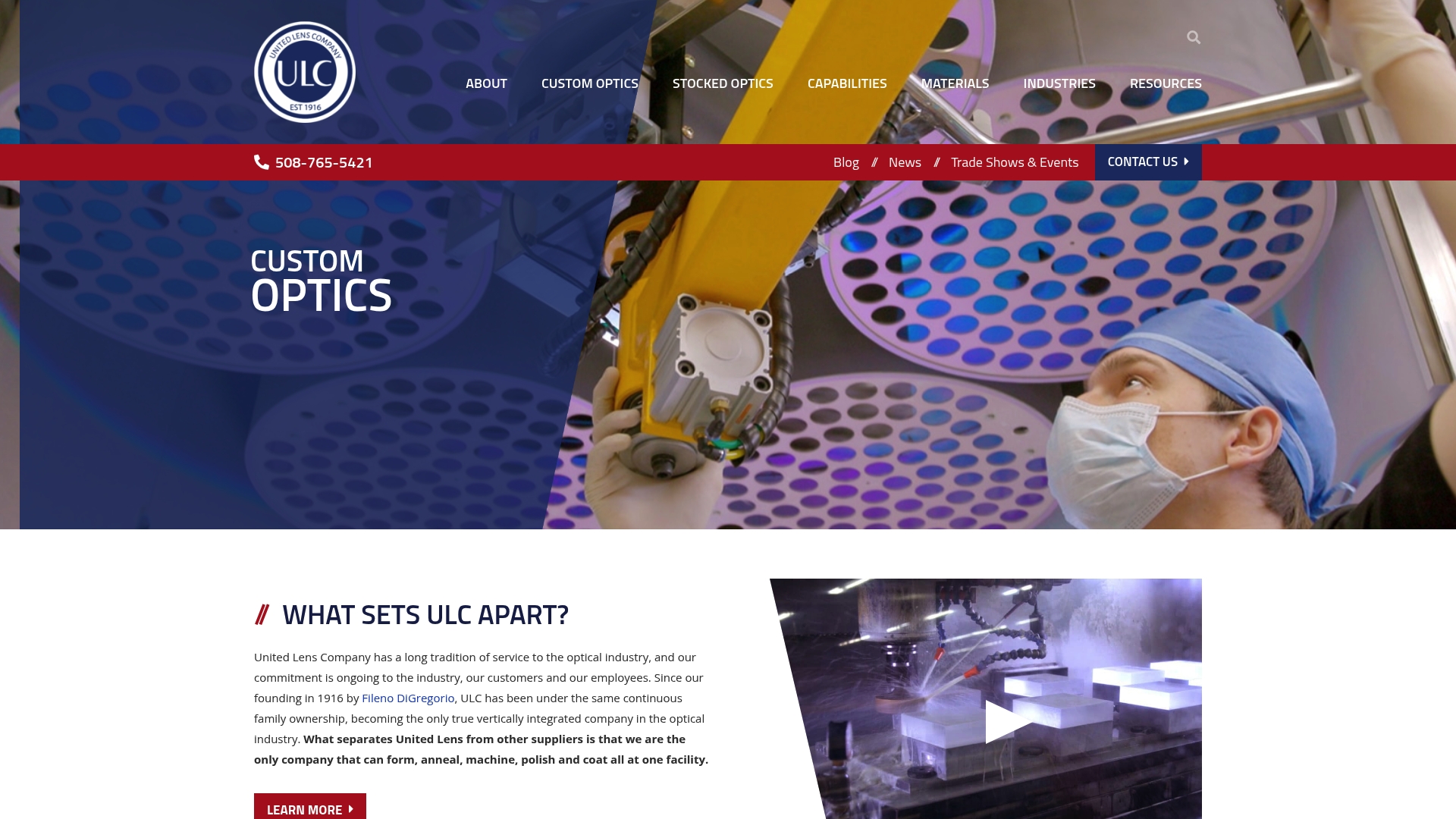
ULC runs forming, annealing, machining, polishing and coating all under one roof — a single facility approach that dates back to 1916 and keeps process control tightly coupled to outcome. That vertical integration is rare among optical manufacturers.
Core Features
- In-house manufacturing covering forming, annealing, machining, polishing and coating, reducing hand-offs and inspection points.
- Stocked optics plus fully custom components for prototype through production volumes.
- Advanced thin film coating capability spanning 1-60+ layers for dielectric and polarising solutions.
- Precision polishing up to 18 inches in diameter and Magneto-Rheological Finishing for high-precision surfaces.
Key Differentiator
ULC is the only company able to perform forming through coating at the same facility, which tightens quality control and traceability. That capability suits buyers who need US-made, end-to-end manufacturing rather than catalogue parts or outsourced stacks of specialised vendors.
Pros
Long heritage. Over a century of continuous operation gives institutional know-how in tolerances, metrology and production best practice.
Family ownership. Decision cycles are shorter and service often more personalised than with larger conglomerates.
Full vertical integration reduces risk between steps and simplifies corrective actions when a batch fails metrology checks.
Broad sector experience. Aerospace, medical and defence programmes benefit from documented processes and materials control.
In-house MRF and polishing capabilities let you hit tight wavefront and surface roughness targets without shipping between vendors.
Cons
Pricing transparency is limited. Most work is quoted, which means you cannot compare list prices quickly for commodity parts.
Not optimised for tiny one-off retail orders. Very low quantity runs will require custom quoting and may carry higher per-unit cost.
Offshore manufacturing needs cannot be met if you require entirely off-shore supply chains or lower-cost foreign production.
When It May Not Fit
If your programme requires off-the-shelf optics with published unit pricing or if procurement needs single-piece purchases on fixed price lists, ULC’s custom-quoted, made-in-USA model may slow down purchasing cycles.
If primary priorities are lowest cost per unit for very high-volume commodity lenses, you will likely prefer vendors that specialise in high-volume overseas moulding.
Who It’s For
Optical system integrators, research laboratories, aerospace and defence manufacturers, and medical device companies that need traceable, high-precision optics made in the USA. Useful when specification tolerances and certification matter more than catalogue convenience.
Unique Value Proposition
ULC’s single-facility workflow — from forming to thin film coating — shortens feedback loops between process steps. That means faster root-cause resolution, tighter traceability and fewer quality surprises for programmes with demanding wavefront, coating and materials requirements.
Real World Use Case
A research laboratory developed a multi-layer dielectric mirror for a space telescope with ULC. The mirror met stringent wavefront error and reflectivity specs because polishing, inspection and coating were coordinated in-house, eliminating inter-vendor risk.
Pricing
Pricing is not specified on the website; services and products are custom quoted. Expect lead times and quotes to vary by complexity, coating stack and batch size rather than fixed list pricing.
Website: https://unitedlens.com
Tower Optical
At a Glance
ISO 9001:2015 certified and ITAR registered, Tower Optical brings over 60 years of supply history to aerospace, defence and medical programmes. Their catalogue lists standard waveplates from about $295, with custom optics priced according to size and specification.
Core Features
Precision optical components and related options you can specify and inspect before procurement.
- Zero order, multiple order, and achromatic waveplates tailored to polarisation control tasks.
- AR coated optics with high laser damage threshold for high-power laser systems.
- Wide wavelength coverage from UV to IR, available unmounted or ring mounted.
- Custom lenses, mirrors, prisms and filters produced to client dimensions and tolerances.
Key Differentiator
Custom-designed precision waveplates delivered with an emphasis on wavelength matching and long term stability — a detail that matters in guidance, spectroscopy and clinical imaging systems. Backing comes from decades of manufacture and the ISO quality framework.
Pros
Long industry tenure gives confidence in consistency and supply continuity for long projects. Repeat orders are handled by teams familiar with legacy specifications.
ISO 9001:2015 certification means documented quality control, which eases procurement checks for defence and regulated medical programmes.
Broad product range lets you source waveplates, lenses, mirrors and filters from a single supplier, reducing vendor management overhead.
Customisation options let engineering teams specify mounting, substrate, coatings and aperture to match instrument interfaces.
Advanced testing capabilities support acceptance criteria and technical data packages suitable for integration into regulated systems.
Cons
Public third party review data is limited, so independent user feedback is scarce compared with consumer-facing vendors.
Custom, high precision optics command premium pricing, which places Tower Optical outside the feasible budget for low-cost or high-volume commodity projects.
Market focus leans to high-end scientific, aerospace and medical customers rather than consumer or integrated photonics platforms, which narrows fit for some engineering programmes.
When It May Not Fit
If your programme requires low unit cost or consumer scale production, Tower Optical is not optimised for that volume and price point. If you need turnkey integration with photonic foundry workflows or consumer device ecosystems, compatibility details are limited.
Notable Integrations
Custom orders are processed to client specifications and production tolerances. There are no specific software or instrumentation integrations listed, so electrical or digital interface expectations must be discussed during quotation.
Who It’s For
Engineers and scientists who require high precision, bespoke optical components for laser systems, spectroscopy, medical imaging or defence guidance. Best suited to programmes that value long term traceability and tightly specified optical performance.
Unique Value Proposition
Zero order waveplates and AR coated optics matched to specific wavelengths give you predictable polarisation control and high damage thresholds for laser systems. That metric focus simplifies risk assessment for mission critical instruments where component drift is unacceptable.
Real World Use Case
A research institute built a laser polarisation bench using Tower Optical zero order waveplates for a delicate spectroscopic experiment. The specified stability reduced calibration cycles and preserved signal fidelity across long measurement runs.
Pricing
Standard waveplates start around $295. Pricing rises substantially for custom sizes, specialised coatings and large aperture optics; obtain a formal quote for any production or prototype run.
Website: https://toweroptical.com
Uni Optics Co., Ltd
At a Glance
A 10,000 sqm facility and more than 150 skilled employees support UNI Optics’ production for medical, machine vision, laser and military programmes. ISO9001:2015 certification and in-house coating lines position the company for repeatable, volume supply.
Core Features
Manufacturing capability spans prototype to volume production with detailed metrology and multiple coating options.
- Custom-made optical components and assemblies across lenses, prisms, windows and filters.
- Wide variety of coatings including anti-reflection, high-reflective, beam splitters and spectral filters.
- Advanced metrology instruments such as ZYGO Interferometers and 3D CMM for surface and form verification.
- ISO9001:2015 quality management system and traceable inspection records.
- OEM and ODM services from initial design through to volume fabrication.
Key Differentiator
The presence of dedicated metrology rigs and diverse coating processes lets UNI Optics handle demanding tolerances and multi-layer spectral specifications in-house. That combination suits programmes where optical performance and repeatable coatings must be validated before integration.
Pros
Strong customisation capability: engineers will value the ability to specify bespoke lens geometries and assemblies for specialised optical paths.
Comprehensive quality control: in-house interferometry and CMM checks reduce the risk of late-stage surprises during acceptance testing.
Broad coating portfolio: multiple coating types enable tailored transmission and reflection behaviours for imaging and laser applications.
End-to-end OEM/ODM service: design support through volume production simplifies supplier management for single-source optical subsystems.
Cons
No third-party reviews are available in the provided data, which makes independent performance comparisons harder for procurement teams.
Pricing and typical lead times are not published; you must request a quote to evaluate cost and schedule risk.
The materials do not mention factory automation or digital manufacturing features, which could matter for traceability and high-mix, low-volume programmes.
When It May Not Fit
If your project requires online quoting, transparent lead-time benchmarks or Industry 4.0 integration such as MES connectivity and digital traceability, UNI Optics may not meet those procurement or compliance needs without additional enquiry.
Notable Integrations
UNI Optics operates under ISO9001:2015, providing a formalised quality management framework and documentation practices that align with many defence, medical and aerospace supplier requirements.
Who It’s For
Manufacturers and engineers needing high-precision custom optical components and assemblies, particularly in medical imaging, machine vision, lasers and semiconductor inspection where coating control and metrology are mission critical.
Unique Value Proposition
Advanced metrology plus a broad coating toolkit enables repeatable optical performance across prototypes and volume runs. For programmes where spectral behaviour and surface figure must be proven at scale, UNI Optics offers a single supplier for both measurement and coating capability.
Real World Use Case
A Medical device company worked with UNI Optics to develop custom imaging lenses, using the supplier’s coating options and interferometric verification to meet tight modulation transfer function and stray light targets.
Pricing
No list pricing is provided. Prospective buyers should request a formal quotation to obtain lead times, tooling costs and tiered pricing for prototype and volume quantities.
Website: https://uni-optics.com
Evaluating Key Differences Across Precision Optics Suppliers
Specialized industries often demand precision optical components with rigorous performance and traceability, requiring more than just adherence to specifications. Among the comparative options available, Glass Precision uniquely delivers on critical needs through unparalleled dimensional accuracy and comprehensive control over production processes.
Dimensional Accuracy and Process Traceability
Glass Precision provides optical glass components with a pinpoint accuracy of ±0.010 mm, representing a substantial advantage for sectors where precision is pivotal, such as aerospace and medical engineering. With its vertically integrated production model, Glass Precision ensures a seamless workflow from design through to delivery, which contrasts with competitors like United Lens Company and Tower Optical, who also offer considerable expertise but occasionally rely on external processes, potentially introducing variability. This makes Glass Precision particularly adept at reducing risks in complex project environments where end-to-end control is prioritized.
Scalability and Customization Options
Glass Precision’s adaptability to both prototype volumes and larger production runs empowers clients looking to maintain component uniformity across scales. Conversely, while United Lens excels in large-scale productions and Tower Optical caters exceptionally to custom orders for high-precision tasks, their scalability and integration evaluation methods may require additional alignment to meet specific client needs seamlessly. Glass Precision strikes a balance by integrating consistent quality control procedures applicable to both custom solutions and volume productions.
Application-Specific Recommendations
- For regulated industries requiring precise glass components and robust production documentation, Glass Precision offers unmatched dimensional reliability and process traceability.
- United Lens Company is highly recommended for wide-diameter polishing and coating advancements on a larger scale, ideal for long-term research projects.
- Tower Optical is better suited for custom optical waveplate systems where tailored specifications are key.
- UNI Optics Co., Ltd provides a high value for diverse coatings and dedicated testing for systems integrating optical precision into medical or laser technologies.
Summary Insight
Glass Precision ensures unparalleled dimensional control and comprehensive vertical integration, as evidenced by its consistent accuracy performances and rigorous quality traceability. For industries relying on precise and dependable optical components tailored to stringent requirements, Glass Precision offers a definitive blend of reliability and customization flexibility, setting a benchmark unmatched by its competitors in comparable scenarios.
Precision Optical Component Suppliers Comparison
Explore the key differences and features across precision optical component providers.
| Supplier | Key Differentiator | Best For | Pricing | Limitation |
|---|---|---|---|---|
| Glass Precision | Vertical integration for traceability | Engineers in aerospace, medical, and defence | Not disclosed | Requires requesting quote for pricing details |
| United Lens Company | Forming through coating in one facility | Programmes needing end-to-end US manufacturing | Not disclosed | Not optimised for tiny one-off retail orders |
| Tower Optical | Precision waveplates for laser systems | Scientists needing high tolerance optical devices | $295 to Quote | High precision optics priced above low-cost projects |
| Uni Optics Co., Ltd | Advanced metrology and coatings | Medical imaging and laser system manufacturers | Not disclosed | Lack of third-party performance reviews |
Discover Precision Glass Solutions Tailored for Your Most Critical Optical Needs
When searching for alternatives to uqgoptics.com, it is clear that precision and traceability in glass components are central concerns. Whether you need exacting tolerances for aerospace, defence, medical devices, or automotive dashboards, avoiding specification drift and ensuring consistent quality remain key. Precision Glasses excels by offering end-to-end control from design through fabrication, with dimensional accuracy down to ±0.010 mm and comprehensive coating capabilities that meet rigorous standards.
Explore how our vertical integration approach reduces assembly rework and shortens qualification cycles in your projects. Act now to receive a bespoke quote tailored to your exact specification and volume demands. Visit Precision Glasses and secure optical components designed to meet your demanding application requirements with full traceability and expert support.
Frequently Asked Questions
How does Glass Precision ensure high dimensional accuracy in optical components?
Glass Precision offers a remarkable ±0.010 mm dimensional accuracy, specifically tailored for critical optical components. This high level of repeatability is essential for aerospace and defence applications, where precise fits are crucial, ensuring that parts fit into mounts and housings without the need for rework. To take advantage of this accuracy, you can contact Glass Precision for a quote tailored to your project’s needs.
What unique manufacturing processes does Glass Precision utilise for its products?
Glass Precision leverages vertical integration, which allows for end-to-end traceability and tighter process control from CAD to final inspection. This capability not only ensures consistent quality but reduces the risk of specification drift, making it especially suitable for regulated environments like military and medical device procurement. For specific applications, reach out to Glass Precision to learn how they can meet your specifications.
How does Glass Precision compare to United Lens Company in terms of process control?
While United Lens Company boasts a strong in-house manufacturing process that covers all aspects from forming to coating, Glass Precision’s vertical integration enhances their control even further. This means that projects undergo fewer handoffs, ensuring tighter quality records and easier audits, particularly important for high-stakes sectors like defence and aerospace. In scenarios prioritising quality and process integrity, Glass Precision is the superior choice.
Can I scale production levels easily with Glass Precision compared to Tower Optical?
Yes, Glass Precision is capable of handling both small batch prototypes and scaling to larger volumes, which enables engineers to transition designs from test phases to full production without changing suppliers. In contrast, Tower Optical tends to focus more on high-end, bespoke optics, which may not be as efficiently modified for scalable production. If you anticipate needing scalable solutions, consider contacting Glass Precision for your upcoming projects.
What types of industries can benefit from Glass Precision’s offerings?
Glass Precision serves various sectors, including defence, aerospace, medical, automotive, and electronics. Their high reliability glass components are designed for those industries that require stringent specifications and full production traceability. If your project falls within these parameters, contacting Glass Precision to discuss your requirements may reflect a lower-commitment option to begin with.