Selecting engineered glass for aerospace, defence, or medical device applications is never a straightforward materials decision. Unlike commodity glazing, every specification carries procurement risk: choose the wrong thermal expansion class and a satellite mirror drifts out of tolerance; specify the wrong heat-treatment grade and a structural panel fails certification. Engineers and procurement managers in these sectors must reconcile demanding performance parameters, compliance obligations, and real-world manufacturability constraints simultaneously. This guide covers the most critical engineered glass categories, the selection criteria that matter most, and the specification practices that separate reliable procurement from costly programme delays.
Table of Contents
- Criteria for evaluating engineered glass in critical industries
- Ultra-low thermal expansion glass-ceramics: ZERODUR® and beyond
- Heat-treated engineered glass: Strength and compliance for demanding environments
- Sapphire and specialty optical windows: Maximum hardness for exposed environments
- Comparing engineered glass options for high-precision applications
- Our perspective: What most engineers miss when specifying engineered glass
- Precision engineered glass: Your partner for critical applications
- Frequently asked questions
Key Takeaways
| Point | Details |
|---|---|
| Specify for application | Choose engineered glass with properties that match your design and operational environment. |
| Evaluate manufacturability | Consider both performance parameters and production realities, such as polishing or distortion testing. |
| Verify certification | Request and review supplier documentation to ensure compliance with sector standards. |
| Compare options | Use a comparison framework to weigh material strengths, weaknesses, and procurement impacts. |
Criteria for evaluating engineered glass in critical industries
With the stakes clarified, it is essential to understand which criteria genuinely matter when choosing precision glass. Not all parameters carry equal weight across every application, and conflating headline material properties with actual tested performance is one of the most common procurement errors we see.
When specifying engineered glass for mission-critical programmes, your evaluation checklist should address the following:
- Dimensional stability and coefficient of thermal expansion (CTE): This is non-negotiable for optical systems, metrology equipment, and any component exposed to temperature cycling. Even minor thermal drift can compromise alignment tolerances measured in nanometres.
- Mechanical strength, heat-treated versus annealed: Annealed glass is the baseline. Heat-strengthened and fully tempered variants offer substantially improved resistance to thermal and mechanical stress. The process controls governing each variant directly determine structural reliability in service.
- Chemical and scratch resistance: Harsh environments in defence or surgical settings demand surfaces that resist corrosion, cleaning agents, and abrasion without degrading optical clarity or surface flatness.
- Manufacturability: Polishing tolerances, CNC work cycle times, achievable surface finish grades, and material machinability all influence both cost and lead time. A specification that is technically correct on paper may be commercially unworkable in practice.
- Industry-specific compliance: Standards such as ASTM C1048 govern heat-treated flat glass properties, while defence and aerospace programmes often carry additional MIL-spec or programme-specific quality requirements.
- Flatness and distortion metrics: Vendors may distinguish HS vs FT and emphasise pre-coating heat treatment and quantified distortion metrics measured in millidiopters, so specifications should request the correct measurement method and acceptance criteria rather than relying on nominal strength claims alone.
Pro Tip: Always request documented distortion and flatness metrics from your supplier, not simply the nominal product description. A distortion map expressed in millidiopters provides far more procurement value than a generic “heat-treated” label on a data sheet.
Understanding glass engineering basics before engaging suppliers puts you in a considerably stronger position to challenge claims and build a specification that is both technically sound and commercially realistic.
Ultra-low thermal expansion glass-ceramics: ZERODUR® and beyond
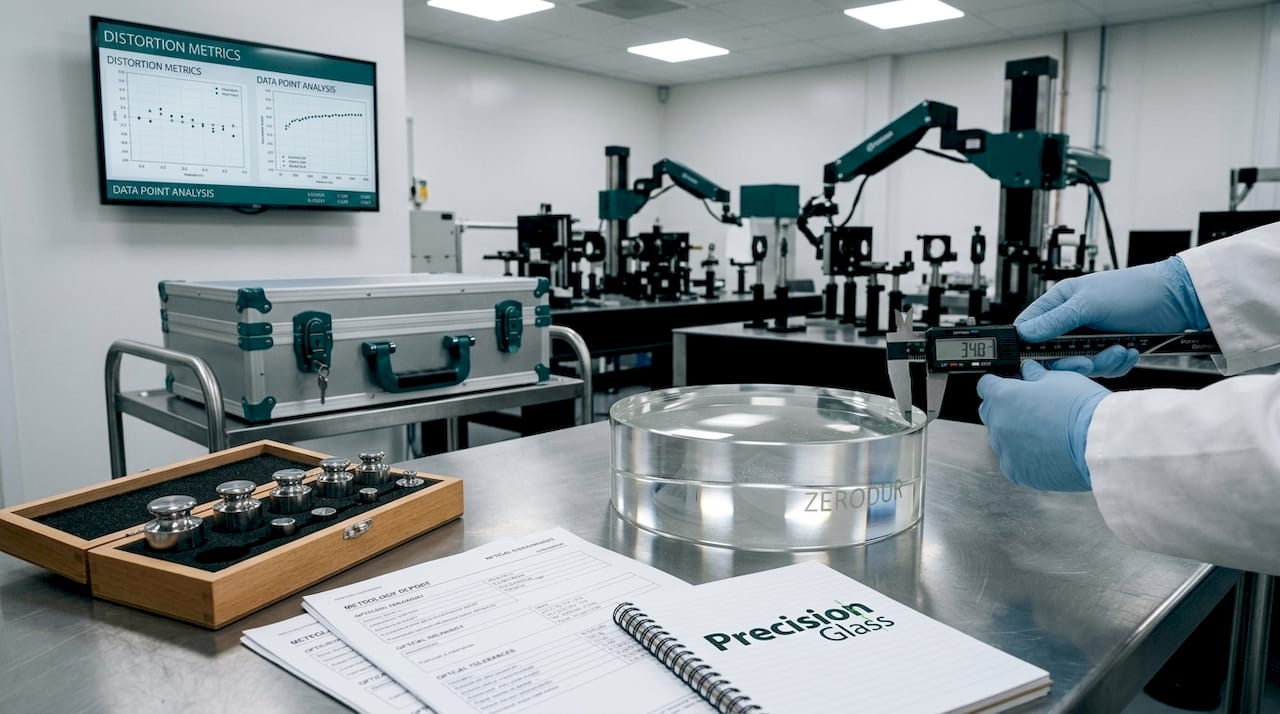
One of the most widely specified engineered glasses, ZERODUR, sets the standard for dimensional stability where failure is not an option. Its defining characteristic is a thermal expansion coefficient so close to zero that temperature changes that would cause measurable deformation in conventional glass leave ZERODUR essentially unaffected.
Ultra-low CTE glass-ceramics such as ZERODUR are engineered for dimensional stability in precision optical, measurement, and aerospace and defence relevant applications. The material achieves this through a carefully controlled crystallisation process during manufacture, producing a glass-ceramic microstructure in which the crystalline and amorphous phases have opposing thermal expansion behaviours that effectively cancel each other out.
“ZERODUR has been specified for NASA Great Observatory mirror substrates, extreme ultraviolet lithography systems, and laser gyroscope platforms precisely because its dimensional stability is not just low, it is predictable and certifiable over the operational lifetime of the programme.”
For procurement and engineering teams evaluating ZERODUR or comparable materials from suppliers, the practical picture looks like this:
- Strengths: Near-zero CTE across a wide temperature range, nanometre-level dimensional repeatability, certifiable material homogeneity, long heritage in space-qualified optical programmes.
- Limitations: Higher raw material cost compared to standard optical glass, longer lead times for large substrates, requires specialist grinding and polishing expertise.
- Procurement factors: Demand material certificates that specify CTE class (expansion class 0 through to class 2 in the SCHOTT classification system), surface figure data, and homogeneity reports. Do not accept material characterisation based on batch averages alone.
The advanced optical glass systems used in satellite payloads, ground-based astronomical instruments, and semiconductor lithography all share a common requirement: the optic must not move when the environment changes. ZERODUR is the material that meets this requirement with documented, programme-grade traceability.
For defence and aerospace procurement teams assessing glass solutions for aerospace, ZERODUR represents the highest tier of dimensional stability available in a commercially produced glass material, and specifications for it should be treated with the same rigour as any other flight-critical component.
Heat-treated engineered glass: Strength and compliance for demanding environments
For many high-stress or large-format applications, glass strength and tested compliance take centre stage. Heat-treated glass covers two distinct product categories: heat-strengthened (HS) and fully tempered (FT), and understanding the differences is critical to writing a procurement specification that will actually deliver the performance you need.
Heat-strengthened glass is produced by heating annealed glass to near softening point and then cooling it at a controlled rate, introducing surface compression stresses roughly twice those of annealed glass. Fully tempered glass undergoes a more rapid cooling process, generating surface compressions four to five times greater than annealed glass and causing the characteristic small-fragment breakage pattern on failure.
Heat-treated procurement-critical glass includes heat-strengthened and fully-tempered products, where manufacturers specify stronger-than-annealed behaviour and emphasise controlled heat treatment parameters and distortion measurement as key performance differentiators.
The practical implications for glass fabrication processes are significant. Because tempering introduces permanent stress states, all cutting, drilling, edgework, and surface treatments must be completed before heat treatment. This sequencing constraint must be built into your production schedule from the outset.
- Heat-strengthened (HS): Approximately twice the strength of annealed; breaks into large pieces similar to annealed; lower residual stress enables better optical flatness; preferred where both strength and optical quality matter.
- Fully tempered (FT): Four to five times the strength of annealed; breaks into small granular fragments; higher residual stress can introduce measurable waviness or distortion; preferred for structural safety-glass applications.
| Property | Annealed | Heat-strengthened | Fully tempered |
|---|---|---|---|
| Relative strength | 1× baseline | ~2× annealed | 4 to 5× annealed |
| Breakage pattern | Large shards | Large pieces | Small granules |
| Surface distortion | Minimal | Low to moderate | Moderate to high |
| Optical suitability | High | Good | Limited |
| Typical applications | Precision optics, instruments | Facades, vehicle glazing | Safety glazing, structural panels |
| ASTM C1048 compliance | N/A | Required | Required |
Understanding the optical versus protective glass trade-off is particularly important here. Programmes that need structural compliance and optical performance simultaneously often require heat-strengthened rather than fully tempered products, as the lower distortion profile better preserves transmitted wavefront quality.
Pro Tip: Request your vendor’s distortion test reports expressed in millidiopters before committing to a heat-treatment specification. Distortion tolerances that appear acceptable in a data sheet summary can translate into unacceptable optical degradation when measured against your actual system’s wavefront budget.
Sapphire and specialty optical windows: Maximum hardness for exposed environments
For applications where glass is exposed to abrasion or high-impact risks, specialty crystalline options like sapphire come into play. Sapphire is not glass in the conventional sense, it is single-crystal aluminium oxide, but it occupies the same specification space in defence and aerospace optical windows where no glass-based material can match its combination of hardness and optical performance.
Sapphire rates 9 on the Mohs hardness scale, making it second only to diamond among commonly specified optical materials. This hardness directly translates into scratch resistance that standard glass cannot approach, even after hard-coating treatments. For technical glass products used in exposed military vehicle viewports, airborne electro-optical sensor windows, and medical laser delivery optics, this property is frequently the decisive selection criterion.
Key performance characteristics of sapphire windows:
- Mohs hardness of 9, offering best-in-class scratch resistance for exposed optical surfaces.
- Optical transmission from approximately 150 nm in the ultraviolet through to 5,500 nm in the mid-infrared, covering UV, visible, near-IR, and mid-IR bands in a single material.
- High mechanical strength and thermal stability, suited to both cryogenic and elevated-temperature operational environments.
- Birefringence must be accounted for in polarisation-sensitive optical designs.
Sapphire for high-hardness applications is recognised across defence and aerospace exposed optics programmes precisely because no other readily available optical material combines wideband clarity with that level of surface hardness. However, the Mohs 9 hardness that makes sapphire so durable also makes it extraordinarily difficult and time-consuming to polish. Material removal rates during lapping and polishing are dramatically lower than for glass, and achieving the surface figure tolerances required for diffraction-limited optical performance requires highly specialist processing equipment and extended cycle times.
For innovative glass and crystalline solutions specified on advanced aerospace and medical programmes, sapphire’s polishing complexity is not merely an academic concern. It directly affects programme lead times and unit costs in ways that must be factored into procurement planning from the earliest stages of design.
Pro Tip: When procuring sapphire windows, build polishing and manufacturing complexity explicitly into your cost model and timeline forecast. A sapphire window that looks competitive on raw material price can represent a significant cost overrun if polishing lead time has not been accounted for in the programme schedule.
Comparing engineered glass options for high-precision applications
To support decision-making, see the direct comparison of top engineered glass options below. ZERODUR, sapphire, and heat-treated glass each address distinct specification challenges across aerospace, defence, and medical contexts, and no single material is optimal across all parameters.
| Property | ZERODUR | Heat-strengthened glass | Fully tempered glass | Sapphire |
|---|---|---|---|---|
| Mechanical strength | Moderate | High | Very high | Very high |
| Dimensional stability (CTE) | Near-zero | Moderate | Moderate | Low to moderate |
| Scratch resistance | Moderate | Moderate | Moderate | Exceptional |
| Optical suitability | Very high | Good | Limited | Very high (broadband) |
| Manufacturability | Specialist | Good | Good | Challenging |
| Relative cost | High | Moderate | Moderate | Very high |
| Typical applications | Satellite mirrors, metrology, laser gyros | Vehicle glazing, sensor housings | Safety panels, structural glazing | Exposed military optics, medical windows |
This table makes the trade-off landscape explicit. No single material dominates every column. ZERODUR wins on dimensional stability but cannot match sapphire’s hardness. Sapphire wins on scratch resistance and spectral range but loses on manufacturability and cost. Heat-treated glass offers the best balance of strength, cost, and processability for applications that do not require the extreme properties of the other two categories.
Our perspective: What most engineers miss when specifying engineered glass
After summarising your options, what separates textbook decisions from real-world programme success? In our experience working with defence, aerospace, and medical device customers, the answer is consistently the same: procurement teams over-index on headline material properties and under-invest in specifying testable, documented performance criteria.
We see this pattern repeatedly. An engineer specifies ZERODUR because its CTE is correct for the application, without addressing surface figure tolerance, material homogeneity class, or the inspection protocol that will verify conformance at delivery. Or a procurement manager selects sapphire on hardness grounds without building sapphire-specific polishing lead times into the programme schedule, then faces a critical path delay six months later.
The uncomfortable truth is that a well-chosen material with a poorly written specification delivers worse programme outcomes than a moderately chosen material with a rigorous, testable specification. Suppliers can only manufacture to what is documented. If your specification says “low distortion” rather than “distortion not to exceed X millidiopters as measured by method Y,” you have no contractual basis for rejection.
Our consistent recommendation, drawing on fabrication insights built up across hundreds of precision glass programmes, is to require hard documentation at every stage: distortion maps, strength test certificates, metrology reports, and material traceability records. Build supplier communication into your procurement process early, not just at the point of order, so that real manufacturability constraints can be surfaced before they become schedule risks.
The best engineered glass specification is one that your supplier can actually meet, that you can verify on receipt, and that your programme can defend in a design review. That alignment between specification, manufacture, and verification is where precision glass procurement either succeeds or fails.
Precision engineered glass: Your partner for critical applications
When your programme demands precision-engineered glass components with full technical traceability, Precision Glasses is ready to support you from specification through to delivery.
Our team works directly with engineers and procurement managers in defence, aerospace, and medical device sectors to design, fabricate, and supply custom glass components that meet the most demanding performance requirements. Whether you need ZERODUR-class dimensional stability, heat-treated structural glazing, or specialist sapphire windows, we provide application-specific guidance at every stage. Explore our technical glass range to review available product categories, consult with our specialists on your application requirements, and access detailed specification support. Discover the full scope of precision glass expertise that underpins every component we deliver, including our precision glass fabrication capabilities tailored to critical industry programmes.
Frequently asked questions
What is the difference between heat-strengthened and fully tempered glass?
Heat-strengthened glass has approximately twice the strength of annealed glass and breaks into large pieces, while fully tempered glass is four to five times stronger and shatters into small, less dangerous granules upon failure.
Why specify ZERODUR for aerospace and metrology applications?
ZERODUR is engineered for ultra-stable, metrology-grade performance, offering near-zero thermal expansion and nanometre-level dimensional stability that makes it indispensable for precision optics and measurement equipment in demanding environments.
Is sapphire suitable for exterior-facing optical applications?
Yes. Sapphire’s exceptional hardness and broadband optical transmission make it the preferred choice for exterior and exposed optics in defence and medical applications, though its polishing difficulty and cost must be factored into procurement planning from the outset.
How can I ensure my glass specification is properly testable by suppliers?
Always require documented distortion maps, strength test certificates, and metrology reports as contractual deliverables within your procurement specification, rather than accepting generic product descriptions or nominal performance claims.
Recommended
- Advanced glass specifications: Guide for engineers and buyers – Precision Glass
- Glass engineering basics: Foundations for high-precision sectors – Precision Glass
- Glass fabrication: Precision processes for critical industries – Precision Glass
- Precision Glass – Medical – Defense – Engineering – Security – Optical – Automotive – Electronic