Ceramic printed glass is produced by fusing ceramic inks into the glass surface during tempering, creating a permanent, weather-resistant image bonded directly into the material rather than sitting on top of it. Designers specify it because that fusion delivers durability that surface-applied graphics cannot match, and because it integrates cleanly into performance-rated insulated glazing units. Printed glass components are supplied across sectors where that permanence and precision genuinely matter.
TL;DR:
- Ceramic printed glass offers decades-long durability because the ink fuses into the glass surface during tempering, resisting fading, scratching, and weathering.
- High-resolution printing up to 720 dpi is possible on large panels up to 3.3 by 18 meters, but designers must account for ink spread and panel seams early.
- Proper specification requires early involvement of fabricators, proofing through physical mock-ups, and confirming tempering compatibility with the substrate and coating.
- Ceramic printing is ideal for exterior façades, bird-safe patterns, and solar control panels where longevity and precise light control are essential.
- Digital ceramic printing costs more than UV or screen printing but justifies the premium through its extensive service life and resilience in challenging conditions.
Table of Contents
- How ceramic printed glass is made
- Ceramic ink chemistry and materials to specify
- What designers can achieve, and where the limits sit
- Durability, performance, and where the numbers matter
- Ceramic printing versus UV and screen printing
- How to specify and order ceramic printed glass
- Where ceramic printed glass earns its place
- What Precision Glasses brings to a printed glass project
- Three rules that separate good printed glass projects from bad ones
- Get your printed glass project specified and fabricated correctly
- Further technical reading
- Sources
- FAQ
How ceramic printed glass is made
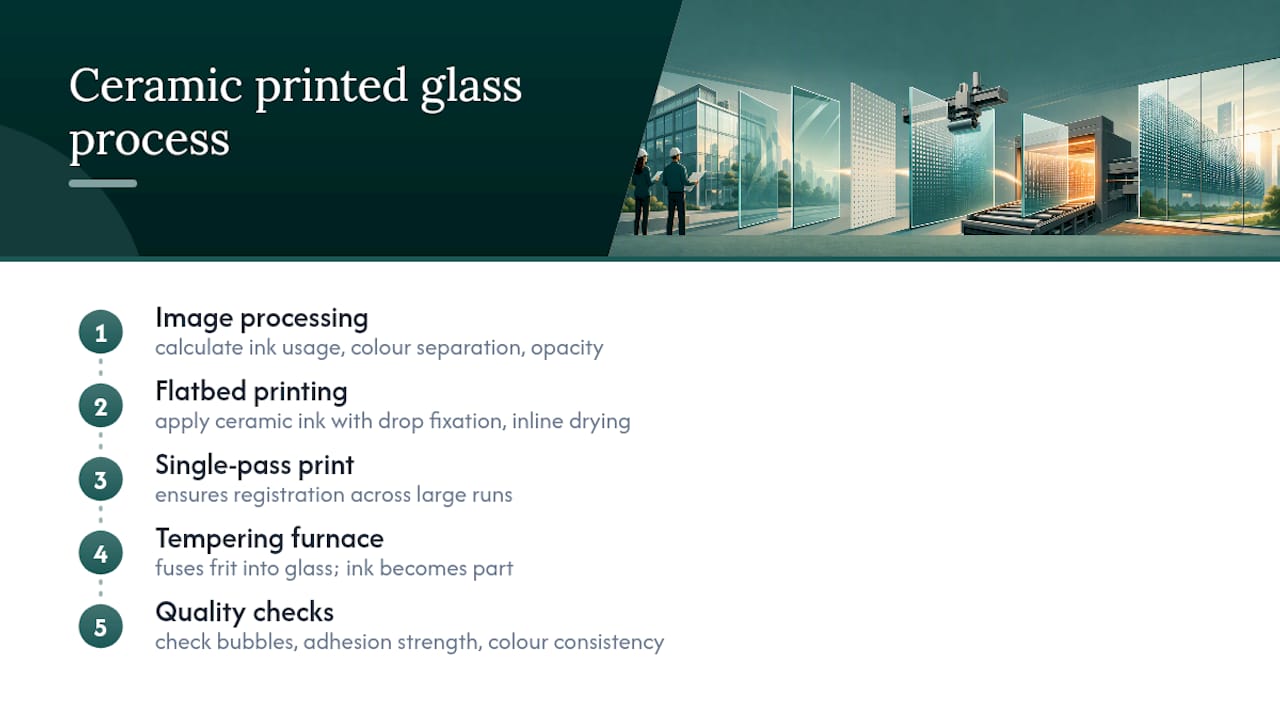
The process starts with image processing software, which calculates ink usage, colour separation, and the opacity or translucency required for each area of the design. This image processing software also compensates for panel size and glass thickness before a single drop is fired.
Flatbed digital printers then apply ceramic ink directly onto the glass, using controlled drop fixation and inline drying to stop pigment migrating before it sets. Single-pass printing keeps colour registration consistent across large runs, which matters when several lites need to match.
Once printed, the glass moves into the tempering furnace, where heat fuses the ceramic frit into the glass surface itself. This firing stage is what separates ceramic printing from every other decorative method: the ink becomes part of the glass matrix, not a layer resting on it. Quality checks at this point focus on bubble-free fusion, adhesion strength, and colour consistency against the approved proof, following the same production workflow used across other technical glass orders.
Ceramic ink chemistry and materials to specify
Ceramic ink is built from inorganic pigments suspended in a ceramic frit carrier. Under heat, the frit softens and bonds to the glass surface while the pigment remains locked inside it, which is why the colour survives tempering rather than burning off.
Specifiers should confirm a handful of material details before signing off artwork:
- Tempering temperature. Commercial inks such as CRYSCOLOR-type ceramic formulations are engineered for tempering at approximately 680°C, which suits most float and low-iron architectural glass.
- Printer hardware and colour management. The predictability of a finished colour depends on how the printer’s colour management system profiles ink density across the panel.
- Substrate treatment. Low-iron glass, coated glass, and oleophobic surface treatments each affect how far ink droplets spread before fixation.
- Pigment loading. Higher pigment concentration increases opacity but can affect firing behaviour, so fabricators adjust formulations per project.
Confirm tempering compatibility with your chosen technical glass substrate early, since not every coating survives the firing cycle unchanged.
What designers can achieve, and where the limits sit
Digital ceramic printing supports resolution up to 720 dpi on panels reported as large as 3.3 by 18 metres, figures that put fine gradients and photographic detail within reach on genuinely large façades. Getting there reliably means working within a few practical rules:
- Design for ink spread. Fine lines and small text need margin allowances, since droplet spread and oleophobic surface treatments both affect edge sharpness.
- Control opacity through layering and placement. Multiple ink passes and the choice of IGU surface (2 or 3) let you dial translucency from a subtle veil to full block-out.
- Plan panel size around seams early. Oversize printers can handle single lites several metres wide, but repeatable patterns across multiple panels still need a matching strategy.
- Proof before committing. A physical mock-up under real daylight catches colour drift that a screen render never will.
Durability, performance, and where the numbers matter
Because ceramic pigment fuses into the glass rather than sitting on its surface, printed panels resist fading, scratching, and weathering far longer than vinyl film, paint, or surface coatings exposed to the same conditions.
Performance callout: Digital ceramic printing lets designers control translucency and light diffusion precisely enough to feed directly into solar heat gain coefficient and visible light transmission calculations during façade energy modelling, rather than treating the printed pattern as a purely decorative add-on.
That control has practical consequences of aesthetics. Ceramic printed patterns are increasingly specified for bird-safe frit designs and solar-control panels calibrated to manage heat gain across a façade, functions that need to survive decades of UV exposure and window cleaning without degrading. Fused ceramic ink shrugs off standard glass cleaning chemicals in a way that surface-applied graphics cannot, which keeps long-term maintenance costs down for building owners.
Ceramic printing versus UV and screen printing
Method choice comes down to how long the graphic needs to last and where it sits on the building.
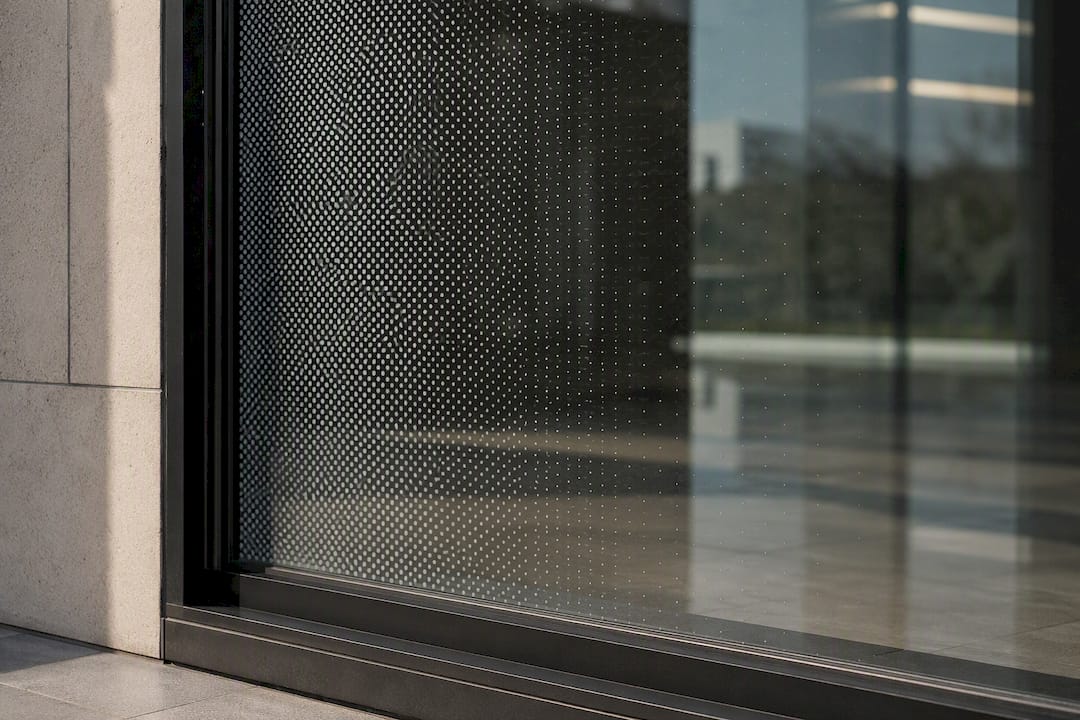
- Ceramic printing fuses during tempering, making it the right call for exterior façades, high-traffic partitions, and anywhere the glass faces weather or heavy cleaning cycles.
- UV printing cures ink with light rather than heat, which is faster and cheaper but leaves a surface layer that can scratch or fade under prolonged sun exposure, better suited to interior signage with a shorter design life.
- Screen printing works well for repeatable single-colour patterns produced at volume, though it struggles with the gradients and photographic detail digital ceramic systems handle easily.
Lead times and cost scale with permanence: UV printing is typically quickest and cheapest, screen printing sits in the middle for large repeat runs, and ceramic printing carries a premium justified by decades of service life rather than months.
How to specify and order ceramic printed glass
Getting a fabricator to quote accurately starts with what you put on the drawing. Show the printed surface number, edge clearances, overall tolerances, and the tempering sequence explicitly, since printing typically happens before the firing step that also toughens the glass.
- Confirm proofing steps. Request a physical mock-up and written colour approval before production release, not just a digital proof.
- Ask about batch matching. For multi-lite façades, confirm the fabricator can guarantee consistent colour and opacity across separate production runs.
- Check maximum panel size and tempering capability. Not every furnace can temper oversize prints, so confirm capacity against your largest lite.
- Request traceability documentation. Certificates covering ink batch, tempering records, and QA sign-off protect you if a panel needs replacing years later.
Pro Tip: Involve your glass fabricator during artwork development, not after final drawings are locked. Ink spread, opacity limits, and panel size constraints are far cheaper to solve on screen than after a proof comes back wrong.
Reviewing a documented production process before you submit an RFQ will also flag whether a supplier’s QA checkpoints match what your project actually needs.
Where ceramic printed glass earns its place
Façade murals and branded glazing on building exteriors remain the most visible use, but the technology earns its keep in less obvious places too.
- Internal partitions and lobbies, where printed frit adds privacy without blocking light entirely.
- Bird-safe frit patterns, designed to break up reflections that would otherwise mislead birds in flight.
- Solar-control panels, printed with density gradients that manage heat gain across large glazed areas.
- Slip-resistant floors and transport glazing, where the printed pattern also serves a functional safety role rather than a purely visual one.
Each application asks something slightly different of the ink and the tempering schedule, which is exactly why the specification conversation with your fabricator needs to happen early, not after artwork is finalised.
What Precision Glasses brings to a printed glass project
Precision-engineered glass components are fabricated for medical, aerospace, defence, and electronics sectors, where tight tolerances and full traceability are standard requirements. That same discipline applies directly to printed glass: batch-level records, documented tempering cycles, and QA sign-off at every stage reduce the risk of colour mismatch turning up on-site months after production.
An integrated workflow, where printing, tempering, and inspection happen under one roof, closes the gaps that appear when artwork, ink supply, and firing are handled by separate vendors. Procurement teams working with Precision Glasses should expect clear documentation on tolerances, certificates covering material and process compliance, and lead times confirmed against actual furnace capacity rather than optimistic estimates.
Three rules that separate good printed glass projects from bad ones
Get the fabricator involved before the artwork is finished, not after. Insist on a physical mock-up under real light, not a screen proof. And never assume a coating or low-iron substrate will survive tempering unchanged without checking first.
The single most common specification error is treating printed glass as a graphics decision rather than a glazing decision. It is both, and the tempering schedule has the final word.
— Alexandra
Get your printed glass project specified and fabricated correctly
Precision-manufactured printed glass components are supplied with design support built into the process, from artwork review through tempering and final QA. Rather than juggling separate vendors for printing, tempering, and inspection, clients work with a team that documents every stage and flags substrate or coating conflicts before they reach the furnace.
That single-point accountability matters most on projects with tight tolerances or multi-lite colour matching, where a break in the chain between printer and fabricator is where most costly mistakes happen. If your project involves architectural glazing, defence, medical, or electronics applications, Precision Glasses can review your drawings and confirm tempering feasibility before you commit to a production run. Get in touch with your technical brief through the technical glass page to start the conversation.
Further technical reading
- Digital ceramic printing on glass — Wikipedia: resolution, hardware, and software fundamentals.
- Expanding the glass canvas with digital printing — Construction Specifier: industry perspective on performance-driven specification.
- Ceramic printing on glass — Window + Door: durability comparison against applied graphics.
Sources
- Digital ceramic printing for bird-safe glass (product listing) — ArchDaily
- Digital ceramic printing on glass — Wikipedia
- Ceramic printing on glass — Window + Door
- Glass ceramic ink – CRYSCOLOR product information — Caldron Graphics
FAQ
Is ceramic glass good for architectural use?
Yes. Because the ink fuses into the glass during tempering, ceramic printed glass resists fading, scratching, and weathering far better than surface-applied alternatives, making it a strong choice for façades and high-traffic glazing.
What is printing on glass called?
The industry term is digital ceramic printing, sometimes shortened to ceramic frit printing. Related decorative methods include UV printing and screen printing, though neither fuses ink into the glass the way ceramic printing does.
What is digitally printed glass?
Digitally printed glass is glass decorated using inkjet-style printers that apply ceramic or UV-curable ink directly onto the surface, controlled by image processing software that manages colour, opacity, and ink usage before firing.
What are some examples of glass ceramics?
In an architectural printing context, glass ceramics refer to the fused frit and pigment layer created during tempering, used in façade murals, bird-safe frit patterns, and solar-control panels calibrated for heat gain management.
How does ceramic printed glass affect SHGC and VLT?
Print density and opacity directly influence how much solar heat and visible light pass through a panel, so designers can use translucency control during artwork development to hit specific energy modelling targets for a façade.