
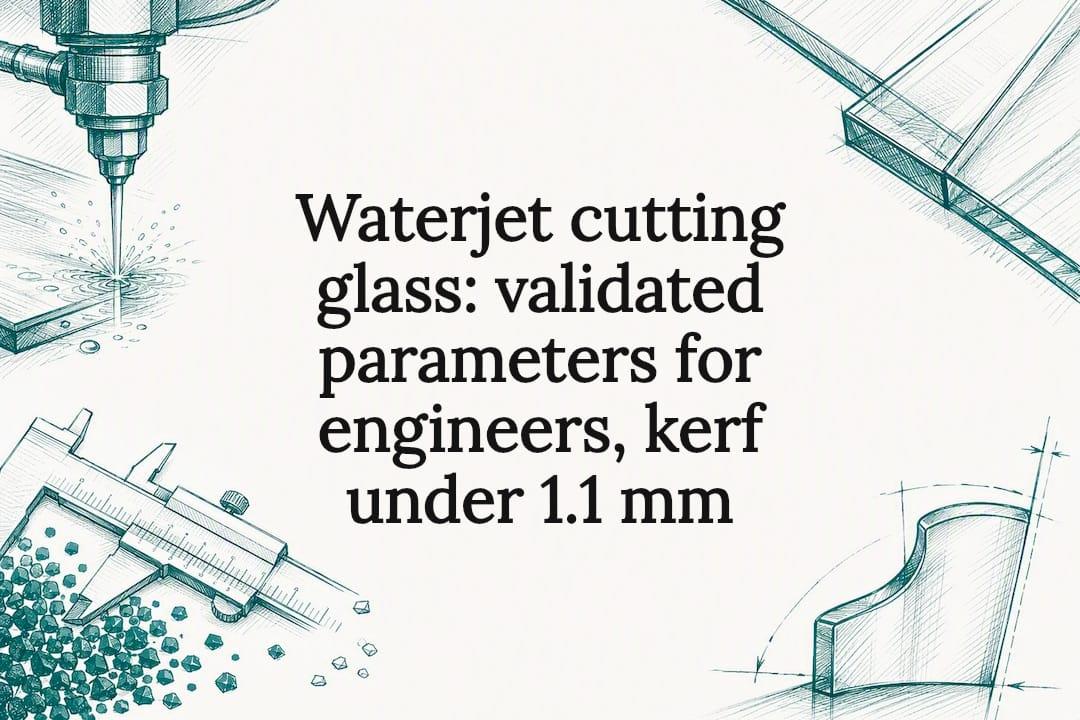
Abrasive waterjet cutting is a suitable production method for specification-driven precision glass parts, provided the supplier validates its parameters against the specific glass type. It is a cold process, so it avoids the thermal stress that ruins optical properties, and its kerf runs under 1.1 mm, which limits material loss on expensive substrates. It handles laminated, borosilicate and optical-grade glass with repeatable results across batches. The rest of this guide covers the parameters, design rules and procurement checks that turn that general suitability into a part that passes inspection.
TL;DR:
- Confirm that the waterjet parameters are validated specifically for the glass type and thickness to ensure consistent, defect-free cuts.
- Request test cut samples and detailed parameter reports from suppliers to verify their process control and repeatability before proceeding with large orders.
- Specify that hole diameters exceed roughly the glass thickness to avoid breakout and that features spaced closely together have enough separation to prevent micro-cracking.
- Ensure drawing specifications include clear tolerances, defined edge finish standards, and traceability documentation like batch reports and material certificates.
- Be wary of bids lacking parameter validation, which do not provide process-specific tolerance justifications, or fail to include inspection and traceability documentation as standard deliverables.
Table of Contents
- How does waterjet cutting work on precision glass?
- Which glass types, thicknesses and shapes suit waterjet cutting?
- What cutting parameters determine glass quality?
- How should you specify waterjet-cut glass parts on a drawing?
- What should you check before awarding a waterjet glass contract?
- A short case: 8 mm glass cut to a tight tolerance band
- Get validated waterjet-cut glass parts from Precision Glasses
- A practical note on where waterjet glass projects go wrong
- Sources
How does waterjet cutting work on precision glass?
Abrasive waterjet cutting fires a stream of water mixed with garnet abrasive through a small nozzle at extreme pressure, eroding the glass rather than melting or burning it. Because there’s no heat input, the glass keeps its microstructure and optical clarity intact right up to the cut edge. That single fact is why the process suits safety-critical parts: there’s no heat-affected zone to weaken the material or distort a lens surface, a point vendors in the waterjet glass sector consistently make.
A working system has five parts that engineers should understand before writing a specification:
- A high-pressure pump, typically running into the thousands of bar
- An orifice that turns pressurised water into a coherent jet
- A mixing chamber and nozzle where abrasive particles join the stream
- An abrasive feed system controlling how much garnet enters the mix
- A CNC traverse system guiding the cutting head along the programmed path
Each variable in that chain shapes the outcome. Higher pressure and finer abrasive tend to narrow the kerf and improve edge finish, while faster traverse speeds cut cycle time at the cost of chipping risk. Vendor data on narrow kerf performance puts typical cutting widths in a narrow range well below mechanical sawing or milling. Well below what mechanical sawing or milling achieves.
One constraint matters more than most buyers expect: toughened or tempered glass must be cut before tempering, not after. Once the surface compression layer is set, any cutting operation risks shattering the part. Laminated glass behaves differently again, since the interlayer absorbs some jet energy, which calls for its own parameter set rather than a scaled-down version of monolithic settings.
Which glass types, thicknesses and shapes suit waterjet cutting?
Not every glass family or geometry produces predictable results. Suitability breaks down roughly like this:
- Laminated glass cuts cleanly through both layers and the interlayer, and waterjet is often the preferred route for complex laminated shapes according to glass processing specialists.
- Borosilicate glass handles the process well across a wide thickness range, with consistent edge quality on both thin sheet and thicker blocks.
- Optical-grade glass and fused silica can be cut to tight geometric tolerance, though the highest-precision surfaces still need secondary polishing.
- Tempered/toughened glass is only viable pre-tempering; cutting after the toughening step is not a safe or supported operation.
Thickness drives a direct trade-off against feature detail. Thinner sheet allows finer features and tighter radii, while thicker stock needs slower traverse speeds to maintain a straight kerf wall, which extends cycle time. As a practical rule, minimum hole diameter should stay proportional to material thickness, and features spaced too close together risk breakout between them during the final pierce. Secondary finishing, usually edge grinding, becomes necessary whenever a drawing calls for a polished or chamfered edge rather than the as-cut satin finish the process naturally leaves behind.
What cutting parameters determine glass quality?
Six parameter classes govern whether a cut part meets specification: pump pressure, traverse speed, abrasive mesh size, abrasive feed rate, the nozzle/orifice combination, and stand-off distance between nozzle and glass surface.
A 2025 experimental study on tempered glass found that a specific combination, moderate pressures with a specific nozzle-orifice combination, fine abrasive, and controlled traverse speed eliminated chipping entirely on 8 mm circular cuts. That level of specificity matters because small deviations in any one variable shift the outcome, as the research on edge fracture mitigation demonstrates. Coarser abrasive tends to widen the kerf and roughen the surface finish, while excessive traverse speed leaves striations and chipped edges that need grinding out afterwards.
Ask any prospective supplier for:
- A written parameter report tied to your specific glass type and thickness
- A test cut sample you can measure before committing to production
- Change-control documentation showing how parameters are locked and revised
Micro abrasive waterjet platforms used in medical device manufacturing can hold very tight positional accuracy in the micron range on flat components, which sets a useful benchmark for what a properly validated process can achieve.
Pro Tip: Never accept a quote that cites tolerance without naming the abrasive mesh and traverse speed behind it. Tolerance claims separated from their parameter set are not repeatable claims.
How should you specify waterjet-cut glass parts on a drawing?
Vague drawings produce vague parts. Precision glass specifications need to state dimensional tolerance, feature limits, edge condition and traceability requirements explicitly, not leave them to supplier discretion.
Dimensional tolerances of a few hundredths of a millimetre are realistic in production once a parameter set is validated, but prototype runs typically carry looser bands until the process is proven on that specific geometry. Build in that distinction on the drawing rather than assuming day-one production tolerance.
Minimum feature guidance worth stating on every drawing:
- Hole diameters should exceed roughly the glass thickness to avoid breakout at the pierce point
- Slots and thin webs need adequate wall thickness either side to survive jet deflection
- Features cut close together should maintain enough spacing to prevent micro-cracking between them
Edge finish needs a named standard, not an adjective. “Fine ground” or “polished to optical clarity” means something specific to a supplier; “smooth edge” does not. Where a part will handle stress or sit in a sealed assembly, call for post-process grinding explicitly rather than assuming the as-cut edge will do.
Traceability requirements belong on the drawing too: part marking, batch identification, dimensional measurement reports and material certificates. Precision Glasses’ quality processes build these into every production batch as standard rather than as a chargeable extra.
What should you check before awarding a waterjet glass contract?
A strong bid looks different from a weak one in ways that are easy to check before you sign anything.
- Request sample cuts on your actual material and thickness, not a generic demonstration piece.
- Ask for the validated parameter set behind those samples, including pressure, mesh size and traverse speed.
- Confirm inspection reports and material traceability are standard deliverables, not optional add ons.
- Check for relevant sector certifications if you’re buying for aerospace, defence or medical applications.
Cost drivers worth understanding before you compare quotes: nesting efficiency (how many parts fit per sheet), abrasive consumption, machine hours, secondary finishing, and batch size. Because narrow kerf widths reduce material loss, waterjet often wins on yield for expensive optical substrates even when the machine hour rate looks higher than a mechanical alternative.
Lead times vary by stage: sample cuts often turn round faster than full first-article inspection, and production runs need their own scheduling once tooling and nesting are locked. Shortening new product introduction usually comes down to sending clean, unambiguous drawings the first time, rather than any change on the shop floor.
Disqualify any bid that offers no parameter validation, states a tolerance without a process behind it, or can’t produce traceability documentation on request.
A short case: 8 mm glass cut to a tight tolerance band
Consider an 8 mm glass part specified with a tight tolerance band and a mix of curved and straight-edge features, the kind of geometry that typically shows chipping at the exit points if parameters are wrong.
The validated set here used moderate pressure between 1000 and 2000 bar, a 0.76 mm nozzle with a 0.25 mm orifice, 120 mesh garnet, and a traverse speed near 1000 mm/min, the same combination confirmed effective in the tempered glass fracture study.
Results worth noting include the elimination of chipping at cut edges, dimensional accuracy maintained within the specified tolerance, and no need for secondary finishing to meet edge quality requirements.
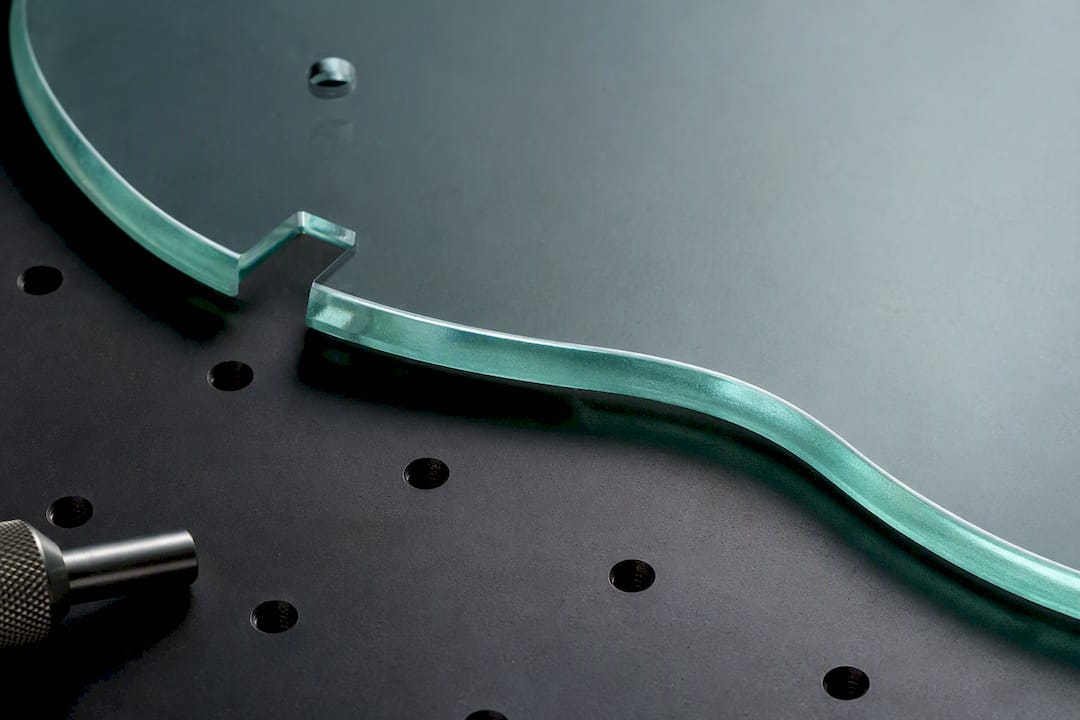
Optimising the parameter set upfront, rather than adjusting after the first bad batch, removed grinding from the process entirely and cut scrap accordingly.
Get validated waterjet-cut glass parts from Precision Glasses
Getting a chipped edge on your first article inspection costs more than the part. It costs the schedule slip while your supplier reworks a parameter set that should have been validated before the quote went out. Precision Glasses runs abrasive waterjet cutting against parameter sets validated per glass type and thickness, so the settings you see on the sample cut are the settings you get in batch ten and batch one hundred.
That validation work sits alongside batch-level traceability, inspection reporting and the sector experience that comes from supplying aerospace, defence and medical device programmes where a chipped edge isn’t just a cosmetic problem. If you need proof before you commit, Precision Glasses will provide a sample cut, a parameter report and first-article inspection so your engineering team can sign off before production starts. Visit Precision Glasses to send over your drawing and request a quote.
A practical note on where waterjet glass projects go wrong
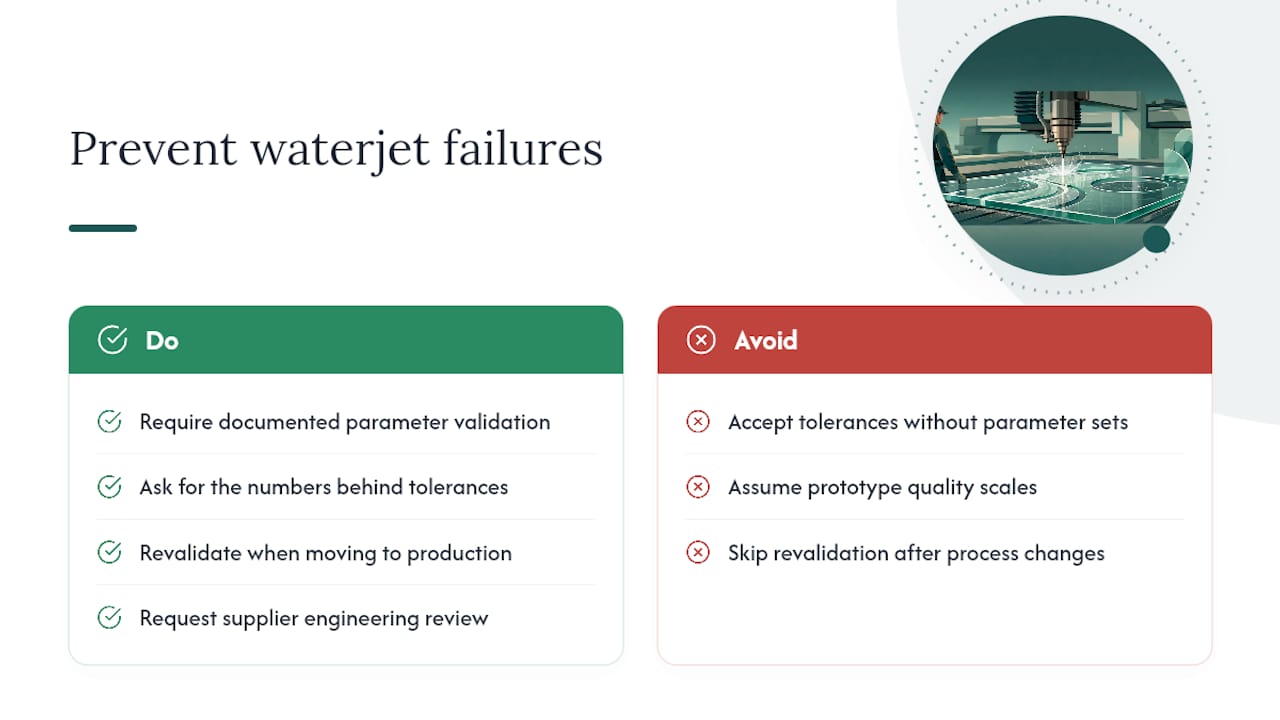
Most failed waterjet glass projects don’t fail because the process is wrong for the part. They fail because someone accepted a tolerance claim with no parameter set behind it, or assumed prototype quality would scale straight into production without revalidation. The process is genuinely capable of holding tight tolerances on demanding glass types, but only when a supplier treats parameter validation as a documented step, not an assumption carried over from the last job. If there’s one habit worth building into every procurement process, it’s this: ask for the numbers behind the tolerance, not just the tolerance itself.
For specification review or a second opinion on a drawing, Precision Glasses’ engineering team is a straightforward point of contact.
— Alexandra
Sources
- Mitigation of edge fracture in tempered glass during abrasive water jet cutting (DOI 2025)
- Medical device waterjet cutting | Finepart
- Cutting glass with waterjet machines | KMT Waterjet