
Float glass is defined as flat glass produced by floating molten glass on a bed of molten tin, creating uniform, distortion-free sheets with exceptional optical clarity. Also known as the Pilkington process, this method accounts for 90% of all flat glass production globally. Float glass is not a finished product in itself. It is the base material from which tempered, laminated, insulating, and coated glass products are made, serving architecture, automotive, electronics, medical, and defence sectors worldwide.
How is float glass made?
The float glass manufacturing process is one of the most precisely controlled continuous production methods in industrial glass. Understanding each stage clarifies why the material achieves such consistent quality at scale.
Raw material preparation. The process begins with silica sand, soda ash, and limestone, blended in precise ratios. Cullet (recycled glass) is added to reduce energy consumption and improve melt consistency.
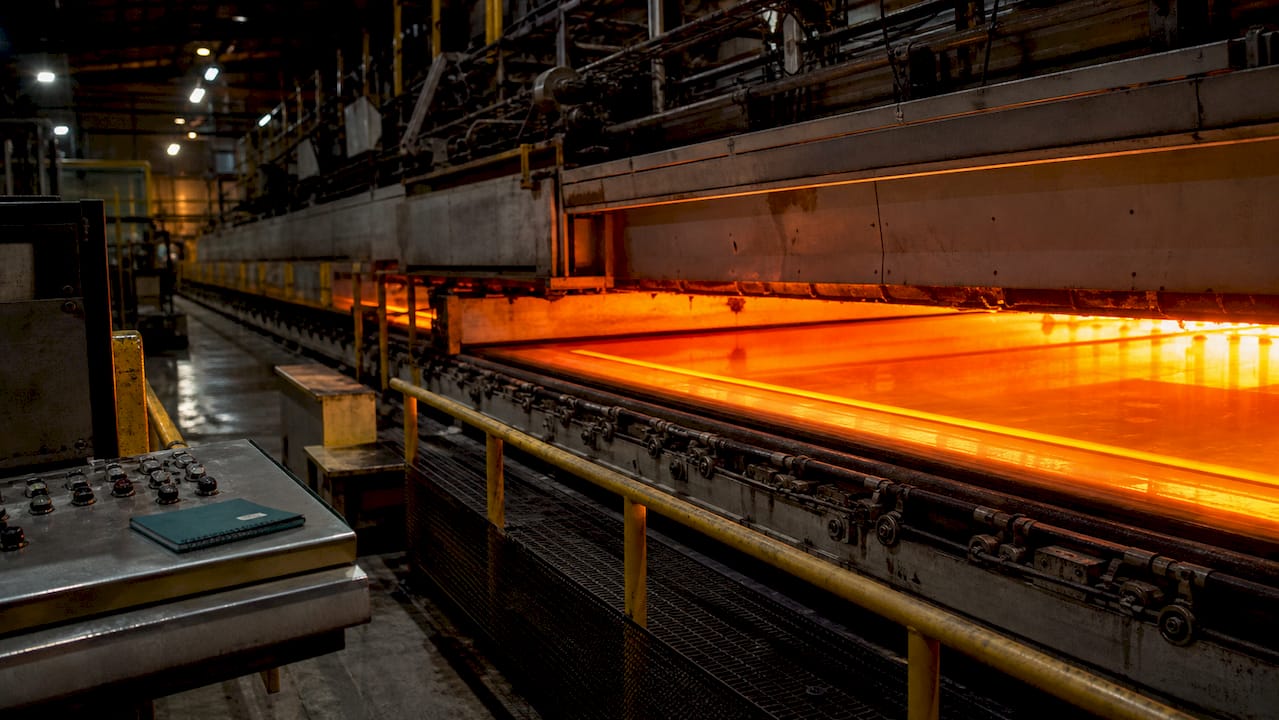
Melting. The batch enters a furnace and is heated to approximately 1,500°C until fully molten. At this temperature, the mixture becomes a homogeneous liquid free of undissolved particles.
Floating on molten tin. Molten glass is poured continuously onto a bath of molten tin held at approximately 1,038°C. Tin is chosen because it is denser than glass, remains liquid across the required temperature range, and does not react with standard soda-lime glass. Surface tension and gravity spread the glass into a flat, parallel-sided ribbon naturally.
Thickness control. Operators adjust the speed at which the ribbon is pulled and use edge rollers to control final thickness. Standard thickness ranges from 2mm to 25mm, with thinner sheets produced by pulling faster and thicker sheets by slowing the ribbon.
Atmosphere control. The tin bath chamber is sealed and filled with a nitrogen and hydrogen mixture under positive pressure. This prevents tin dioxide formation, which would create surface defects and ruin optical quality. Tin oxidation, known as dross, is the primary quality risk at this stage.
Annealing. The glass ribbon passes through a long annealing lehr, where it is cooled gradually from around 1,100°C to 600°C. This controlled cooling removes internal stress and prepares the sheet for cutting and handling without cracking.
Cutting and inspection. Automated systems score and cut the ribbon into standard sheets. Optical sensors inspect for defects before sheets are sorted, stacked, and dispatched.
Furnaces can measure 9 metres wide and 45 metres long, with capacities exceeding 1,200 tonnes. That scale explains why float glass is the most cost-efficient base material available for downstream glass processing.
Pro Tip: When specifying float glass for a downstream process, always confirm the tin side versus the air side. The tin side has a slight surface difference detectable under UV light, which matters for certain coatings and laminates.
Key properties of float glass
Float glass is valued primarily for its optical clarity and parallel surface alignment, which eliminate the need for secondary polishing in most applications. These properties make it the preferred substrate for mirrors, display glass, and architectural glazing.
Key physical and optical properties include:
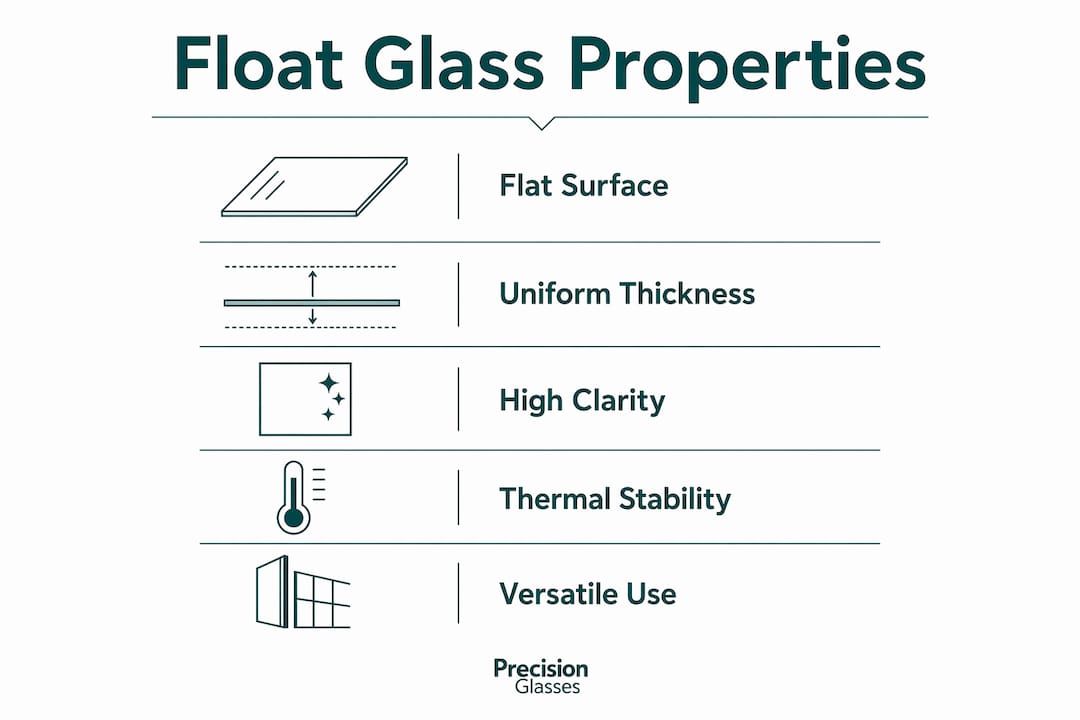
- Surface flatness. The float process produces inherently flat sheets without grinding, a quality that previously required expensive mechanical polishing.
- Optical distortion. Parallel surfaces mean light passes through without bending or distortion, critical for architectural facades and vehicle windscreens.
- Thickness range. Standard production covers 2mm to 25mm, giving specifiers a wide range for structural and optical applications.
- Colour. Standard soda-lime float glass carries a slight green tint from iron oxide in the raw materials. Low-iron variants, sometimes called ultra-clear or extra-clear glass, are specified where colour neutrality is required, such as solar panels and display screens.
- Strength. Annealed float glass has moderate mechanical strength. It is not inherently a safety glass and will break into sharp shards under impact.
A common misconception is that float glass and safety glass are the same thing. Float glass requires secondary processing such as tempering or laminating before it meets building or automotive safety codes. The float process produces the substrate. Safety performance comes from what happens next.
Pro Tip: Always specify whether you need annealed, tempered, or laminated float glass at the enquiry stage. Supplying a drawing that specifies only “float glass” leaves the safety classification undefined, which creates compliance risk on site.
What is float glass used for?
Float glass serves as the essential raw material for tempered, laminated, insulating glass units, and mirrors across multiple sectors. Its consistent quality and wide availability make it the logical starting point for almost every flat glass product in use today.
Primary applications by sector:
- Architecture. Windows, curtain wall facades, internal partitions, and doors all begin as float glass sheets. The material is then cut, edged, tempered, or laminated to meet building regulations.
- Automotive. Windscreens, side windows, and rear screens use float glass as the substrate. Automotive glass undergoes laminating or tempering before fitting.
- Furniture and interiors. Tabletops, shelving, and decorative panels use polished float glass, often with edge work and toughening for safety.
- Mirrors. Float glass provides the flat, distortion-free base that makes mirror silvering effective. Any surface irregularity would produce a distorted reflection.
- Electronics and displays. Thin float glass sheets form the substrate for LCD screens, touch panels, and photovoltaic modules. Low-iron variants are specified here for colour accuracy.
- Solar energy. Photovoltaic panels use low-iron float glass to maximise light transmission to the cells beneath.
| Sector | Typical float glass product | Key secondary process |
|---|---|---|
| Architecture | Curtain wall glazing | Tempering, laminating |
| Automotive | Windscreens, side windows | Laminating, tempering |
| Electronics | Display substrates | Precision cutting, coating |
| Solar energy | PV panel cover glass | Low-iron specification |
| Furniture | Tabletops, shelving | Edge polishing, toughening |
For engineers specifying glass components, understanding the glass selection process for each sector prevents costly misspecification at the procurement stage.
How does float glass differ from other glass types?
Float glass is a type of flat glass, but not all flat glass is float glass. The term “flat glass” describes the category. Float glass describes the production method within that category. This distinction matters when reading technical specifications or procurement documents.
The most important comparisons for engineers and buyers are:
Float glass vs tempered (toughened) glass. Tempered glass starts as float glass. The sheet is reheated to around 620°C and then rapidly quenched with air jets. This creates compressive stress on the surfaces and tensile stress in the core. The result is glass that is significantly stronger than annealed float glass and shatters into small, blunt fragments rather than sharp shards. Secondary processes like tempering transform base float glass into safety or high-performance products meeting modern building and automotive codes.
Float glass vs laminated glass. Laminated glass bonds two or more float glass sheets with a polymer interlayer, typically polyvinyl butyral (PVB). On impact, the interlayer holds fragments together. This is the standard construction for automotive windscreens and security glazing.
Standard soda-lime vs borosilicate float glass. Standard float glass uses a soda-lime composition suited to architecture and automotive applications. High-tech sectors use float processes to produce borosilicate or aluminosilicate glass with higher melting points, requiring furnace modifications and different raw material mixes. Borosilicate float glass appears in laboratory equipment, medical devices, and optical systems where thermal stability is critical.
For a detailed breakdown of how these variants perform under engineering tolerances, the glass tolerances guide for engineers covers the key parameters specifiers need.
Key takeaways
Float glass is the universal base material for flat glass production, and understanding its properties and processing stages is the foundation of sound glass specification.
| Point | Details |
|---|---|
| Float glass definition | Glass produced by floating molten glass on a tin bath, yielding flat, distortion-free sheets. |
| Manufacturing scale | Furnaces exceed 1,200 tonnes capacity; thickness is controlled by ribbon speed and edge rollers. |
| Not a safety product | Annealed float glass must be tempered or laminated before meeting safety standards. |
| Colour variation | Standard soda-lime float glass has a green tint; low-iron variants are specified for colour-critical uses. |
| Specialist variants | Borosilicate and aluminosilicate float glass serve medical, optical, and high-temperature applications. |
Why float glass still defines the industry
I have spent years working alongside engineers and procurement teams across defence, medical, and automotive sectors, and the same misunderstanding appears repeatedly. Professionals assume that specifying “float glass” is a complete specification. It is not. Float glass is the starting point, not the destination.
What strikes me most is how the Pilkington process, developed in the 1950s, has remained essentially unchanged at its core despite decades of materials innovation. That longevity is not inertia. It reflects how well the process solved the fundamental problem of producing optically flat glass at industrial scale and cost. No subsequent technology has matched it for that combination of quality and volume.
The area where I see the most costly errors is in low-iron specification. Engineers working on display or solar applications sometimes accept standard soda-lime float glass because the supplier describes it as “clear.” Standard float glass is not optically clear in the way low-iron glass is. The green tint is subtle in thin sheets but cumulative in stacked or coated assemblies. Specifying the wrong variant at the design stage creates rework that is expensive and time-consuming to resolve.
Float glass also remains the foundation for the most technically demanding glass products. Understanding it well, including its tin side, its annealed state, and its iron content, gives engineers the vocabulary to specify correctly and the knowledge to understand technical glass derivatives with confidence.
— Alexandra
Precision Glasses: float glass applications for critical industries

Precision Glasses works with engineers and procurement teams in defence, aerospace, medical, automotive, and electronics sectors to supply glass components built on float glass foundations. Whether the requirement is standard annealed sheet, low-iron substrates for optical assemblies, or borosilicate components for medical devices, Precision Glasses applies meticulous quality assurance at every fabrication stage. Our process covers design, precision fabrication, and delivery, with tailored specifications for each client’s technical requirements. For sectors where dimensional accuracy and material integrity are non-negotiable, visit glassprecision.com to discuss your component requirements or request a detailed quotation from our engineering team.
FAQ
What is the float glass definition in simple terms?
Float glass is flat glass made by pouring molten glass onto a bath of molten tin, which spreads it into a uniform, distortion-free sheet. It is the base material for most glass products used in buildings, vehicles, and electronics.
How thick can float glass be produced?
Standard float glass production covers a thickness range of 2mm to 25mm, controlled by the speed of the glass ribbon and the position of edge rollers during manufacture.
Is float glass the same as safety glass?
Float glass is not safety glass. It must undergo secondary processing, either tempering or laminating, before it meets the safety standards required by building regulations and automotive codes.
What is the difference between float glass and tempered glass?
Float glass is annealed sheet glass in its base state. Tempered glass is float glass that has been reheated and rapidly cooled to create surface compression, making it significantly stronger and causing it to shatter into small, blunt fragments rather than sharp shards.
Why does standard float glass have a green tint?
The green tint in standard soda-lime float glass comes from iron oxide present in the raw silica sand. Low-iron float glass is produced with purer raw materials to remove this tint, and is specified for solar panels, display screens, and other colour-sensitive applications.
Recommended
- What is tempered glass: properties, uses, and benefits – Precision Glass
- Gradient index glass explained: properties and applications – Precision Glass
- What is toughened glass? Properties and uses explained – Precision Glass
- Glass substrate explained: definition, roles and precision challenges – Precision Glass