Glass is the superior touch screen material in the vast majority of applications, outperforming plastic on optical clarity, scratch resistance, and long-term durability. The choice between glass vs plastic in touch screens is not simply a cost decision. It is an engineering decision with measurable consequences for display performance, user experience, and product lifespan. Understanding the difference between tempered glass and PET (polyethylene terephthalate) film, the two dominant touch screen materials, gives technology professionals and consumers the foundation to make the right call for any application.
How do optical properties affect touch screen performance?
Optical clarity is the single most important performance variable in touch screen design. Glass-on-glass panels achieve approximately 91% light transmittance, compared to 83–89% for PET-on-glass configurations. That gap translates directly into brighter, sharper images with less eye strain, particularly in high-ambient-light environments.
Plastic films introduce higher glare and light scattering. This is not a minor cosmetic issue. Outdoor readability degrades noticeably when haze increases, and users compensate by raising screen brightness, which accelerates battery drain. For tablets used in field operations, medical carts, or automotive dashboards, this trade-off carries real operational cost.
Touch sensitivity is also affected by material choice. Glass transmits capacitive signals more cleanly than plastic, reducing input lag and improving multi-touch accuracy. Thicker or lower-quality plastic films can introduce a slight delay between touch and response, which becomes apparent in precision-input applications such as industrial control panels or medical imaging interfaces.
- Glass provides approximately 91% light transmittance versus 83–89% for PET film configurations.
- Plastic films scatter more light, reducing outdoor readability and increasing glare.
- Glass transmits capacitive signals more cleanly, improving touch accuracy.
- Optical clarity directly affects user fatigue in prolonged-use environments such as defence consoles or medical workstations.
Pro Tip: When specifying a touch screen for outdoor or high-brightness use, request the haze percentage alongside transmittance figures. A low-haze glass panel will consistently outperform a high-transmittance plastic film in direct sunlight.
Optical clarity for engineers covers the measurement standards and tolerances relevant to display-grade glass selection.
Comparing surface durability: scratch resistance and impact absorption
Surface hardness is where the gap between glass and plastic becomes most visible in everyday use. Tempered glass carries a hardness rating of 8H to 9H on the pencil hardness scale, while PET plastic films rate only 2H to 3H. That difference means glass resists scratching from coins, keys, and general surface contact, while plastic films show visible damage within weeks of normal use.
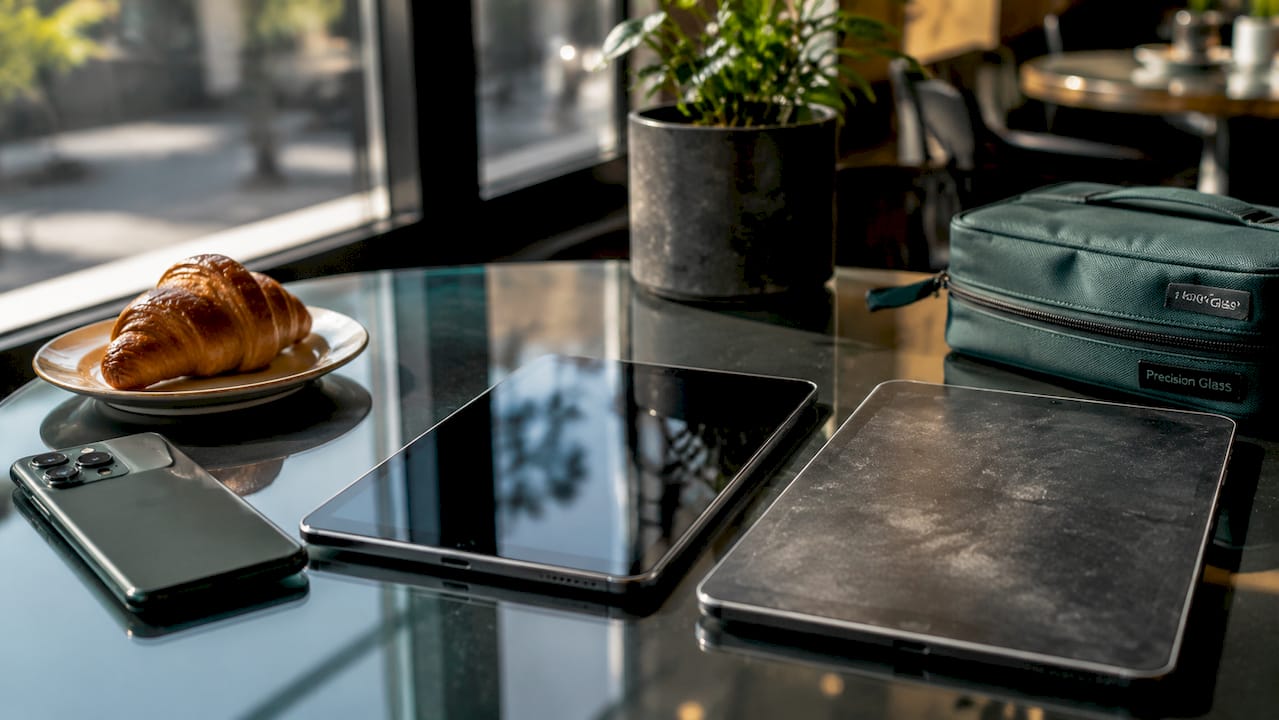
PET films do not just scratch. They haze over time as micro-abrasions accumulate across the surface. This progressive degradation reduces optical clarity and makes the screen appear worn, even when the underlying display is undamaged. For consumer electronics, this is an aesthetic problem. For industrial or medical equipment, it is a reliability concern.
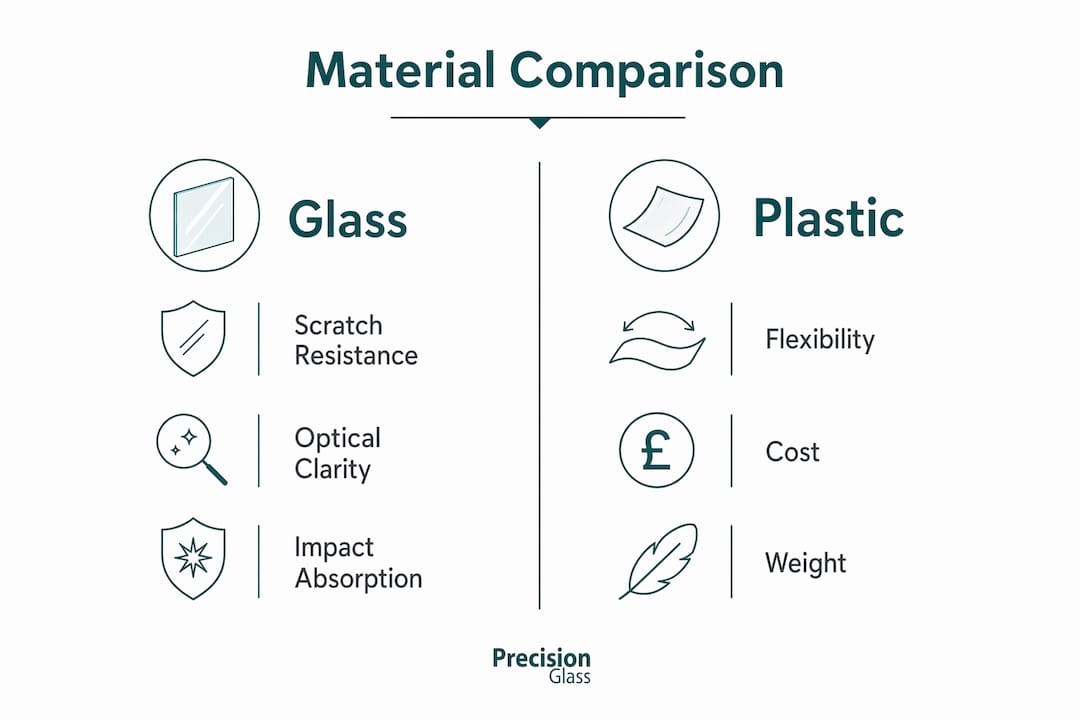
Impact absorption is a more nuanced comparison. Tempered glass acts as a sacrificial layer, absorbing and distributing impact force across its surface before fracturing. This protects the underlying display from damage. Plastic films flex under impact but cannot distribute force effectively, meaning the energy transfers directly to the display panel beneath.
Tempered glass is the preferred choice in 90% of screen protection applications due to this combination of impact absorption and optical clarity. Plastic retains a role primarily in foldable and curved display formats where rigidity is a structural liability rather than an asset.
Pro Tip: A simple field test reveals material type without tools. Press a fingernail gently near the bezel of a screen. PET film will deform visibly under light pressure. Tempered glass remains rigid, confirming its structural integrity.
| Property | Tempered glass | PET plastic film |
|---|---|---|
| Pencil hardness rating | 8H–9H | 2H–3H |
| Scratch resistance | High: resists keys, coins, general wear | Low: visible scratches within weeks |
| Impact absorption | Sacrificial fracture protects display | Flexes but transfers force to display |
| Surface degradation over time | Minimal under normal use | Progressive hazing from micro-abrasions |
| Optical clarity retention | Stable long-term | Degrades with surface wear |
What environmental and application factors influence material choice?
The operating environment often determines material choice more decisively than cost. Glass withstands chemical exposure, temperature extremes, and repeated cleaning with industrial solvents far better than plastic. PET films are prone to warping, yellowing, and touch drift under heat and humidity. In a factory floor environment or outdoor kiosk, this degradation is not a question of if but when.
Plastic does retain genuine advantages in specific contexts. Foldable displays, curved surfaces, and weight-sensitive applications such as wearables benefit from PET’s flexibility and lower mass. The material bends without fracturing, which glass cannot do without specialised ultra-thin processing. For these niche applications, plastic remains the only practical option with current technology.
Long-term cost analysis consistently favours glass despite higher upfront pricing. Consider the following factors when evaluating total cost of ownership:
- Replacement frequency. Plastic films require replacement every few months under heavy use. Tempered glass components last significantly longer before performance degrades.
- Downtime cost. In industrial or medical settings, screen replacement causes operational downtime. Glass’s longer service life reduces this exposure.
- Thermal expansion mismatch. PET-on-glass configurations delaminate when glass substrates and PET covers expand at different rates under heat cycling. This failure mode is common in high-temperature industrial environments and adds unplanned maintenance cost.
- Chemical resistance. Glass tolerates isopropyl alcohol, acetone, and other cleaning agents without surface degradation. PET films cloud and peel under repeated chemical cleaning.
- Regulatory compliance. Medical and defence applications often require materials that meet specific cleanliness and chemical resistance standards. Glass meets these requirements reliably; plastic frequently does not.
Glass selection for industry provides a practical framework for matching material properties to application requirements across sectors including automotive, aerospace, and medical devices.
How does touch technology integration influence material choice?
The type of touch sensing technology built into a screen directly constrains material options. Resistive touch screens require flexible PET layers because they detect input through physical deformation of the top surface. Glass cannot flex in the way resistive sensing demands, making plastic a structural necessity in these designs.
Capacitive touch screens operate differently. They detect changes in an electrostatic field rather than physical pressure. This means they can use rigid glass as the top layer while still supporting multi-touch input, wet hand operation, and gloved use with appropriate sensor calibration. Capacitive technology has become the dominant standard in consumer electronics, industrial HMIs, and medical interfaces precisely because it allows glass to replace plastic without sacrificing input versatility.
- Resistive screens require PET film: no glass alternative exists for this sensing method.
- Capacitive screens support glass covers with full multi-touch and wet-hand capability.
- Modern capacitive designs achieve input versatility with thicker glass layers, making plastic unnecessary for most professional applications.
- Material thickness affects touch sensitivity: thinner glass improves signal clarity but reduces mechanical strength.
- Under-display sensors, including fingerprint readers, perform more reliably through glass than through plastic due to consistent signal transmission.
Optical bonding eliminates the air gap between the cover layer and the display panel, improving readability and reducing internal reflection. This performance gain applies to both glass and plastic but is frequently omitted in cost-sensitive products. Specifying optical bonding alongside a glass cover layer delivers the highest achievable display performance for demanding applications.
Pro Tip: If your application uses capacitive sensing, specify glass as the cover layer and optical bonding as the assembly method. This combination delivers the best optical and touch performance available with current technology.
Key takeaways
Glass outperforms plastic in touch screen applications on every critical metric except flexibility, making it the correct choice for the vast majority of professional and consumer deployments.
| Point | Details |
|---|---|
| Optical transmittance advantage | Glass achieves approximately 91% light transmittance versus 83–89% for PET film configurations. |
| Scratch resistance gap | Tempered glass rates 8H–9H on the pencil hardness scale; PET plastic rates only 2H–3H. |
| Impact protection method | Glass fractures sacrificially to protect the display; plastic transfers impact force directly to the panel. |
| Environmental reliability | PET films warp, yellow, and delaminate under heat and chemical exposure; glass remains stable. |
| Technology compatibility | Capacitive screens support glass covers with full multi-touch capability, removing the need for plastic in most applications. |
Why I think the cost argument for plastic is often misleading
The most persistent misconception in touch screen material selection is that plastic is the economical choice. It is cheaper to purchase. It is not cheaper to own. I have seen this play out repeatedly in industrial and medical procurement decisions where upfront savings on PET film components were erased within a year by replacement costs, cleaning protocol failures, and unplanned downtime.
What rarely gets discussed is the optical bonding question. Manufacturers who skip optical bonding to reduce cost, regardless of whether they use glass or plastic, are making a false economy. The readability and durability gains from bonding are significant. A bonded glass panel will outperform an unbonded glass panel by a wider margin than the difference between bonded glass and bonded plastic. The bonding decision matters as much as the material decision.
The thermal expansion issue with PET-on-glass designs is also underestimated. Delamination in high-temperature environments is not a rare failure mode. It is a predictable one. Engineers specifying screens for automotive dashboards, outdoor kiosks, or industrial control panels should treat PET delamination as a near-certainty over a multi-year service life, not a risk to be managed.
Plastic does have a genuine future in foldable and ultra-thin flexible display formats. That is a real and growing application space. For everything else, the performance data points consistently in one direction. Glass wins on clarity, durability, chemical resistance, and long-term cost. The professionals who understand this make better procurement decisions and build better products.
— Alexandra
Precision Glasses: engineered glass for demanding touch screen applications
Precision Glasses designs and fabricates custom glass components for applications where optical clarity, surface durability, and dimensional accuracy are non-negotiable. From optical components for electronics to precision cover glass for medical and industrial touch interfaces, every component is manufactured to exact specifications with full quality assurance at each production stage. Precision Glasses works with clients across defence, aerospace, automotive, and medical sectors to deliver glass solutions that perform reliably in the most demanding environments. If your application requires glass that meets precise optical and mechanical standards, contact Precision Glasses to discuss your requirements with our engineering team.
FAQ
What is the main difference between glass and plastic in touch screens?
Glass offers superior scratch resistance (8H–9H hardness versus 2H–3H for PET film), higher optical transmittance, and better chemical resistance. Plastic is lighter and flexible, making it suitable only for foldable or curved display formats.
Which material is better for outdoor touch screen use?
Glass is the better choice for outdoor applications. It achieves approximately 91% light transmittance with lower glare and haze than PET film, and it withstands UV exposure, temperature cycling, and chemical cleaning without degrading.
Does plastic or glass work better with capacitive touch screens?
Glass works better with capacitive touch screens. Capacitive sensing does not require surface deformation, so rigid glass can be used as the cover layer while still supporting multi-touch and wet-hand input.
Why does PET film delaminate in industrial environments?
PET film and glass substrates expand at different rates when heated. This thermal expansion mismatch causes the adhesive bond between layers to fail over time, particularly in high-temperature or thermally cycled environments such as automotive dashboards and factory equipment.
Is optical bonding worth the additional cost?
Optical bonding eliminates the air gap between the cover layer and display panel, reducing internal reflection and improving both readability and mechanical strength. For professional, outdoor, or high-brightness applications, the performance gain justifies the additional cost in almost every case.