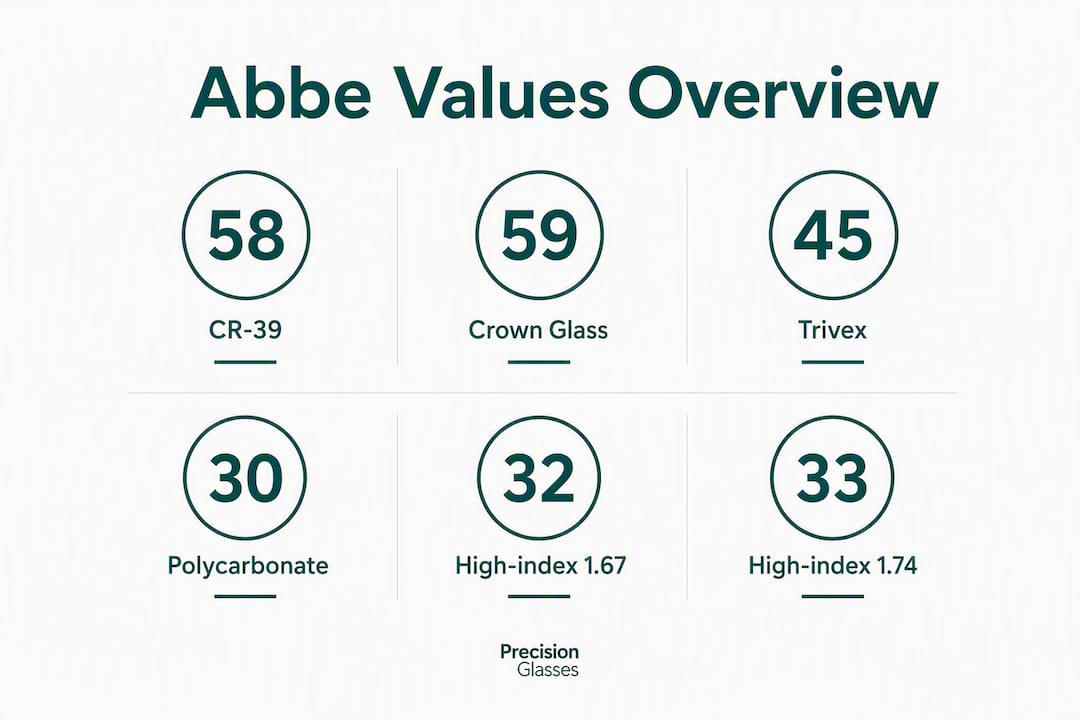
The Abbe value chart below lists the V-number (Abbe number) for the most common ophthalmic lens materials. The single most important rule: higher Abbe number = less chromatic dispersion = cleaner, colour-accurate vision. Use this table as your starting reference, then read on for the practical implications.
| Material | Refractive index | Typical Abbe value (V) |
|---|---|---|
| Crown glass | typical refractive index around 1.6 | about 59 |
| CR-39 plastic | typical refractive index near 1.6 | about 58 |
| Trivex | refractive index about 1.6 | about 45 |
| High-index plastic 1.6 | refractive index approximately 1.6 | about 42 |
| High-index plastic 1.67 | refractive index roughly 1.67 | about 32 |
| Polycarbonate | refractive index near 1.6 | about 30 |
| High-index plastic 1.74 | refractive index around 1.74 | about 33 |
Values are typical figures. Abbe numbers depend on the spectral reference lines used and vary between manufacturers; always confirm with your supplier or optician.
Quick decision rule: If optical clarity is the priority, choose a material with a V-number above 40. If lens thinness matters more, you will likely trade some clarity for a higher refractive index and a lower Abbe number.

Table of Contents
- What is the Abbe value and how is it calculated?
- Detailed chart: comparing common ophthalmic lens materials
- How refractive index and Abbe value trade off against each other
- What wearers actually notice with low-Abbe lenses
- How to use the Abbe chart when choosing lenses with your optician
- Quick reference: Abbe values by refractive index band
- Key takeaways
- Why the Abbe chart deserves more attention than it gets
- Useful sources and further reading
What is the Abbe value and how is it calculated?
The Abbe number (V, or Vd) measures how strongly a material separates light of different wavelengths — its optical dispersion. A low V-number means the material bends blue and red light very differently, producing colour fringing at edges. A high V-number means those wavelengths travel through the material at nearly the same speed, so colours stay aligned.

The formula uses refractive indices at three standard Fraunhofer spectral lines:
V = (nd − 1) / (nF − nC)
where nd is measured at 587.6 nm (yellow), nF at 486.1 nm (blue), and nC at 656.3 nm (red). The denominator, nF − nC, is the material’s principal dispersion: the wider it is, the more the material splits colours, and the lower the resulting V-number.
Key implications at a glance:
- V above 50: very low dispersion; minimal colour fringing; typical of crown glass and CR-39.
- V 40–50: moderate dispersion; acceptable for most prescriptions; Trivex sits here.
- V 30–40: noticeable dispersion under demanding conditions; typical of polycarbonate and 1.67/1.74 high-index plastics.
- V below 25: high dispersion; characteristic of dense flint glasses, rarely used in ophthalmic lenses.
Note that the d-line and e-line reference systems produce slightly different V-numbers for the same material. When comparing data from different sources, confirm which spectral reference was used.
Detailed chart: comparing common ophthalmic lens materials
The table below expands the opening reference with the practical dimensions that matter at an optician appointment. Common ophthalmic materials have characteristic Abbe values: CR-39 around 58, polycarbonate about 30, crown glass about 59, with high-index plastics ranging roughly 32–47 depending on index.
| Material | Refractive index | Typical Abbe value | Typical uses | Optical effect | Thickness/weight | UK availability/cost |
|---|---|---|---|---|---|---|
| Crown glass | typical refractive index around 1.6 | about 59 | Single vision, low prescriptions | Excellent clarity, minimal fringing | Heavier than plastics | Specialist suppliers; less common on high street |
| CR-39 plastic | typical refractive index near 1.6 | about 58 | Single vision, progressives, low–moderate Rx | Excellent clarity; benchmark material | Thicker at high Rx | Widely available; budget-friendly |
| Trivex | refractive index about 1.6 | about 45 | Safety, children’s, sports, thin mid-range Rx | Good clarity; better than polycarbonate | Lighter than CR-39 | Available at most UK opticians; mid-range cost |
| High-index 1.6 | 1.6 | about 42 | Single vision, progressives, moderate Rx | Good clarity; slight fringing at edges | Noticeably thinner | Widely available; moderate cost uplift |
| High-index 1.67 | 1.67 | about 32 | Progressives, moderate–high Rx | Visible fringing possible; peripheral distortion | Significantly thinner | Available at most UK chains; higher cost |
| Polycarbonate | refractive index near 1.6 | about 30 | Safety, children’s, sports, impact-resistant Rx | Highest fringing risk; adequate for most wearers | Thin and light | Very widely available; mid-range cost |
| High-index 1.74 | 1.74 | about 33 | High Rx (above ±4.00), cosmetically thin lenses | Fringing similar to 1.67; peripheral distortion | Thinnest available | Specialist UK opticians; premium cost |
CR-39
CR-39 remains the benchmark for optical clarity in plastic lenses. Its Abbe value of approximately 58 places it almost level with crown glass, and its relatively low cost makes it the default choice for low-to-moderate prescriptions where thinness is not a concern.
Polycarbonate
Polycarbonate’s V-number of around 30 is the lowest of the mainstream ophthalmic materials. Its impact resistance makes it the standard choice for children’s lenses and safety eyewear, but wearers with high prescriptions or sensitivity to colour fringing may notice artefacts, particularly in peripheral vision.
Trivex
Trivex occupies a useful middle ground. At approximately V = 45, it offers meaningfully better dispersion than polycarbonate while matching or exceeding it for impact resistance. UK opticians increasingly recommend Trivex for children and active adults who need both safety and clarity.
Crown glass
Crown glass, with a V-number near 59, delivers outstanding optical performance. Weight and fragility limit its use in modern ophthalmic practice, though it remains relevant in specialist and industrial optical contexts. For precision optical components beyond spectacle lenses, engineered glass types offer a broader range of dispersion and index combinations.
High-index 1.6
At V ≈ 42, the 1.6 index material offers a reasonable compromise. Lenses are noticeably thinner than CR-39 at the same prescription, and most wearers report no significant colour fringing in everyday use.
High-index 1.67
The step to 1.67 brings V down to around 32. Wearers with prescriptions above ±4.00 dioptres often find the cosmetic improvement worthwhile, but those sensitive to peripheral distortion may prefer 1.6 or Trivex.
High-index 1.74
The thinnest mainstream ophthalmic plastic, 1.74 index, carries a V-number of approximately 33. The dispersion is similar to 1.67 rather than dramatically worse, so the thinness benefit is real without a significant additional clarity penalty compared with the step from 1.6 to 1.67.
UK availability note: CR-39, polycarbonate, Trivex, and 1.6 index lenses are stocked by most high-street opticians. The 1.67 and 1.74 index options are available at major chains but may require ordering; specialist independent opticians often carry a wider range.
How refractive index and Abbe value trade off against each other
Higher refractive index materials produce thinner lenses, but they almost always carry lower Abbe values. This is not a coincidence: the physical mechanisms that allow a material to bend light more strongly tend to increase its dispersion as well. Refractive index and Abbe value are often inversely related in common optical glasses and plastics, and designers must balance thinning potential against chromatic performance.
The practical consequence is straightforward. A wearer moving from CR-39 to 1.74 high-index lenses gains a significantly thinner, lighter lens but accepts increased dispersion. For most prescriptions below moderate strength, that trade-off may be unnoticeable in daily life. For higher prescriptions, or for wearers who spend long periods reading fine print or driving at night, the difference can become perceptible.
The core constraint: you cannot simultaneously maximise refractive index and Abbe value in a single material. Every lens choice is a point on a trade-off curve, not a free selection of independent properties. Coatings and multi-element achromatic designs can reduce the visible effects of dispersion, but they do not change the material’s V-number.
Anti-reflective coatings are the most practical mitigation available to ophthalmic wearers. By reducing surface reflections, they lower the contrast of any colour fringing that does occur, making it less perceptible even when the underlying Abbe value is modest.
Pro Tip: If a wearer reports colour fringing with a high-index lens, ask the optician to check whether a premium anti-reflective coating was applied. In many cases, the coating makes a more noticeable difference to perceived clarity than stepping up to a higher Abbe material.
What wearers actually notice with low-Abbe lenses
Low Abbe values translate into chromatic aberration: the lens focuses different wavelengths of light at slightly different points, which the eye perceives as colour fringing or a subtle softness at high-contrast edges.
Common symptoms reported by wearers of low-Abbe materials:
- Colour fringing at edges: a faint red or blue halo around high-contrast boundaries, such as black text on white paper or window frames against a bright sky.
- Peripheral blurriness: most noticeable when looking through the outer zones of the lens rather than the optical centre.
- Haloing at night: street lights and oncoming headlamps may appear to have coloured halos, particularly with polycarbonate lenses.
- Subjective “softness”: some wearers describe the image as slightly less sharp than expected, even when visual acuity tests are normal.
A 1.74 lens versus polycarbonate illustrates the nuance well. Both carry V-numbers in the low 30s, so the dispersion is comparable. A wearer switching from polycarbonate to 1.74 for cosmetic reasons should not expect a clarity improvement; the gain is purely in lens thickness and weight.
Reported blurriness is often multi-factorial. Vertex distance (how far the lens sits from the eye), pantoscopic tilt, and the quality of the progressive design all affect perceived clarity, sometimes more than the Abbe value itself.
Pro Tip: Before attributing colour fringing to a low Abbe number, ask the optician to check vertex distance and pantoscopic tilt. Adjusting the frame fit costs nothing and frequently resolves complaints that would otherwise lead to an unnecessary lens upgrade.
How to use the Abbe chart when choosing lenses with your optician
Start with one question: “What is the Abbe value of the lens you are recommending, and how does it compare with the alternatives at my prescription strength?” That single question signals to the optician that you understand the trade-offs and want a considered recommendation.
Numbered checklist for your appointment:
- State your prescription strength. Above ±4.00 dioptres, the Abbe value becomes more consequential; below that, most wearers notice little difference.
- Ask for the Abbe value of each material option. Request the V-number, not just the brand name.
- Confirm the refractive index. Pair it with the Abbe value to understand the thinness-versus-clarity trade-off.
- Ask about lens type. Progressive lenses amplify peripheral distortion; a higher Abbe value is more beneficial in progressives than in single-vision lenses.
- Enquire about anti-reflective coating. A premium AR coating is the most cost-effective way to reduce the visible impact of a lower Abbe value.
- Check impact-resistance requirements. If safety or children’s lenses are needed, polycarbonate or Trivex are the standard choices regardless of Abbe value.
- Ask about a trial period. Many UK opticians offer a short adaptation period; use it to assess whether colour fringing is noticeable in your daily environment.
Red flags to watch for:
- An optician recommending polycarbonate for a high-prescription adult who frequently drives at night, without discussing the dispersion implications.
- A quote for 1.74 lenses for a prescription below ±4.00, where CR-39 or 1.6 would deliver better clarity at lower cost.
In the UK market, the cost difference between CR-39 and 1.74 high-index can be substantial. The optical clarity advantage runs in the opposite direction. Weigh both before committing.
Quick reference: Abbe values by refractive index band
This table is a rapid lookup, not a substitute for the detailed chart above. Figures are typical ranges; confirm with your optician or lens supplier.
| Refractive index | Typical Abbe value range | Visual expectation |
|---|---|---|
| about 1.5 (CR-39) | around 58 | Excellent clarity; minimal fringing |
| around 1.53 (Trivex) | around 45 | Good clarity; low fringing |
| 1.6 | 40–42 | Good clarity; slight fringing at edges |
| 1.67 | around 32 | Moderate fringing; noticeable at high Rx |
| 1.74 | around 33 | Moderate fringing; similar to 1.67 |
Manufacturer and measurement-standard differences mean actual values may fall outside these ranges. Always request the specific V-number from your supplier.
Key takeaways
Higher Abbe values consistently deliver less chromatic dispersion, and for prescriptions above ±4.00 dioptres, the choice of lens material has a measurable effect on perceived clarity.
| Point | Details |
|---|---|
| Higher V-number = less dispersion | CR-39 (V ≈ 58) and crown glass (V ≈ 59) offer the best optical clarity of common materials. |
| Index and Abbe trade off | Moving to 1.67 or 1.74 index gains thinness but drops V to around 32–33. |
| Polycarbonate is the lowest-Abbe mainstream material | At V ≈ 30, it is best reserved for safety and children’s lenses, not high-Rx clarity. |
| Fitting matters as much as material | Vertex distance and pantoscopic tilt often cause reported blurriness; check fit before changing lens material. |
| Ask for the V-number by name | Request the specific Abbe value from your optician to make a genuinely informed comparison. |
Why the Abbe chart deserves more attention than it gets
Most wearers never hear the term “Abbe value” during an optician appointment. They are shown lens thickness samples and quoted a price, and the dispersion figure stays buried in a technical data sheet. That is a missed opportunity, because the V-number is one of the few objective metrics that directly predicts a wearer’s subjective experience of colour fringing and edge clarity.
The chart is also frequently misread in one specific way: people assume that 1.74 lenses must be optically inferior to 1.67 because the index is higher. In practice, their Abbe values are similar (both around 32–33), so the clarity difference between them is negligible. The real optical step-change happens between 1.6 (V ≈ 42) and 1.67 (V ≈ 32), not between 1.67 and 1.74.
That said, the Abbe number is a first-order approximation. As RP Photonics notes, it is adequate for most ophthalmic design purposes but insufficient for high-precision or multi-wavelength applications where full Sellmeier dispersion modelling is required. For precision optical components in medical imaging, defence, or aerospace, a single V-number is a starting point, not a specification. Precision Glasses works with full dispersion data and manufacturer Sellmeier coefficients when specifying optical glass components for demanding industrial applications, precisely because the Abbe number alone does not capture the full picture.
For eyeglass wearers, the practical takeaway is simpler: use the chart to open the conversation with your optician, not to close it.
Useful sources and further reading
- Abbe number — Wikipedia: Concise definition, the standard formula, and a note on spectral-line conventions; a reliable first reference.
- What is the Abbe value in optics? — ICO Optics: Practical explanation of the formula and the designer’s balancing act between index, Abbe, and specific gravity.
- Abbe number — RP Photonics Encyclopedia: Authoritative technical treatment including the limits of the Abbe approximation and when Sellmeier modelling is needed.
- Optical properties of glass for precision engineering — Precision Glasses: Technical guidance on refractive index, dispersion, and material selection for readers who need manufacturing-grade detail beyond ophthalmic applications.
- Glass material selection for precision industries — Precision Glasses: Selection criteria and material tables for engineers and procurement teams specifying optical glass components.