

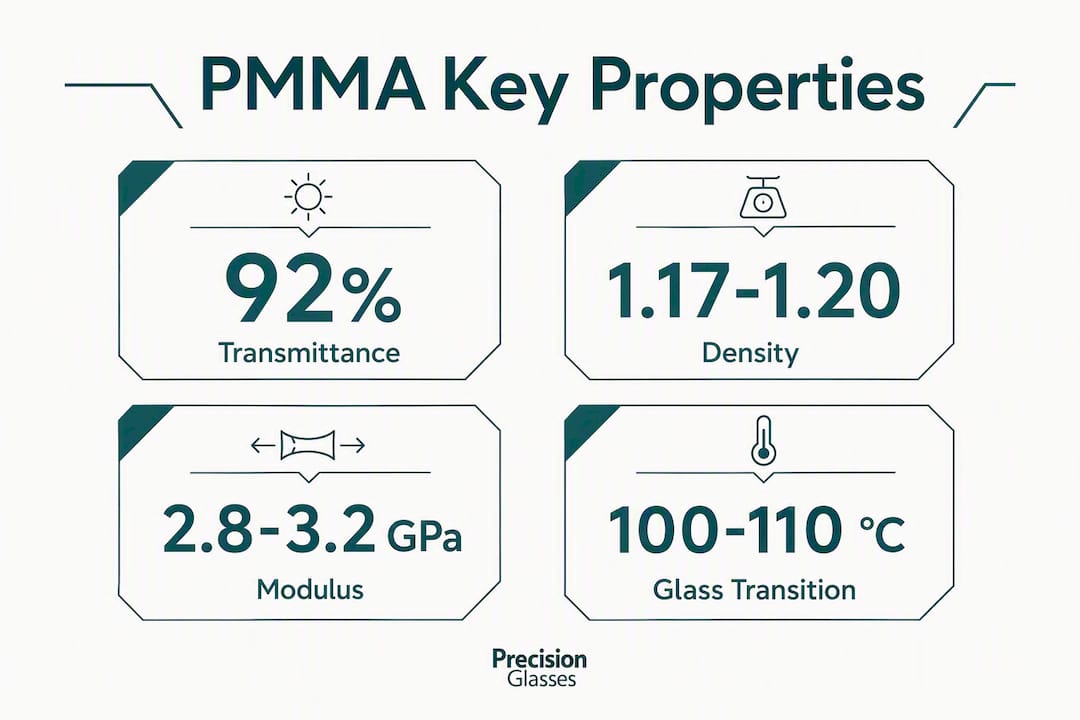
Poly(methyl methacrylate), universally abbreviated as PMMA and commonly known as acrylic or acrylic glass, is a transparent amorphous thermoplastic whose PMMA properties make it one of the most specified optical polymers in engineering. Three figures define its appeal at a glance: luminous transmittance of approximately 92% at 3 mm thickness, a density of 1.17–1.20 g·cm⁻³, and a Young’s modulus of 2.8–3.2 GPa. Its principal limitations are low abrasion resistance, susceptibility to solvent-induced crazing, a relatively high coefficient of linear thermal expansion (5–10 × 10⁻⁵ °C⁻¹), and a modest glass transition temperature that restricts continuous service to well below 100 °C for most commercial grades.
For engineers, those numbers translate into three immediate design implications:
- Optical assemblies: ~92% luminous transmittance and a refractive index of ~1.49 make PMMA competitive with optical glass for lighting, display, and low-power lens work, provided surface finish and haze are controlled.
- Structural use: At 2.8–3.2 GPa stiffness and tensile strength of 48–76 MPa, PMMA carries moderate loads in thin sections, but its brittleness (elongation at break ~3–5%) demands generous safety factors and careful notch design.
- Environmental exposure: The high CTE requires designed-in movement allowances when bonding to metals or glass, and solvent-safe cleaning protocols are non-negotiable in service.
Luminous transmittance ~92% at 3 mm; refractive index ~1.49 (ISO 13468-2; ISO 489) — PMMA delivers optical performance that rivals inorganic glass at roughly half the density.
Table of Contents
- What is PMMA and how does its chemistry govern material form?
- PMMA properties: comprehensive datasheet table with test standards
- How do you use mechanical and optical values in design calculations?
- How do processing and fabrication choices affect final PMMA properties?
- Which PMMA grades are available and what do modifiers change?
- What are PMMA’s main limitations and how do you mitigate them?
- How to specify PMMA for an engineering application
- Which test standards apply to PMMA property measurements?
- When should you choose PMMA and when should you choose precision glass?
- Key takeaways
- Why precision glass often outperforms PMMA in critical applications
- Precision Glasses: precision glass components for engineers moving beyond PMMA
- Authoritative datasheets and standards for PMMA specification
What is PMMA and how does its chemistry govern material form?
Polymethyl methacrylate is produced by free-radical polymerisation of methyl methacrylate monomer, yielding a fully amorphous thermoplastic) with no crystalline domains. That amorphous structure is the direct reason for its optical clarity: there are no crystallite boundaries to scatter light. The pendant ester groups on the polymer backbone make the chain relatively stiff, which accounts for the moderate modulus and the brittleness that engineers must design around.
Trade names you will encounter in procurement include Perspex (Röhm), Plexiglas and Altuglas (Arkema), and Lucite (Mitsubishi Chemical). Each brand covers multiple grades with materially different properties, so specifying by trade name alone is insufficient. Always specify by grade designation and required test values.
Cast, extruded, and injection-moulded forms
The production route governs residual stress, optical quality, and machinability in ways that matter considerably for precision work.
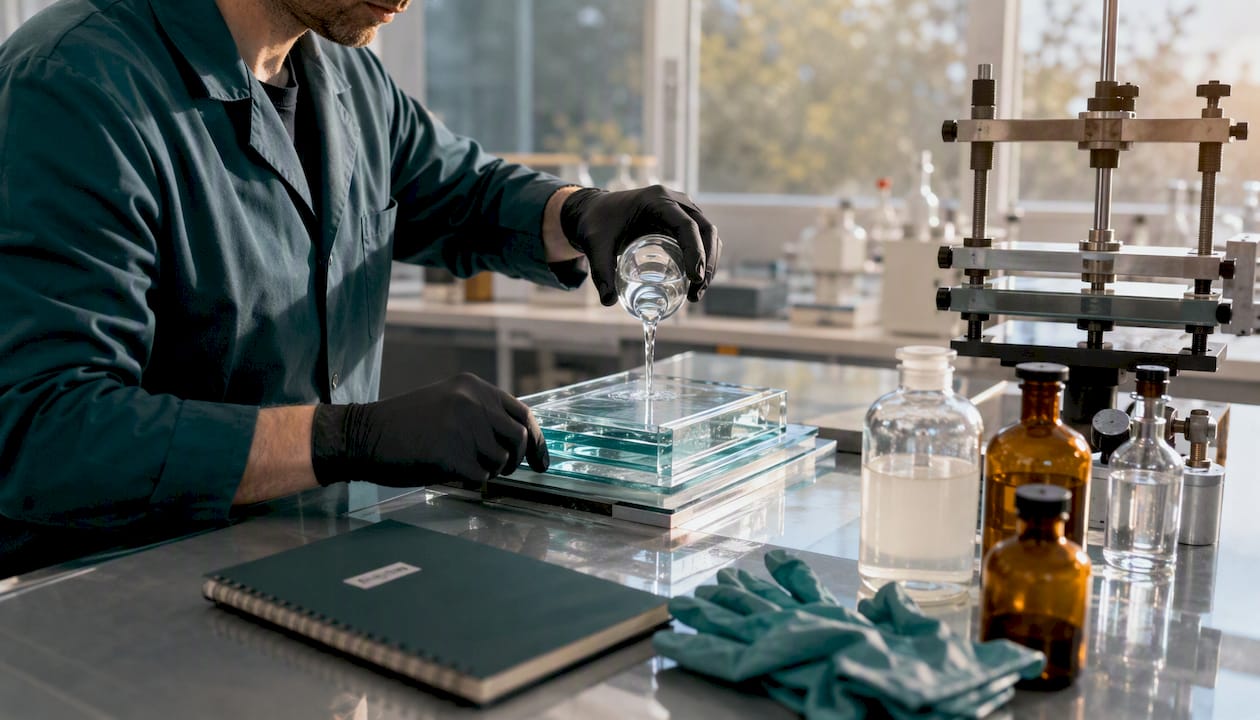
Cell-cast (cast) sheet is produced by polymerising monomer between glass plates. The slower process yields higher molecular weight polymer, lower residual stress, and superior surface polishability. For precision optical components, cast PMMA is the correct starting material: it machines cleanly, polishes to optical surface quality, and shows less tendency to warp during CNC operations.
Extruded sheet is faster and cheaper to produce, making it the standard choice for large-format glazing and display applications where tight optical tolerances are not required. Orientation stresses introduced during extrusion can cause uneven material removal during machining and may produce variable optical performance across a sheet. Extruded material is satisfactory for structural glazing but should not be specified for precision lens or optical window work.
Injection-moulded grades are formulated for high melt-flow index, which typically reduces molecular weight and can slightly reduce mechanical properties compared with cast material. They are widely used for automotive lighting lenses and consumer optics where geometry complexity outweighs the need for the highest possible optical purity.
Copolymer variants extend the property envelope significantly. Impact-modified grades incorporate rubber particles (typically polybutyl acrylate) to raise toughness at the cost of some clarity and stiffness. UV-stabilised grades include absorbers or stabilisers that extend outdoor service life. Medical grades are produced under controlled conditions with documented biocompatibility and sterilisation compatibility. The Tg of atactic commercial PMMA sits around 100–110 °C for the standard homopolymer, but copolymerisation can shift it anywhere from 85 °C to 165 °C depending on the co-monomer system.
PMMA properties: comprehensive datasheet table with test standards
The table below provides typical property ranges for commercial PMMA grades. Values reflect published engineering data; always request supplier-specific test certificates for specification work, as grade, form, and test conditions all affect the reported number.
| Property | Typical value / range | Units | Test standard | Design implication |
|---|---|---|---|---|
| Luminous transmittance (3 mm) | ~92 | % | ISO 13468-2 | Suitable for lighting, display, and optical window applications |
| Refractive index | ~1.49 | — | ISO 489 | Enables lens design; lower than optical glass but sufficient for many applications |
| Haze (3 mm clear) | <0.5 | % | ISO 14782 | Confirms optical-grade clarity; specify maximum haze in RFQ |
| Density | 1.17–1.20 | g·cm⁻³ | ISO 1183 | Roughly half the density of glass; weight saving in large panels |
| Young’s modulus | 2.8–3.2 | GPa | ISO 527 / ASTM D638 | Use for deflection calculations; lower than glass (~70 GPa) |
| Tensile strength | 48–76 | MPa | ISO 527 / ASTM D638 | Grade-dependent; use lower bound for conservative design |
| Elongation at break | 3–5 | % | ISO 527 / ASTM D638 | Low ductility; treat as brittle in impact and fatigue scenarios |
| Flexural modulus | 2.8–3.2 | GPa | ISO 178 | Consistent with tensile modulus; use for beam and panel calculations |
| Charpy impact strength (unnotched) | 10–20 | kJ·m⁻² | ISO 179 | Significantly lower than polycarbonate; specify impact-modified grade where needed |
| Vickers hardness | ~200 | HV | — | Relatively soft surface; hard coatings required for abrasion-critical applications |
| Glass transition temperature (Tg) | 85–110 (homopolymer ~100–110) | °C | ISO 11357 | Sets upper service temperature; copolymers can reach 165 °C |
| Heat deflection temperature (HDT) | 80–100 | °C | ISO 75 / ASTM D648 | Practical upper limit under load; allow margin in design |
| Coefficient of linear thermal expansion (CLTE) | 5–10 × 10⁻⁵ | °C⁻¹ | ISO 11359 | High relative to metals and glass; design movement joints for bonded assemblies |
| Thermal conductivity | — | W·m⁻¹·K⁻¹ | — | Low; relevant for heat dissipation in LED optics |
| Dielectric strength | — | kV·mm⁻¹ | — | Good electrical insulator; suitable for instrument windows and sensor covers |
| Volume resistivity | >10¹⁴ | Ω·cm | — | Excellent insulation; note static charge build-up in dry environments |
| Water absorption | — | % | — | Low but non-zero; account for dimensional change in precision fits |
| UV resistance (unmodified) | Moderate–good | — | ISO 4892-2 | Better than most polymers; UV-stabilised grades extend outdoor life significantly |
Pro Tip: Manufacturer datasheets frequently report tensile properties at different test speeds (1 mm·min⁻¹ vs 5 mm·min⁻¹) and specimen geometries (Type 1A vs 1B per ISO 527). When comparing grades from different suppliers, always request results at the same test rate, temperature (23 °C ± 2 °C), and specimen type. A supplier who cannot provide this level of detail on their test certificate should be treated with caution.
How do you use mechanical and optical values in design calculations?
Start with the modulus and section geometry to calculate deflection, then apply a safety factor that accounts for PMMA’s brittle failure mode. For a simply supported panel under uniform load, the standard beam-bending formula using Young’s modulus (2.8–3.2 GPa) gives a first-pass deflection estimate. Because PMMA does not yield plastically before fracture, a safety factor of 3–4 on tensile strength is common practice for structural glazing, compared with 1.5–2 for ductile metals.
Key guidance for structural and optical calculations:
- Stiffness vs thickness: Deflection scales with the cube of thickness, so doubling panel thickness reduces deflection eightfold. This is often more efficient than switching to a stiffer polymer.
- Long-term loads (creep): PMMA creeps under sustained stress, particularly above 50 °C. Design allowable stresses for long-term loading should be reduced to 20–30% of the short-term tensile strength; request supplier creep data at the service temperature.
- Thermal movement: With a CLTE of 5–10 × 10⁻⁵ °C⁻¹, a 500 mm PMMA panel will expand or contract by 0.25–0.50 mm across a 10 °C temperature swing. Bonded assemblies joining PMMA to aluminium (CLTE ~2.3 × 10⁻⁵ °C⁻¹) or borosilicate glass (~3.3 × 10⁻⁶ °C⁻¹) must use flexible adhesives or mechanical allowances tested across the full expected temperature range.
- Optical assemblies: A refractive index of ~1.49 and haze below 0.5% at 3 mm make PMMA suitable for collimating lenses, light guides, and diffuser panels. For imaging optics, surface finish dominates performance: specify surface roughness Ra ≤ 2 nm for polished optical surfaces and request haze measurements on production samples, not just catalogue values.
- Impact and fatigue: Treat PMMA as a brittle material in all impact and cyclic-load scenarios. Notches, drill holes, and sharp internal corners are stress concentrators that can initiate fracture at loads well below the nominal tensile strength.
Pro Tip: Anneal cast PMMA sheet at 70–80 °C for 2–4 hours before precision polishing or bonding. This relieves residual stress from cutting and machining, reducing the risk of stress-crazing when the part later contacts adhesives or cleaning solvents. Skipping this step is one of the most common causes of premature field failures in precision optical assemblies.
How do processing and fabrication choices affect final PMMA properties?
The process that best preserves optical clarity and minimises residual stress is cell casting followed by controlled annealing. Every subsequent fabrication step introduces some degree of stress or surface damage that must be managed deliberately.
Casting and extrusion
Cell casting produces the lowest residual stress and the highest molecular weight, making it the preferred starting form for optical components. Extrusion is faster and more economical for sheet goods but introduces orientation stresses along the extrusion direction. These stresses become visible as birefringence under polarised light and can cause differential machining behaviour across a sheet.
CNC machining
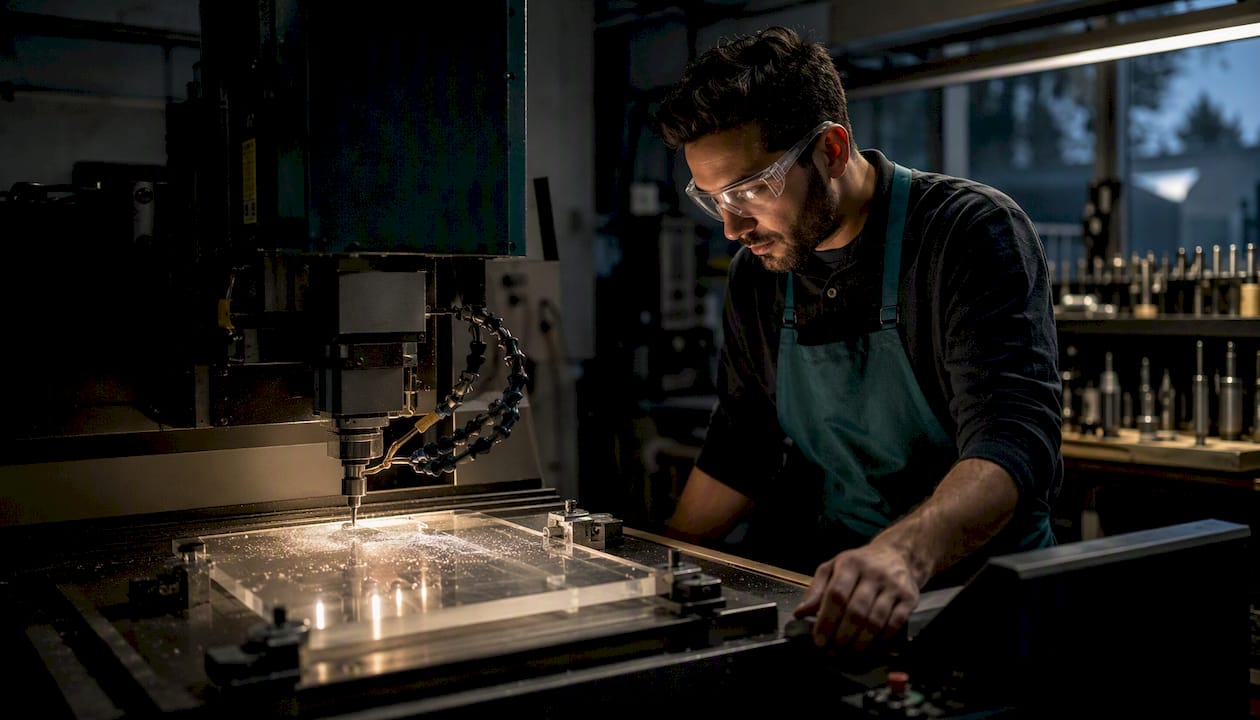
PMMA machines well with sharp, high-speed tooling and adequate coolant (compressed air or water-soluble coolant, not aromatic solvents). Feed rates and spindle speeds must be balanced to avoid heat build-up, which softens the surface and creates a stressed subsurface layer. After machining, anneal the part before any bonding or coating step.
Laser cutting
CO₂ laser cutting produces a clean, polished edge on PMMA and is widely used for sheet fabrication. The heat-affected zone introduces tensile residual stresses at the cut edge, however, and these stresses make the edge particularly susceptible to solvent-induced crazing. Pulsed laser parameters reduce heat input compared with continuous-wave operation, but annealing and mechanical edge-finishing remain the most reliable mitigations for precision parts.
Solvent welding and bonding
Solvent cements (dichloromethane-based or purpose-formulated acrylic cements) create strong, optically clear joints by locally dissolving and re-fusing the polymer. The solvent must be compatible with the grade and the joint must be held under controlled pressure during cure. Residual solvent in the joint is a crazing risk; allow full cure time before exposing the assembly to mechanical or thermal stress.
Annealing
Thermal annealing at 70–80 °C for 2–4 hours is the single most effective post-process step for stress relief. It reduces birefringence, lowers the risk of solvent crazing, and improves dimensional stability before precision polishing. For injection-moulded parts, annealing schedules are typically specified by the mould tool designer based on wall thickness.
Coatings
Hard coatings (typically silicone-based or sol-gel systems) applied by dip or flow coating raise surface hardness from ~200 HV to values approaching 600–800 HV, substantially improving scratch resistance. Anti-reflection coatings can raise effective transmittance above the uncoated 92% figure. Both coating types require a clean, stress-free substrate surface to achieve adhesion and avoid delamination.
Which PMMA grades are available and what do modifiers change?
Specifying PMMA by trade name alone is insufficient) — Perspex, Plexiglas/Altuglas, and Lucite each cover multiple grade families with materially different properties. Specify by performance requirements and grade designation, then use trade names as a secondary reference.
The main grade families and their engineering trade-offs:
- Cast optical grade: Highest molecular weight, lowest residual stress, best polishability. The correct choice for precision optical windows, lenses, and light guides. Slightly higher cost than extruded equivalents.
- Extruded general purpose: Cost-effective for large sheet applications, signage, and structural glazing. Orientation stresses limit precision machining performance. Not recommended for optical-quality surfaces.
- Impact-modified (rubber-toughened): Rubber particles (typically polybutyl acrylate) dispersed in the PMMA matrix raise Charpy impact strength substantially but reduce optical clarity and lower stiffness modestly. Specify where impact resistance is a primary requirement and optical perfection is secondary.
- UV-stabilised: Incorporates UV absorbers or hindered amine light stabilisers (HALS). Extends outdoor service life significantly. Standard for exterior glazing, automotive lighting covers, and any application with prolonged solar exposure.
- Flame-retardant grades: Formulated to meet UL 94 V-0 or equivalent classifications. Additives can reduce optical clarity and alter surface finish; verify optical properties independently.
- Optical moulding grades: High melt-flow formulations for injection moulding of lenses and light guides. Optimised for surface replication quality in precision moulds.
- Medical/biocompatible grades: Produced under controlled conditions with documented biocompatibility per ISO 10993. PMMA is established in bone cement, dialysers, and dental prosthetics once fully polymerised. Always request medical-grade supplier documentation and sterilisation compatibility data for implantable or body-contact parts.
When procuring any grade, request full test certificates with ISO/ASTM test conditions stated, sample coupons from the production batch, and long-term UV/weathering data rather than relying on catalogue summaries. Ensuring robust manufacturing data protection workflows for supplier documentation and batch traceability is increasingly standard practice in regulated industries.
What are PMMA’s main limitations and how do you mitigate them?
PMMA is often described as “acrylic glass,” but that label obscures a critical engineering reality: it trades the inherent hardness and scratch resistance of inorganic glass for superior optical transmission and far lower density. Engineers must weigh those gains against four principal limitations.
Abrasion and scratch resistance
PMMA’s surface hardness (~200 HV) is low relative to inorganic glass (~500–600 HV for soda-lime). Uncoated PMMA scratches readily in service, degrading optical performance and surface appearance. Hard coatings are the primary mitigation; mechanical protection (recessed mounting, protective films during installation) reduces damage before the part enters service.
Solvent-induced crazing
PMMA swells and dissolves in many organic solvents), and even brief contact with alcohols, aromatic solvents, or some cleaning agents can initiate surface crazing, particularly at stressed edges. Mitigation measures:
- Specify solvent-safe cleaning protocols (dilute aqueous detergents, isopropanol at low concentration on unstressed surfaces only).
- Anneal parts before assembly to reduce residual stress.
- Choose adhesives with proven compatibility — cyanoacrylates and purpose-formulated acrylic cements rather than general-purpose solvents.
- Avoid contact with ketones, esters, chlorinated solvents, and aromatic hydrocarbons in service.
Impact resistance
Non-modified PMMA is brittle. Its Charpy impact strength (10–20 kJ·m⁻²) is substantially lower than polycarbonate. PMMA offers superior optical transmission and does not contain bisphenol-A, but polycarbonate’s higher impact resistance often governs material selection for protective applications. Where impact resistance is the primary requirement, specify rubber-toughened impact-modified grades rather than increasing wall thickness alone.
Thermal limits
The glass transition temperature of standard commercial grades sits around 100–110 °C, with HDT values of 80–100 °C under load. Continuous service above 70–80 °C is inadvisable for most grades without specific high-Tg copolymer selection. The high CLTE (5–10 × 10⁻⁵ °C⁻¹) compounds thermal issues in bonded assemblies: differential expansion between PMMA and low-CTE substrates generates interfacial stress that can delaminate coatings or crack adhesive joints.
When to reject PMMA: If the application requires sustained temperatures above 100 °C, continuous abrasion resistance without coatings, resistance to aromatic or chlorinated solvents, or optical tolerances tighter than PMMA’s polishing capability can deliver, consider precision-engineered glass or high-performance engineering polymers. For critical optical, defence, or medical applications where dimensional stability and surface durability are paramount, precision glass components offer properties that no polymer grade can match.
Pro Tip: When specifying PMMA for an outdoor application, always request accelerated weathering data (ISO 4892-2, xenon arc, minimum 1,000 hours) from the supplier rather than relying on generic UV-resistance claims. UV-stabilised grades vary considerably in their long-term colour stability and retention of mechanical properties.
How to specify PMMA for an engineering application
Specify form and grade family first, then set numeric minima for the properties that govern your application. A trade name without a grade designation is not a specification.
- Define application conditions: Operating temperature range, UV/outdoor exposure, chemical environment, load type (static, dynamic, impact), and regulatory requirements (medical, automotive, flame-retardant).
- Select form: Cast sheet for optical or precision-machined parts; extruded sheet for structural glazing and large-format applications; injection-moulded grade for complex geometries.
- Set optical minima: Specify minimum luminous transmittance (e.g., ≥90% at stated thickness), maximum haze (e.g., ≤1%), and refractive index tolerance if relevant to the optical design.
- Set mechanical minima: Minimum tensile strength, minimum flexural modulus, and impact strength class (standard or impact-modified). Reference ISO 527 or ASTM D638 and state test conditions.
- Set thermal requirements: Minimum HDT (ISO 75 Method A or B; state load), maximum CLTE, and continuous service temperature.
- Specify surface and finishing requirements: Surface roughness (Ra), coating type and adhesion standard, edge finish, and annealing requirement.
- State regulatory and traceability requirements: ISO 10993 biocompatibility for medical grades; UL 94 classification for flame-retardant grades; batch-level traceability and certificate of conformance.
- Include in your RFQ: Request ISO/ASTM test reports at stated conditions, sample coupons from the production batch, accelerated UV/weathering data (ISO 4892-2 for outdoor grades), and confirmation of sterilisation compatibility for medical applications.
For broader guidance on specifying optical and structural materials, the advanced glass specifications guide from Precision Glasses covers tolerance frameworks and procurement templates that translate directly to PMMA specification practice.
Which test standards apply to PMMA property measurements?
Citing the correct test standard in a specification is not a formality; it defines the exact conditions under which the reported number was measured and makes supplier data comparable. The standards below are the ones engineers should reference when writing PMMA specifications or evaluating datasheet values.
- ISO 527 / ASTM D638: Tensile properties (strength, modulus, elongation at break). Specify specimen type and test speed; results differ between 1 mm·min⁻¹ and 5 mm·min⁻¹.
- ISO 178: Flexural properties (flexural modulus and strength). Three-point bend; specify span-to-depth ratio.
- ISO 179 / ASTM D256: Impact resistance. ISO 179 reports Charpy (kJ·m⁻²); ASTM D256 reports Izod (J·m⁻¹). Specify notched or unnotched and specimen conditioning.
- ISO 75 / ASTM D648: Heat deflection temperature (HDT). Specify Method A (1.80 MPa) or Method B (0.45 MPa); the two methods give substantially different numbers for the same material.
- ISO 1183: Density by immersion or pycnometer.
- ISO 489: Refractive index by Abbe refractometer.
- ISO 13468-2: Luminous transmittance of plastics.
- ISO 14782: Haze measurement.
- ISO 11357: Glass transition temperature by DSC.
- ISO 11359: Coefficient of linear thermal expansion by TMA.
- ISO 4892-2: Accelerated weathering (xenon arc); specify irradiance level and exposure hours.
- ISO 10993: Biocompatibility evaluation for medical devices; relevant for medical-grade PMMA.
- BS EN ISO equivalents of the above are the UK-adopted versions and carry identical test procedures; cite the BS EN ISO prefix when writing specifications for UK procurement.
For authoritative datasheet values, the BWF PMMA technical data PDF and the MIT material property database are reliable engineering references. MatWeb is a widely used polymer datasheet repository that aggregates supplier data and is useful for cross-checking grade-specific values, though always verify against the primary supplier certificate.
When should you choose PMMA and when should you choose precision glass?
PMMA is the correct choice for lightweight optical components, cost-sensitive display glazing, and applications where complex geometry or large format makes glass impractical. Precision-engineered glass is preferable wherever abrasion resistance, dimensional stability across temperature, or long-term optical durability are non-negotiable.
| Dimension | Optical polymer (PMMA) | Precision glass |
|---|---|---|
| Optical clarity | ~92% luminous transmittance; refractive index ~1.49; haze <0.5% | Transmittance varies by glass type; refractive index varies depending on composition; near-zero haze |
| Abrasion resistance | Low (~200 HV uncoated); hard coatings raise to ~600–800 HV | High (500–600 HV for soda-lime; 600 HV for borosilicate); no coating required for most applications |
| Thermal stability | Tg 85–110 °C; CLTE 5–10 × 10⁻⁵ °C⁻¹; HDT 80–100 °C | Service temperatures >400 °C for borosilicate; CLTE ~3.3 × 10⁻⁶ °C⁻¹ (borosilicate); dimensionally stable across wide ranges |
| Machinability | Excellent; CNC, laser, solvent welding; complex shapes readily achievable | Requires specialist CNC grinding and polishing; more constrained geometry; longer lead times |
| Long-term environmental stability | Good with UV-stabilised grades; susceptible to solvent crazing; surface degrades under abrasion | Excellent; chemically inert to most solvents; no crazing; surface stable over decades |
| Typical achievable tolerances | ±0.5 mm for machined parts; optical surfaces Ra ≤ 2 nm with polishing | ±0.05 mm for precision-ground components; optical surfaces Ra < 1 nm routinely achievable |
| Weight | 1.17–1.20 g·cm⁻³ | — |
| Regulatory / biocompatibility | Medical grades available; established in implants and dental use | Biocompatible glass types available; preferred in some implantable and long-term contact applications |
Application vignettes:
PMMA is the right call for a retail display diffuser panel, a lightweight automotive interior lens, or a cost-sensitive instrument cover where the operating temperature stays below 70 °C and abrasion is managed by design. Its optical performance at low cost and weight is genuinely difficult to match with glass in these scenarios.
Precision glass becomes the correct answer when the application involves continuous abrasion (scanner windows, touch-screen overlays), elevated temperatures (engine bay sensors, industrial lighting), tight dimensional tolerances across a wide temperature range, or long-term optical stability in defence and aerospace environments. For optical components in medical devices, defence systems, and aerospace instruments, the dimensional stability and surface durability of precision glass are not achievable with any polymer grade.
Precision Glasses supports projects that begin with PMMA prototyping and transition to production glass parts, providing the same specification framework across both stages. Engineers who have validated an optical design in PMMA can work with Precision Glasses to translate that design into a precision glass component with equivalent geometry and tighter tolerances, without restarting the specification process.
Key takeaways
PMMA delivers ~92% luminous transmittance, a density of 1.17–1.20 g·cm⁻³, and a Young’s modulus of 2.8–3.2 GPa, making it a capable optical polymer for cost- and weight-sensitive applications, but its high CLTE, low surface hardness, and brittleness require deliberate mitigation in demanding environments.
| Point | Details |
|---|---|
| Optical performance | Luminous transmittance ~92% at 3 mm (ISO 13468-2); refractive index ~1.49 (ISO 489); haze <0.5% for optical-grade cast sheet. |
| Mechanical limits | Tensile strength 48–76 MPa; elongation at break 3–5%; treat as brittle and apply safety factors of 3–4 on tensile strength. |
| Thermal and CTE constraints | Tg 85–110 °C; CLTE 5–10 × 10⁻⁵ °C⁻¹; design movement joints for all bonded assemblies and avoid sustained service above 70–80 °C. |
| Specify by grade, not trade name | Cast optical, extruded, impact-modified, UV-stabilised, and medical grades differ materially; always request ISO/ASTM test certificates at stated conditions. |
| Precision Glasses for critical applications | Where abrasion resistance, thermal stability, or tight tolerances exceed PMMA’s capability, Precision Glasses supplies precision-engineered glass components for medical, defence, aerospace, and industrial applications. |
Why precision glass often outperforms PMMA in critical applications
The engineering case for PMMA is clear and well-supported by the data. It is an excellent material within its performance envelope. The question worth asking, however, is how often that envelope is actually sufficient for the application as it will be used in service, rather than as it was initially specified.
In practice, PMMA specifications frequently start with the optical and weight advantages and treat the thermal and abrasion limitations as secondary concerns to be addressed later. That sequencing creates problems. A display cover that performs well in a controlled environment can craze within months of field deployment if cleaning protocols are not enforced. A lighting lens that meets optical requirements at room temperature may distort at the temperatures generated by the LED array it was designed to house. These are not edge cases; they are recurring failure modes that appear precisely because PMMA’s limitations are underweighted at the specification stage.
The materials that consistently avoid these failure modes in demanding environments are precision-engineered glasses. Their CLTE is an order of magnitude lower than PMMA’s, their surface hardness requires no coating to resist routine abrasion, and their dimensional stability across temperature is a structural property rather than a design workaround. For engineers working in defence, aerospace, medical devices, or any application where long-term field performance is the measure of success, the weight and cost premium of glass is almost always recovered in reduced warranty claims and rework. The role of glass in advanced optical systems is not simply about superior numbers on a datasheet; it is about predictable, repeatable performance over the service life of the product.
Precision Glasses: precision glass components for engineers moving beyond PMMA
When PMMA reaches the boundary of its performance envelope, Precision Glasses provides the next step: custom precision-engineered glass components manufactured to tight tolerances for medical devices, defence systems, aerospace instruments, automotive dashboards, lighting assemblies, and electronics.

Our capabilities cover the full specification-to-delivery cycle: optical glass windows, display glass, sensor windows, CNC-machined technical glass, protective and chemically strengthened glass, advanced coatings, ceramic printing, and batch-level traceability with compliance certification. Whether you are transitioning a validated PMMA optical design into a production glass part or specifying a glass component from the outset, we work from your engineering drawings and tolerance requirements directly.
Explore our technical glass components or contact our engineering team to discuss your specification. We provide technical consultation, sample parts, and full test documentation as standard.
Authoritative datasheets and standards for PMMA specification
A compact reference list for engineers verifying property values or preparing procurement specifications:
- Poly(methyl methacrylate) — PubChem: chemical identity, CAS registry, and molecular structure data.
- Poly(methyl methacrylate) — Wikipedia): broad property overview, trade names, and application summary; useful for orientation but not a primary specification source.
- MIT 6.777J/2.751J Material Property Database — PMMA: tabulated mechanical, thermal, and optical values with source references; a reliable cross-check for datasheet values.
- BWF PMMA clear raw material technical data PDF: manufacturer-level datasheet with ISO test references and numeric tables; cite test conditions when using these values in specifications.
- MatWeb (matweb.com): Aggregates supplier datasheets for hundreds of PMMA grades; useful for grade comparison, but always verify against the primary supplier certificate before specifying.
- ISO standards: ISO 527, ISO 178, ISO 179, ISO 75, ISO 1183, ISO 489, ISO 13468-2, ISO 11357, ISO 11359, ISO 4892-2, ISO 10993. Available from BSI (British Standards Institution) for UK procurement.
- ASTM standards: ASTM D638, ASTM D256, ASTM D648. Available from ASTM International; BS EN ISO equivalents carry identical procedures and are the preferred citation for UK specifications.
When requesting supplier test reports, always state the standard number, method variant (e.g., ISO 75 Method A), specimen geometry, test speed, and conditioning temperature. A certificate that omits these conditions cannot be used to make a valid grade comparison.
Recommended
- Advanced glass specifications: Guide for engineers and buyers – Precision Glass
- Why choose advanced glass materials: 2026 engineer’s guide – Precision Glass
- Medical device glass and industrial display glass: engineer’s guide – Precision Glasses
- Materials in glass: a guide for engineers and developers – Precision Glasses