
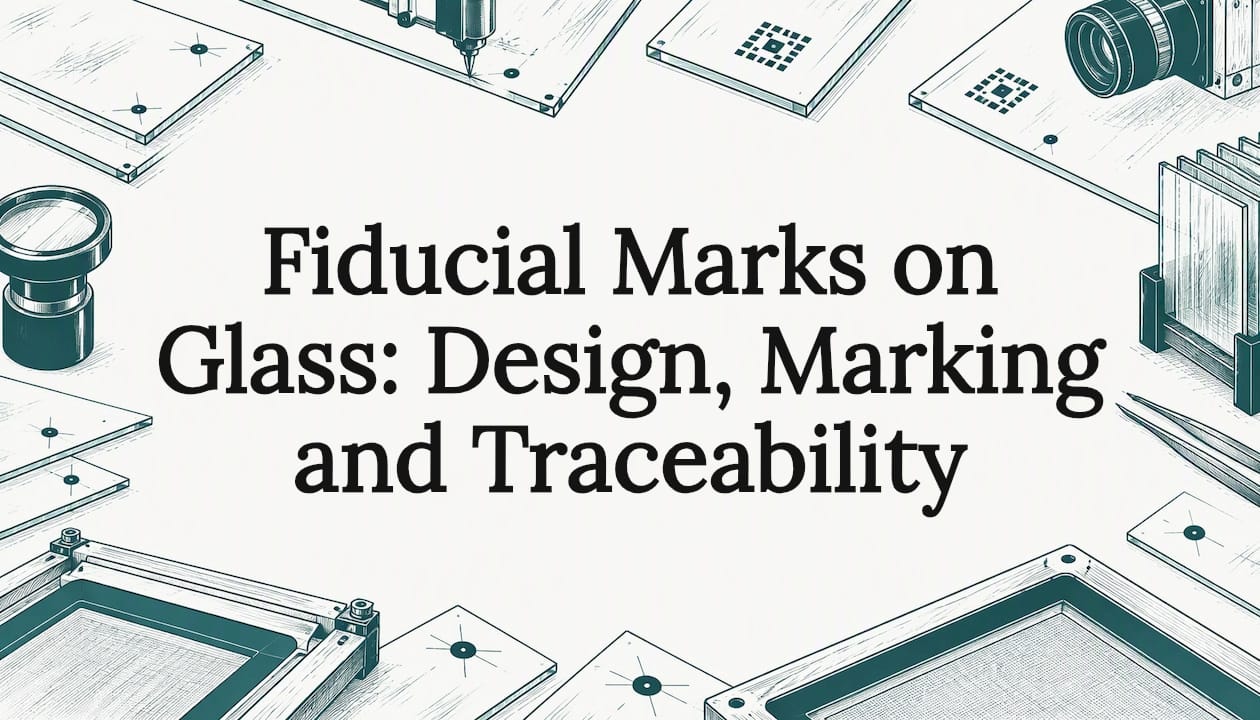
A fiducial mark on glass is a small, recognisable reference feature that a camera can find every time, so a machine knows exactly where the part sits and how it is oriented. It is not a serial number and it is not a UDI. It tells the machine where to look, while serialisation and UDI tell people and databases which part it is. This guide covers how fiducials are made on glass, what makes them readable, how they differ from identifiers, and what to put in your drawing before you request a quote.
TL;DR
- A fiducial is a positional reference for machine vision. A serial number or UDI is an identity code. A glass part often needs both, and they must not interfere with each other.
- Glass is hard to image: clear glass gives weak edge contrast, so a fiducial needs deliberate contrast, lighting and placement.
- Common durable methods are fired ceramic printing, laser marking and etching. The right one depends on the glass, the coating stack and whether the mark must survive heat, chemicals or sterilisation.
- Test the actual part. Colour, curvature, coatings and surface finish change how a mark reads.
- In Great Britain, medical devices follow the MHRA regime, separate from the EU MDR framework used in Northern Ireland. Check which route applies before you decide how to mark.
Table of Contents
- What a fiducial mark on glass actually does
- Why glass makes fiducials harder
- Methods for making durable marks on glass
- Fiducials, serialisation and UDI: three different jobs
- UDI on glass and the UK rules
- Design and placement: what to put on the drawing
- Why you must test the real part
- Our perspective
- Getting marked glass made
- FAQ
- Sources
What a fiducial mark on glass actually does
A patent record on fiducial design defines a fiducial marker as a marking that gives a visual point of reference for precise placement, alignment or orientation. A machine-vision camera images the mark, software recognises it, and the mark’s position helps determine the orientation of the substrate and where components should go relative to it.
On glass, that is used in several places:
- Display and touch assemblies. Cover glass is aligned to a panel, mask or sensor stack. One vendor describes a display alignment system that uses matrix cameras and dedicated lighting to measure fiducial marks through the glass and align display and mask automatically.
- Touch-screen manufacture. A published patent for a one-glass-solution touch screen describes forming an alignment mark by screen printing, etching or printing so that later film layers and cutting steps register accurately.
- Optical and sensor assemblies. Windows, filters and lenses are bonded into housings where position matters at the micrometre scale.
- Inspection and CNC work. A mark gives a machining or measuring cell a datum on a part that otherwise has very little visual detail.
The same logic that applies to PCB fiducials in electronics applies here: the mark exists to give a stable reference. The difference is the substrate. A copper dot on a green board is easy to see. A mark on transparent glass is not.
Why glass makes fiducials harder
Transparent glass is intrinsically difficult to detect with ordinary optical edge methods, because measuring light can pass through it rather than producing a reliable dark boundary. A patent on edge detection for transparent materials sets out this problem. The fiducial patent makes the same point from the other side: flat glass may not give sufficient brightness contrast for edge detection, so the design works to enhance edge contrast on transparent material. On glass, specialised optical features can redirect light and create a brighter, more detectable region.
In practice, that means three decisions belong together:
- Contrast. Is the mark opaque, frosted, or a light-scattering feature? Does it sit against a printed border, a coating or bare glass?
- Illumination. Backlight, coaxial light or dark-field each show different features. A mark that reads well under one setup can vanish under another.
- Position. Which face carries the mark, and does the camera see it directly or through the glass thickness?
If your assembler’s vision system is fixed, tell us its lighting and camera view at the enquiry stage. It narrows the choice of mark quickly.
Methods for making durable marks on glass
No single method suits every part. These are the routes engineers use most, with what the evidence says about each.
Fired ceramic printing
Ceramic ink is printed and fired into the glass surface, so the mark becomes part of the glass. A British Glass knowledge-base article notes that fired ceramic-decal barcodes on glass resist scratching, chemical attack and thermal processes, and give high-resolution output for scanning. Ceramic printing is also how most borders, masks and fiducial dots on cover glass are produced, which is why it is a natural first option for displays, dashboards and instrument panels. It is one of the processes we run in-house, alongside coatings and CNC work, as described on our services page.

CO₂ laser marking
CO₂ lasers can create permanent, tamper-proof Data Matrix codes directly on glass and can also apply human-readable text, according to a laser equipment manufacturer’s glass marking page. That suits identifiers, and it can suit fiducials where a frosted, light-scattering dot gives good camera contrast.
UV laser etching, on or inside the glass
Nanosecond pulsed UV lasers can mark glass internally or etch the outside surface without compromising glass strength or producing debris or contaminants, according to a laser-marking company’s article on UDI labels. This matters for medical and optical parts where particles and microcracks are unacceptable. We cover how to choose between laser approaches in choosing the right approach for laser marking on glass.
Which one when
| Need | Typical route | Watch for |
|---|---|---|
| Alignment dots on cover glass, large volume | Ceramic printing | Registration to the printed border, firing tolerance |
| Fiducial on a coated optical window | Laser mark outside the clear aperture, or a printed dot | Coating adhesion and damage near the mark |
| Permanent identifier on a medical part | UV or CO₂ laser, Data Matrix | Mark depth, cleaning and sterilisation, glass strength |
| Marks that must survive heat or chemicals | Fired ceramic or laser | Test after the real process, not before |
| Mark inside the glass, no surface change | Sub-surface laser | Whether the camera can see it at the working distance |
This table is a starting point, not a specification. Final selection depends on the glass type, thickness, coating and the downstream process.
Fiducials, serialisation and UDI: three different jobs
Readers often search these terms together, and they are easy to confuse because all three are small marks on a part.
| Fiducial | Serial number | UDI | |
|---|---|---|---|
| Purpose | Position and orientation | Identify an individual item | Identify a medical device and its production data |
| Read by | Machine-vision camera during assembly or inspection | Scanner, operator or database | Scanner and people, through regulated systems |
| Carries data | No | Yes | Yes |
| Same on every part | Yes | No, unique | Device identifier is shared; production identifier varies |
GS1 explains that serialisation assigns each individual instance a lifetime serial number, which makes it possible to trace individual products through the supply chain. A fiducial does none of that. It gives a machine a reference point and nothing more.
What serialisation on glass is for
Serialisation is about traceability and process control. A glass-container forming system vendor describes how its ID Mark+ links forming-machine settings and sensor data to individual container codes, supporting data-driven analysis and closed-loop control. Trade press describes hot-end laser marking that identifies each container as soon as it is shaped, with a code that can include production date, mould number and location.
For pharmaceutical containers, the ISPE good practice guide on unique ID of glass primary containers says uniquely coded containers can improve batch visibility and accountability and streamline investigations. The same guide stresses managing the container UID and its data through process steps, verifying readability, using automated inspection and ensuring container-level identifiers do not conflict with required package-level serialisation.
That last point carries over to technical glass. If a part has a fiducial, a laser-marked serial code and a printed border, they need to be planned as one layout, not added one by one.
UDI on glass and the UK rules
UDI applies when the glass is part of a medical device or is a device in its own right, for example a window, cover or optical element in diagnostic or surgical equipment. Which rules apply depends on where the device is placed on the market.
GOV.UK guidance explains that Great Britain operates a distinct regime in which medical devices are registered with the MHRA and follow GB conformity assessment routes, separate from the EU MDR framework used in Northern Ireland. The page is updated regularly, so read the current version before deciding on a marking plan.
If you also sell in the United States, the FDA UDI Rule requires the UDI on the label or package in both human-readable and AIDC formats, on every packaging level except the logistics unit, as summarised in a GS1 US FAQ on the rule. A glass component supplier does not decide your regulatory route. Your regulatory affairs lead or your notified or approved body does. What we can do is mark to the specification you give us and document the batch it came from.
Where a glass part supports a medical device, biological evaluation is a separate topic; our guide to ISO 10993 actions for medical device makers covers it.

Design and placement: what to put on the drawing
Before you request a quote, settle these points. Most rework we see traces back to marks that were added late.
- Define the purpose of each mark. Label every feature as fiducial, serial code or human-readable text. Do not let one mark serve two jobs.
- Choose the face. State which surface carries the mark and which side the camera views from. A mark seen through the glass is reversed and refracted.
- Keep marks out of the optical aperture. For windows and lenses, place fiducials in the clear-aperture exclusion zone or the printed border. Our optical window tolerances guide covers how to specify the rest of the window.
- Respect edges and corners. Keep marks clear of chamfers, radii and slots. Our DFM guide for glass procurement explains why geometry decisions made early save scrap later.
- Specify contrast, not just size. Give a minimum contrast against the background under your own lighting, and name the lighting.
- Allow for coatings. If the part gets anti-reflective or anti-glare coating, say whether the mark goes on before or after, and whether coating over it is acceptable.
- Call out the datum. Say which feature the fiducial is positioned relative to: an edge, a hole or the printed border. The tolerance chain should be unambiguous.
- State survival conditions. Heat, chemical strengthening, cleaning agents, sterilisation and abrasion all affect marks differently.
If you are early in the design, our step-by-step guide to glass component design covers the wider sequence.
Why you must test the real part
Readability depends on contrast, code size and placement, and testing the real article. A UK laser-marking supplier’s glass guide notes that colour, curvature, wall thickness, surface treatments, moulding marks, condensation, vibration and line speed can affect marking quality and scanning. That guide is about containers, but the principle holds for flat technical glass: nominally similar clear, coloured, frosted or coated glass can give materially different mark contrast and scan reliability.
A sensible validation plan has four steps:
- Mark a small pilot batch on production glass with the production coating stack.
- Read the marks on the real vision or scanning equipment, under real lighting.
- Put sample parts through the downstream process: toughening, chemical strengthening, cleaning, sterilisation or thermal cycling.
- Read them again and record the pass rate, then fix the acceptance criteria in the specification.
Automated inspection is the only practical way to hold this over volume. For regulated work, record the results against the batch.
Our perspective
We see marks on glass as part of the specification, not an afterthought. Customers in medical, defence, aerospace and electronics usually arrive with a clear idea of the glass and the coating, and a vague one of the marking. That gap is where delays start.
Our advice is simple. Decide early what each mark is for. Keep fiducials and identifiers physically and logically separate. Put them where they cannot be damaged by edge work or coatings. And ask for a pilot batch read on your own equipment before you commit to volume.
We work under ISO 9001, with batch-level traceability and documented export compliance, so the identifiers you specify can be tied back to a production batch. Where a design is likely to cause problems, we say so at the quote stage, not after the first run.
— Alexandra
Getting marked glass made
Precision Glasses makes custom technical glass for medical devices, defence, aerospace, automotive dashboards, lighting and electronics. That includes display glass, optical windows, sensor windows and CNC-machined parts, with ceramic printing and coatings available on the same part. Prototype to volume runs through the same process, which keeps marking consistent from first sample to production.
Send your drawing with the mark locations, the vision or scanning setup and the downstream processes, and we will tell you what is practical.
See our glass services, read about technical glass, or contact us through our site with your specification.
FAQ
What is the difference between a fiducial mark and a UDI on glass?
A fiducial is a positional reference that a camera uses to align or orient a part. It carries no data. A UDI is an identifier that links a medical device to regulated information and is read by scanners and people. A part can carry both, placed so neither interferes with the other.
Can you put a fiducial on clear glass?
Yes, but contrast needs deliberate design. Clear glass gives weak edge contrast, so fiducials are usually printed in ceramic ink, laser-frosted or paired with controlled lighting. The camera setup should be part of the specification, not left to chance.
Which marking method lasts longest on glass?
Fired ceramic marks and laser-etched marks are both permanent options. Ceramic decals and prints resist scratching, chemicals and thermal processes, while lasers can mark the surface or inside the glass. The best choice depends on glass type, coating and the process the part will go through, so test on real samples.
Does serialisation on glass replace a fiducial?
No. A serial code is unique to each part and identifies it, but it is not designed as an alignment reference. Vision systems usually need a consistent mark in a known position, which a changing code cannot provide.
Which UK rules apply to UDI on a glass medical component?
In Great Britain, devices follow the MHRA registration and conformity route, and Northern Ireland follows the EU MDR framework. Your regulatory lead or conformity body decides what your device needs. We mark to your specification and keep batch-level records.
Sources
- Fiducial design (patent record)
- NeaROB display alignment
- Preparation method of one glass solution touch screen
- Edge detection method (patent)
- Barcoding for glass, British Glass
- Glass laser marking and cutting
- How manufacturers use lasers to etch UDI labels on and inside glass
- How does serialisation differ from unique identification? GS1
- ID Mark+, Bucher Emhart Glass
- Tracing each glass container, Glass International
- Good Practice Guide: Unique ID of Glass Primary Containers, ISPE
- Regulating medical devices in the UK, GOV.UK
- US FDA UDI Rule FAQ, GS1 US
- Glass laser marking for bottles and packaging